Rational modernism · 1970–2015 · Northern Europe
10-gruppen (Tiogruppen) Printed Textiles
Also known as 10-gruppen, Tiogruppen, Tio-gruppen, Ten Swedish Designers, Group of Ten
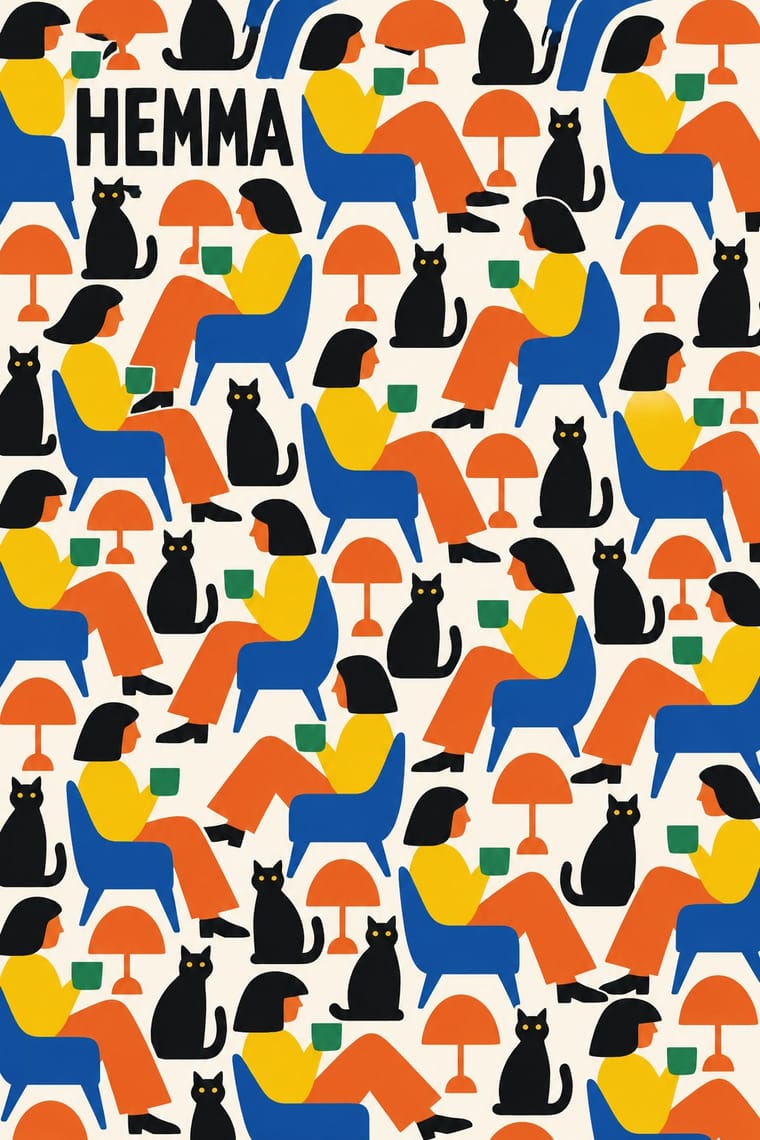
The printed fabrics of 10-gruppen, a Stockholm collective of ten textile designers founded in 1970: bright, flat all-over repeats of stripes, checks, dripping drops and simple figurative motifs such as dogs, bananas and Stockholm landmarks, in a few saturated inks on cotton or linen. Against the discreet patterns then usual in Swedish textiles, they made cheap, cheerful pattern for everyday goods, sold by the metre at IKEA and on bags and trays in the group's own shop. Unlike Marimekko's large organic shapes, the repeats are mid-sized, cleanly drawn and often pictorial.
Make something in this style Get advice in this style Mix it with another style
01
How it works
- Repeat a mid-sized motif edge to edge across the whole cloth, so the pattern itself is the picture.
- Choose plain, everyday subjects (a dog, a banana, a raindrop, a traffic interchange, a stripe) and draw them as clean, flat, simplified shapes.
- Print a few saturated, unmixed inks side by side, and set one bright motif against black and white or a strong ground colour.
- Combine figurative motifs with stripes or checks in the same design rather than separating picture and geometry.
- Leave out florals, shading and optical tricks: keep the cloth flat, legible and cheerful.
- Price and place the pattern for ordinary homes, on fabric by the metre, curtains, shower curtains, bags and trays.
Stockholm, 1970. With the Swedish textile industry in crisis in the late 1960s and early 1970s, ten textile designers formed 10-gruppen to bring their colourful patterns to producers and buyers themselves, selling finished fabrics instead of pattern sketches so they kept more control of their work: Inez Svensson, Gunila Axén, Birgitta Hahn, Tom Hedqvist, Ingela Håkansson (later Håkansson-Lamm), Britt-Marie Christoffersson, Lotta Hagerman, Susanne Grundell, Carl Johan De Geer and Tage Möller (founders as listed by Swedish Wikipedia; Nationalmuseum gives 1970, an IKEA Museum press release 1971). Svensson had headed the design studio of Borås Wäfveri from 1957 to 1967, and Borås Wäfveri printed several of the group's fabrics. The ten worked side by side at one large table, each on their own patterns. Their colourful, eye-catching prints broke with the discreet patterns then usual in Swedish textiles and were at first thought provocative and hard to sell. The patterns are said to draw on painting, architecture and older Swedish folk art (sv.wikipedia); Hahn also drew Stockholm landmarks such as Slussen, the Public Library and Globen (Nationalmuseum). The group made collections for IKEA (the first in 1978, dated 1979 in some IKEA Museum texts, sold at about EUR 1.50 a metre; a second in 1985) and opened its own shop at Götgatan 25, Stockholm, in 1983, later also selling bags and trays. Hahn, Hedqvist and Håkansson ran the company until 2015, when the Götgatan shop closed (28 February 2015) and the group was dissolved and taken over by IKEA (Swedish press reported a sale; IKEA Museum speaks of acquiring the archive; LACMA dates Tiogruppen 1970-2014). IKEA holds the archive and has reissued patterns (AVSIKTLIG, 2017; STRIX/STRAX as NICKFIBBLA, 2023).
02
Its design choices
From Stylogeny’s vocabulary of design choices: defining choices make the style, characteristic ones are usual, occasional ones turn up now and then.
- Layout & composition
- Space & hierarchy
- Typography
- Colour
- Form & shape
- Surface & texture
- Imagery
- Medium & production
- Tone & intent
- Avoids
- Floral & vegetal, Gradients, Pastel, Illusion of depth, Optical pattern, Naturalistic depiction, Halftone & Ben-Day dots, Painterly brushwork, Straight photography, Ironic & self-aware
Palette
-
#f4f1e8 -
#161616 -
#f6c800 -
#e8641c -
#2e9e4f -
#1f5fbf
Typefaces
-
No lettering in the repeat
the motifs carry the cloth, and pattern and designer names belong on labels, catalogues and shop graphics
-
IKEA's capitalised Swedish product names (STRIX/STRAX, PLASK, SOLREGN, RANDIG BANAN, as IKEA Museum writes them), the form in which most buyers met the group's prints; this naming is IKEA's convention, not a choice of the group, and the only lettering tied to the prints in the sources
Known for
-
Gunila Axén, 'Hundar' (Dogs), from 10-gruppen's first collection, printed cotton, Borås Wäfveri, manufactured 1972, pattern repeat 45.5 x 42.5 cm (Nationalmuseum Stockholm, NMK 134/1987); a blue colourway dated 1969–70 is at LACMA (M.2020.249.4)
-
Inez Svensson, 'Strax'
striped printed cotton on a cream ground, Borås Wäfveri, manufactured 1970, with its sister pattern 'Strix' in the same colours and reversed stripe widths (Nationalmuseum Stockholm, NMK 33/1972, gift of IKEA); sold by IKEA as STRIX/STRAX from 1971 and on the cover of the 1972 IKEA catalogue
-
Inez Svensson, PLASK shower curtain, IKEA, 1973
a pattern of dripping drops, also used on SOLREGN cotton curtains
-
10-gruppen's first collection for IKEA, 1978, and RANDIG BANAN, yellow bananas printed on black and white stripes, from the second IKEA collection, 1985 (IKEA Museum)
-
Tom Hedqvist, 'Radio X', textile print, 1983, given by Borås Wäfveri
Röhsska Museum, Gothenburg, RKM 162-1985
-
Birgitta Hahn, 'Slussen', printed linen depicting the 1935 cloverleaf interchange in Stockholm, designed 1988 for Svenskt Tenn
Nationalmuseum Stockholm, NMK 199/2002
-
Tiogruppen AB (Birgitta Hahn, Ingela Håkansson, Tom Hedqvist), bags, 2003
Nasjonalmuseet, Oslo, NMK.2007.0689.001 and .002
03
Make something in this style
Say what you need, and Stylogeny’s image studio draws it from 10-gruppen (Tiogruppen) Printed Textiles’s design choices and checks it against them. It takes about a minute, and you get a link to share.
04
Where it comes from, and what it’s close to
Before it
The style it grew out of, and the styles it borrowed from.
After it
The styles that grew out of it.
No later style in the atlas grew out of it yet.
Alike in its design choices
Styles that make many of the same choices, related or not, besides those above.
-
-
-
-
- African Wax & Fancy Print 57% alike
-
05
Often taken for
10-gruppen Printed Textiles has no real works recorded yet, so these are its nearest styles by its choices alone, with the choices that tell them apart.
-
NK Textilkammare Geometric Print (Astrid Sampe, Signerad Textil)
NK Textilkammare Geometric Print is one of 10-gruppen Printed Textiles’s nearest styles by choices; no real work of either fits the other better.
Choices that tell 10-gruppen Printed Textiles and NK Textilkammare Geometric Print apart Choice 10-gruppen Printed Textiles NK Textilkammare Geometric Print Stylised figuration defining avoids Monochrome — defining Full polychrome characteristic avoids Restrained accents — defining Flat vector illustration characteristic — Both descend from Scandinavian Functionalism in the family tree.
-
Finnish Bold Print (Marimekko Modernism)
Finnish Bold Print is one of 10-gruppen Printed Textiles’s nearest styles by choices; no real work of either fits the other better.
Choices that tell 10-gruppen Printed Textiles and Finnish Bold Print apart Choice 10-gruppen Printed Textiles Finnish Bold Print Stylised figuration defining occasional Floral & vegetal avoids characteristic Flat vector illustration characteristic — Painterly brushwork avoids characteristic Communal & popular characteristic — 10-gruppen Printed Textiles descends from Finnish Bold Print: a shared line, so the likeness is inherited.
-
Diné (Navajo) Weaving Design
Diné Weaving Design is one of 10-gruppen Printed Textiles’s nearest styles by choices; no real work of either fits the other better.
Choices that tell 10-gruppen Printed Textiles and Diné Weaving Design apart Choice 10-gruppen Printed Textiles Diné Weaving Design Stylised figuration defining occasional Optical pattern avoids characteristic Flat vector illustration characteristic — Earth & mineral — defining Full bleed characteristic — No shared descent in the atlas: they reached these choices separately.
-
Amazigh Sign System & Tifinagh
Amazigh Sign System & Tifinagh is one of 10-gruppen Printed Textiles’s nearest styles by choices; no real work of either fits the other better.
Choices that tell 10-gruppen Printed Textiles and Amazigh Sign System apart Choice 10-gruppen Printed Textiles Amazigh Sign System Stylised figuration defining occasional Earth & mineral — defining Rectilinear characteristic — Angular & zigzag — defining Flat vector illustration characteristic — No shared descent in the atlas: they reached these choices separately.
— means the choice isn’t among the style’s recorded choices. Critics recorded each work’s choices with the styles’ descriptions in view, so this shows whether the descriptions hold together, not proof that they are right.
06
Combine it with
Styles 10-gruppen (Tiogruppen) Printed Textiles pairs well with or plays against, from the research. Each is worked out as a combination: which style gives the type, the colours and the forms.
- Finnish Bold Print (Marimekko Modernism) Pairs well · Mix a large organic Marimekko shape with a mid-sized pictorial 10-gruppen repeat for a Nordic interior that is bold at two scales.
- Josef Frank and Svenskt Tenn Botanical Prints Contrasts · Frank fills a long repeat with many small botanical motifs; 10-gruppen uses one plain everyday motif in few flat colours, the cheerful answer to that richness.
- Op Art Graphics Contrasts · Both use stripes and repeats, but Op Art makes them vibrate; keep the stripes calm and add a figure to stay on the 10-gruppen side.
- Scandinavian Functionalism Pairs well · Set a bright repeat behind calm functionalist typography and white space: the pattern brings the colour, the layout keeps the order.
07
Sources
- https://collection.nationalmuseum.se/en/collection/item/7762/
- https://collection.nationalmuseum.se/en/collection/item/2293/
- https://collection.nationalmuseum.se/en/collection/item/76973/
- https://collections.lacma.org/object/267079
- https://collection.rohsska.se/en/collection/item/26108/
- https://www.nasjonalmuseet.no/en/collection/producer/50154
- https://ikeamuseum.com/en/explore/designer-portraits/inez-svensson/
- https://ikeamuseum.com/en/explore/product-stories/textile-collection-1979/
- https://ikeamuseum.com/en/about/press-room/unique-collection-of-180-fabrics-and-patterns-in-new-exhibition/
- https://sv.wikipedia.org/wiki/10-gruppen
- https://www.shift.jp.org/guide/?p=19264
How Stylogeny researches and checks a style: where the facts come from.