Traditions & vernacular · c. 0–present · Middle East & North Africa, Sub-Saharan Africa
Amazigh Sign System & Tifinagh
Also known as Berber symbols, Neo-Tifinagh, Amazigh tattoo and weaving signs
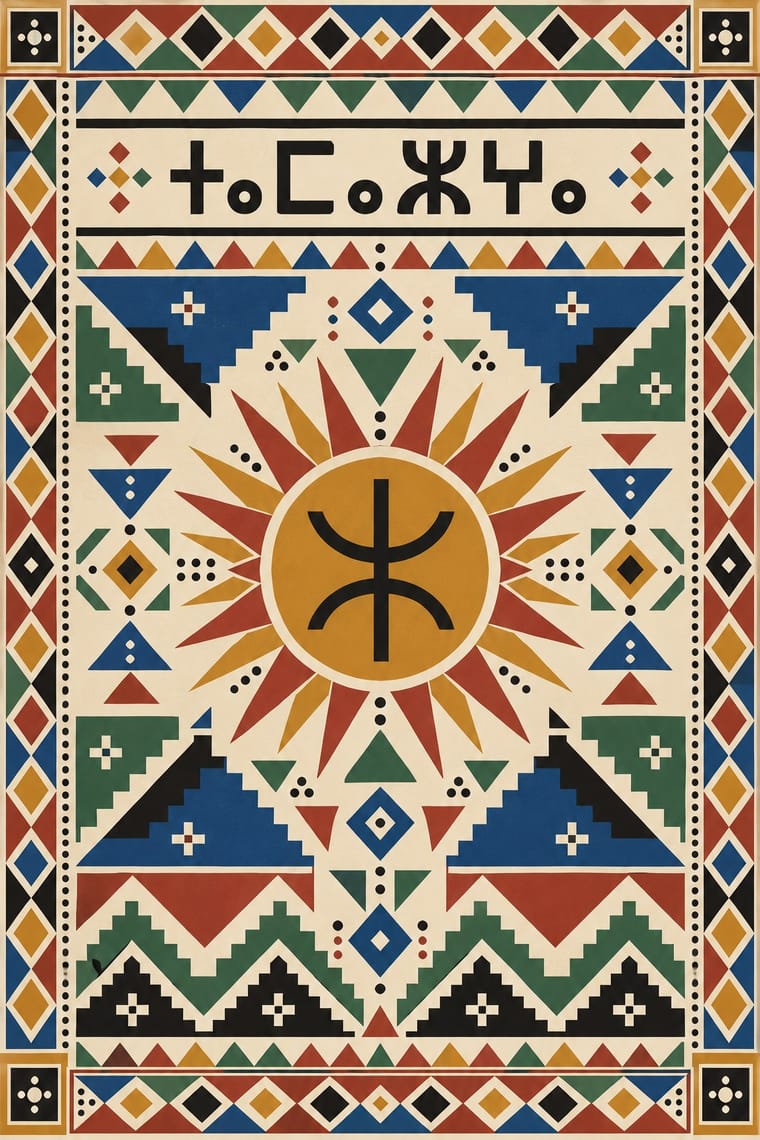
The visual language shared by Amazigh communities from the Rif, Atlas and Kabylie to the Aurès and the Tuareg Sahara. Women weave a common repertoire of geometric signs (lozenges, chevrons, triangles, crosses, zigzags, dots) into rugs and capes, paint it on pottery and tattoo it on the face, and smiths, many of them Jewish in Morocco and Kabylie until the 1950s, cast and engrave it in silver. Its script, Tifinagh, descends from Libyco-Berber writing. Since 2003 Neo-Tifinagh has marked Amazigh identity on Moroccan public signs; the red yaz ⵣ has stood on the Amazigh flag since 1970.
Make something in this styleGet advice in this styleMix it with another style
Use it with care
These signs belong to living Amazigh communities, and much of the repertoire is women's work: weavers, potters, and older women whose facial tattoos belong to a fading practice that many Moroccans now regard as sacrilegious. Signs and jewellery are worn for protection against the evil eye and to mark region, tribe and life stage, so do not merge regional motifs into a generic 'Berber' pattern or put tattoo signs on throwaway goods. The best-known photographs of Kabyle women's facial tattoos, Marc Garanger's portraits of 1960, were made by a French army conscript for compulsory identity cards, with the women made to unveil; do not use them as neutral pattern sources, and prefer documentation made with the women's consent or by Amazigh researchers. The choice of script is itself political: IRCAM's 2003 adoption of Neo-Tifinagh was a palace compromise that many Amazigh activists criticised, most Moroccan speakers and Kabyle writers use Latin script, and Tuareg Tifinagh is its own living variant. Have any Tifinagh text spelled and checked by a speaker and set it in a proper Unicode font rather than inventing pseudo-letters. The yaz and the Amazigh flag are political emblems of the Amazigh identity movement, and the flag was banned in Algeria during the 2019 Hirak. Much historical Moroccan and Kabyle 'Berber' silver was made by Jewish silversmiths, and Tuareg pieces by Tuareg smiths: credit them accurately, commission and credit Amazigh weavers, potters and type designers, and do not sell printed 'Berber' rug pattern as hand-woven.
01
How it works
- Build every sign from a few straight strokes and points: lozenge, chevron, triangle, cross, zigzag, dotted line, circle. Draw the signs themselves without modelled curves or calligraphic swell.
- Lay signs on an axis, in bands or on a lozenge lattice, then let the hand vary them: a lattice may drift, change scale or break off, and single signs may stand alone on bare ground. Beni Ouarain and Azilal pile rugs take this furthest; flatweaves, pots, fibulae and tattoos keep the axis.
- Keep to the colours of the materials, all flat and never shaded: dark signs on undyed cream wool, light signs or an orange eye on black wool and goat hair (Middle Atlas tent bands, the akhnif cape), brighter dyed carpets in Azilal and the Tafilalet, dark lines on white slip, and silver with blue, green and yellow enamel, coral and amber.
- Carry the same signs across skin, cloth, clay, wood, silver and wall, and let each medium shape them: stepped in weaving, painted in bands on pots, cast or engraved in silver, incised in cedar.
- Set Tifinagh from the monoline, epigraphic model of circles, crosses, strokes and dots (IRCAM's 2005 standard, Noto Sans Tifinagh). Contemporary families modulate it: Awal curves its strokes slightly and flares their ends, and Qandus pairs a 'carved' Tifinagh with one 'written on sand' beside Maghribi Arabic. On Moroccan trilingual signs give it equal standing with Arabic and Latin. Elsewhere ask which script the community writes: Kabyle literature is written in Latin script, most Moroccan speakers also write Amazigh in Latin, and Tuareg Tifinagh differs from Neo-Tifinagh. The yaz ⵣ standing alone is the emblem of the Amazigh movement; use it only where that meaning is intended.
- Treat each sign as a mark of protection, region and life stage, not as neutral texture, and keep each region's motifs distinct rather than merging them into a generic 'Berber' pattern.
Amazigh (Berber) communities of North Africa, the Sahara and the Sahel: the Rif, the Middle, High and Anti-Atlas, the Souss, Kabylie, the Aurès, Tunisia and Libya, and the Tuareg of Algeria, Libya, Niger, Mali and Burkina Faso. Amazigh call these lands Tamazgha, stretching from the Canary Islands to western Egypt. The script descends from Libyco-Berber inscriptions, the oldest probably of the 6th century BCE; the bilingual Libyco-Berber and Punic inscriptions at Dougga date from the 2nd century BCE. Neo-Tifinagh was developed by the Berber Academy in Paris in the 1970s and, from 2003, standardised as the official orthography of Standard Moroccan Amazigh by IRCAM in Rabat.
02
Its design choices
From Stylogeny’s vocabulary of design choices: defining choices make the style, characteristic ones are usual, occasional ones turn up now and then.
- Layout & composition
- Space & hierarchy
- Typography
- Colour
- Form & shape
- Surface & texture
- Ornament
- Medium & production
- Tone & intent
- Avoids
- Brush & pen calligraphy, Floral & vegetal, Whiplash line, Naturalistic depiction, Gradients, Illusion of depth, Gloss & highlights
Palette
#efe7d6#1b1916#c48a2c#a23a2a#1f4f8f#3f7a4a
Typefaces
IRCAM standard Neo-Tifinagh
the model published by the Royal Institute of Amazigh Culture in 2005
Noto Sans Tifinagh
Google Noto, SIL Open Font License
Awal (Redouan Chetuan, ANRT Nancy), Latin, Arabic and Tifinagh for signage, its Tifinagh given slightly curved strokes and flared ends
Qandus (Khatt Foundation, 2015–17; Tifinagh by Juan Luis Blanco), a 'carved' Solid and a 'written on sand' Fluid Tifinagh designed beside Maghribi calligraphic Arabic and Latin
Tuareg Tifinagh, written in several directions, including vertically, with a dot for a word-final vowel
Libyco-Berber inscriptions
lettering tradition, 2nd century BCE onward
Known for
Libyco-Punic Mausoleum of Atban, Dougga (Tunisia), 2nd century BCE
its bilingual Libyco-Berber and Punic inscription, now in the British Museum, made it possible to decipher the Numidian script
Beni Ouarain pile rugs (thick wool with black geometric motifs on white) and the more colourful Azilal rugs, woven by women in Morocco
Aït Khabbash women's arts around the Tafilalet oasis, south-eastern Morocco
brightly coloured carpets, embroidered indigo head coverings, saffron face paint, and clothing, tattoos and jewellery worn as public statements of identity (Cynthia Becker, Amazigh Arts in Morocco, 2006)
Akhnif, the hooded cape of the southern Atlas in black goat hair with a woven orange eye on the back, worn by both Muslims and Jews
Israel Museum, Jerusalem, late 19th – early 20th century
Kabyle painted pottery platters, Great Kabylie, Algeria, early to mid-20th century
Metropolitan Museum of Art 2014.749.1–10
Musée du quai Branly, 'Ideqqi: the art of Berber women' (Paris, 2007; curator Marie-France Vivier), on Algerian Berber women's pottery, comparing its compositions with Kabyle women's tattoos photographed by Marc Garanger (identity-card portraits he made as a French army conscript in 1960)
Musée Pierre Bergé des Arts Berbères, Marrakech (opened 13 December 2011)
Tiznit enamelled silver fibulae, 'du ver' fibulae in silver with blue and yellow enamel from the Souss, and cedar chests from the Anti-Atlas incised and painted with geometric motifs
Kabylie silver fibulae with enamel and imitation coral, 20th century
Metropolitan Museum of Art 55.111.53
03
Make something in this style
Say what you need, and Stylogeny’s image studio draws it from Amazigh Sign System & Tifinagh’s design choices and checks it against them. It takes about a minute, and you get a link to share.
04
Where it comes from, and what it’s close to
Before it
The style it grew out of, and the styles it borrowed from.
Nothing earlier is recorded: in the atlas it is a starting point.
After it
The styles that grew out of it.
No later style in the atlas grew out of it yet.
Alike in its design choices
Styles that make many of the same choices, related or not, besides those above.
05
Sources
- Mucem, 'Amazighes: Cycles, ornaments, patterns', exhibition page (dates, curators; Tamazgha 'stretching from the Canary Islands to western Egypt, including the Sahelian strip'; the Canary Islands 'so deeply Amazigh'; 'Amazigh' in the feminine plural to highlight 'the fundamental role of women'; the same motifs, forms and symbols found in tattoos, jewellery, textiles, pottery, house walls, doors and tent stretchers; tifinagh's 'graphic and symbolic character'): https://mucem.org/en/expositions/amazigh-cycles-parures-motifs-cycles-ornaments-patterns/
- Musée Pierre Bergé des Arts Berbères, Guide de l'exposition (Fondation Jardin Majorelle, 2025; inauguration on 13 December 2011; rugs woven by women in a vocabulary of signs and techniques proper to each region, passed from mother to daughter, and the lighter hanbel; a Middle Atlas tent band with obliques in white and colours 'sur fond noir'; dominant geometric decoration in wood, leather, pottery and basketry; prophylactic jewellery with enamel, coral and amber; Tiznit and 'du ver' fibulae in silver with blue, green and yellow enamel; incised and painted Anti-Atlas chests; enamelled bracelets 'portés par les femmes juives' of Tiznit and Tahala; Libyco-Berber script built from circle, stroke and point): https://www.jardinmajorelle.com/wp-content/uploads/2025/07/mpbab_Qrcode_francais-2025.pdf
- Cynthia Becker, Amazigh Arts in Morocco: Women Shaping Berber Identity (University of Texas Press, 2006), publisher's description on Project MUSE (Aït Khabbash women of the Tafilalet weave brightly coloured carpets; Amazigh groups entrust artistic work to women; 'Their clothing, tattoos, and jewelry are public identity statements'; French colonialism, an Arab-dominated government and 'a transnational Berber movement' have made the women adapt their arts; chapter 'Contemporary Amazigh Arts: Giving Material Form to Amazigh Consciousness'): https://muse.jhu.edu/book/3088
- Musée du quai Branly, Ideqqi: The Art of Berber Women (catalogue, 2007; Marie-France Vivier, Ernest Hamel, Dalila Marsly; female pottery of Algeria compared with Kabyle women's tattoos photographed by Marc Garanger): https://m.quaibranly.fr/en/publications/the-museum-publications/exhibitions-catalogues/folk-art/ideqqi
- Noorderlicht, 'Femmes algériennes 1960' (Garanger, a military conscript, made the portraits under orders of the French government, which required all Algerians to carry an ID card): https://noorderlicht.com/en/whats-on/noorderlicht-photofestival-2004-nazar/nazar-a-look-back/femmes-algeriennes-1960-1960
- Émilie Goudal, 'Warding off Disappearance, Getting Beyond Icons: The (Counter-)Visuality of Algerian Women', AWARE, 8 September 2018 (Garanger's identity-card portraits for the French army; the women's veils 'forcibly removed'): https://awarewomenartists.com/en/magazine/conjurer-leffacement-depasser-les-icones-contre-visualite-des-femmes-dalgerie/
- Israel Museum, Jerusalem, 'Man's hooded cape (akhnif)', late 19th – early 20th century, on Google Arts & Culture (southern Atlas; worn by both Muslims and Jews; typically black, goat hair, with a woven orange decoration on the back 'resembling an eye'): https://artsandculture.google.com/asset/egHI0JVJrGTWYg
- Metropolitan Museum of Art, Kabyle platters, early to mid-20th century, 2014.749.1–10 (collection API): https://www.metmuseum.org/art/collection/search/635648; Fibulae, Kabylie, 20th century, 55.111.53: https://www.metmuseum.org/art/collection/search/453604
- Wikipedia, 'Jewellery of the Berber cultures' (Jewish Berbers of the Drâa-Tafilalet and Souss renowned silversmiths until their emigration in the late 1950s; workshops in Tiznit, Sefrou and Kabylia 'often run by Jewish silversmiths'; Tuareg blacksmiths' lost-wax casting and the Agadez cross; Tuareg of the Hoggar, Libya, Niger, Mali and Burkina Faso; Chaoui silver jewellery of the Aurès with enamel and coral; enamelled jewellery of Moknine and Djerba, Djerba's figurative motifs and gold): https://en.wikipedia.org/wiki/Jewellery_of_the_Berber_cultures
- Wikipedia, 'Tifinagh' (Libyco-Berber origins, the oldest remains likely of the 6th century BCE; Tuareg use in crafts, games and graffiti; Neo-Tifinagh by the Berber Academy in the 1970s; 'the Latin alphabet became the predominant used script'; Unicode 4.1, 2005; multidirectional writing): https://en.wikipedia.org/wiki/Tifinagh
- Wikipedia, 'Standard Moroccan Amazigh' (IRCAM chose Neo-Tifinagh in 2003, a palace compromise 'for political reasons' met with 'widespread criticism, particularly among Amazigh activists', Salem Chaker calling it 'dangerous'; 'Most Moroccan speakers of Amazigh use the Latin alphabet'; official language since 2011; Tifinagh largely limited to public signage as of 2016): https://en.wikipedia.org/wiki/Standard_Moroccan_Amazigh
- Wikipedia, 'Kabyle language' ('Kabyle literature continues to be written in Latin script'): https://en.wikipedia.org/wiki/Kabyle_language
- Wikipedia, 'Royal Institute of Amazigh Culture' (founded 17 October 2001): https://en.wikipedia.org/wiki/Royal_Institute_of_Amazigh_Culture
- Wikipedia, 'Berber flag' (designed in 1970 by Mohand Arav Bessaoud of the Berber Academy, with Youcef Medkour credited in another account; made official by the World Amazigh Congress at Tafira, 1997; meaning of colours and the yaz; banned in Algeria during the 2019 Hirak): https://en.wikipedia.org/wiki/Berber_flag
- Wikipedia, 'Libyco-Punic Mausoleum of Dougga' (2nd century BCE; bilingual inscription in the British Museum): https://en.wikipedia.org/wiki/Libyco-Punic_Mausoleum_of_Dougga
- Wikipédia (fr), 'Tapis berbère', used only for the two rug types it describes (Beni Ouarain 'motifs géométriques noirs sur fond blanc', Azilal 'plus colorés'); a short stub, kept because no museum record of these rug types could be retrieved: https://fr.wikipedia.org/wiki/Tapis_berb%C3%A8re
- Wikipedia, 'Agadez Cross' (Tuareg cast-silver pendants, lost-wax casting): https://en.wikipedia.org/wiki/Agadez_Cross
- Wikipedia, 'Azilal' (facial tattoos still seen on older Amazigh women; the practice declining and seen as sacrilegious by many): https://en.wikipedia.org/wiki/Azilal
- ANRT Nancy, Redouan Chetuan, 'Awal. One country, three writing systems' (built on the IRCAM model of 2005; 'slightly curved straight lines, and flared forms on the top and the bottom' to give Tifinagh a handwritten sensitivity): https://anrt-nancy.fr/en/projets/awal-one-country-three-wrting-systems
- Khatt Foundation, 'Typographic Matchmaking in the Maghrib 3.0' (13 September 2015 – 30 November 2017): https://www.khtt.net/en/page/1315/typographic-matchmaking-in-the-maghrib-3.0; and 'The Qandus Multiscript Typeface Family Wins TDC2 2017 Award' (Arabic in the Maghribi calligraphic style; Latin by Laura Meseguer, Arabic by Kristyan Sarkis, Tifinagh by Juan Luis Blanco): https://www.khtt.net/en/page/28249/the-qandus-multiscript-typeface-family-wins-tcd2-2017-award
- Laura Meseguer Studio, 'Qandus, a triscript typeface family' (homage to the calligrapher al-Qandusi; the duality of Maghribi forms carried into the other two scripts; Solid subfamily 'carved (for the Tifinagh)', Fluid subfamily 'written on sand (for the Tifinagh)'): https://laurameseguer.com/project/qandus
- Noto Tifinagh font repository (SIL Open Font License): https://github.com/notofonts/tifinagh
How Stylogeny researches and checks a style: where the facts come from.