Rational modernism · 1937–1971 · Northern Europe
NK Textilkammare Geometric Print (Astrid Sampe, Signerad Textil)
Also known as NK Textilkammare, NK:s Textilkammare (the textile department of Nordiska Kompaniet), Signerad Textil (Signed Textiles, 1954), Swedish Modern geometric textile print
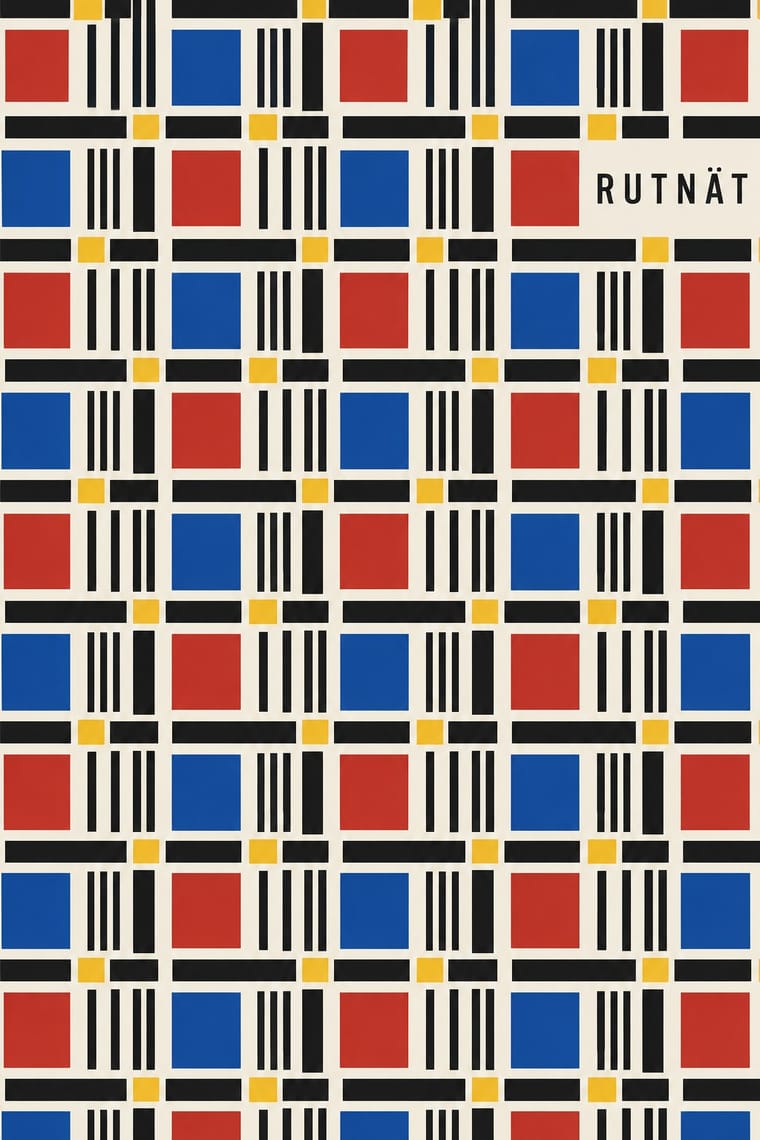
The reduced, geometric household textiles of NK's textile department in Stockholm under Astrid Sampe: small ruled units, stripes, checks, arrows and thin outlines repeated evenly, mostly on screen-printed linen and cotton, some on woven linen, in black and white with a few flat accents of red, blue or yellow. Sampe's late-1940s fabrics followed Mondrian; the 1954 Signerad Textil collection put artists' names, Aalto's among them, on industrially printed cloth. Quiet, rational cloth with no focal point and no type in the repeat.
Make something in this style Get advice in this style Mix it with another style
01
How it works
- Build the repeat from one small geometric unit (a stripe, a square, a short arrow, a thin outline) and repeat it evenly so that no part of the cloth becomes the centre.
- Rule the lines straight and keep them thin and even; leave the wobble of the hand-cut edge to other prints.
- Start from black and white, then add one to three flat accents of red, blue or yellow, in the Mondrian manner, rather than many colours.
- Keep the scale small enough for curtains, tablecloths and household linen, so the pattern reads as a calm texture across the room.
- Let the designer's name and the pattern's name carry the identity, instead of lettering or emblems in the repeat.
- Design mainly for screen printing by the metre in industrial runs (flat colour, no shading, a repeat a printer can register), and carry the same stripes and checks into woven household linen.
Stockholm: the textile department (Textilkammaren) of the Nordiska Kompaniet (NK) department store. NK employed Astrid Sampe (1909–2002) as a textiles expert in 1936, and in 1937 she became head of the newly founded department; SKBL dates her NK post to about 1936–1960, English Wikipedia says she led the department until it closed in 1971, and Swedish Wikipedia that she left NK in 1972 to set up her own studio. The period's start of 1937 marks the department's founding, not this strand: the geometric prints documented here belong to the late 1940s and the 1950s. She designed around 250 patterns in various techniques and materials (SKBL), for NK and for manufacturers such as Kasthall and Almedahls, and brought in designers such as Viola Gråsten, Stig Lindberg and Arne Jacobsen. NK's textiles were printed by the metre at Erik Ljungbergs Textiltryck in Floda, which also printed the 1954 'Signerad Textil' collection of designs by twelve artists (SKBL); Alvar Aalto's '14/6' was printed and distributed by NK Textilkammare for it. The department also commissioned woven cloth (from Mölnlycke, per SKBL), and Sampe's Linnelinjen household linen for Almedahls was woven, so the strand covers mostly printed but also woven household textiles. This entry covers the department's reduced, geometric strand, not all of its output.
02
Its design choices
From Stylogeny’s vocabulary of design choices: defining choices make the style, characteristic ones are usual, occasional ones turn up now and then.
- Layout & composition
- Space & hierarchy
- Typography
- Colour
- Form & shape
- Surface & texture
- Medium & production
- Avoids
- Floral & vegetal, Abundant decoration, Full polychrome, Horror vacui, Single focal point, Painterly brushwork, Stylised figuration, Naturalistic depiction, Gradients, Optical pattern, Straight photography, Illusion of depth
Palette
-
#f2eee4 -
#161616 -
#c62a20 -
#1f4f9a -
#e5b51f -
#8f8b82
Typefaces
-
No lettering in the repeat
the pattern carries the identity, and any type belongs on a plain label, tag or panel beside the cloth
-
The printed selvedge mark naming maker, pattern and designer in capitals, such as 'TEXTILKAMMARE MADE IN SWEDEN "14/6" ALVAR AALTO DESIGN' on Aalto's 14/6 (MFA Boston 2012.847)
-
The artist's name as the brand
the 1954 collection was sold as Signerad Textil ('signed textiles'), naming each pattern's designer, from Astrid Sampe to the architect Alvar Aalto
-
For accompanying graphics, a quiet geometric or grotesque sans set small and flush left in the Swedish functionalist manner, such as Futura
a modern pairing, not a documented NK house face
Known for
-
Astrid Sampe, 'Tattoo', 1956, screen-printed linen furnishing fabric retailed by Nordiska Kompaniet
white stripes on a yellow ground with black double-pointed arrows facing each other across them (V&A CIRC.164-1956)
-
Alvar Aalto, '14/6', screen-printed cotton for the Signerad Textil collection, printed and distributed by NK Textilkammare, 1954
a black, grid-like print on white cotton, the selvedge marked 'TEXTILKAMMARE MADE IN SWEDEN "14/6" ALVAR AALTO DESIGN' (MFA Boston 2012.847); the Nationalmuseum holds the original design (NMH 39/1982) and a length in the black-and-white colourway (NMK 151/1979)
-
Astrid Sampe's late-1940s curtain fabrics 'Rutil' and 'Fibra' and tablecloth 'Campari', inspired by Piet Mondrian, with 'simple geometrics in black, white, with blue, red, and yellow accents' (SKBL)
-
Astrid Sampe and Marianne Nilsson, Linnelinjen household linen for Almedahls, shown at H55, Helsingborg, 1955, including the woven linen kitchen towel 'Kökstrivsel' with red and black stripes (still made by Klässbols linneväveri)
-
Astrid Sampe and Louise Fougstedt, archive binder of textile samples made by Almedahls AB for Nordiska Kompaniets Textilkammare, designed 1955–59 (Nationalmuseum NMK 190/1976)
-
The organic, outline edge of the strand
Astrid Sampe, 'Coral Structure', 1954, screen-printed linen furnishing fabric with outlines of coral formations on a dark ground, Nordiska Kompaniet (V&A CIRC.589B-1954 and CIRC.589D-1954, given by AB Nordiska Kompaniet)
03
Make something in this style
Say what you need, and Stylogeny’s image studio draws it from NK Textilkammare Geometric Print (Astrid Sampe, Signerad Textil)’s design choices and checks it against them. It takes about a minute, and you get a link to share.
04
Where it comes from, and what it’s close to
Before it
The style it grew out of, and the styles it borrowed from.
After it
The styles that grew out of it.
No later style in the atlas grew out of it yet.
Alike in its design choices
Styles that make many of the same choices, related or not, besides those above.
-
-
-
-
-
-
05
Often taken for
NK Textilkammare Geometric Print has no real works recorded yet, so these are its nearest styles by its choices alone, with the choices that tell them apart.
-
10-gruppen (Tiogruppen) Printed Textiles
10-gruppen Printed Textiles is one of NK Textilkammare Geometric Print’s nearest styles by choices; no real work of either fits the other better.
Choices that tell NK Textilkammare Geometric Print and 10-gruppen Printed Textiles apart Choice NK Textilkammare Geometric Print 10-gruppen Printed Textiles Monochrome defining — Stylised figuration avoids defining Restrained accents defining — Full polychrome avoids characteristic Rules & bars defining occasional Both descend from Scandinavian Functionalism in the family tree.
-
Zagreb Modernist Graphics (EXAT 51 to Teatar &TD)
Zagreb Modernist Graphics is one of NK Textilkammare Geometric Print’s nearest styles by choices; no real work of either fits the other better.
Choices that tell NK Textilkammare Geometric Print and Zagreb Modernist Graphics apart Choice NK Textilkammare Geometric Print Zagreb Modernist Graphics Restrained accents defining — Optical pattern avoids characteristic Rules & bars defining — Grotesque & neo-grotesque — defining Monochrome defining occasional Both descend from Russian Constructivism in the family tree.
-
Early Computer Art & Plotter Graphics
Early Computer Art & Plotter Graphics is one of NK Textilkammare Geometric Print’s nearest styles by choices; no real work of either fits the other better.
Choices that tell NK Textilkammare Geometric Print and Early Computer Art apart Choice NK Textilkammare Geometric Print Early Computer Art Limited spot colours defining — Generative imagery — defining Restrained accents defining — Full polychrome avoids occasional Rules & bars defining — No shared descent in the atlas: they reached these choices separately.
-
De Stijl
De Stijl is one of NK Textilkammare Geometric Print’s nearest styles by choices; no real work of either fits the other better.
Choices that tell NK Textilkammare Geometric Print and De Stijl apart Choice NK Textilkammare Geometric Print De Stijl Limited spot colours defining — Dynamic asymmetry — defining Monochrome defining — Typography only — characteristic Pattern & repeat defining — Both descend from Cubist Pictorial Space in the family tree.
— means the choice isn’t among the style’s recorded choices. Critics recorded each work’s choices with the styles’ descriptions in view, so this shows whether the descriptions hold together, not proof that they are right.
06
Combine it with
Styles NK Textilkammare Geometric Print (Astrid Sampe, Signerad Textil) pairs well with or plays against, from the research. Each is worked out as a combination: which style gives the type, the colours and the forms.
- Scandinavian Functionalism Pairs well · The parent language: a calm functionalist layout of type and white space with one band of NK-style striped cloth as its only ornament.
- Finnish Bold Print (Marimekko Modernism) Contrasts · Marimekko enlarges one hand-cut or brushed motif to a huge repeat with a deliberately wobbly edge; NK's geometric strand keeps small, ruled units on a black-and-white base. Set one against the other to show scale against restraint.
- Festival of Britain 'Contemporary' Pattern (Lucienne Day and the Festival Pattern Group) Pairs well · The British contemporary prints of the same years share screen-printed, all-over repeats in limited flat colour; borrow their spindly drawn line for a lighter variant of a ruled NK stripe.
- Josef Frank and Svenskt Tenn Botanical Prints Contrasts · The other Stockholm house of printed linen in the same decades: Frank fills the cloth with many-coloured invented plants, NK's geometric prints with a few lines in black, white and one accent.
- De Stijl Pairs well · Sampe's late-1940s fabrics followed Mondrian: take De Stijl's black lines and primary accents and turn them into an even, directionless repeat.
07
Sources
- https://www.skbl.se/en/article/AnnaAstridSampe
- https://en.wikipedia.org/wiki/Astrid_Sampe
- https://sv.wikipedia.org/wiki/Astrid_Sampe
- https://collections.vam.ac.uk/item/O269707/
- https://collections.vam.ac.uk/item/O269705/
- https://collections.vam.ac.uk/item/O16643/
- https://collection.nationalmuseum.se/en/collection/item/9129/
- https://coraginsburg.com/artworks/9529-alvar-aalto-14-6-printed-cotton-1954/
- https://en.wikipedia.org/wiki/Viola_Gr%C3%A5sten
- https://collections.mfa.org/objects/566020
How Stylogeny researches and checks a style: where the facts come from.