Rational modernism · 1951–present · Northern Europe
Finnish Bold Print (Marimekko Modernism)
Also known as Marimekko style, Finnish printed-textile modernism
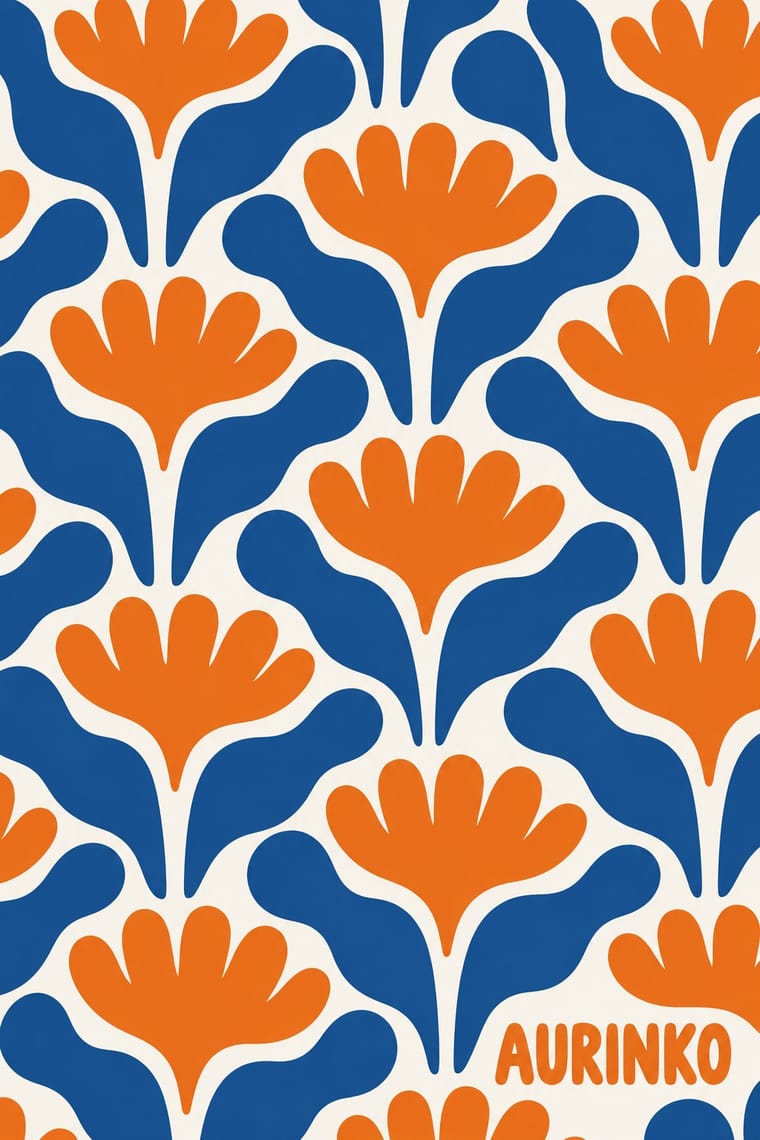
The printed-cotton modernism of Marimekko, founded in Helsinki in 1951 by Armi and Viljo Ratia out of Viljo's printing firm Printex. Its designers, chiefly Maija Isola, the first (1949-1987), with Vuokko Nurmesniemi (1953-1960) and from 1960 Annika Rimala, painted or cut one motif (stones, a poppy, waves, stripes), enlarged it to repeats often over half a metre and screen-printed it edge to edge in a few flat inks, often on white. It turns the Nordic ideal of good everyday things into one pattern for dress, curtain and home; from 1974 Fujiwo Ishimoto added brushstroke and calligraphic marks.
Make something in this styleGet advice in this styleMix it with another style
Use it with care
Many of the best-known patterns, Unikko and Kivet among them, are still produced by Marimekko and remain protected designs, so work in the manner rather than copying them. Folk sources carry two further, separate risks. Anonymous folk ornament can be living devotional material: the käspaikka, the Karelian linen towel named in Isola's 1959 print, is still used to dress icons in Orthodox churches and homes, so abstract such ornament rather than quote it, and keep it out of contexts that trivialise it. A named folk artist's work is authored, not a shared tradition: in 2013 Kristina Isola admitted that her 'Metsänväki' (2007), by then painted on a Finnair aircraft, copied elements of Maria Prymachenko's 1963 painting 'Rat on a Journey'; Finnair undertook to repaint the plane and Marimekko ended its collaboration with Kristina Isola in September 2013.
01
How it works
- Draw one motif (a stone, a poppy, a wave, a stripe) with a brush or cut it from paper, and enlarge it until a single repeat fills much of the width of the cloth.
- Print in two or three flat inks, one screen per colour, usually on white cotton; leave out outlines, shading and gradients.
- Keep the hand in the edge: let shapes keep the wobble of scissors and brush instead of ruling them into geometry.
- Run the pattern edge to edge, selvedge to selvedge, so the same cloth works as a dress, a curtain, a wall or a shop interior without redesign.
- Abstract nature and folk sources into a few large silhouettes instead of quoting their detail: Slavic ornament, the lace edge of a Karelian towel, a field of stones, waves and a seagull's wingbeat.
- Sign the cloth, not the picture: print designer, pattern name, maker and year along the selvedge, and let one plain lowercase typewriter wordmark carry the brand.
Helsinki: Printex Oy, Viljo Ratia's textile printing firm, for which Armi Ratia hired Maija Isola in 1949, and Marimekko Oy, registered by Armi and Viljo Ratia on 25 May 1951
02
Its design choices
From Stylogeny’s vocabulary of design choices: defining choices make the style, characteristic ones are usual, occasional ones turn up now and then.
- Layout & composition
- Space & hierarchy
- Colour
- Form & shape
- Surface & texture
- Medium & production
- Tone & intent
- Avoids
- Gradients, Illusion of depth, Horror vacui, Halftone & Ben-Day dots, Gloss & highlights, Straight photography, Optical pattern, Ironic & self-aware
Palette
#f7f5f0#141414#d4211c#e8478b#ef7d1a#1d4f91
Typefaces
The Marimekko wordmark (in use since 1954)
lowercase letters adapted by Helge Mether-Borgström from Olivetti typewriter type
Selvedge inscriptions repeated along the edge of the cloth, naming designer, pattern, maker, country and year
e.g. 'MAIJA ISOLA "LOKKI" ® MARIMEKKO OY SUOMI FINLAND 1961' on the left selvedge of Lokki, Art Institute of Chicago 1980.140
Known for
Maija Isola, 'Kivet' (Stones), 1956
rows of jagged black circles cut from coloured paper with scissors, screenprint on cotton (LACMA M.80.38.1, gift of Marimekko, Inc.)
Vuokko Nurmesniemi, the 'Piccolo' brushstroke pattern (1953), the 'Jokapoika' (Every Boy) shirt in plain red-and-white stripes (1956), and her 'Ram' furnishing fabric (1956), squares and lines in blue and grey, screen-printed cotton with a warp repeat of 123.2 cm (Art Institute of Chicago 1980.146)
Maija Isola, the 'Ornamentti' series of about 30 patterns based on Slavic folk art
(from 1958), and 'Käspaikka' (1959), bands of trompe-l'oeil lace edging in red, orange and pink, bearing the name of the Karelian embroidered towel, with a warp repeat of 143.8 cm (Art Institute of Chicago 1980.136; National Museum of American History 1988.0255.63)
Maija Isola, 'Lokki' (Seagull), 1961
broad wave bands across the width of the cloth, screen-printed cotton (Art Institute of Chicago 1980.140)
Maija Isola, 'Unikko' (Poppy), painted in 1964 in pink, red and black on white against Armi Ratia's professed dislike of floral prints, first issued in 1965 and still in production (Nationalmuseum Stockholm NMK 119/1970, screen-printed cotton, 1965; Röhsska Museum RKM 116-2007, a 2007 reprint)
Katsuji Wakisaka, trained in Kyoto and Marimekko's first non-Finnish designer (1968-1976), 'Karuselli' (Carousel), 1973
ultra-saturated red, yellow and pink flowers (Art Institute of Chicago 1980.141); his car-patterned 'Bo Boo' was especially popular in the United States
Fujiwo Ishimoto, interior-fabric designer for Marimekko 1974-2006
whose brushstroke mark-making Armi Ratia at first rejected as not Marimekko: 'Onni' (Happiness, 1975), a peasant-motif print after Finnish folk art with abstract botanical shapes, and 'Uomo' (Midwinter, 1987), a marbled wave pattern in black and gold after Japanese suminagashi (Wargula 2019)
03
Make something in this style
Say what you need, and Stylogeny’s image studio draws it from Finnish Bold Print (Marimekko Modernism)’s design choices and checks it against them. It takes about a minute, and you get a link to share.
04
Where it comes from, and what it’s close to
Before it
The style it grew out of, and the styles it borrowed from.


After it
The styles that grew out of it.
No later style in the atlas grew out of it yet.
Alike in its design choices
Styles that make many of the same choices, related or not, besides those above.


05
Sources
- Wikipedia: Marimekko (founding on 25 May 1951; Nurmesniemi's Jokapoika, 1956; Isola's Unikko, 1964; the 1954 logo after Olivetti typewriter letters, citing Aav 2003, p. 324; the 2013 Finnair/Primachenko case and the repainted plane): https://en.wikipedia.org/wiki/Marimekko
- Wikipedia: Maija Isola (hired for Printex in 1949; retired 1987; Luonto, 1957-63; Ornamentti from 1958, based on Slavic folk art; Unikko against Ratia's dislike of florals; pattern books drawn to scale), citing Aav 2003, Jackson and Shimatsuka 2012: https://en.wikipedia.org/wiki/Maija_Isola
- Wikipedia: Vuokko Nurmesniemi (at Marimekko 1953-1960; with Isola responsible for most of Marimekko's patterns; Jokapoika, 1956; Vuokko Oy, 1964-1988): https://en.wikipedia.org/wiki/Vuokko_Nurmesniemi
- Wikipedia (fi): Marimekko (Printex Oy; Isola at Marimekko 1949-1987; Annika Rimala from 1960, Tasaraita; Ishimoto from 1974, Maisema 1982; Wakisaka 1968-1976 and his Bo Boo; Mether-Borgström's logo; Metsänväki, 2013): https://fi.wikipedia.org/wiki/Marimekko
- Wikipedia (fi): Maija Isola (first patterns for Printex, 1949; Kivet cut from paper circles, 1956; Lokki, 1961): https://fi.wikipedia.org/wiki/Maija_Isola
- Wikipedia (fi): Käspaikka (the Karelian towel and its use on icons in Orthodox churches and homes): https://fi.wikipedia.org/wiki/Käspaikka
- Marianne Aav (ed.), Marimekko: Fabrics, Fashion, Architecture (Bard Graduate Center / Yale University Press, 2003), as cited by Wikipedia; Bard Graduate Center exhibition page (Isola's oversized patterns and bright colours; Nurmesniemi's Piccolo brushstroke pattern, 1953; Rimala's Even Stripe T-shirt; Ishimoto's Maisema, 1982): https://www.bgc.bard.edu/exhibitions/exhibitions/43/marimekko
- Lesley Jackson, Twentieth-Century Pattern Design: Textile & Wallpaper Pioneers (Princeton Architectural Press, first edition 2002; Wikipedia cites the 2007 edition), pp. 136-137 on Lokki and Unikko, as cited by Wikipedia
- Marianne Aav, Harri Kivilinna, Eeva Viljanen et al., Maija Isola: Life, Art, Marimekko (Designmuseo, Helsinki, 2005; ISBN 9529878427), exhibition catalogue, with Kristina Isola as author of the 'Life' section (CaGeWeB record: https://www.cageweb.be/catalog/kub01:000720049; Viva, NZ Herald, on its five authors: https://www.nzherald.co.nz/viva/culture/the-material-miracles-of-maija-isola-the-artist-behind-some-of-marimekkos-most-iconic-prints/BBVRAZ23BVEAU7FPILJEWFKI7U/)
- Carolyn Wargula, 'Fujiwo Ishimoto Exhibition: From Marimekko Flowers to Ceramic Fruits in Dialogue with the Rinpa', Contemporaneity 8, no. 1 (2019), DOI 10.5195/contemp/2019.292 (Ishimoto at Marimekko 1974-2006; Ratia's rejection of his brushstroke designs, citing Aav 2003, pp. 70-72; Onni, 1975; Uomo, 1987): https://contemporaneity.pitt.edu/ojs/contemporaneity/article/download/292/307/1118
- LACMA, Maija Isola, Textile Length 'Kivet' (1956), M.80.38.1: https://collections.lacma.org/object/40209
- Art Institute of Chicago, Marimekko furnishing fabrics (records read through api.artic.edu): Lokki 1980.140 with its selvedge inscription (https://www.artic.edu/artworks/59928), Käspaikka 1980.136 (https://www.artic.edu/artworks/59920), Ram 1980.146, subject terms squares, lines, blue, grey (https://www.artic.edu/artworks/59943), Albatrossi 1980.138, 'high-contrast yet painterly' (https://www.artic.edu/artworks/59924), Karuselli 1980.141 (https://www.artic.edu/artworks/59929), Metsänväki 2016.550 (https://www.artic.edu/artworks/237845)
- Nationalmuseum Stockholm, Textile 'Unikko', Maija Isola for Marimekko (1965), NMK 119/1970: https://collection.nationalmuseum.se/en/collection/item/7205/
- Röhsska Museum, 'Unikko' (designed 1964, first published 1965; 2007 reprint), RKM 116-2007: https://collection.rohsska.se/en/collection/item/28801/
- National Museum of American History, 'Kaspaikka' (1959), Maija Isola for Marimekko Oy, 1988.0255.63: bands of trompe-l'oeil lace edging in bright red, orange and pink, with a selvage inscription
How Stylogeny researches and checks a style: where the facts come from.