Traditions & vernacular · 1927–present · East Asia
Serizawa Katazome and Mingei Stencil-Dye Graphics
Also known as Kataezome (型絵染), Serizawa style, Mingei stencil dyeing, Katazome calendars
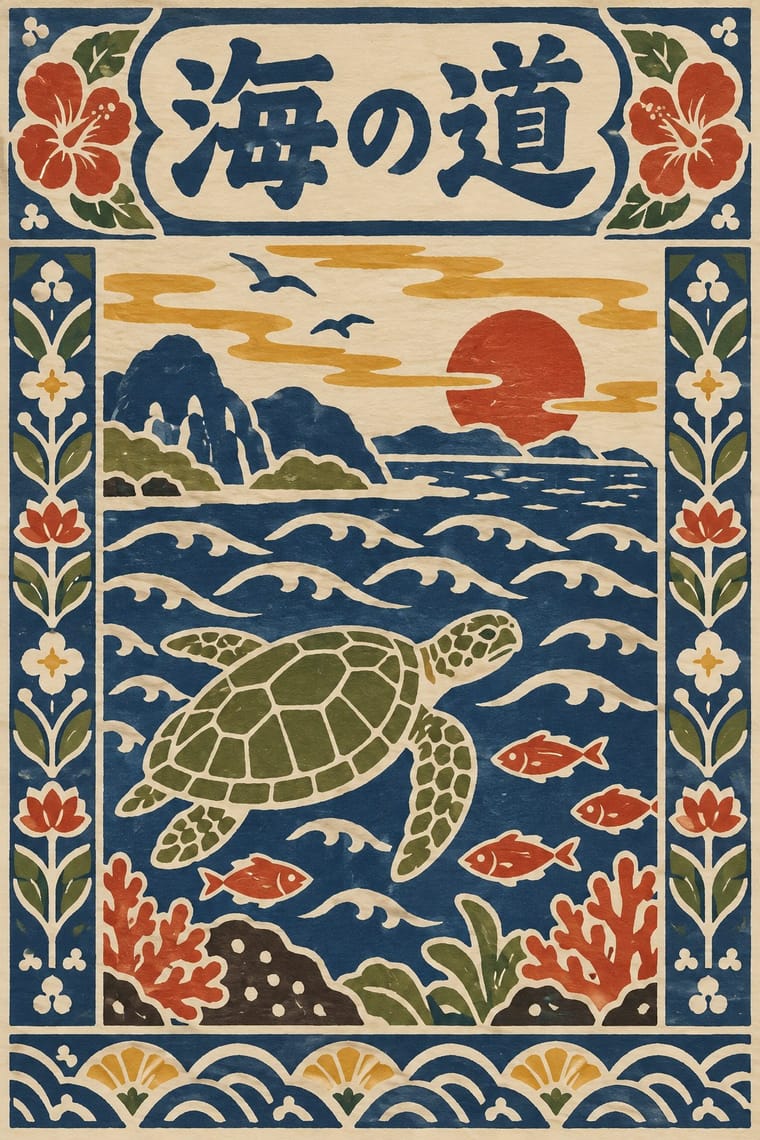
Japanese folk-craft graphic design made by cutting paper stencils and dyeing through a rice-paste resist. Figures, tools, houses, plants and kana or kanji are cut as one stencil, so letters and pictures share the same soft, hand-cut edge and sit as flat fields of earth, indigo and bingata red on undyed cloth or washi. Serizawa used it for calendars, book covers, screens and picture books, setting small everyday scenes in grids of panels or repeating them across the cloth.
Make something in this style Get advice in this style Mix it with another style
Use it with care
Katazome and Okinawan bingata are living crafts: bingata is an Okinawan (Ryukyuan) tradition, carried on by dye houses such as the Shiroma family, and is protected as an intangible cultural property, so credit Okinawa and its makers when borrowing its colours and motifs, and do not sell printed or generated imitations as hand-dyed katazome or bingata. Mainland mingei collecting of Okinawan and Korean crafts in the 1930s and 1940s is now read critically against Japan's colonial rule over Korea and its treatment of annexed Okinawa, which is one more reason to name Okinawan makers rather than present bingata as Serizawa's invention. Serizawa's and Yunoki's designs are authored works held by their museums: work in the manner rather than copying a calendar or screen. His Buddhist subjects, such as the 1939 scroll of the priest Hōnen, are devotional images, not decoration. Kana and kanji must be real, correct text checked by a fluent reader, never pseudo-script used as texture.
01
How it works
- Cut every shape, letters included, as a paper stencil, and keep the soft, slightly rounded edge the knife leaves, with a visible bridge where the stencil needs one.
- Fill each shape with one flat dye colour, with no shading or modelling, and let the undyed cloth or paper show between them.
- Draw letters as pictures: cut kana, kanji and numerals as bold decorative shapes in the same hand as the image.
- Take motifs from everyday working life, such as tools, crafts, houses, plants and people at work, and simplify them into friendly figures.
- Set the motifs in a grid of framed panels for a calendar, screen or book, or repeat them across the whole cloth.
- Keep to a few warm earth colours and indigo, with bingata red or yellow as an accent, or to a single dye on undyed cloth.
Tokyo and Shizuoka. Keisuke Serizawa (1895–1984) joined Yanagi Sōetsu's mingei (folk-craft) movement in 1927, first saw Okinawan bingata in 1928 and went to Okinawa to learn its technique in 1939. He applied stencil and rice-paste resist dyeing to cloth, screens, book covers and, from 1945, annual calendars on handmade washi. In 1956 he was named a Living National Treasure for kataezome (型絵染), a term coined for the designation meaning that one artist designs, cuts the stencils and dyes. Pupils such as Samiro Yunoki (1922–2024) carried the work on.
02
Its design choices
From Stylogeny’s vocabulary of design choices: defining choices make the style, characteristic ones are usual, occasional ones turn up now and then.
- Layout & composition
- Space & hierarchy
- Typography
- Colour
- Form & shape
- Surface & texture
- Ornament
- Medium & production
- Tone & intent
- Avoids
- Straight photography, Gradients, Fluorescent & neon, Illusion of depth, Naturalistic depiction, Painterly brushwork, Gloss & highlights, Grotesque & neo-grotesque
Palette
-
#efe6d2 -
#1f3a5f -
#b5432a -
#d9a635 -
#2b2622 -
#6b7a3a
Typefaces
-
Hand-cut stencil kana and kanji, dyed together with the picture, for calendar month names, book titles and inscriptions
-
Moji-e (文字絵), letters built from figures and objects, collected in Serizawa Keisuke no moji-e, san
1997, edited by Serizawa Chōsuke and Sugiura Kōhei
-
Bold stencil-cut numerals in the grids of the annual calendars
Known for
-
Keisuke Serizawa, annual stencil-dyed calendars on handmade washi, from 1945
-
Keisuke Serizawa, covers of the journal Kōgei (工藝), Japanese-bound with stencil-dyed cloth covers, 120 issues from 1931
-
Keisuke Serizawa, book designs for most of Yanagi Sōetsu's writings
-
Keisuke Serizawa, six-fold screen showing the stages of making paper, stencil-resist dyeing on silk, about 1938
Victoria and Albert Museum
-
Keisuke Serizawa, six-fold screen with a map of Okinawa and round vignettes of Okinawan life and crafts, stencilled resist-dyed silk in the bingata technique, about 1940 (Victoria and Albert Museum)
-
Keisuke Serizawa, Shinpan Ehon Don Kihōte (new edition of the Don Quixote picture book, stencil-dyed), limited edition, Gohachi (吾八), 1976
-
Shizuoka City Serizawa Keisuke Art Museum (opened 1981) and the Serizawa Keisuke Museum of Art and Craft, Tohoku Fukushi University, Sendai
collections of his calendars, screens, noren and book designs
-
Samiro Yunoki, katazome noren, kimono, prints and picture books, made after studying katazome with Serizawa
03
Make something in this style
Say what you need, and Stylogeny’s image studio draws it from Serizawa Katazome and Mingei Stencil-Dye Graphics’s design choices and checks it against them. It takes about a minute, and you get a link to share.
04
Where it comes from, and what it’s close to
Before it
The style it grew out of, and the styles it borrowed from.
Nothing earlier is recorded: in the atlas it is a starting point.
After it
The styles that grew out of it.
No later style in the atlas grew out of it yet.
Alike in its design choices
Styles that make many of the same choices, related or not, besides those above.
-
-
-
- Pardhan Gond Painting (Jangarh Kalam) 67% alike
- Norwegian and Finnish National Romantic Graphics (Munthe & Karelianism) 67% alike
-
05
Often taken for
Serizawa Katazome and Mingei Stencil-Dye Graphics has no real works recorded yet, so these are its nearest styles by its choices alone, with the choices that tell them apart.
-
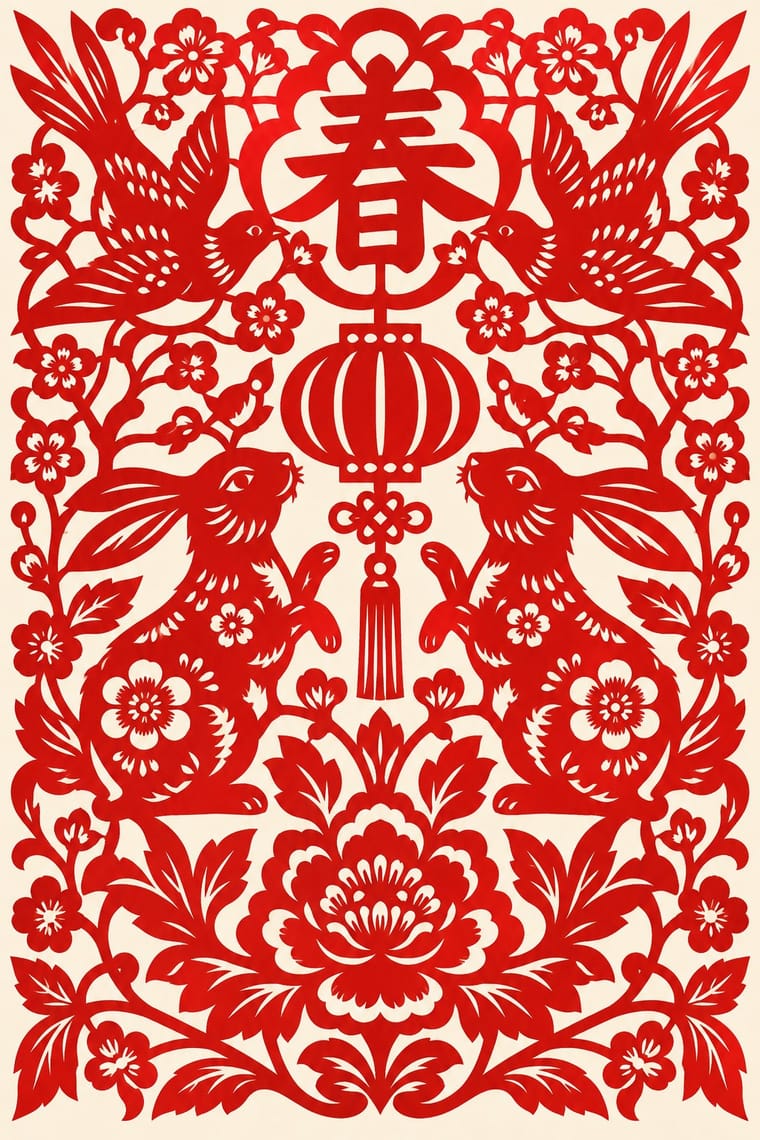
Chinese Paper-Cut (Jianzhi)
Chinese Paper-Cut is one of Serizawa Katazome and Mingei Stencil-Dye Graphics’s nearest styles by choices; no real work of either fits the other better.
Choices that tell Serizawa Katazome and Mingei Stencil-Dye Graphics and Chinese Paper-Cut apart Choice Serizawa Katazome and Mingei Stencil-Dye Graphics Chinese Paper-Cut Earth & mineral defining — Monochrome occasional defining Framed panels defining occasional Central symmetry occasional defining Rounded & pill characteristic — No shared descent in the atlas: they reached these choices separately.
-
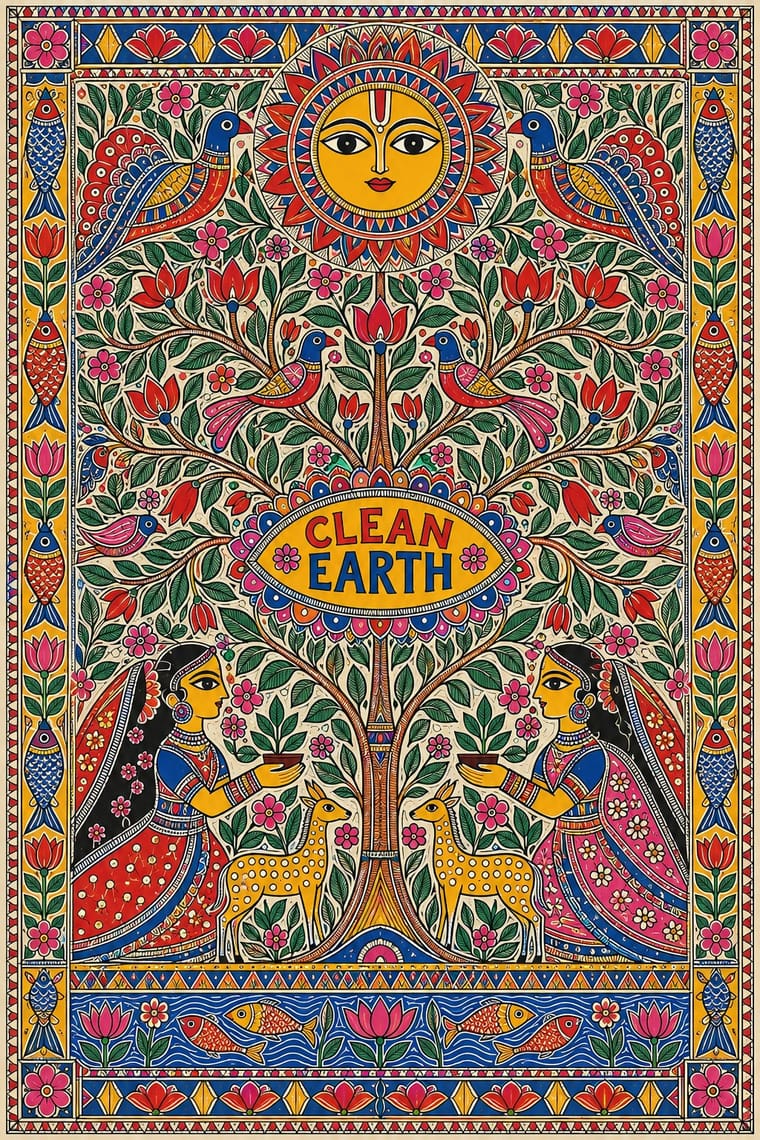
Mithila (Madhubani) Painting
Mithila Painting is one of Serizawa Katazome and Mingei Stencil-Dye Graphics’s nearest styles by choices; no real work of either fits the other better.
Choices that tell Serizawa Katazome and Mingei Stencil-Dye Graphics and Mithila Painting apart Choice Serizawa Katazome and Mingei Stencil-Dye Graphics Mithila Painting Generous white space occasional avoids Abundant decoration — defining Hand-lettering defining occasional Horror vacui — defining Rounded & pill characteristic — No shared descent in the atlas: they reached these choices separately.
-
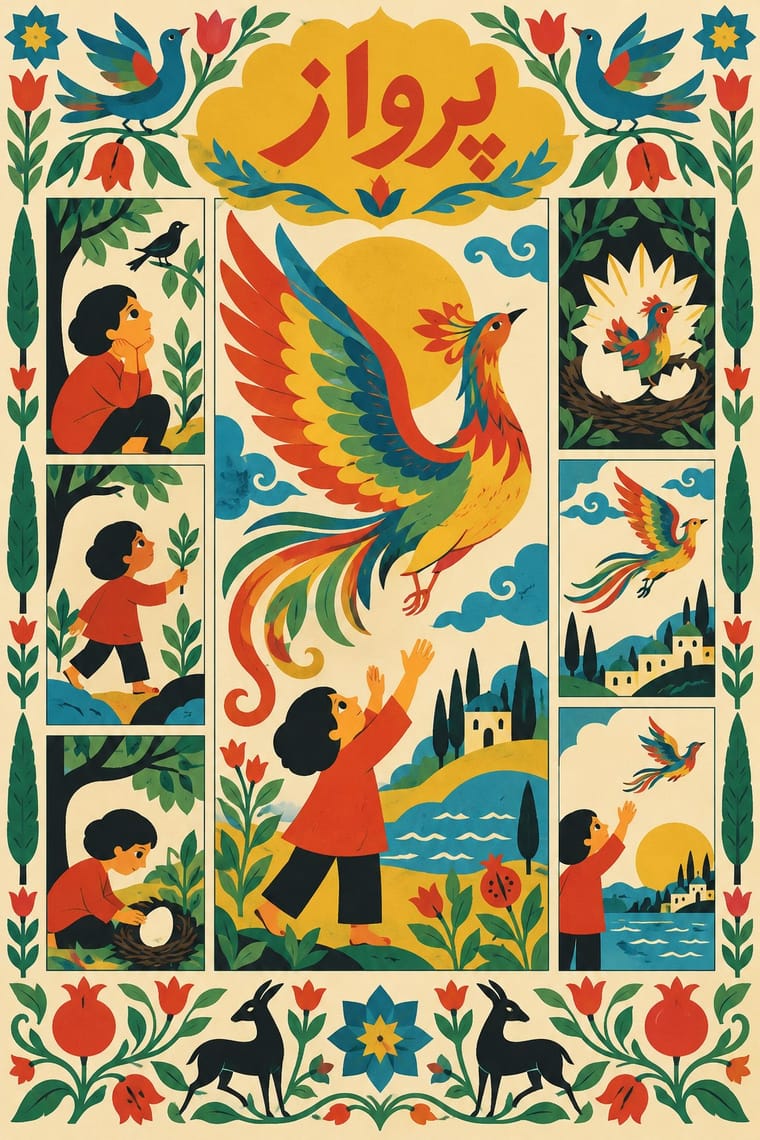
Kanoon Children's Book Illustration (Iran, 1965 to 1979)
Kanoon Children's Book Illustration is one of Serizawa Katazome and Mingei Stencil-Dye Graphics’s nearest styles by choices; no real work of either fits the other better.
Choices that tell Serizawa Katazome and Mingei Stencil-Dye Graphics and Kanoon Children's Book Illustration apart Choice Serizawa Katazome and Mingei Stencil-Dye Graphics Kanoon Children's Book Illustration Earth & mineral defining — Full polychrome occasional defining Limited spot colours characteristic — Dynamic asymmetry — characteristic Rounded & pill characteristic — No shared descent in the atlas: they reached these choices separately.
-
Pardhan Gond Painting (Jangarh Kalam)
Pardhan Gond Painting is one of Serizawa Katazome and Mingei Stencil-Dye Graphics’s nearest styles by choices; no real work of either fits the other better.
Choices that tell Serizawa Katazome and Mingei Stencil-Dye Graphics and Pardhan Gond Painting apart Choice Serizawa Katazome and Mingei Stencil-Dye Graphics Pardhan Gond Painting Earth & mineral defining occasional Isolated object — defining Framed panels defining occasional Full polychrome occasional defining Hand-lettering defining occasional No shared descent in the atlas: they reached these choices separately.
— means the choice isn’t among the style’s recorded choices. Critics recorded each work’s choices with the styles’ descriptions in view, so this shows whether the descriptions hold together, not proof that they are right.
06
Combine it with
Styles Serizawa Katazome and Mingei Stencil-Dye Graphics pairs well with or plays against, from the research. Each is worked out as a combination: which style gives the type, the colours and the forms.
- Ukiyo-e Woodblock Prints Contrasts · Ukiyo-e is carved line, urban pleasure and diagonal drama; Serizawa is a stencil edge, rural work and calm panel grids.
- Edo-moji Commercial Lettering (Kanteiryū, Yose-moji, Sumō-ji) Contrasts · Edo-moji crams heavy brush letters for the theatre and the street; Serizawa cuts open, airy letters that share the cloth with pictures.
- Finnish Bold Print (Marimekko Modernism) Pairs well · Both make everyday design from hand-cut shapes in few flat colours; Marimekko's large abstract repeats can carry Serizawa's small figurative panels and stencil letters.
- Kamon (Japanese Family Crests) Pairs well · Crest-like roundels sit naturally beside stencil-dyed panels; draw new crests by the tradition's rules rather than borrowing real family mon.
- Japanese Postwar Modernism Contrasts · Postwar modernism reduces to emblem and white space with set type; Serizawa fills the sheet with hand-cut figures and letters.
- Đông Hồ & Hàng Trống Folk Prints Pairs well · Another East Asian folk picture on handmade paper in earth colours; compare the woodblock's carved line with the stencil's cut field.
07
Sources
- Wikipedia (ja), 芹沢銈介: https://ja.wikipedia.org/wiki/芹沢銈介
- Wikipedia (en), Keisuke Serizawa: https://en.wikipedia.org/wiki/Keisuke_Serizawa
- Wikipedia (en), Katazome: https://en.wikipedia.org/wiki/Katazome
- Wikipedia (en), Bingata: https://en.wikipedia.org/wiki/Bingata
- Wikipedia (en), Samiro Yunoki: https://en.wikipedia.org/wiki/Samiro_Yunoki
- Wikipedia (en), Mingei (Critiques): https://en.wikipedia.org/wiki/Mingei
- Victoria and Albert Museum, six-fold screen of papermaking by Serizawa Keisuke, ca. 1938: https://collections.vam.ac.uk/item/O16161/
- Victoria and Albert Museum, six-fold screen with a map of Okinawa by Serizawa Keisuke, ca. 1940: https://collections.vam.ac.uk/item/O24291/
- Victoria and Albert Museum, hanging scroll of the priest Hōnen by Serizawa Keisuke, 1939: https://collections.vam.ac.uk/item/O25682/
How Stylogeny researches and checks a style: where the facts come from.