Traditions & vernacular · c. 500–present · East Asia
Chinese Paper-Cut (Jianzhi)
Also known as Jianzhi (剪纸), Chinese papercut, Chuanghua (窗花, window flowers)
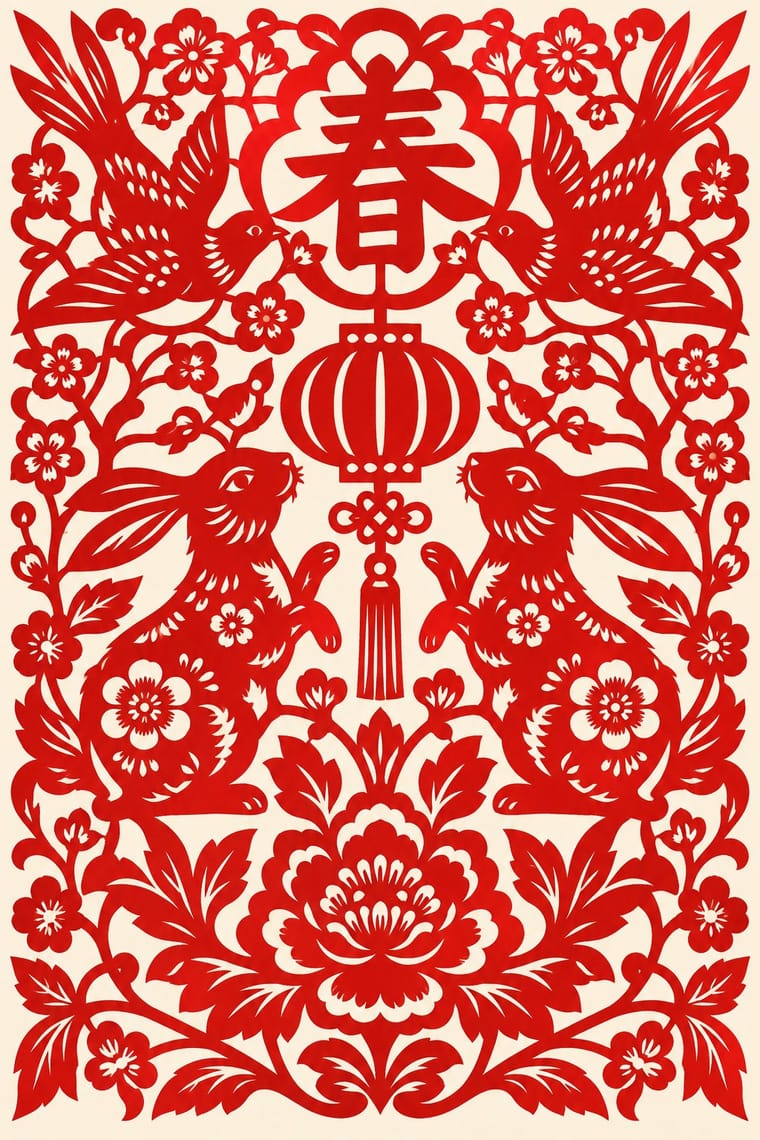
China's folk art of cut paper, made mostly by rural women and passed from mother to daughter, and by town guilds and workshops. A sheet, usually red, is cut with scissors or a knife into a silhouette that holds together; folding before cutting gives mirror and radial symmetry, and saw-tooth and crescent notches stand in for texture. Window flowers, wedding characters, lucky animals and embroidery patterns dress windows, beds and ceilings for festivals, weddings and prayers. Yuxian (Hebei) knife-cuts are dyed in many colours; Foshan backs cut metal foil (copper or gold) with coloured paper.
Make something in this styleGet advice in this styleMix it with another style
Use it with care
Paper-cutting is a living craft, practised mostly by rural women who learn it from their mothers, and some cuts serve ritual ends, from invoking rain and warding off evil to calling back the spirit of the dead at funerals. Commission, buy from or credit named cutters and regional workshops rather than tracing their designs, keep auspicious characters correct and legible, do not use funerary or ritual cuts as festive decoration, and treat Miao embroidery-pattern cuts as part of a minority community's dress rather than a free motif bank. Use 囍 (double happiness) only for weddings, not as a generic Chinese luck motif; a 福 hung upside down at New Year is deliberate (倒福, a pun on 'fortune arrives'), so do not correct it, and do not flip other characters.
01
How it works
- Cut the whole picture from one sheet, usually red, so that it holds together: keep the outlines and join them into a lattice of paper lines (yang-cut), cut the lines out of a solid mass (yin-cut), or combine the two in one piece.
- Fold the paper before cutting for exact mirror symmetry, and fold it again for round, radiating designs.
- Show fur, feathers, petals and folds with saw-tooth and crescent notches, scored lines and pierced holes, never with shading.
- Cut wishes as signs: double happiness for a wedding, fu for the New Year, and flowers, animals and objects whose names pun on luck.
- Let the image read as flat colour against light or a pale ground, as on a papered window.
- Match the cutting to the region: bold, simple masses for northern window flowers, fine lace-like detail for southern work, thin knife-cut paper dyed in several colours for Yuxian (Hebei) opera figures.
Rural China, where it is made mostly by women; the oldest surviving paper-cuts are sixth-century folded roundels from the Astana tombs at Turpan, Xinjiang, the first excavated in 1959. Centres include Shaanxi (Ansai and Luochuan in the north, Xunyi in Xianyang where the Guanzhong plain meets the Loess Plateau), Yuxian (Hebei), Yangzhou, Yueqing (Zhejiang), Zhangpu (Fujian), Foshan (Guangdong) and the Miao of south-eastern Guizhou, who cut patterns for embroidery. Beside the domestic craft ran professional lines: in Yuxian the peasant cutter Wang Laoshang (1890–1951) developed dyed knife-cut opera figures, drawing on Yangliuqing New Year prints and Wuqiang woodblock window flowers; in Yangzhou Zhang Yongshou, son of the cutter Zhang Jinsheng, took the family craft from practical embroidery patterns to decorative set pieces; and Foshan's paper-cut had its own guilds by the Qing dynasty, and in the early twentieth century hundreds of shops in a dozen allied trades made its door hangings, foils and dyed papers
02
Its design choices
From Stylogeny’s vocabulary of design choices: defining choices make the style, characteristic ones are usual, occasional ones turn up now and then.
- Layout & composition
- Space & hierarchy
- Colour
- Form & shape
- Surface & texture
- Ornament
- Medium & production
- Tone & intent
- Avoids
- Illusion of depth, Naturalistic depiction, Straight photography, Painterly illustration, Ornament-free, Gloss & highlights
Palette
#c8161d#f5f0e6#c9a227#e0558a#2f9e8f
Typefaces
Double happiness (囍) cut from folded red paper for weddings, the doubled character mirrored across the fold
Fu (福) and other auspicious characters cut as solid, bridged glyphs for the New Year
Characters cut either as strokes joined to a frame or pierced out of a solid ground, set in roundels and squares
Known for
Sixth-century folded roundels (tuanhua) of paired horses and paired monkeys from the Astana tombs at Turpan, Xinjiang, the oldest paper-cuts that survive, in which saw-tooth and crescent cuts first appear
Twin girls holding hands, with birds perched on their heads, a symmetrical scissor-cut in paper coloured red, much of the sheet left uncut, Shaanxi, 1988 (V&A, O75263)
Ku Shulan (1920–2004) of Xunyi County, Shaanxi, whose large, bright pasted cuts each include the 'Flower-Cutting Lady' (剪花娘子) she called herself
Zhao Jingan, knife-cut child astride a qilin with a lotus (lian) and a sheng pipe, after a Qing design, standing for the wish 'lian sheng gui zi' (continually giving birth to noble sons), Hebei, 1985–88 (V&A, O75050)
Knife-cut opera mask of Jiang Ziya on very fine white paper, dyed pink, red, purple, turquoise, yellow, orange, green and blue, Hebei, 1975–85 (V&A, O75237)
Zhang Yongshou (1907–1989) of Yangzhou, son of the cutter Zhang Jinsheng, whose Hundred Chrysanthemums (百菊图) shows the fine, flowing line of southern work
Foshan roundel landscape with an outline of cut gold foil filled in with coloured papers, 1965–70
V&A, O75029
Cut zodiac pig in glossy blue paper, its hair a band of saw-tooth cuts, Shaanxi, 1985
V&A, O75166
03
Make something in this style
Say what you need, and Stylogeny’s image studio draws it from Chinese Paper-Cut (Jianzhi)’s design choices and checks it against them. It takes about a minute, and you get a link to share.
04
Where it comes from, and what it’s close to
Before it
The style it grew out of, and the styles it borrowed from.


After it
The styles that grew out of it.
No later style in the atlas grew out of it yet.
Alike in its design choices
Styles that make many of the same choices, related or not, besides those above.


05
Sources
- UNESCO Intangible Cultural Heritage, 'Chinese paper-cut', inscribed 2009 on the Representative List (https://ich.unesco.org/en/RL/chinese-paper-cut-00219)
- Ruth Bottomley, Chinese Papercuts (Singapore and London: Sun Tree Publishing, 1994), the reference cited by the V&A papercut records
- Victoria and Albert Museum, papercut O75263, symmetrical twin girls, scissor-cut, paper coloured red, Shaanxi, 1988 (https://collections.vam.ac.uk/item/O75263/)
- Victoria and Albert Museum, papercut O75050, Zhao Jingan, Hebei, 1985–88 (https://collections.vam.ac.uk/item/O75050/)
- Victoria and Albert Museum, papercut O75237, knife-cut and dyed opera mask, Hebei, 1975–85 (https://collections.vam.ac.uk/item/O75237/)
- Victoria and Albert Museum, papercut O75029, gold foil and coloured papers, Foshan, 1965–70 (https://collections.vam.ac.uk/item/O75029/)
- Victoria and Albert Museum, papercut O75166, pig with saw-tooth cuts, Shaanxi, 1985 (https://collections.vam.ac.uk/item/O75166/)
- Victoria and Albert Museum, papercut O457442, scissor-cut funeral scene, 'calling back the spirit of the dead', 1980–85 (https://collections.vam.ac.uk/item/O457442/)
- Victoria and Albert Museum, papercut O457316, red-dyed paper, Luochuan, Shaanxi, 1988 (https://collections.vam.ac.uk/item/O457316/)
- Victoria and Albert Museum, papercut O75119, paper coloured with ink, Yangzhou, 1980 (https://collections.vam.ac.uk/item/O75119/)
- China Intangible Cultural Heritage Network (ihchina), '剪纸(扬州剪纸)', on Zhang Jinsheng, Zhang Yongshou and the Hundred Chrysanthemums (https://www.ihchina.cn/project_details/13928.html)
- China Intangible Cultural Heritage Network (ihchina), '剪纸(广东剪纸)', on Foshan copper-foil cuts and guilds (https://www.ihchina.cn/project_details/13932)
- China Intangible Cultural Heritage Network (ihchina), '略谈中国民间剪纸的主要流派', on Wang Laoshang and Yuxian yin- and yang-cut dyed paper-cuts (https://www.ihchina.cn/art/detail/id/8074.html)
- China Intangible Cultural Heritage Network (ihchina), '剪纸艺术', on saw-tooth and crescent cuts and the paired-horse and paired-monkey roundels (https://www.ihchina.cn/news_1_details/11473.html)
- China Intangible Cultural Heritage Network (ihchina), '非遗数据知多少 | 一刀一剪,现人间千种温情', defining yin-cut and yang-cut (https://www.ihchina.cn/project_details/24793.html)
- 人民政协网, '世界非物质文化遗产:蔚县剪纸', 13 February 2014, on Wang Laoshang (1890–1951) (https://www.rmzxw.com.cn/scjb/ypyj/2014/02/13/273636_1.shtml)
- 界面新闻, on the Astana paper-cuts excavated in 1959 (https://m.jiemian.com/article/1917100.html)
- 扬子晚报网, 22 June 2025, on Zhang Yongshou (1907–1989) (https://www.yzwb.net/news/jiangsu/202506/t20250622_225450.html)
- Museum of Ethnic Cultures, Minzu University of China, 'Miao Intangible Cultural Heritage —— Paper Cutout', Google Arts & Culture (https://artsandculture.google.com/story/hwUhV7ft1mGTLA)
- Wikipedia, 'Chinese paper cutting' (https://en.wikipedia.org/wiki/Chinese_paper_cutting)
- Wikipedia, 'Fu (character)' (https://en.wikipedia.org/wiki/Fu_(character))
- Wikipedia, 'Double Happiness (calligraphy)' (https://en.wikipedia.org/wiki/Double_Happiness_(calligraphy))
- Wikipedia (Chinese), '剪纸' (https://zh.wikipedia.org/wiki/%E5%89%AA%E7%BA%B8)
- Wikipedia (Chinese), '中国剪纸' (https://zh.wikipedia.org/wiki/%E4%B8%AD%E5%9B%BD%E5%89%AA%E7%BA%B8)
- Wikipedia (Chinese), '库淑兰' (https://zh.wikipedia.org/wiki/%E5%BA%93%E6%B7%91%E5%85%B0)
- Wikipedia (Chinese), '旬邑县' (https://zh.wikipedia.org/wiki/%E6%97%AC%E9%82%91%E5%8E%BF)
- Wikipedia (Chinese), '施洞镇' (https://zh.wikipedia.org/wiki/%E6%96%BD%E6%B4%9E%E9%95%87)
- Wikipedia, 'Lü Shengzhong' (https://en.wikipedia.org/wiki/L%C3%BC_Shengzhong)
How Stylogeny researches and checks a style: where the facts come from.