Traditions & vernacular · c. 1350–present · South Asia
Mithila (Madhubani) Painting
Also known as Madhubani painting, Madhubani art, Mithila art, Maithil painting
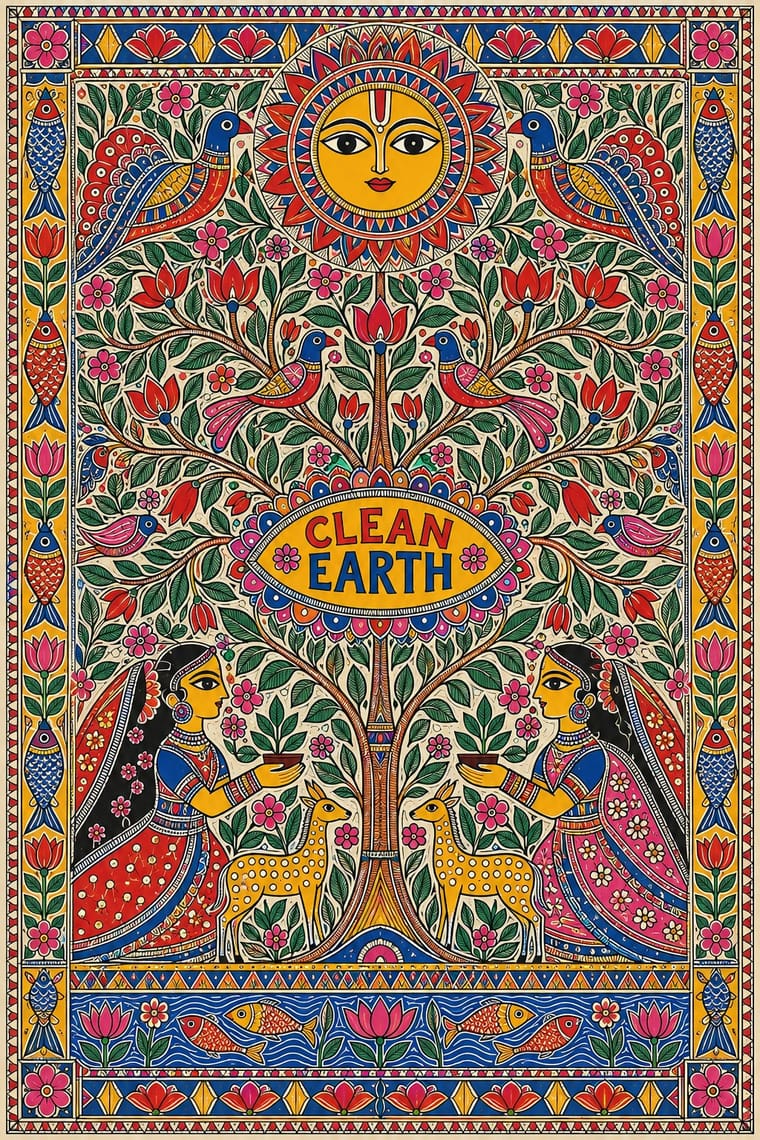
Women's ritual wall and floor painting from Mithila in north Bihar and Nepal's Terai, attested from at least the 14th century, seen by W. G. Archer after the 1934 earthquake and photographed in 1940, and moved to paper for sale in the 1966–67 drought. Line comes first: figures and borders are drawn, often as double outlines, then filled with flat colour (bharni), fine hatching (kachni) or tattoo-derived rings (godna) until no ground is left empty. Wedding-chamber kohbar images, deities, epics and, later, village life and world events fill sheets closed by border bands.
Make something in this styleGet advice in this styleMix it with another style
Use it with care
Mithila painting is the living craft and livelihood of named painters, mostly women, across many castes in Madhubani district and southern Nepal, and 'Madhubani paintings' is a registered Geographical Indication of Bihar (2006–07): do not label machine-printed, traced or AI-generated images as Madhubani or Mithila painting, never add a painter's name or signature to generated work, and commission, buy from or credit painters by name instead. Kohbar and aripana images are made for marriages, births and other rites and many sheets show Hindu deities still worshipped, so do not crop, distort or put them on disposable or demeaning goods. Godna painting and the figure of Raja Salhesh belong to the Dalit Dusadh community's history of claiming a place their painting was once denied; do not treat them as generic tribal pattern or erase whose tradition they are. Godna painting also draws on the tattoo art of Nat (Natin) women; credit that source too. Use 'Mithila painting' as the inclusive name: 'Madhubani' is the Bihar GI name, so do not label work by Maithil painters in Nepal, such as those of Janakpur, as Madhubani or Indian.
01
How it works
- Draw before you colour: outline every figure, tree, animal and border with a bamboo nib or fine brush, often as two parallel lines whose narrow gap is filled with hatching, dashes or tiny triangles.
- Leave no ground empty: pack every gap between the figures with flowers, leaves, fish, birds, hatching or dots, but keep the motifs side by side on one flat plane, with no overlap into depth, cast shadow or horizon.
- Let one mode lead the sheet: bharni packs each outlined shape with flat, unmixed colour (vermilion, turmeric yellow, palash orange, pink, indigo, lampblack, leaf green); kachni builds everything from fine black or red-and-black line hatching; tantrik sets Kali and the other Tantric goddesses as many-armed icons, in colour or in kachni line; godna repeats concentric rings and rows of tattoo-derived marks, often in black on a cow-dung-washed sheet; gobar lays bright colour over such a dung wash, and geru works in red ochre. Hatched double outlines and border bands may run through any of them.
- Set a deity or the kohbar lotus frontal and symmetrical at the centre, draw human faces mostly in profile with a large eye, and arrange smaller attendants, animals, trees and the sun and moon around the centre without regard to natural scale.
- Close every sheet with one or more border bands of repeated florals, scallops, triangles or hatching, and for marriage themes build the kohbar programme of lotus, bamboo, fish and paired birds as signs of fertility.
The Mithila region of north Bihar, India (Madhubani district, notably the villages of Jitwarpur, Ranti and Rasidpur), extending into the Terai lowlands of southern Nepal around Janakpur. A women's ritual wall- and floor-painting tradition that moved to paper for sale during the 1966–67 drought. Literary references show women painting gods on their house walls at least as early as the 14th century; the oldest surviving wall painting known is the 1919 kohbar ghar (marriage room) of Rajnagar Palace, painted for the wedding of Maharaja Rameshwar Singh's only daughter.
02
Its design choices
From Stylogeny’s vocabulary of design choices: defining choices make the style, characteristic ones are usual, occasional ones turn up now and then.
- Layout & composition
- Space & hierarchy
- Typography
- Colour
- Form & shape
- Surface & texture
- Ornament
- Medium & production
- Tone & intent
- Avoids
- Illusion of depth, Generous white space, Naturalistic depiction, Gradients, Gloss & highlights, Ornament-free, Straight photography
Palette
#f1e6cc#1a1714#c8281e#e9b21b#26408b#d8457f
Typefaces
Hand-written artist's names, villages and occasional titles in Devanagari or Latin script, added with the outlining nib along a margin or inside the border band
For accompanying Hindi or Maithili text in graphic work, a sturdy even-stroke Devanagari text face (for example Mukta or Hind) set outside the bordered painting rather than over its filled ground
A Latin humanist sans with open forms (for example Gill Sans or Fira Sans) kept small and plain beside the painting so the line work stays the only ornament
Known for
W. G. Archer's photographs of Mithila house murals, seen in 1934 while he assessed earthquake damage and photographed in 1940, when he revisited the villages as census superintendent for North Bihar (over 200 prints in the British Library), and his article 'Maithil Painting', Marg 3(3), 1949
The All India Handicrafts Board programme of the 1966–67 drought, in which Pupul Jayakar engaged the Bombay artist Bhaskar Kulkarni to help Mithila women transfer wall designs to paper for sale
Jagdamba Devi of Jitwarpur (born in Bhajparaul), the first Madhubani painter awarded the Padma Shri (1975), after a National Award in 1970
Lakshmi, in natural colours with repeated oranges, pinks, reds, yellows and an inky blue (Sainsbury Centre, Norwich)
Sita Devi (1914–2005) of Jitwarpur, who popularised the bharni style
a female dancer flanked by two horn players, ink and colour on paper, c. 1973 (Victoria and Albert Museum, IS.59-1983); murals for the Akbar Hotel, New Delhi (1978); Padma Shri 1981
Karpuri Devi, Narasimha Avatara, black and red ink on cream paper, early 1970s (V&A, IS.79-1983), and a lotus aripana (floor-painting) design in ink (V&A, IS.80-1983)
Ganga Devi (1928–1991), master of kachni line
the America series painted after the Festival of India in the United States (including Ride in a Roller Coaster), the Manav Jivan (Life of Mankind) series, and the Kohbar Ghar mural at the Crafts Museum, New Delhi (1980s, demolished 2015); Padma Shri 1984
Baua Devi of Jitwarpur
Krishna and dancing Gopis, commercial pigments on paper, c. 1977 (Syracuse University Art Museum, 2020.0012), and Naga Kanya (Snake Girls), watercolour and acrylic (Syracuse, 2015.0710); the only Indian woman artist in Magiciens de la Terre (Centre Pompidou, Paris, 1989); Padma Shri 2017
Godna painting of the Dusadh community of Jitwarpur, begun on paper in the 1970s by Chano Devi with paintings of Raja Salhesh; Suchita Devi, Godhana (tattoo painting of a village scene), natural pigments and dung wash on paper, c. 2004 (Syracuse University Art Museum, 2020.0010)
03
Make something in this style
Say what you need, and Stylogeny’s image studio draws it from Mithila (Madhubani) Painting’s design choices and checks it against them. It takes about a minute, and you get a link to share.
04
Where it comes from, and what it’s close to
Before it
The style it grew out of, and the styles it borrowed from.
Nothing earlier is recorded: in the atlas it is a starting point.

After it
The styles that grew out of it.
No later style in the atlas grew out of it yet.
Alike in its design choices
Styles that make many of the same choices, related or not, besides those above.


05
Sources
- Wikipedia, 'Madhubani art' (https://en.wikipedia.org/wiki/Madhubani_art)
- Sainsbury Centre, Norwich, collection entry for Krishnanand Jha, Mahakali (1980), with an account of Mithila painting's history (https://www.sainsburycentre.ac.uk/?p=47387)
- Victoria and Albert Museum, Madhubani paintings bequeathed by J. L. and B. Naylor, 1983, including IS.59-1983 (Sita Devi), IS.79-1983 and IS.80-1983 (Karpuri Devi), IS.102-1983 (historical note on Archer and the 1960s move to paper) (https://collections.vam.ac.uk/item/O82400/, https://collections.vam.ac.uk/item/O82458/, https://collections.vam.ac.uk/item/O82481/, https://collections.vam.ac.uk/item/O82483/)
- W. G. Archer, 'Maithil Painting', Marg 3(3), 1949, as cited by the V&A and Sahapedia (not consulted directly)
- Syracuse University Art Museum, Mithila paintings, gifts of the Ethnic Arts Foundation and of Susan S. Wadley (https://onlinecollections.syr.edu/objects/43992/krishna-and-dancing-gopis, https://onlinecollections.syr.edu/objects/41107/naga-kanya-snake-girls, https://onlinecollections.syr.edu/objects/43990/godhana-tattoo-painting-of-village-scene, https://onlinecollections.syr.edu/objects/41353/women-moving-forward-with-help-from-others)
- Asian Art Museum, San Francisco, 'Painting Is My Everything: Art from India's Mithila Region' (2018) (https://exhibitions.asianart.org/exhibitions/painting-is-my-everything-art-from-indias-mithila-region)
- Wikipedia, 'Sita Devi (painter)' (https://en.wikipedia.org/wiki/Sita_Devi_(painter))
- Wikipedia, 'Ganga Devi (painter)' (https://en.wikipedia.org/wiki/Ganga_Devi_(painter))
- Wikipedia, 'Baua Devi' (https://en.wikipedia.org/wiki/Baua_Devi)
- Sarmaya Arts Foundation, Mumbai: Untitled (Krishna and Gopis), Bharni style, 2015.2.138, on double-line outlines and aripana-like borders, and Untitled (Godna style), 2015.2.58, on Godna's tattoo origins and Raja Salhesh (https://sarmaya.in/objects/indigenous-tribal-art/untitled-krishna-and-gopis/, https://sarmaya.in/objects/indigenous-tribal-art/untitled-godna-style/)
- Aditi Narayani, article on Dalit Mithila painting, DailyO, 18 August 2018, on Chano Devi, Jamuna Devi, Erika Moser and the Dusadh godna and gobar styles (https://dailyo.in/variety/dalit-mithila-paintings-bihar-25978)
- Wikipedia, 'List of geographical indications in India' (Madhubani paintings, Bihar, application no. 37, 2006–07) (https://en.wikipedia.org/wiki/List_of_geographical_indications_in_India)
- Carolyn Brown Heinz, 'Documenting the Image in Mithila Art', Visual Anthropology Review 22(2), 2006, pp. 5–33, on Archer's 1934 encounter and 1940 census-trip photographs (over 200 in the British Library), the 1919 kohbar ghar at Rajnagar Palace, and Janakpur as a centre of the paper art (https://www.folkartopedia.com/wp-content/uploads/2020/06/CBH_Documenting-the-Image-in-Mithila-Art.pdf)
- Sainsbury Centre, Norwich, collection entries for Jagdamba Devi, Lakshmi, on her natural colours and repeated oranges, pinks, reds, yellows and inky blue (https://www.sainsburycentre.ac.uk/?p=47369), and for Sanjul Mandal, Lotus Plant and Birds, on brilliant magenta, Neel Rekha's styles and the gobar and geru materials (https://www.sainsburycentre.ac.uk/?p=47359)
- Wikipedia, 'Jagdamba Devi' (https://en.wikipedia.org/wiki/Jagdamba_Devi) and 'Mahasundari Devi' (https://en.wikipedia.org/wiki/Mahasundari_Devi)
- Wikipedia, 'Shanti Devi Paswan' (https://en.wikipedia.org/wiki/Shanti_Devi_Paswan), and Amar Ujala, 25 January 2024, on the Padma Shri to Shanti Paswan and Shivan Paswan for godna art (https://www.amarujala.com/bihar/bihar-news-padma-awards-2024-shanti-paswan-and-shivan-paswan-for-godna-art-what-is-godna-art-godna-kala-ky-2024-01-25)
- Sarmaya Arts Foundation, Krishnanand Jha, Das Mahavidyas, ink and pigment on cloth, 2021.3.16, on his Tantric goddesses and kachni line (https://sarmaya.in/objects/indigenous-tribal-art/das-mahavidyas/)
- Claire Burkert, introduction to the Janakpur Women's Development Center exhibition, asianart.com, June 1998 (https://asianart.com/exhibitions/jwdc/introduction.html), and 'Meet the Maithil Women Artists of Nepal', Hinduism Today, 2021, republished by Ask Me About Nepal (https://askmeaboutnepal.com/post/maithil-women-artists-of-nepal)
- Organiser, 'The Mithila way', 29 May 2018, on the painting of Madhubani railway station (https://organiser.org/2018/05/29/120636/bharat/the-mithila-way/)
How Stylogeny researches and checks a style: where the facts come from.