Digital native · 1998–present · Central Europe, Northern Europe, Global / networked
Isometric Pixel Art
Also known as Iso pixel art, Pixel isometric, Pixoramas (eBoy's name for its city panoramas), Pixel cityscapes, 2:1 dimetric pixel art
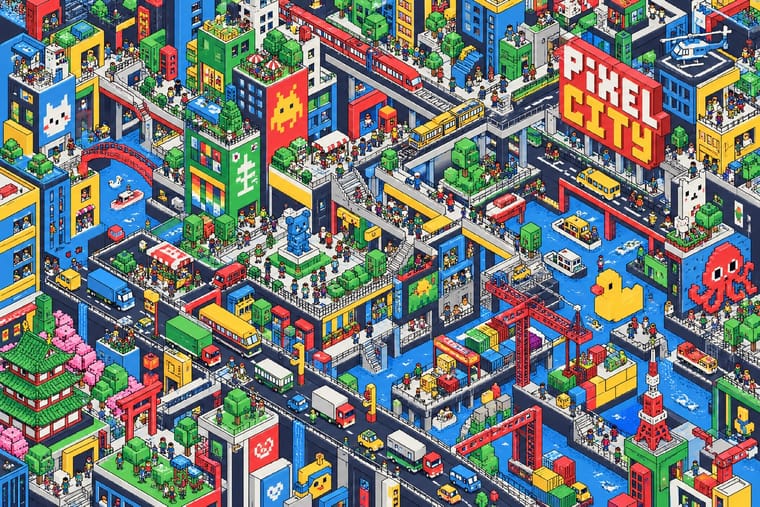
Pictures built by hand from single pixels in a 2:1 dimetric 'isometric' projection, made as posters, prints, covers and web graphics rather than as game screens. Its signature is eBoy's Pixorama: a dense, toy-like city of modular buildings, cars, billboards, brand logos and tiny figures packed edge to edge in flat, saturated colour. Habbo Hotel's furnished pixel rooms, though a game world themselves, set off a wide amateur practice of isometric pixel rooms and dioramas made as pictures.
Make something in this style Get advice in this style Mix it with another style
01
How it works
- Draw every receding line on the 2:1 pixel step (about 26.6 degrees), so the whole picture sits on one tilted grid with no vanishing point.
- Place each pixel by hand in flat, saturated colour, with hard outlines and one lit and one shaded tone per face instead of gradients.
- Pack the field edge to edge with buildings, vehicles, signs and tiny figures, so the eye wanders with no single focal point.
- Assemble scenes from a reusable library of drawn modules (eBoy's holds more than 5,000) and recombine them like a construction kit.
- Stock the city with brand logos, ads and pop-culture props, and treat consumer culture as a toy town with an ironic wink.
- Or isolate one furnished room, building or diorama on a plain ground, cut out along its 2:1 edges like a model on a tabletop.
Berlin: the pixel studio eBoy (Kai Vermehr, Steffen Sauerteig, Svend Smital; founded 1997 (Dezeen gives 1998), with Peter Stemmler in New York by 2001), whose isometric Pixoramas began in 1998; spread through the Finnish virtual world Habbo Hotel (Sulake; launched as Hotelli Kultakala, August 2000) and pixel-art web communities. The projection comes from games such as Zaxxon (1981), Knight Lore (1984) and SimCity 2000 (1994)
02
Its design choices
From Stylogeny’s vocabulary of design choices: defining choices make the style, characteristic ones are usual, occasional ones turn up now and then.
- Layout & composition
- Space & hierarchy
- Typography
- Colour
- Form & shape
- Surface & texture
- Imagery
- Medium & production
- Tone & intent
- Avoids
- Gradients, Gloss & highlights, Chrome & 3D render, Painterly brushwork, Generous white space, Straight photography, 3D render, Biomorphic curves, Whiplash line, Script
Palette
-
#f2f2ee -
#26263a -
#e8413c -
#ffc933 -
#3d8fe0 -
#4dbb5a
Typefaces
-
Hand-pixelled lettering drawn into the scene
shop signs, billboards and brand logos sheared onto the 2:1 planes of the buildings, as in eBoy's Pixoramas
-
Small bitmap fonts for captions and navigation beside the picture, such as Silkscreen (Jason Kottke), a typeface for web graphics where extremely small display type is needed (a working recommendation: the style has no settled typeface)
Known for
-
eBoy, Pixoramas
detailed isometric city panoramas, more than 20 since 1998, among them Berlin, London, Los Angeles, New York, Paris, Rio, San Francisco and Tokyo
-
eBoy, eCity London for Paul Smith, used as a fabric print on bags, T-shirts and shoe linings
2004
-
eBoy, monthly cover for the online magazine SHIFT
February 2001
-
eBoy, Hello (Laurence King, 2002) and Pixorama (eBoy, 2008), books
-
eBoy in Game Over, Museum für Gestaltung Zürich (1999), and Drones of New York, Museum of the Moving Image, New York
2013
-
Habbo Hotel (Sulake; launched as Hotelli Kultakala, August 2000), whose rooms and furniture inspired a great amount of fan-made isometric pixel art (Wikipedia, Pixel art)
-
Precedents in games
Zaxxon (1981), Knight Lore (ZX Spectrum, 1984) and SimCity 2000 (1994)
03
Make something in this style
Say what you need, and Stylogeny’s image studio draws it from Isometric Pixel Art’s design choices and checks it against them. It takes about a minute, and you get a link to share.
04
Where it comes from, and what it’s close to
Before it
The style it grew out of, and the styles it borrowed from.
After it
The styles that grew out of it.
No later style in the atlas grew out of it yet.
Alike in its design choices
Styles that make many of the same choices, related or not, besides those above.
-
-
- Yami-Kawaii (Sick-Cute) 55% alike
- Hong Kong Protest Art (Umbrella Movement to the 2019–20 Protests) 54% alike
- Indian Pop-Kitsch Design (Desi Kitsch) 54% alike
- Danmaku Bullet-Comment Overlay 49% alike
05
Often taken for
Isometric Pixel Art has no real works recorded yet, so these are its nearest styles by its choices alone, with the choices that tell them apart.
-
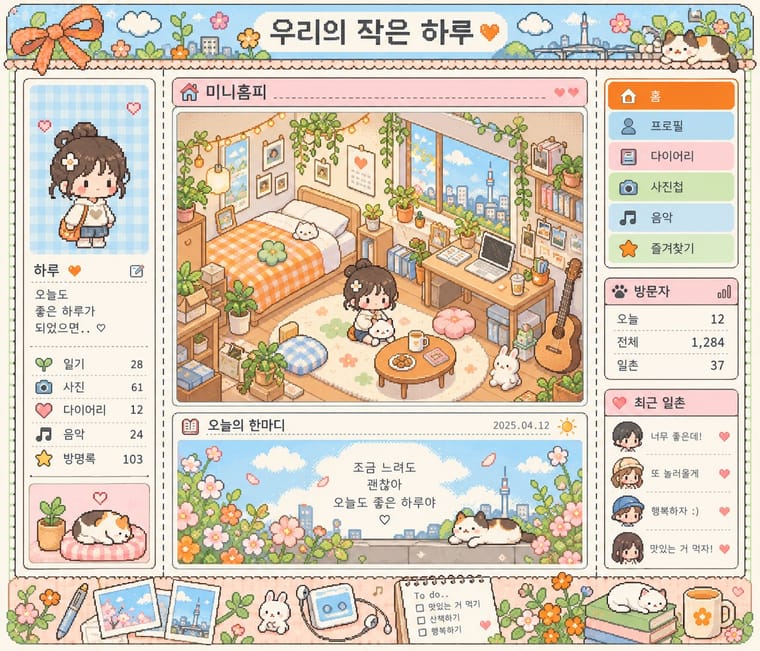
Cyworld Minihompy & Minimi (Korean Mini-Homepage Culture)
Cyworld Minihompy & Minimi is one of Isometric Pixel Art’s nearest styles by choices; no real work of either fits the other better.
Choices that tell Isometric Pixel Art and Cyworld Minihompy apart Choice Isometric Pixel Art Cyworld Minihompy Full bleed characteristic avoids Straight photography avoids defining All-over field defining — Framed panels — defining Bitmap & pixel defining occasional Both descend from Bitmap & Pixel Graphics in the family tree.
-
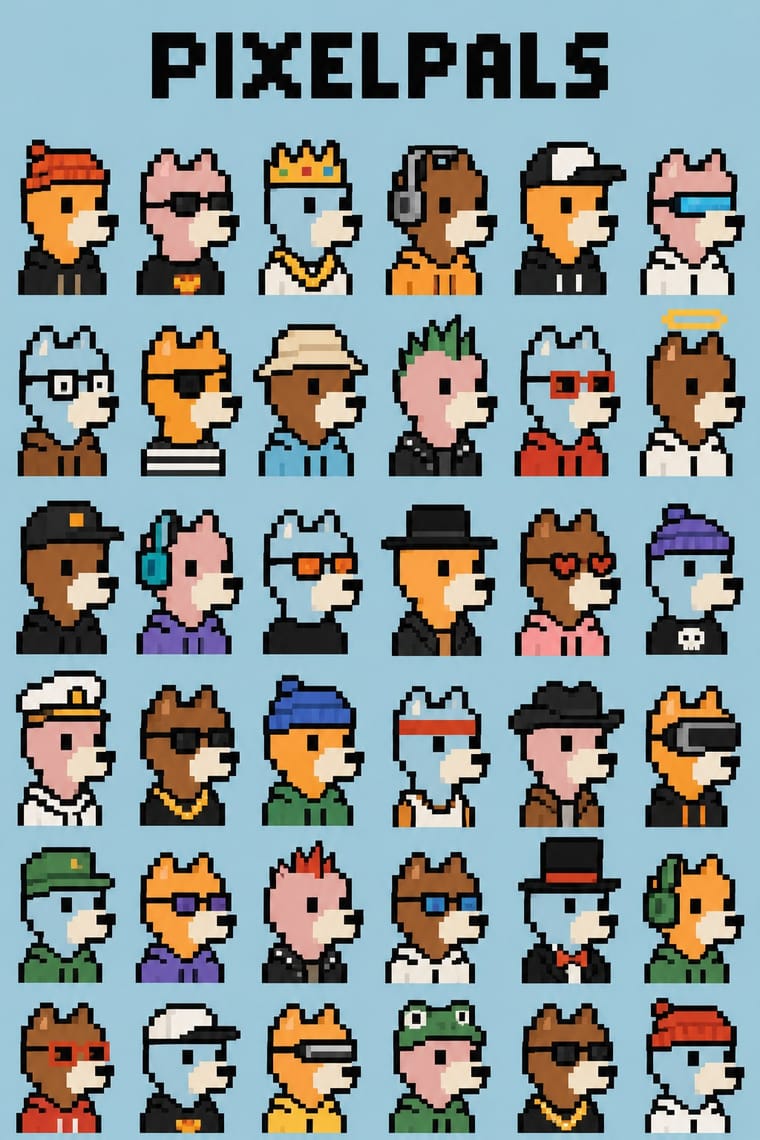
NFT Profile-Picture Collections (CryptoPunks to Bored Apes)
NFT Profile-Picture Collections is one of Isometric Pixel Art’s nearest styles by choices; no real work of either fits the other better.
Choices that tell Isometric Pixel Art and NFT Profile-Picture Collections apart Choice Isometric Pixel Art NFT Profile-Picture Collections All-over field defining — Generative imagery — defining Horror vacui defining — 3D render avoids occasional Illusion of depth defining — Both descend from Bitmap & Pixel Graphics in the family tree.
-
Yami-Kawaii (Sick-Cute)
Yami-Kawaii is one of Isometric Pixel Art’s nearest styles by choices; no real work of either fits the other better.
Choices that tell Isometric Pixel Art and Yami-Kawaii apart Choice Isometric Pixel Art Yami-Kawaii Full polychrome defining — Pastel — defining Rectilinear defining — Rounded & pill — defining Illusion of depth defining — No shared descent in the atlas: they reached these choices separately.
-
Hong Kong Protest Art (Umbrella Movement to the 2019–20 Protests)
Hong Kong Protest Art is one of Isometric Pixel Art’s nearest styles by choices; no real work of either fits the other better.
Choices that tell Isometric Pixel Art and Hong Kong Protest Art apart Choice Isometric Pixel Art Hong Kong Protest Art Rectilinear defining — Hand-lettering — defining Illusion of depth defining — Gradients avoids occasional Bitmap & pixel defining — No shared descent in the atlas: they reached these choices separately.
— means the choice isn’t among the style’s recorded choices. Critics recorded each work’s choices with the styles’ descriptions in view, so this shows whether the descriptions hold together, not proof that they are right.
06
Combine it with
Styles Isometric Pixel Art pairs well with or plays against, from the research. Each is worked out as a combination: which style gives the type, the colours and the forms.
- International Typographic Style Contrasts · Set a calm grotesque headline and white margin against a crowded pixel panorama to frame the chaos with order.
- Bitmap & Pixel Graphics Contrasts · Same hand-placed pixels, but front-on icons and sprites under hardware limits against a crammed, full-colour 2:1 city made as a picture.
- Isometric Tech Illustration Contrasts · Same tilted projection, opposite temper: sparse vector SaaS diagrams on white against a crammed, ironic pixel city.
- Superflat Pairs well · Both crowd a flat, saturated field with cute consumer figures and irony; add superflat's rounded characters to the pixel city for a denser pop dialogue.
- Cyworld Minihompy & Minimi (Korean Mini-Homepage Culture) Pairs well · Borrow a denser pixel diorama for the miniroom panel, but keep the profile frame, photos and friends' comments around it.
07
Sources
- Wikipedia, eBoy, en.wikipedia.org/wiki/EBoy
- Dezeen, eCity by eBoy (20 March 2007; an excerpt from Marcus Fairs, Twenty-First Century Design, Carlton Books), dezeen.com/2007/03/20/ecity-by-eboy/
- SHIFT (online magazine), eBoy (February 2001), shift.jp.org/en/archives/2001/02/eboy.html
- Wikipedia, Habbo, en.wikipedia.org/wiki/Habbo
- Wikipedia, Pixel art, en.wikipedia.org/wiki/Pixel_art
- Wikipedia, Isometric video game graphics, en.wikipedia.org/wiki/Isometric_video_game_graphics
- Jason Kottke, Silkscreen, kottke.org/plus/type/silkscreen/
How Stylogeny researches and checks a style: where the facts come from.