Digital native · 2001–2015 · East Asia
Cyworld Minihompy & Minimi (Korean Mini-Homepage Culture)
Also known as Minihompy, 미니홈피, Mini-homepage, Minimi (미니미), Miniroom (미니룸), Dotori items (도토리)
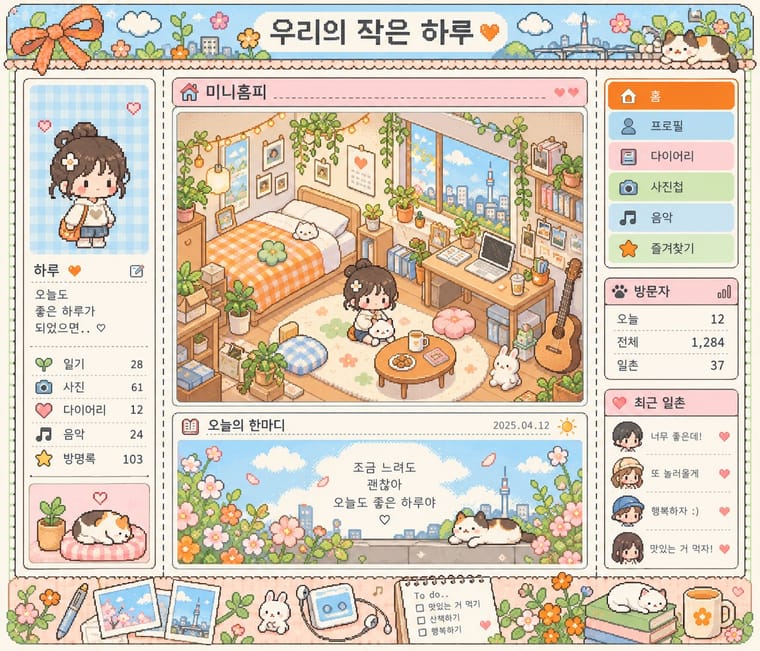
The personal mini-homepage of Korea's Cyworld: one fixed, framed template that every user decorated item by item with a paid currency of acorns (dotori). A title bar; a left column with profile photo, mood line and friend list; in the centre the miniroom, a small isometric room of bought pixel furniture where a small pixel-style avatar (the minimi) lives; a right-hand menu of tabs; and a visitor counter. Selfies, diary entries, guestbook notes and wistful captions made it, in Korean press words, the nation's collective diary and photo album.
Make something in this style Get advice in this style Mix it with another style
Use it with care
Cyworld, minihompy and minimi are trade names of a company that has relaunched the service: draw new avatars, rooms and frames rather than copying Cyworld's own items, logo or interface art. Real minihompys hold private people's selfies, diaries and comments; do not reproduce or scrape them as examples. The palette is an evocation of the pastel skins and light frames, not a sourced record of Cyworld's interface colours; the orange is unsourced.
01
How it works
- Keep every page inside the same small, framed window: title on top, profile column on the left, main panel in the centre, tab menu and visitor statistics on the right.
- Let the owner speak through bought items, not code: swap the background, banner, font, minimi clothes, room furniture and background music one purchase at a time.
- Put a tiny pixel-style avatar in a little isometric room of pixel furniture at the heart of the home view, as the owner's stand-in for visitors.
- Fill the panels with personal photographs, a diary and friends' short comments, written for close friends rather than the public.
- Make items temporary and cheap, so the page is redecorated with the seasons and the owner's moods.
Cyworld, Seoul, South Korea: a company founded on 1 September 1999 by members of a KAIST graduate-student club and absorbed into SK Communications on 2 August 2003. A 2001 minihompy project turned it from a club service into personal homepages; Weekly Kyunghyang (2004) dates the minihompy's birth to September 2001, and it officially launched in September 2002. On 7 October 2015 the minihompy was merged with the blog into Cyhome (싸이홈), which ends the period; a retro relaunch followed in October 2018.
02
Its design choices
From Stylogeny’s vocabulary of design choices: defining choices make the style, characteristic ones are usual, occasional ones turn up now and then.
- Layout & composition
- Space & hierarchy
- Typography
- Colour
- Surface & texture
- Ornament
- Imagery
- Medium & production
- Tone & intent
- Avoids
- Dark ground, Fluorescent & neon, Glitch, Chrome & 3D render, Generous white space, Rebellious & subversive, Authoritative & institutional, Full bleed
Palette
-
#fbf7ee -
#f58220 -
#a9cfe8 -
#f5c6d3 -
#c9e3b3 -
#5b5b5b
Typefaces
-
Gulim (굴림), the default Korean Windows system face of Korean web pages
-
Dotum (돋움), the companion Korean system sans
-
Decorative Hangul fonts bought as minihompy items with dotori
Known for
-
Cyworld minihompy home page (from 2002)
title, left column with photo, self-introduction and friend list, centre with recent posts, minimi, miniroom and friends' comments (ilchonpyeong), right-hand menu of profile, board, photo album, diary and guestbook, far-right counter of visitors, scraps and gifts
-
Isometric minirooms furnished with bought pixel furniture and wall paintings and inhabited by the minimi, whose hair, face and outfit were styled with paid items (isometric view and pixelated furniture: English Wikipedia; paid styling: Lady Kyunghyang, 1 August 2003)
-
Paid minihompy items bought with dotori (acorns, 100 won each)
background screens, banners, fonts and background-music tracks, most of them time-limited
-
Rival minihompy services from Buddy Buddy, MSN, Dreamwiz and Nexon, which Weekly Kyunghyang (10 June 2004) called a 'warring states era'
-
Cyworld's foreign versions, among them the United States (2006 to February 2010) and China
from 2005
-
'Mini Life' (July 2008), a 3D virtual community reached through a new tab beside the miniroom, with about 650 3D items at launch
-
The October 2018 redesign that brought back the guestbook, minimi, minihompy and diary with an old-days sensibility
-
The 2025 'pixel minimi' trend of pixel-style avatars composited onto one's own photos, recalling the Cyworld era
Hankyung, 7 July 2025
03
Make something in this style
Say what you need, and Stylogeny’s image studio draws it from Cyworld Minihompy & Minimi (Korean Mini-Homepage Culture)’s design choices and checks it against them. It takes about a minute, and you get a link to share.
04
Where it comes from, and what it’s close to
Before it
The style it grew out of, and the styles it borrowed from.
After it
The styles that grew out of it.
No later style in the atlas grew out of it yet.
Alike in its design choices
Styles that make many of the same choices, related or not, besides those above.


05
Often taken for
Cyworld Minihompy & Minimi has no real works recorded yet, so these are its nearest styles by its choices alone, with the choices that tell them apart.
-
Japanese Dense Web Design
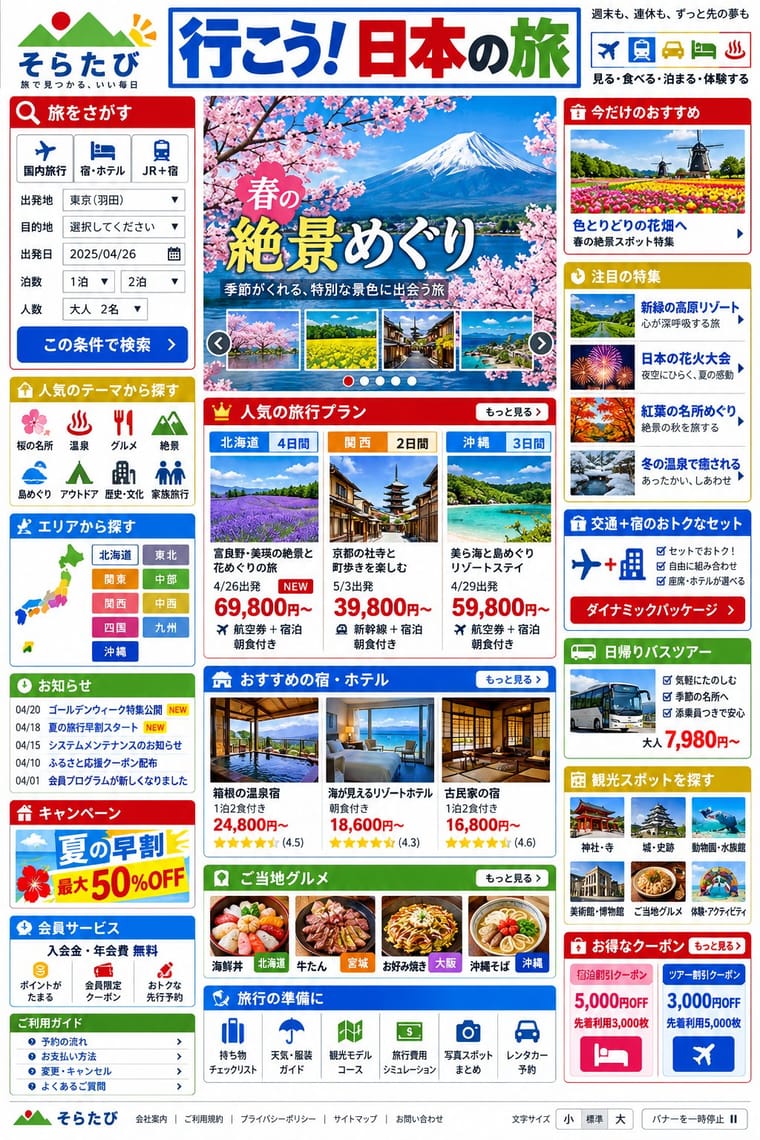
Japanese Dense Web Design is one of Cyworld Minihompy & Minimi’s nearest styles by choices; no real work of either fits the other better.
Choices that tell Cyworld Minihompy and Japanese Dense Web Design apart Choice Cyworld Minihompy Japanese Dense Web Design Isolated object characteristic avoids Rules & bars — characteristic Stylised figuration defining — Grotesque & neo-grotesque — characteristic Pastel characteristic — Both descend from Early Web Vernacular in the family tree.
-
Isometric Pixel Art
Isometric Pixel Art is one of Cyworld Minihompy & Minimi’s nearest styles by choices; no real work of either fits the other better.
Choices that tell Cyworld Minihompy and Isometric Pixel Art apart Choice Cyworld Minihompy Isometric Pixel Art Straight photography defining avoids Full bleed avoids characteristic Framed panels defining — All-over field — defining Light ground defining occasional Both descend from Bitmap & Pixel Graphics in the family tree.
-
Kawaii Design
Kawaii Design is one of Cyworld Minihompy & Minimi’s nearest styles by choices; no real work of either fits the other better.
Choices that tell Cyworld Minihompy and Kawaii Design apart Choice Cyworld Minihompy Kawaii Design Straight photography defining — Fluorescent & neon avoids occasional Framed panels defining — Rounded & pill occasional defining Rectilinear characteristic — No shared descent in the atlas: they reached these choices separately.
-
Purikura Photo-Sticker Decoration
Purikura Photo-Sticker Decoration is one of Cyworld Minihompy & Minimi’s nearest styles by choices; no real work of either fits the other better.
Choices that tell Cyworld Minihompy and Purikura Photo-Sticker Decoration apart Choice Cyworld Minihompy Purikura Photo-Sticker Decoration Stylised figuration defining — Collage & layering — defining Flat fields characteristic — Fluorescent & neon avoids occasional Rectilinear characteristic — No shared descent in the atlas: they reached these choices separately.
— means the choice isn’t among the style’s recorded choices. Critics recorded each work’s choices with the styles’ descriptions in view, so this shows whether the descriptions hold together, not proof that they are right.
06
Combine it with
Styles Cyworld Minihompy & Minimi (Korean Mini-Homepage Culture) pairs well with or plays against, from the research. Each is worked out as a combination: which style gives the type, the colours and the forms.
- Isometric Pixel Art Pairs well · Borrow a denser pixel diorama for the miniroom panel, but keep the profile frame, photos and friends' comments around it.
- International Typographic Style Contrasts · Neutral grid and objective type against a page made of bought ornaments, pastel skins and a cute avatar.
- Japanese Dense Web Design Contrasts · Both pack framed panels onto one screen, but the Japanese portal informs strangers while the minihompy decorates one person's page for friends.
- Newtro (Korean New-Retro) Pairs well · Two Korean nostalgia currents: pair a framed minihompy layout with newtro's flat hand-lettered emblems for a 2000s throwback.
07
Sources
- Wikipedia: 'Cyworld' (https://en.wikipedia.org/wiki/Cyworld: EC club of KAIST students, August 1999; minihompy officially launched 9 September 2002; miniroom as a decorative room with virtual furniture, minirooms as apartment-like spaces in an isometric projection, pixelated furniture among the virtual goods; minime avatar; one dotori costs 100 won; background skins and songs bought with acorns; ilchon; US 2006 to February 2010; China from 2005)
- Korean Wikipedia: '싸이월드' (https://ko.wikipedia.org/wiki/싸이월드: company founded 1 September 1999 by EBIZ club members from KAIST; absorbed into SK Communications 2 August 2003; 2001 minihompy project turning the club service into personal homepages; minihompy and blog merged into 싸이홈 on 7 October 2015; 10 million members in 2004; background, fonts, banners and background music as items, most of them time-limited; ilchon rules)
- Korean Wikipedia: '미니홈피' (https://ko.wikipedia.org/wiki/미니홈피: small, cute (아기자기한) design and interface; layout of title, left photo, self-introduction and friend list, centre with minimi, miniroom and ilchonpyeong, right menu, far-right visitor and gift counter; items of background screen, minimi clothes, room interior, music, banners and fonts; October 2018 retro redesign)
- 'Tech Talk: Cyworld Key Features', Emergic, 21 November 2006 (https://emergic.org/2006/11/21/tech-talk-cyworld-key-features/: title and four main areas; miniroom where the mini-me lives; background music, banners and fonts bought with dotori; visitor statistics window)
- Lady Kyunghyang, 1 August 2003 (https://lady.khan.co.kr/finance/article/3268: minimi hair, face and outfit styled with paid items; the miniroom as a small room; background music as a paid item; Cyworld's jukebox for saving songs, 350 won a song)
- Weekly Kyunghyang, '지금 대한민국은 싸이에 접속 중', 10 June 2004 (https://weekly.khan.co.kr/article/7413: the minihompy born in September 2001 (미니홈피가 탄생한 것이 2001년 9월); dotori at 100 won; rival minihompys from Buddy Buddy, MSN, Dreamwiz and Nexon)
- Money Today, 19 October 2019 (https://www.mt.co.kr/tech/2019/10/19/2019101809525629656: skins, background music, minimi and miniroom as paid decorating items; dotori at 100 won; profile pictures, greetings and mood icons mixing 'gamseong' and showiness)
- Korea JoongAng Daily, 'Cyworld reopening excites some…', 21 July 2021 (https://www.koreajoongangdaily.com/lifestyle/cyworld-reopening-excites-some-but-leaves-others-worried-about-what-will-resurface/11270039: the miniroom as the front page; minihompys as the nation's collective diary and photo album; selfies with cheesy captions; peak of about 32 million users in 2009)
- Etoday, 8 July 2008 (https://www.etoday.co.kr/news/view/173684: 'Mini Life' 3D community launched via a tab beside the miniroom, about 650 3D items)
- Hankyung, 7 July 2025 (https://www.hankyung.com/article/2025070728427: the 2025 'pixel minimi' trend of pixel-style minimi characters (픽셀풍 미니미 캐릭터) composited onto one's own photos, recalling the Cyworld era)
- Korean Wikipedia: '굴림체' (https://ko.wikipedia.org/wiki/굴림체: Gulim preinstalled with Korean Windows 3.1 in 1992 alongside Batang and Dotum; still paired with Malgun Gothic in web font stacks for layout safety)
How Stylogeny researches and checks a style: where the facts come from.