Tone & intent · Reason
Technological & futurist
Speed, machines, progress and the future.
A design choice in Stylogeny’s vocabulary, under tone & intent: what should the work make people feel or do?
- styles make it
- 64
- as a defining choice
- 13
- as a usual one
- 26
- now and then
- 25
- avoid it
- 2
Styles defined by it 13
For these styles it is one of the choices that make the style.
- Italian FuturismLaunched by Marinetti's 1909 manifesto, Futurism glorified speed, machines, the city and war, and turned the printed page into an explosive, noisy field.
- Estridentismo (Stridentist) GraphicsMexico's first avant-garde (1921-27), launched when Manuel Maples Arce pasted his manifesto Actual No. 1 on Mexico City walls.
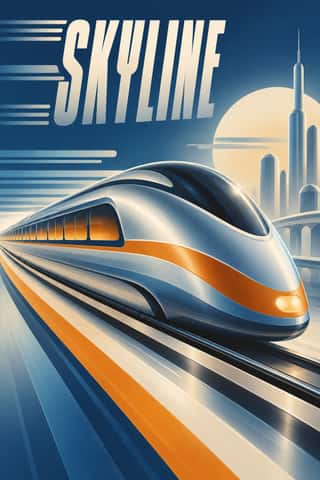
Streamline ModerneThe late, chiefly American phase of Art Deco, in which aerodynamic science became a visual language for a Depression-era culture hungry for progress.
Googie & Atomic AgeThe exuberant commercial modernism of post-war American roadside culture (coffee shops, motels, car washes, bowling alleys and neon signs), named in 1952 by critic Douglas Haskell after John Lautner's Googie's coffee shop in Los Angeles (1949).
- Machine-Age Simplified Arabic TypeArabic redrawn for the machine rather than the reed pen.
Roman-like Thai Typography (modern loopless Thai)A Thai type genre that drops the head loops of most Thai letters, so the script reads as an even sans like Helvetica.
Métal hurlant Science-Fiction Comics (Mœbius, Druillet & Les Humanoïdes Associés)The adult science-fiction comics of Métal hurlant, the Paris magazine founded in 1974 by Mœbius, Philippe Druillet, Jean-Pierre Dionnet and Bernard Farkas.
Bitmap & Pixel GraphicsGraphics and lettering built from the square pixels of low-resolution screens (arcade and console sprites, home-computer displays and the first graphical user interfaces), where every dot was placed by hand within tight limits of memory, resolution and palette.
Demoscene Graphics (Cracktros, Demos & Text-Mode Art)The graphics of the demoscene, a mainly European community of coders, graphicians and musicians that grew from the intros software crackers added to pirated Commodore 64 and Amiga games in the mid-1980s.
Techno-Futurist GraphicsElectronic-music and video-game graphics of the late 1980s and 1990s that turned corporate modernism into a sci-fi consumer fantasy.
Y2K FuturismThe optimistic, chrome-plated vision of the future that surrounded the turn of the millennium, spread by consumer electronics, music videos, games, fashion and dot-com branding.
Fantasy User Interface (FUI) & Sci-Fi HUDFantasy user interfaces are the screen graphics of films and series: computer screens, holograms and helmet HUDs made to be watched for a few seconds, not used.
Dark Tech MinimalismThe dark, restrained aesthetic of developer tools and SaaS landing pages since about 2019: near-black grounds, grey type ramps, a neutral grotesque such as Inter, hairline borders, soft radial glows and bento grids of crisp product screenshots.
Styles that often use it 26
A characteristic choice: usual in these styles, though not essential.
Art DecoThe glamorous modern style named after the 1925 Paris Exposition des Arts Décoratifs, which disciplined ornament into geometry: sunbursts, chevrons, stepped forms and sleek stylised figures rendered in lacquer-smooth colour with metallic accents.
- Vorticism & BLAST TypographyLondon's short-lived rival to Futurism, launched by Wyndham Lewis with BLAST (dated 20 June 1914; War Number, July 1915).
- Russian ConstructivismConstructivism rejected art for art's sake in favour of the artist-engineer building useful things for the new Soviet society.
- BauhausThe German school founded by Walter Gropius in 1919 moved from Expressionist craft ideals to a programme of 'art and technology' after 1923, when Moholy-Nagy, Herbert Bayer and Joost Schmidt made its printing and advertising workshops a laboratory for functional communication.
- MavoTokyo's anarchist avant-garde, founded in July 1923 by Murayama Tomoyoshi, back from a year in Berlin, with four former Futurists, and its magazine MAVO (seven issues, July 1924 to August 1925).
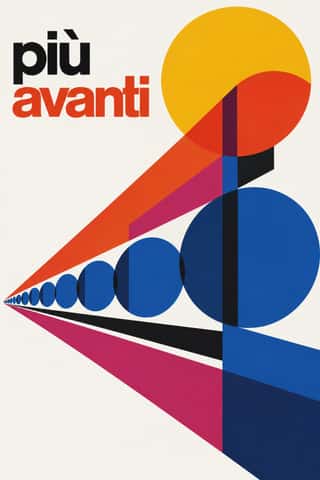
Milanese Industrial Modernism (Olivetti, Pirelli, Studio Boggeri)The Milan-centred school that married Bauhaus- and Swiss-trained discipline with Italian painterly wit for enlightened industrial patrons such as Olivetti, Pirelli and La Rinascente.
- Nippon Kōbō & Tōhōsha Photo-Propaganda Magazines (NIPPON & FRONT)Luxury photo-propaganda magazines that imperial Japan sent abroad, 1934–45.
HfG Ulm Systematic DesignThe Hochschule für Gestaltung Ulm (1953–1968) was founded as the successor to the Bauhaus.
Polish Cold War Neon (PRL Neonisation)The neon of People's Poland: after the 1956 thaw a state firm, Reklama, and a planned 'neonisation' set out to make war-ruined Warsaw a European capital of neon.
Thaw Modernism (Soviet and Czechoslovak)The light, stylised modernism that replaced Socialist Realist illusionism and Stalinist pomp in Soviet and Czechoslovak graphic and applied design, from the 1956 Secret Speech, the 1957 Moscow youth festival and Expo 58 to the crushing of the Prague Spring in 1968 (a political cut-off; the manner ran on into the 1970s).
Op Art GraphicsA 1960s style that turned perceptual research into graphic effect: precisely drawn lines, checks, concentric rings and modular grids, usually black and white or complementaries of equal value, that seem to vibrate, swell or move.
Total Design & Dutch FunctionalismThe Dutch strand of systematic modernism took shape when Wim Crouwel, Benno Wissing, Friso Kramer and Paul and Dick Schwarz founded Total Design in Amsterdam in 1963 as the country's first multidisciplinary studio.
Soviet Central Asian Ornamental ModernismThe monumental art of Soviet Central Asia after the 1966 Tashkent earthquake: a strand of Socialist Realism mixed with Islamic and national ornament.
Afrofuturist DesignA visual language of Black futures that fuses African and diasporic iconography (pyramids and ankhs, Adinkra and Nsibidi glyphs, textile patterning) with spacecraft, cosmic fields and technology.
Emigre & Early Digital TypeRudy VanderLans and Zuzana Licko's magazine and type foundry, launched in 1984 alongside the first Macintosh, turned the computer's low-resolution constraints into a new typographic idiom.
Rave & Acid House GraphicsThe pocket-sized promotional art of acid house, rave and early techno, handed out in record shops and car parks to advertise all-night parties.
- Frutiger AeroThe glossy, optimistic look of consumer technology from the mid-2000s to the early 2010s, retrospectively named in 2017 by the Consumer Aesthetics Research Institute after Windows Vista's Aero interface and Adrian Frutiger's humanist sans.
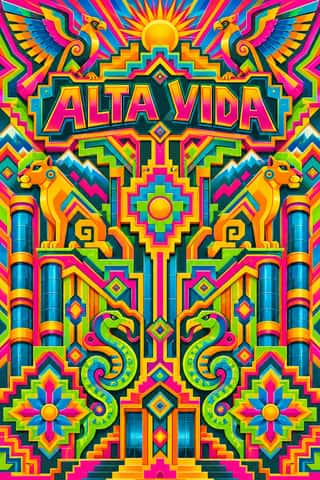
Neo-Andean Architecture (Cholets)The facades and party halls of El Alto, Bolivia, begun by the Aymara builder-architect Freddy Mamani in 2005 for a new Aymara merchant class.
Synthwave / OutrunThe retro-futurist look of synthwave music: a 1980s revival that grew from mid-2000s French electro and online synth scenes, took its other name from Sega's arcade racer Out Run (1986) and reached the mainstream with Drive (2011).
Generative & Dynamic IdentitiesIdentity systems designed as rules rather than fixed marks: logos and graphics generated by code, data or parameters so that they vary endlessly while staying recognisable.
Low Poly IllustrationA digital illustration and game look in which subjects are built from a visible mesh of a few flat-shaded polygons, so that animals, faces, vehicles and landscapes read as hard-edged facets with no outline or texture.
SolarpunkHopeful eco-futurist imagery born online.
Acid Graphics / New UglyA late-2010s club and poster style that updates 1990s rave graphics with modern 3D tools: liquid-chrome and melting lettering, neo-tribal spikes, wireframes, op-art patterns and acid-green palettes on black, mixed with blackletter and stretched grotesques.
Kinetic Typography & Variable TypeTypography as the moving image: letterforms that stretch, squash, rotate and morph along variable-font axes, loop seamlessly and cut to the beat of music, used for identities, social-media posters and digital out-of-home screens.
NFT Profile-Picture Collections (CryptoPunks to Bored Apes)Sets of thousands of avatar portraits that code assembles from one or two hundred hand-drawn traits, each sold as a token on a blockchain.
GlassmorphismAn interface style of translucent, frosted panels floating over vivid, blurred backgrounds, so that depth and hierarchy come from layered transparency.
Styles that use it now and then 25
An occasional choice in these styles.
- London Transport Design1908–1966
- Suprematism1915–1925
- Italian Fascist Graphics (Romanità & Exhibition Photomontage)1921–1943
- Brazilian Modernismo Graphics (Klaxon and the Semana de 22)1922–1929
- Czech Poetist Book Design (Devětsil)1922–1938
- Leningrad Avant-Garde Picture Book1922–1936
- Die Neue Typographie1923–1940
- Ligne Claire (Franco-Belgian Clear Line)1929–present
- American Four-Colour Comic Book (Golden to Bronze Age)1934–1993
- Story Manga (Postwar Japanese Comics)1947–present
- Corporate Identity Modernism1955–1990
- Di Tella Graphic Design (Instituto Torcuato Di Tella)1960–1970
- Mexico 68 Olympic & Metro Identity1966–1970
- Picó Sound-System Painting (Colombian Caribbean)1967–present
- Hipgnosis Photographic Concept Sleeve1968–1983
- Pop Achorado (Peruvian Agrarian Reform Posters)1969–1975
- Early Web Vernacular1994–2004
- Glitch Art & Datamosh Graphics2001–present
- Contemporary Arabic & Dual-Script Type Design2004–present
- Flat Design2010–2016
- Analog Horror Graphics2015–present
- VTuber Avatar and Stream Graphics2016–present
- Neumorphism2019–2021
- Claymorphism & Soft 3D2020–present
- Generative-AI Image Aesthetic2022–present
It often goes with
Choices that the styles making it make more often than the atlas as a whole.
- Geometric sansin 28 of 64
- Illusion of depthin 33 of 64
- Geometric primitivesin 38 of 64
- 3D renderin 19 of 64
- Motion & broadcastin 23 of 64
- Gradientsin 29 of 64
Styles that avoid it
Styles that deliberately leave it out.