Digital native · 1995–present · East Asia
Purikura Photo-Sticker Decoration
Also known as Purikura, Print Club photo stickers, Rakugaki purikura, プリクラ落書き
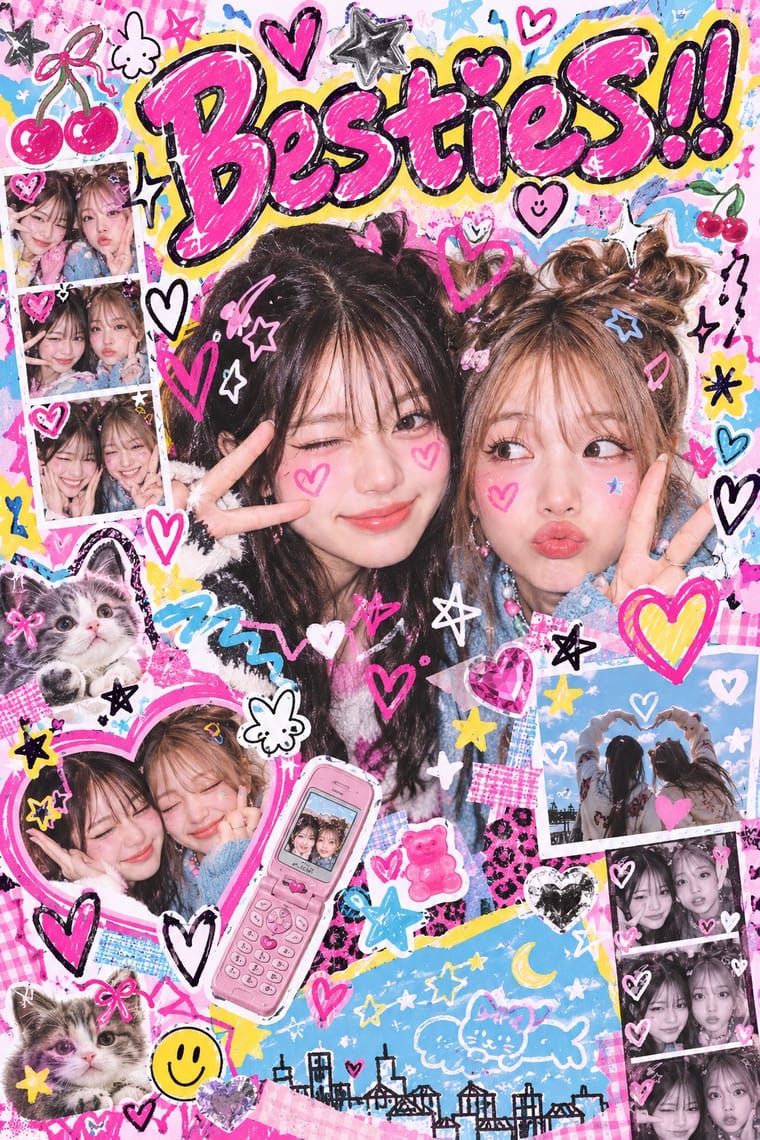
A participatory Japanese photo-sticker idiom: friends turn their portraits into keepsakes by layering freehand or supplied lettering, coloured pen marks, hearts, stars and decorative stamps over the photograph. The format began with Print Club in 1995; later booths added elaborate drawing and face-retouching tools. Unlike kawaii's drawn mascots, the photograph and its decoration remain central. This entry follows the decorated strand, not the undecorated portraits also made by contemporary booths.
Make something in this style Get advice in this style Mix it with another style
Use it with care
Treat participants as people with privacy and consent interests, not anonymous visual resources. Distinguish their own poses and annotations from manufacturer-supplied lettering, stamps and commissioned overlays; selecting an asset does not make it participant-authored. Obtain consent before reusing identifiable portraits, especially those of minors; use original or explicitly licensed portraits and decoration assets. Do not sexualise adolescent subjects or present eye enlargement and skin-lightening conventions as requirements for attractiveness or Japanese identity. Print Club and Purikura are associated with Sega trademarks, and commercial booth designs and stamps are not automatically free to reuse. The manufacturer sample images researched here have no verified open-file licences and should remain link-only if later entered as specimens.
01
How it works
- Start with a photograph of the participants, often a pair of friends; keep their faces recognisable beneath the decoration instead of replacing them with a drawn mascot.
- Write directly into the picture: add names, friendship declarations or short in-jokes in freehand pen lettering, outlined characters or selectable lettering stamps.
- Layer hearts, stars, sparkles and small decorative stamps around the heads and across the clothing; let words and ornaments share the photographic plane rather than reserving a separate caption strip.
- Pair pale or candy-coloured grounds with brighter pen accents; use multicoloured letters and contrasting outlines when a message needs to stand out against the photograph.
- Use the booth's retouching controls, where available, to adjust skin, eye size and makeup; treat this as a variable, period-dependent choice rather than a feature of every early sticker.
- Make the result shareable as a sticker sheet or saved image; repeat or group decorated frames without mistaking the sheet's production grid for a requirement inside every portrait.
Japan's amusement arcades. Sega and Atlus introduced Print Club in July 1995; its photo-sticker format is the starting point, not evidence that the first machine already offered every later drawing or face-retouching feature. This entry isolates the decorated, rakugaki idiom and its subsequent revivals, rather than all booth photography.
02
Its design choices
From Stylogeny’s vocabulary of design choices: defining choices make the style, characteristic ones are usual, occasional ones turn up now and then.
- Layout & composition
- Space & hierarchy
- Typography
- Colour
- Form & shape
- Surface & texture
- Ornament
- Imagery
- Medium & production
- Tone & intent
- Avoids
- Ornament-free, Typography only, Diagram & data, Non-representational, Rational & objective, Authoritative & institutional
Palette
-
#FFF8FC -
#F6A9CE -
#EC168C -
#66C9E8 -
#FFE252 -
#211825
Typefaces
-
Rakugaki freehand message lettering
participant-written Japanese names and friendship phrases, often mixed with Latin words and outlined pen strokes
-
Decorative lettering stamps
outlined, multicoloured friendship slogans and uchiwa-moji-style fan lettering, explicitly offered among Luvholi's font stamps
Known for
-
FuRyu, UP 'Mori no Kuma-san' Story Set completed sample sheet, published in the 27 April 2016 launch announcement
five photographic frames of two participants with illustrated woodland motifs, outlined sound-effect lettering and bear-face overlays. The manufacturer identifies the frames and stamps as automatically applied decorations, not participant-drawn marks
-
FuRyu, Luvholi decorated sample portraits (2024 launch release; machine released 19 September 2024), including the two-person portrait with fan goods, a fandom message, multicoloured hearts and yellow sparkles
-
REDFISH with FuRyu and Instagram, EVERFILM Instagram 15th-anniversary decoration designs (6 October 2025–5 January 2026), including the illustrated automatic-doodle overlay on a two-person photographic portrait
03
Make something in this style
Say what you need, and Stylogeny’s image studio draws it from Purikura Photo-Sticker Decoration’s design choices and checks it against them. It takes about a minute, and you get a link to share.
04
Where it comes from, and what it’s close to
After it
The styles that grew out of it.
No later style in the atlas grew out of it yet.
Alike in its design choices
Styles that make many of the same choices, related or not, besides those above.
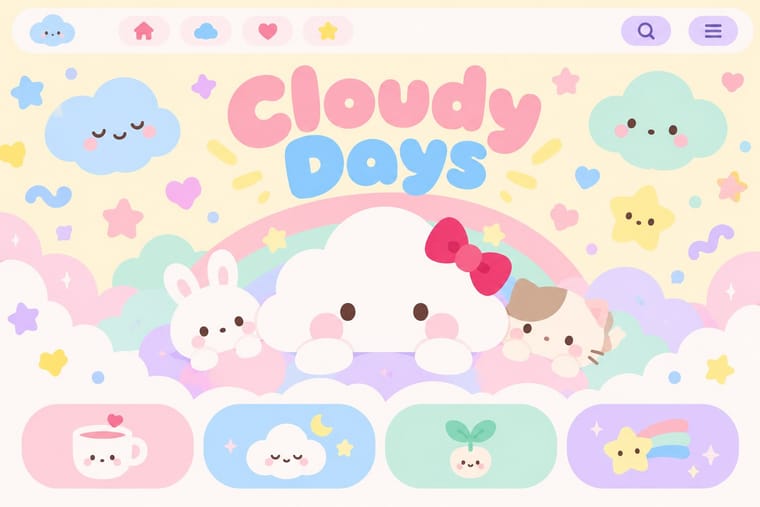
- 'Good Morning' Greeting Images (WhatsApp Forward Vernacular) 58% alike
-
- VTuber Avatar and Stream Graphics 48% alike
- Tamil Nadu Flex Banners 48% alike
-

-

05
Often taken for
Purikura Photo-Sticker Decoration has no real works recorded yet, so these are its nearest styles by its choices alone, with the choices that tell them apart.
-
'Good Morning' Greeting Images (WhatsApp Forward Vernacular)
'Good Morning' Greeting Images is one of Purikura Photo-Sticker Decoration’s nearest styles by choices; no real work of either fits the other better.
Choices that tell Purikura Photo-Sticker Decoration and 'Good Morning' Greeting Images apart Choice Purikura Photo-Sticker Decoration 'Good Morning' Greeting Images Modular grid occasional avoids Full bleed — defining Collage & layering defining occasional Single focal point occasional defining Abundant decoration defining occasional No shared descent in the atlas: they reached these choices separately.
-
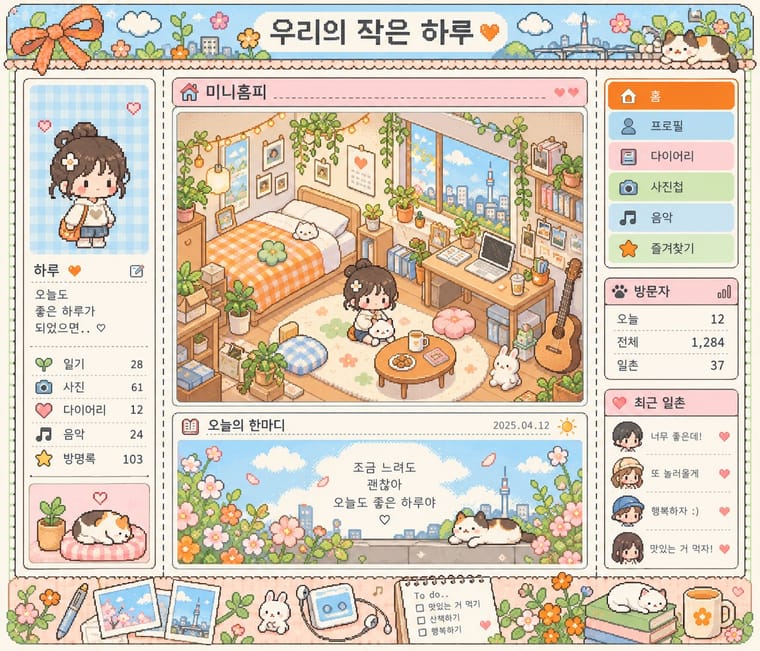
Cyworld Minihompy & Minimi (Korean Mini-Homepage Culture)
Cyworld Minihompy & Minimi is one of Purikura Photo-Sticker Decoration’s nearest styles by choices; no real work of either fits the other better.
Choices that tell Purikura Photo-Sticker Decoration and Cyworld Minihompy apart Choice Purikura Photo-Sticker Decoration Cyworld Minihompy Collage & layering defining — Stylised figuration — defining Fluorescent & neon occasional avoids Flat fields — characteristic Distortion & exaggeration characteristic — No shared descent in the atlas: they reached these choices separately.
-
VTuber Avatar and Stream Graphics
VTuber Avatar and Stream Graphics is one of Purikura Photo-Sticker Decoration’s nearest styles by choices; no real work of either fits the other better.
Choices that tell Purikura Photo-Sticker Decoration and VTuber Avatar and Stream Graphics apart Choice Purikura Photo-Sticker Decoration VTuber Avatar and Stream Graphics Straight photography defining avoids Stylised figuration — defining Abundant decoration defining — Layered information — defining Light ground characteristic — Both descend from Kawaii Design in the family tree.
-
Kawaii Design
Kawaii Design is one of Purikura Photo-Sticker Decoration’s nearest styles by choices; no real work of either fits the other better.
Choices that tell Purikura Photo-Sticker Decoration and Kawaii Design apart Choice Purikura Photo-Sticker Decoration Kawaii Design Distortion & exaggeration characteristic avoids Stylised figuration — defining Straight photography defining — Rounded sans occasional defining Collage & layering defining — Purikura Photo-Sticker Decoration descends from Kawaii Design: a shared line, so the likeness is inherited.
— means the choice isn’t among the style’s recorded choices. Critics recorded each work’s choices with the styles’ descriptions in view, so this shows whether the descriptions hold together, not proof that they are right.
06
Combine it with
Styles Purikura Photo-Sticker Decoration pairs well with or plays against, from the research. Each is worked out as a combination: which style gives the type, the colours and the forms.
- Shōjo Manga (Japanese Girls' Comics) Pairs well · Borrow a small halo of flowers or sparkles to intensify a portrait's mood, but retain photographic faces and personal messages rather than turning the sticker into a drawn sequential story.
- Kawaii Design Contrasts · Keep the hearts and candy accents, but replace kawaii's self-contained drawn mascot with the participants' photograph and personally addressed lettering; the photo-plus-annotation relationship, not pink alone, defines this entry.
- Superflat Contrasts · Superflat's repeated drawn characters occupy a flattened cartoon field; keep photographic participants visibly distinct from the added doodles when using this decorated photo-sticker idiom.
07
Sources
- FuRyu, 30th-anniversary project announcement, 25 July 2025: https://www.furyu.jp/news/2025/07/puri30th/ . Identifies the first Print Club release as 25 July 1995. The 1995 start dates the format, not the invention of every later decorative tool.
- FuRyu, manufacturer chronology panel for 2003 onward, published with the 25 July 2025 anniversary release: https://static.furyu.jp/wp-content/uploads/2025/07/25094106/20250725_puri30th_img09.jpg . Whole panel and upper-left crop visually checked. Labels 花鳥風月 as 2003, names Namco (now Bandai Namco Entertainment), and describes nine themed worlds; also documents colourful pens and stamps, with decorated portrait samples along the lower timeline. The nearby phrase 'third' refers to the 美肌プロジェクト series, not a numeral in the product name. This is historical equipment context only: no particular lower-strip decorated portrait has been established as output from that machine, so the cabinet is not retained as a decorated-work exemplar.
- FuRyu, UP launch announcement, 27 April 2016: https://www.furyu.jp/news/2016/04/up.html . Announces a mid-July 2016 release and identifies the 'Mori no Kuma-san' completed Story Set sample, explaining that frames and stamps are applied automatically across five shots. Sample visually inspected at https://www.furyu.jp/wp-content/uploads/2016/04/up/6_sealimage.jpg : two participants recur in five photographic frames on a green sheet, with woodland drawings, outlined lettering and bear-face overlays. This specifically attributable decorated output replaces the 2003 cabinet exemplar; its 2016 date is the manufacturer's sample-publication year, not a claim that a personal session occurred on the sheet's printed sample timestamp. The image does not establish participant-drawn lettering. No open-file licence was confirmed; retain link-only treatment.
- FuRyu, Luvholi launch release, 22 August 2024: https://www.furyu.jp/news/2024/08/luvholi/ . Confirms the 19 September launch and coloured pens, stamps and fan-lettering font stamps. Decorated portrait visually checked at https://static.furyu.jp/wp-content/uploads/2024/08/17121034/20240822_Luvholi_img02.jpg . The message concerns fandom and favourite performers, not simply interpersonal friendship; the example extends the same portrait-plus-annotation structure into fan activity.
- FuRyu, EVERFILM and Instagram 15th-anniversary collaboration, 6 October 2025: https://www.furyu.jp/news/2025/10/instagram15th/ . Names REDFISH and dates the collaboration through 5 January 2026; distinguishes automatic doodle overlays, stamps and sheet designs. Sample visually checked at https://static.furyu.jp/wp-content/uploads/2025/10/03131559/20251006_Instagram15th_img02.jpg .
- Routledge, Introducing Japanese Popular Culture, student resources for Laura Miller's 'Purikura: Expressive Energy in Female Self-Photography': https://routledgetextbooks.com/textbooks/9781032298092/students.php . Confirms bibliography: Laura Miller, 'Graffiti Photos: Expressive Art in Japanese Girls’ Culture', Harvard Asia Quarterly 7(3), 2003, pp. 31–42. The full article was not examined, so this entry does not rely on unexamined passages for its genome or a direct shōjo-manga descent claim.
- Taxonomic interpretation: kawaii is the proposed broad parent, not a claim of documented technical invention or a named designer-to-designer transmission. Shōjo manga is retained as a compositional affinity only. Palette colours are representative design selections from the inspected examples, not historical ink standards. Genome weights describe the decorated strand: modular grids refer only to some output sheets, dense ornament and face distortion vary, and no exact first year for touchscreen drawing was confirmed. Medium.app-ui represents the interactive screen-based editing workflow, not a claim that the stickers were printed by a specific process. Southeast Asian regional coverage and the scout's early competitor dates were not independently established and are omitted. Sega's chronology was blocked by a browser challenge, and the puri.furyu.jp pages/PDFs returned maintenance errors; no claims depend on reading those inaccessible pages.


How Stylogeny researches and checks a style: where the facts come from.