Traditions & vernacular · c. 800–1150 · Northern Europe
Viking Age Animal Styles ( Borre, Jellinge, Mammen, Ringerike, Urnes )
Also known as Scandinavian animal ornament, Norse art styles, Urnes style, Ringerike style, Jelling style, gripping beast ornament
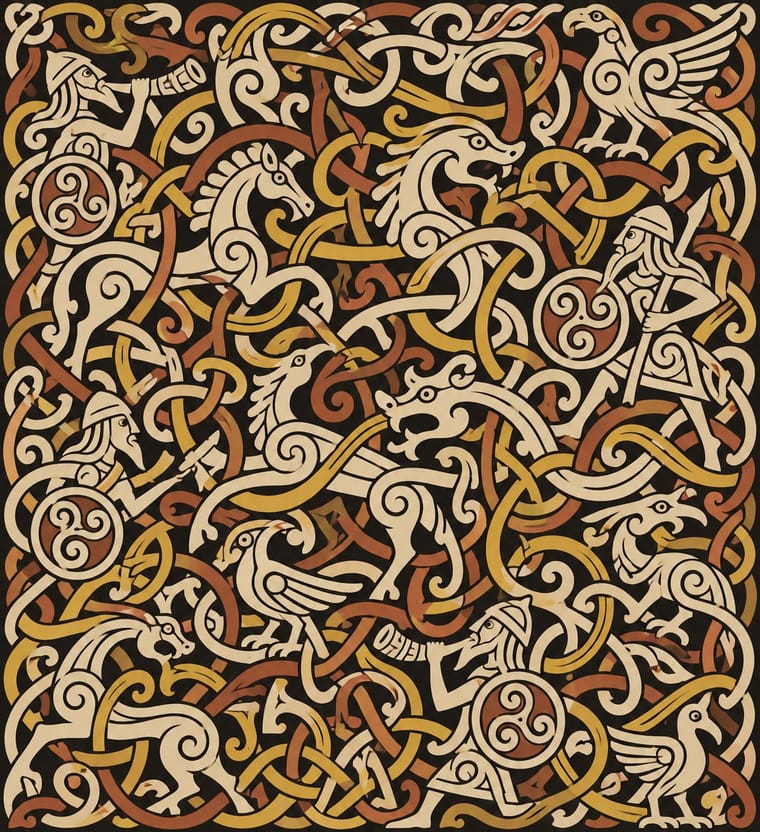
A sequence of Scandinavian ornament styles in which ribbon-bodied animals, birds and tendrils are woven into interlace and fitted tightly to metalwork, wood and rune-carved stone. Borre, Jellinge, Mammen, Ringerike and Urnes each reshape the same beast, and runic text often winds through the design as part of it. The tradition is historical Scandinavian craft of the Christianising era; modern Norse runes and Viking imagery are often co-opted by white-supremacist groups, so use them with care and context.
Make something in this style Get advice in this style Mix it with another style
01
Its picture in other colours
Change a colour and every picture on this page follows. It happens in your browser, from the same pictures: nothing new is made or saved.
Choose a colour to change it
-
#1c1a17 -
#d9cfb8 -
#8a6a3b -
#b8923a -
#7a3b2a
A faded colour isn’t in these pictures, so changing it changes nothing.
Light and dark stay where they are; greys hardly move.
More colours: any style’s, or your own
The pictures show the style’s own colours.
02
Make something in this style
Say what you need, and Stylogeny’s image studio draws it from Viking Age Animal Styles (Borre, Jellinge, Mammen, Ringerike, Urnes)’s design choices and checks it against them. It takes about a minute, and you get a link to share.
03
How it works
Palette
-
#1c1a17ink · 13% -
#d9cfb8accent · 10% -
#8a6a3bground · 25% -
#b8923aaccent · 28% -
#7a3b2aaccent · 21%
Shares measured from its picture. The ground is what the pictures sit on (of the colours covering most, the most neutral), the ink stands out from it most, the rest are accents.
Typefaces
-
Younger Futhark, Danish long-branch runes
-
Younger Futhark, short-twig runes
- Build the surface from animals whose ribbon-shaped bodies twist, grip and interlace.
- Fit the creature to its field so the beast, not a frame, decides the outline.
- Run lettering as a band that coils through the ornament and shares its line.
- Keep one line weight; set carved or inlaid line against its ground.
- Choose one phase's grammar and keep to it: pelleted birds (Mammen), axial tendrils (Ringerike) or slim looped animals with almond eyes (Urnes).
Scandinavia: a succession of ornament styles from the early 9th-century Oseberg phase to the Urnes style of the late 11th and early 12th century
Change it with an idea. Any of the 73 moves that make a design say something can go on this style.
04
Its design choices
From Stylogeny’s vocabulary of design choices: defining choices make the style, characteristic ones are usual, occasional ones turn up now and then.
- Layout & composition
- Space & hierarchy
- Colour
- Form & shape
- Surface & texture
- Ornament
- Imagery
- Medium & production
- Tone & intent
- Avoids
- Generous white space, Modular grid, Grotesque & neo-grotesque, Gradients, Fluorescent & neon, Gloss & highlights, Straight photography, Ornament-free, Rectilinear
How its pictures are made Drawn & painted, Systematic
Kind of picture: Drawn & painted · Systematic
Known for
-
Jelling stones
Jellinge style, 10th century
-
Mammen axe
felled winter 970-971; Mammen style
-
Urnes stave church carvings, Norway
Urnes style
-
Gilt-bronze harness mounts and brooches from Borre
Borre style
-
Vang Stone and Söderala weather-vane
Ringerike style, 11th century
-
Uppland runestones
Urnes style
05
Where it comes from, and what it’s close to
Borrowed from
Viking Age Animal Styles (Borre, Jellinge, Mammen, Ringerike, Urnes) c. 800–1150
No later style in the atlas grew out of it yet.
Alike in its design choices
06
Combine it with
Styles Viking Age Animal Styles (Borre, Jellinge, Mammen, Ringerike, Urnes) pairs well with or plays against, from the research. Each is worked out as a combination: which style gives the type, the colours and the forms.
- Norwegian and Finnish National Romantic Graphics (Munthe & Karelianism) Pairs well · Its dragon-style revival reuses Urnes and Ringerike beasts for flat decorative graphics.
- Gothic Blackletter & Fraktur Tradition Contrasts · Pen-built Gothic letters against carved, coiling runic bands: two northern traditions with opposite line logic.
- Extreme Metal Band-Logo Lettering Pairs well · Tangled, band-shaped lines bring a Norse register to illegible logo lettering.
- Icelandic Magical Staves (Galdrastafir) Contrasts · Animal styles are medieval carved interlace; staves are later, written, linear and have no animals, so do not blend them to make a Viking look.
07
Often taken for
Stylogeny checks the choices recorded in each of Viking Age Animal Styles’s 3 real works against all 702 styles. All 3 fit its own choices best, so these are its nearest styles by choices, with the choices that tell them apart.
-
Kōwhaiwhai & Toi Māori Design
Kōwhaiwhai & Toi Māori Design is one of Viking Age Animal Styles’s nearest styles by choices; no real work of either fits the other better.
Choices that tell Viking Age Animal Styles and Kōwhaiwhai apart Choice Viking Age Animal Styles Kōwhaiwhai Stylised figuration defining occasional Limited spot colours — defining Monochrome characteristic — Central symmetry occasional defining Icons & pictograms characteristic — No shared descent in the atlas: they reached these choices separately.
-
Black Orpheus, Mbari and Oshogbo Graphics
Black Orpheus, Mbari and Oshogbo Graphics is one of Viking Age Animal Styles’s nearest styles by choices; no real work of either fits the other better.
Choices that tell Viking Age Animal Styles and Black Orpheus, Mbari and Oshogbo Graphics apart Choice Viking Age Animal Styles Black Orpheus, Mbari and Oshogbo Graphics Whiplash line defining occasional Full polychrome — characteristic Icons & pictograms characteristic — Distortion & exaggeration — characteristic Organic flow characteristic — No shared descent in the atlas: they reached these choices separately.
-
Northwest Coast Formline Design
Northwest Coast Formline Design is one of Viking Age Animal Styles’s nearest styles by choices; no real work of either fits the other better.
Choices that tell Viking Age Animal Styles and Northwest Coast Formline Design apart Choice Viking Age Animal Styles Northwest Coast Formline Design Whiplash line defining — Limited spot colours — defining Floral & vegetal occasional avoids Central symmetry occasional defining All-over field defining occasional No shared descent in the atlas: they reached these choices separately.
-
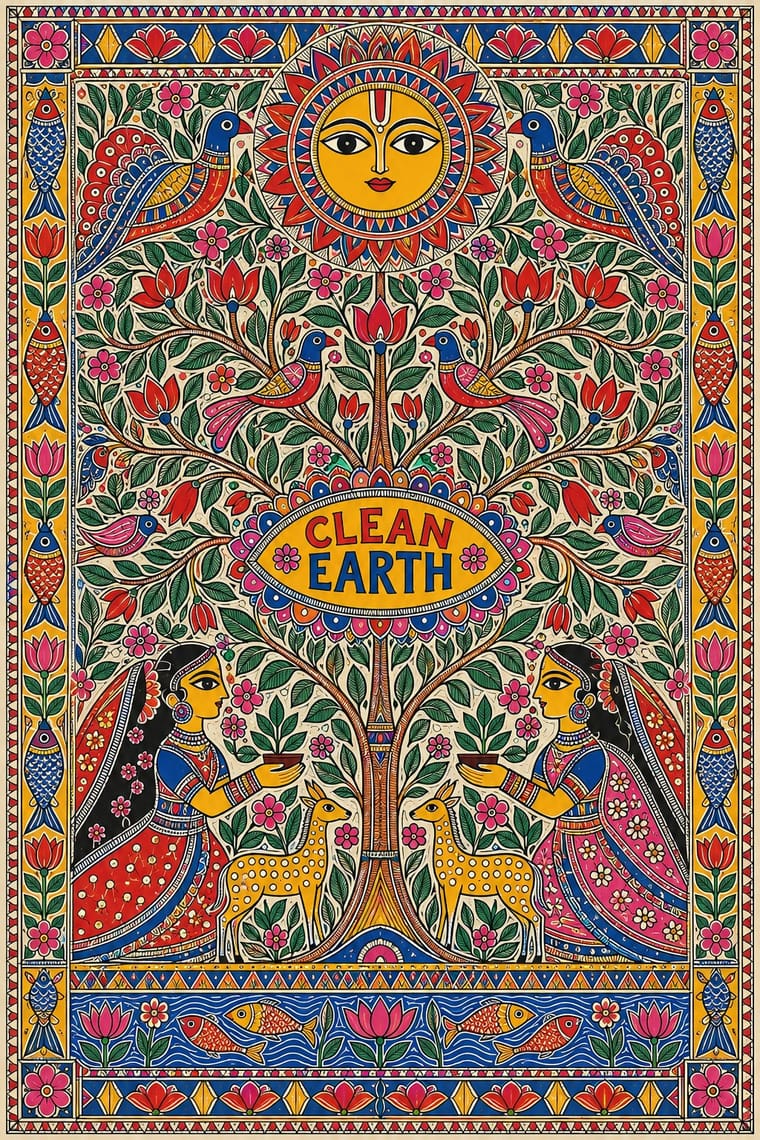
Mithila (Madhubani) Painting
Mithila Painting is one of Viking Age Animal Styles’s nearest styles by choices; no real work of either fits the other better.
Choices that tell Viking Age Animal Styles and Mithila Painting apart Choice Viking Age Animal Styles Mithila Painting Whiplash line defining — Full polychrome — defining All-over field defining occasional Light ground — characteristic Icons & pictograms characteristic — No shared descent in the atlas: they reached these choices separately.
— means the choice isn’t among the style’s recorded choices. Critics recorded each work’s choices with the styles’ descriptions in view, so this shows whether the descriptions hold together, not proof that they are right.
08
Real works
Artefacts in museums, libraries and archives that show the style, linked at their source.
- Mammen axe, bird-decorated face 10th century; deposited in winter 970–971 · National Museum of Denmark
- Urnes stave church, reused north-portal animal carvings (detail) 1070s; reused in the church built in the early 1130s · Urnes stave church, preserved in situ; photograph on Wikimedia Commons
- Söderala weather vane, front (recto) c. 1050 (stylistic dating) · Swedish History Museum (Statens historiska museum), Stockholm; photograph on Wikimedia Commons

09
Sources
- https://en.wikipedia.org/wiki/Viking_art
- https://en.wikipedia.org/wiki/Urnes_style
- https://en.wikipedia.org/wiki/Ringerike_style
1 more source
How Stylogeny researches and checks a style: where the facts come from.