Traditions & vernacular · c. 862–1800 · Middle East & North Africa, Eastern Europe
Armenian Manuscript Illumination
Also known as Armenian miniature painting, Armenian illuminated manuscripts, Cilician illumination
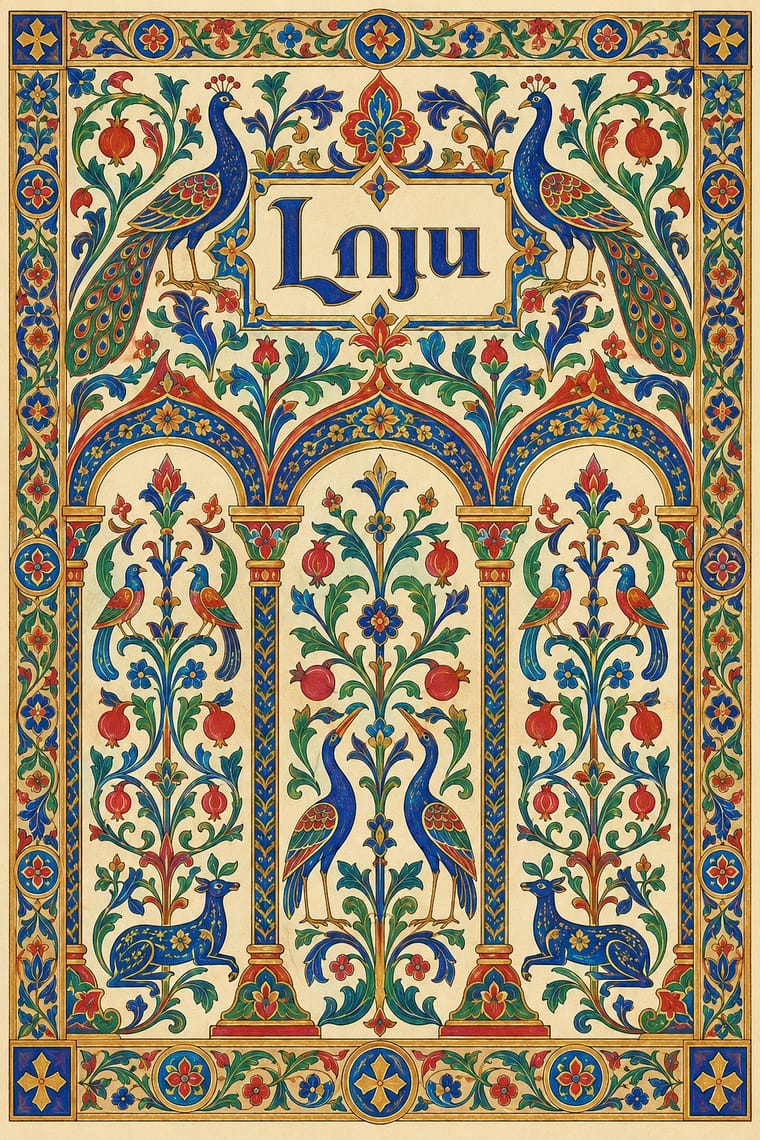
The illuminated books of the Armenian Church, from the Gospel of Queen Mlke (c. 862) and the Etchmiadzin Gospels (989) to the last manuscripts around 1800. A Gospel book opens with Eusebian canon tables under painted arcades whose arches and headpieces teem with vegetal and geometric ornament and perched birds. Text runs, usually in two columns, in erkatagir or bolorgir script, chapters open on letters built from birds and beasts, and birds, trees and crosses stand in the margins, in ultramarine, vermilion and gold on parchment.
Make something in this styleGet advice in this styleMix it with another style
Use it with care
These are Gospel books, lectionaries and Bibles of the Armenian Apostolic Church, and their crosses, evangelist symbols, portraits of Christ and the saints and holy names keep their sacred meaning; do not use them as texture, logos or decoration on trivial products. Armenian letter art, including ornamental letters made of birds, animals and people, is living heritage (UNESCO Representative List, 2019) practised by calligraphers, carpet weavers, embroiderers and jewellers, so commission or collaborate with Armenian artists rather than lifting motifs, and have any Armenian text written or checked by a fluent reader instead of assembling letters as pseudo-script. Manuscripts were seized, scattered or lost in the Armenian Genocide of 1915, the Zeyt'un Gospels among them (its canon tables were removed and sold to the J. Paul Getty Museum in 1994; a 2015 agreement acknowledged the Armenian Church as their owner while the leaves stayed at the Getty), and several of the scriptoria (Vaspurakan, Cilicia) now lie outside Armenia: credit the work as Armenian, naming its Byzantine models, and the Syriac ones of the earliest books, where they matter, and do not fold it into a generic 'Byzantine' or 'Oriental' style.
01
How it works
- Open the book with a run of canon tables: columns of section numbers set under painted arcades of columns and arches, later enclosed in a rectangular headpiece, in facing pairs that repeat the architecture with varied ornament. In the grander books, follow the canon tables with a gathering of full-page paintings (a cross, the Virgin, scenes from the life of Christ) before the text begins.
- Fill the arches, tympana and headpieces with vegetal scrolls and geometric ornament, perch peacocks, cranes, cocks and fabulous beasts on top, and in the densest books let the ornament crowd the tables themselves.
- Write the text, usually in two columns, in pen-written Armenian script, erkatagir uncials in the earlier books and rounded bolorgir from about the 13th century, and open each chapter and Gospel with a large initial built from birds, animals or the evangelist symbols.
- Frame the text pages with birds, fish, trees, crosses and floral motifs set in the margins beside the columns, and open each Gospel with a spread: the evangelist's portrait, usually seated before a writing stand, on the left-hand page, facing an incipit page under a rectangular or trilobed headpiece whose decoration carries his symbol.
- Paint in intense ultramarine, vermilion, green and gold on parchment, laying gold leaf behind figures in luxury books and imitating it with yellow paint in provincial ones.
- Let the figure style follow the school: elegant, finely drawn and classically proportioned in the Cilician court books, flat, frontal, round-faced and large-eyed in Vaspurakan.
Monastic and court scriptoria of Greater Armenia (Vaspurakan, Syunik, Gladzor, Tatev) and the Armenian Kingdom of Cilicia (Hromkla, Sis), later also Crimea, New Julfa and Constantinople
02
Its design choices
From Stylogeny’s vocabulary of design choices: defining choices make the style, characteristic ones are usual, occasional ones turn up now and then.
- Layout & composition
- Space & hierarchy
- Typography
- Colour
- Form & shape
- Surface & texture
- Ornament
- Medium & production
- Tone & intent
- Avoids
- Dynamic asymmetry, Full bleed, Ornament-free, Straight photography, Grotesque & neo-grotesque, Fluorescent & neon
Palette
#f0e6cf#1e3a8f#c0392b#c8a03a#2e7d5b#2b1e16
Typefaces
Erkatagir ('iron letters'), the uncial held to be Mesrop Mashtots's original form of the alphabet of 405, used for manuscript text from the 5th to the 13th century and still preferred for inscriptions
Bolorgir ('rounded letters'), a minuscule invented in the 10th century, widespread by the 13th and the standard printed form of Armenian since the 16th
Ornamental letters built from birds, animals, people and fabulous creatures (bird letters), and evangelist symbols shaped into the first letter of each Gospel in 13th-century Cilician workshops
Notrgir, a quicker minuscule widely used in diaspora manuscripts of the 16th to 18th centuries
Known for
Gospel of Queen Mlke (dated 851 or 862; San Lazzaro, Venice, MS 1144/86), named for the wife of King Gagik I of Vaspurakan, the 10th-century queen who had it restored, the oldest fully preserved Armenian illuminated manuscript
Etchmiadzin Gospels (Bgheno-Noravank, Syunik, 989; Matenadaran MS 2374), whose canon tables Carl Nordenfalk judged the best surviving example of the original Caesarean design
T'oros Roslin, Zeyt'un Gospels (Hromkla, 1256; Matenadaran MS 10450, canon tables in the J. Paul Getty Museum, Ms. 59), with cranes, quails and a rooster perched on the canon tables
T'oros Roslin, Malatia Gospel
Hromkla, 1268; Matenadaran MS 10675
Lectionary of Het'um II (Cilicia, 1286; Matenadaran MS 979), with miniatures on almost every page
Gladzor Gospels (Gladzor, early 14th century; UCLA Library Special Collections, Armenian MS 1), known for its bird-letter initials
T'oros Taronats'i, Bible of 1318 (Gladzor; Matenadaran MS 206), whose canon tables are so densely ornamented that little room is left for the tables
Gospel of the Eight Painters (probably copied in Sis in the late 13th century, left unfinished and completed with its gilding by Sargis Pitsak, colophon of 1320; Matenadaran MS 7651), painted in horizontal strips rather than full pages, a rarity in Armenian books
03
Make something in this style
Say what you need, and Stylogeny’s image studio draws it from Armenian Manuscript Illumination’s design choices and checks it against them. It takes about a minute, and you get a link to share.
04
Where it comes from, and what it’s close to
Before it
The style it grew out of, and the styles it borrowed from.


After it
The styles that grew out of it.
No later style in the atlas grew out of it yet.
Alike in its design choices
Styles that make many of the same choices, related or not, besides those above.


05
Sources
- https://en.wikipedia.org/wiki/Armenian_illuminated_manuscripts
- https://en.wikipedia.org/wiki/Echmiadzin_Gospels
- https://en.wikipedia.org/wiki/Zeytun_Gospels
- https://en.wikipedia.org/wiki/Armenian_alphabet
- https://en.wikipedia.org/wiki/Gospels_of_Queen_Mlké (dated 851 or 862, Venice MS 1144/86, restored for the wife of King Gagik I in the 10th century)
- Annie Vernay-Nouri, Livres d'Arménie: Collections de la Bibliothèque nationale de France (BnF, 2007), pp. 55–56, as cited in Wikipedia, Armenian illuminated manuscripts: the 10th–11th-century formation as 'a reinterpretation of Byzantine decorative elements in the light of Islamic art', and the Mlke Gospel's canon tables and frontispiece resembling the Syriac Rabbula Gospels
- J. Paul Getty Museum, Canon Table Page, T'oros Roslin, Zeyt'un Gospels, 1256, Ms. 59, fol. 7v (94.MB.71.2.7.verso): https://artsandculture.google.com/asset/canon-table-page-t-oros-roslin/GgE9sgsm7KYE8g
- Dickran Kouymjian, The Arts of Armenia (Calouste Gulbenkian Foundation, 1992), Miniatures: https://cah.fresnostate.edu/armenianstudies/resources/artsofarmenia/miniatures.html
- Morgan Library & Museum, MS M.620, fol. 3v (canon table): https://ica.themorgan.org/manuscript/page/4/122663
- Morgan Library & Museum, MS M.620, fol. 197r (bird initials, marginal ornament): https://ica.themorgan.org/manuscript/page/29/122663
- Morgan Library & Museum, MS M.749, fol. 15r (Van, 1461): https://ica.themorgan.org/manuscript/page/20/146986
- UCLA Library, Up close and personal with the Gladzor Gospels (image reference only: early 14th century, canon tables): https://www.library.ucla.edu/about/news/up-close-and-personal-with-the-gladzor-gospels/
- Morgan Library & Museum, MS M.828 (Zir Ganela Gospels, Ethiopia, 1400–01), fol. 4v (birds above the arch of an Ethiopian canon table): https://ica.themorgan.org/manuscript/page/9/158943
- Bibliographical Society of America, Decorative Bird Initials in the Medieval Armenian Manuscript Culture (2022): https://bibsite.org/Detail/objects/207
- UNESCO, Armenian letter art and its cultural expressions (Representative List, 2019): https://ich.unesco.org/en/RL/armenian-letter-art-and-its-cultural-expressions-01513
- Thomas F. Mathews & Alice Taylor, The Armenian Gospels of Gladzor: The Life of Christ Illuminated (J. Paul Getty Museum, 2001)
- Sirarpie Der Nersessian, Miniature Painting in the Armenian Kingdom of Cilicia from the Twelfth to the Fourteenth Century (Dumbarton Oaks, 1993)
How Stylogeny researches and checks a style: where the facts come from.