Ornament · Motif
Geometric tessellation
Interlaced stars, tilings, strapwork.
A design choice in Stylogeny’s vocabulary, under ornament: how much decoration, and of what kind?
- styles make it
- 52
- as a defining choice
- 6
- as a usual one
- 21
- now and then
- 25
- avoid it
- 3
Styles defined by it 6
For these styles it is one of the choices that make the style.

- Hebrew MicrographyA Jewish scribal art in which lines of minute Hebrew script, usually the Masoretic notes that guard the biblical text, are written so that the line itself draws: interlaced frames and star rosettes on full carpet pages, and animals, knights, fish and grotesques in the margins.


Styles that often use it 21
A characteristic choice: usual in these styles, though not essential.
- Ethiopian Ge'ez Manuscript & Haräg IlluminationThe manuscript art of the Ethiopian and Eritrean Orthodox Tewahedo Church, written in the Ge'ez syllabary on parchment from the Garima Gospels (radiocarbon-dated to roughly the 4th–7th centuries) to the present.
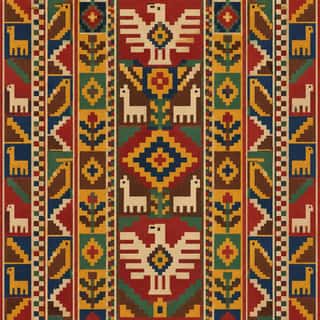
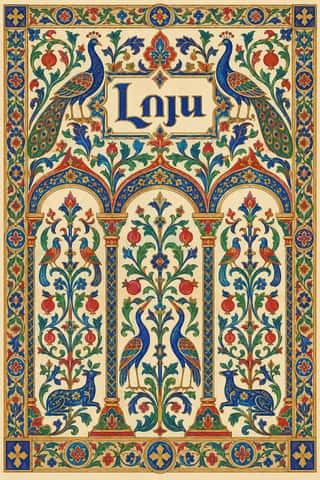
- Square Kufic (Bannāʾī)Square Kufic builds Arabic script on a square grid: straight lines and right angles only, with every stroke as wide as the gap beside it.
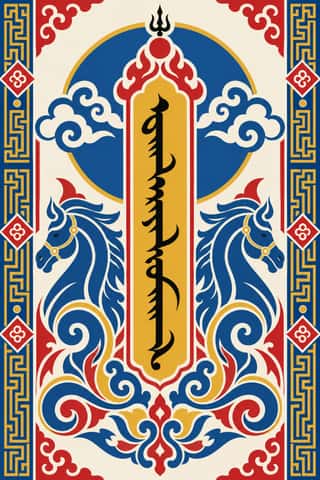


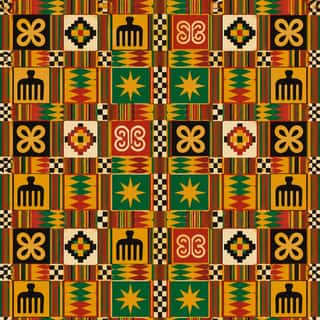
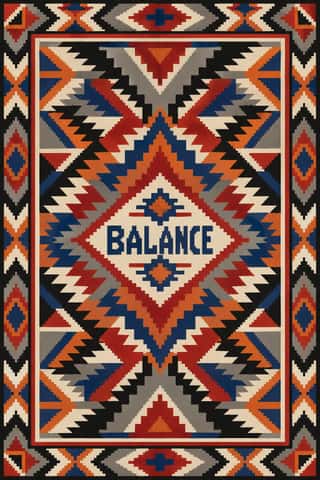
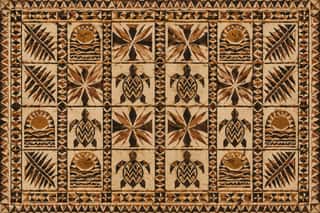
- Glasgow StyleGlasgow's distinctive answer to Art Nouveau, formed around Charles Rennie Mackintosh, Margaret and Frances Macdonald and Herbert MacNair at the Glasgow School of Art.
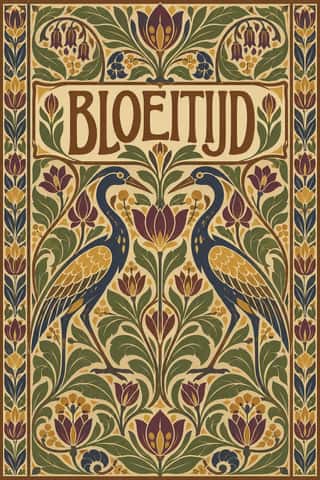
- Bezalel SchoolThe house style of the Bezalel School of Arts and Crafts, opened in Jerusalem by Boris Schatz in 1906 with E.

- Arnhem Land Bark Painting & RarrkPainting in ochres on flattened stringybark by Yolŋu, Kunwinjku, Kuninjku and other clans of Arnhem Land, carrying ceremonial designs into portable form; collected from 1912, painted through art centres since the 1970s.

- Ndebele Geometric PaintingThe mural tradition of Southern Ndebele women, who paint homestead walls and gateways, and later canvases and objects, with bold, symmetrical geometric designs.
- Pakistani Truck ArtThe total decoration of Pakistan's trucks and buses, which grew from company marks and saints' portraits painted in the late 1940s into a workshop art in which painters, metalworkers, woodcarvers and reflective-tape specialists collaborate on each vehicle.
- Casablanca School Graphic ModernismA postcolonial modernism formed at the Casablanca fine-art school under Farid Belkahia, where Mohamed Melehi, Mohammed Chabâa and colleagues set Amazigh rugs and jewellery, painted ceilings and calligraphy beside a Bauhaus-style merging of art, craft and design.


Styles that use it now and then 25
An occasional choice in these styles.
- Amazigh Sign System & Tifinaghc. 0–present
- Chinese Paper-Cut (Jianzhi)c. 500–present
- Maghrebi Script (Maghribi Calligraphy of al-Andalus and North Africa)c. 900–present
- Kamon (Japanese Family Crests)c. 1100–present
- European Heraldryc. 1140–present
- Mithila (Madhubani) Paintingc. 1350–present
- Renaissance Book Typographyc. 1460–1600
- Javanese Wayang Kulit (Tatah Sungging)1500–present
- Rinpa & Saga-bon1600–present
- Cuban Tobacco Lithography (Habilitaciones & Marquillas)1845–present
- Fante Asafo Flags (Frankaa)1850–present
- Japonisme1860–1910
- Norwegian and Finnish National Romantic Graphics (Munthe & Karelianism)1880–1922
- Kanga (Swahili Message Cloth)1886–present
- Bògòlanfini Mud Cloth1900–present
- Guna Mola1900–present
- Shanghai Modern & Yuefenpai1910–1949
- Tiki Pop (Polynesian Pop)1934–present
- Bengali Modernist Book Cover (Prachchhad)1943–present
- Hurufiyya Calligraphic Modernism1949–present
- Taiwan Floral Cloth (Huabu)1950–present
- Cairo–Beirut Arab Modernist Book & Periodical Design1952–1990
- Greek Tourism Modernism (EOT)1960–1974
- Op Art Graphics1960–1975
- Pardhan Gond Painting (Jangarh Kalam)1981–present
It often goes with
Choices that the styles making it make more often than the atlas as a whole.
- Pattern & repeatin 38 of 52
- Abundant decorationin 35 of 52
- Textile & craftin 31 of 52
- Folk & sacred symbolsin 38 of 52
- Angular & zigzagin 30 of 52
- Borders & framesin 37 of 52
Styles that avoid it
Styles that deliberately leave it out.