Style combination · Pairs well
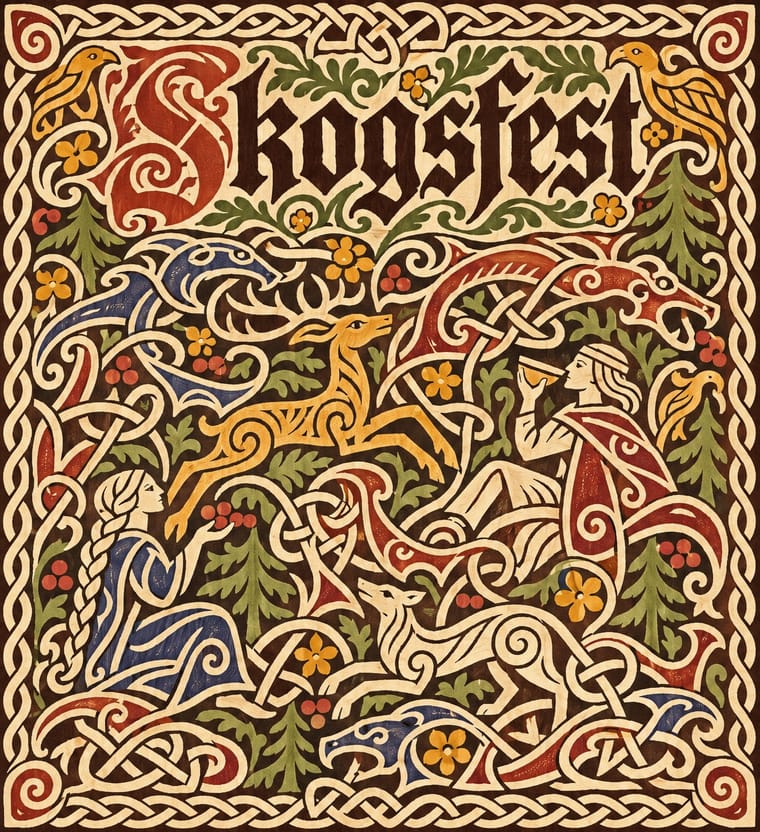
Norwegian and Finnish National Romantic Graphics × Viking Age Animal Styles
Its dragon-style revival reuses Urnes and Ringerike beasts for flat decorative graphics.
Mix them and make something Norwegian and Finnish National Romantic Graphics Viking Age Animal Styles
01
What each style brings
Each part of the design comes from the style with the stronger say in it, and each style gives at least two.
Norwegian and Finnish National Romantic Graphics (Munthe & Karelianism) Viking Age Animal Styles (Borre, Jellinge, Mammen, Ringerike, Urnes)
- Type from Norwegian and Finnish National Romantic Graphics
- Colour from Norwegian and Finnish National Romantic Graphics
- Form from Viking Age Animal Styles
-
Norwegian and Finnish National Romantic Graphics avoids whiplash line: this is where the two pull against each other.
- Composition from Viking Age Animal Styles
- Surface from Norwegian and Finnish National Romantic Graphics
02
The type
Open fonts standing in for each style’s own type, which is often hand-drawn or commercial.
Display · Norwegian and Finnish National Romantic Graphics
Atlas
UnifrakturMaguntia, standing in for The hand-lettered text of Draumkvæde (1904): a pen hand of blackletter character with long swashed ascenders and descenders, modelled on Norse saga manuscripts of the 13th and early 14th centuries, above all Codex Frisianus (c. 1300–1325), with ornamented capitals in red, some roman and some blackletter; drawn by Aug. Sørensen after Munthe's models
Text · Viking Age Animal Styles
A sequence of Scandinavian ornament styles in which ribbon-bodied animals, birds and tendrils are woven into interlace and fitted tightly to metalwork, wood and rune-carved stone. Borre, Jellinge, Mammen, Ringerike and Urnes each reshape the same beast, and runic text often winds through the design as part of it. The tradition is historical Scandinavian craft of the Christianising era; modern Norse runes and Viking imagery are often co-opted by white-supremacist groups, so use them with care and context.
Oswald; Viking Age Animal Styles used Younger Futhark, Danish long-branch runes and Younger Futhark, short-twig runes
03
The colours
The ground and leading colours come from Norwegian and Finnish National Romantic Graphics, with a counter-accent from Viking Age Animal Styles. The ink reads on the ground at 4.5:1 or more.
Norwegian and Finnish National Romantic Graphics (Munthe & Karelianism) Viking Age Animal Styles (Borre, Jellinge, Mammen, Ringerike, Urnes)
-
#e8dcc2ground · 36% -
#2a1f17ink · 14% -
#c9932eaccent · 18% -
#a3342baccent · 14% -
#2e4a7daccent · 10% -
#56703faccent · 8%
As CSS
:root {
  --ground: #e8dcc2;
  --ink: #2a1f17;
  --accent-1: #c9932e;
  --accent-2: #a3342b;
  --accent-3: #2e4a7d;
  --accent-4: #56703f;
  --font-display: "UnifrakturMaguntia", serif;
  --font-text: "Oswald", sans-serif;
}
Use it with care
Norwegian and Finnish National Romantic Graphics (Munthe & Karelianism): In Norway the fascist Nasjonal Samling (1933–45) took a golden sun cross on red, which it claimed as St Olav's shield, for its emblem, leaned heavily on Viking art and symbolism and built on romantic nationalism, so keep saga warriors, dragon ships and the Olav cross away from ethnic-nationalist framing. Old signs near this material, the othala rune, the sun cross (also called Odin's cross) and Odin's valknut, are used by neo-Nazis and other white supremacists, though non-racist pagans also use the othala rune and the valknut: check how such a sign reads in context before borrowing it. Gallen-Kallela's 1918 insignia for the White Army's Order of the Cross of Liberty set a golden swastika into the cross: do not borrow it. Karelianism cast Karelia as a refuge of authentic Finnishness, and some of its ideas later fed the irredentist Greater Finland project, so do not present Karelian or Orthodox folk culture as merely Finland's past: Karelians are a living people with their own language and crafts. In these decades Norway's Norwegianisation policy pressed the Sámi to assimilate: do not fold Sámi duodji motifs into this Norse ornament.
04
The two styles
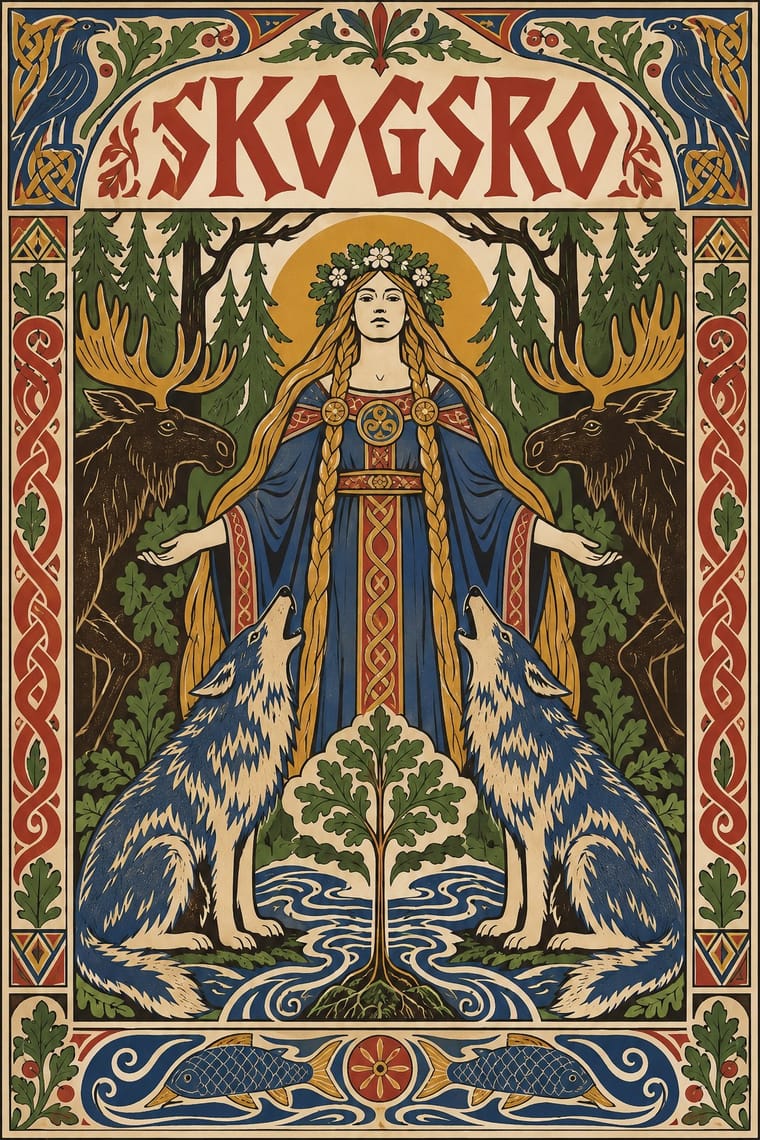
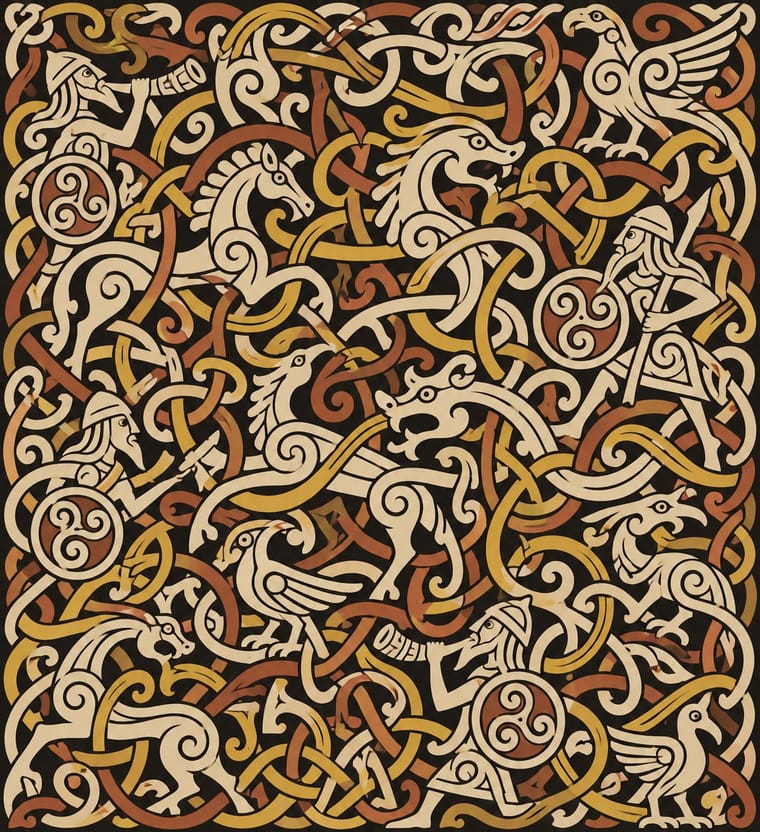
05
More combinations
With Norwegian and Finnish National Romantic Graphics
- Finnish Bold Print (Marimekko Modernism) Contrasts · Later Finnish flat printing abstracts into large repeat patterns what this style still draws as myth figures; put a Kalevala frieze against a bold abstract field to show the shift.
- Mir iskusstva Book Art Pairs well · A parallel national revival of the same years: Bilibin framed Russian fairy tales in Old Russian borders as Munthe framed the sagas; combine for a northern storybook, but keep the Norse and Russian sources distinct.
- Celtic Revival Illumination & Lettering Pairs well · Both turned medieval interlace and beast heads into the ornament of a national book; set Norse dragon-head vignettes beside Insular knotwork for a North Sea saga cycle.
- Black Metal Graphics Contrasts · Norway's second-wave black metal put Theodor Kittelsen's pictures on Burzum's Filosofem (1996), quoted blackletter and kept a pagan tone in grainy black and white; set one Munthe-style saga vignette against such a sleeve to show a decorative national revival turned to misanthropy, minding the far-right uses named in the caution.
- Scandinavian Functionalism Contrasts · The Nordic modernism that followed rejected its myth and ornament; drop one carved dragon-head vignette or saga figure into a functionalist layout to warm it.
- Skønvirke (Danish Art Nouveau, Bindesbøll) Contrasts · The neighbouring Nordic revival tells sagas with dragons and figures; Bindesbøll's strand of Skønvirke keeps ornament abstract, so borrow its interlace and flora but leave the saga figures out.
- Swedish Painted Wall Hangings (Dalmålning, Bonadsmålning and Kurbits) Contrasts · A learned 1880–1920 revival of ornament versus the peasant painters' own freehand working tradition.
- Nordic Fairy-Tale and Troll Illustration (Werenskiold, Kittelsen, Bauer) Contrasts · The same decades and some of the same artists (Werenskiold led the illustrators of the 1899 Kongesagaer), but flat, frontal and ornamental where this is deep, tonal and atmospheric; frame one deep troll forest with a Munthe-style flat border to show the two branches side by side.
With Viking Age Animal Styles
- Gothic Blackletter & Fraktur Tradition Contrasts · Pen-built Gothic letters against carved, coiling runic bands: two northern traditions with opposite line logic.
- Extreme Metal Band-Logo Lettering Pairs well · Tangled, band-shaped lines bring a Norse register to illegible logo lettering.
- Icelandic Magical Staves (Galdrastafir) Contrasts · Animal styles are medieval carved interlace; staves are later, written, linear and have no animals, so do not blend them to make a Viking look.