Style combination · Contrasts
Icelandic Magical Staves × Viking Age Animal Styles
Animal styles are medieval carved interlace; staves are later, written, linear and have no animals, so do not blend them to make a Viking look.
Mix them and make something Icelandic Magical Staves Viking Age Animal Styles
01
What each style brings
Each part of the design comes from the style with the stronger say in it, and each style gives at least two.
Icelandic Magical Staves (Galdrastafir) Viking Age Animal Styles (Borre, Jellinge, Mammen, Ringerike, Urnes)
- Type from Viking Age Animal Styles
- Colour from Icelandic Magical Staves
- Form from Icelandic Magical Staves
- Composition from Icelandic Magical Staves
- Surface from Viking Age Animal Styles
02
The type
Open fonts standing in for each style’s own type, which is often hand-drawn or commercial.
Display · Viking Age Animal Styles
Light
Uncial Antiqua; Viking Age Animal Styles used Younger Futhark, Danish long-branch runes and Younger Futhark, short-twig runes
Text · Icelandic Magical Staves
Single-line sigils drawn in ink in Icelandic grimoires, each with a named purpose: the Ægishjálmur (helm of awe) for fear and victory, the Vegvísir for finding the way, the Lukkustafir for luck. Built from crossed and branching arms ending in forks, crosses and rune-like bars, often inside a circle, they were copied and varied by hand. Today they circulate as tattoos, t-shirts and pendants, often wrongly sold as Viking.
VT323; Icelandic Magical Staves used Icelandic hand-written manuscript scripts (post-medieval cursive) of the grimoires and Runic letters and rune-like bars used as terminals and in the instructions
03
The colours
The ground and leading colours come from Icelandic Magical Staves, with a counter-accent from Viking Age Animal Styles. The ink reads on the ground at 4.5:1 or more.
Icelandic Magical Staves (Galdrastafir) Viking Age Animal Styles (Borre, Jellinge, Mammen, Ringerike, Urnes)
-
#efe6d2ground · 36% -
#1f1a15ink · 14% -
#8a2f26accent · 18% -
#b8923aaccent · 14% -
#5b3a29accent · 10% -
#7b8a8eaccent · 8%
As CSS
:root {
  --ground: #efe6d2;
  --ink: #1f1a15;
  --accent-1: #8a2f26;
  --accent-2: #b8923a;
  --accent-3: #5b3a29;
  --accent-4: #7b8a8e;
  --font-display: "Uncial Antiqua", sans-serif;
  --font-text: "VT323", monospace;
}
Use it with care
Icelandic Magical Staves (Galdrastafir): Icelandic magical staves are historically real occult practice, recorded in grimoires, and are now a living part of Icelandic heritage and of Nordic neo-pagan practice. The Vegvísir has no known attestation before 1860 and is often falsely sold as a Viking compass, and the Ægishjálmur has been taken up by some extremist groups, including in the logo of a Swedish party. Do not present them as Viking Age symbols, do not use them as neutral decoration for brands tied to hate or far-right politics, credit the manuscripts and Icelandic sources, and do not invent new staves and claim they work. Date it honestly: these are a post-Reformation Icelandic book tradition, not a Viking Age emblem.
04
The two styles
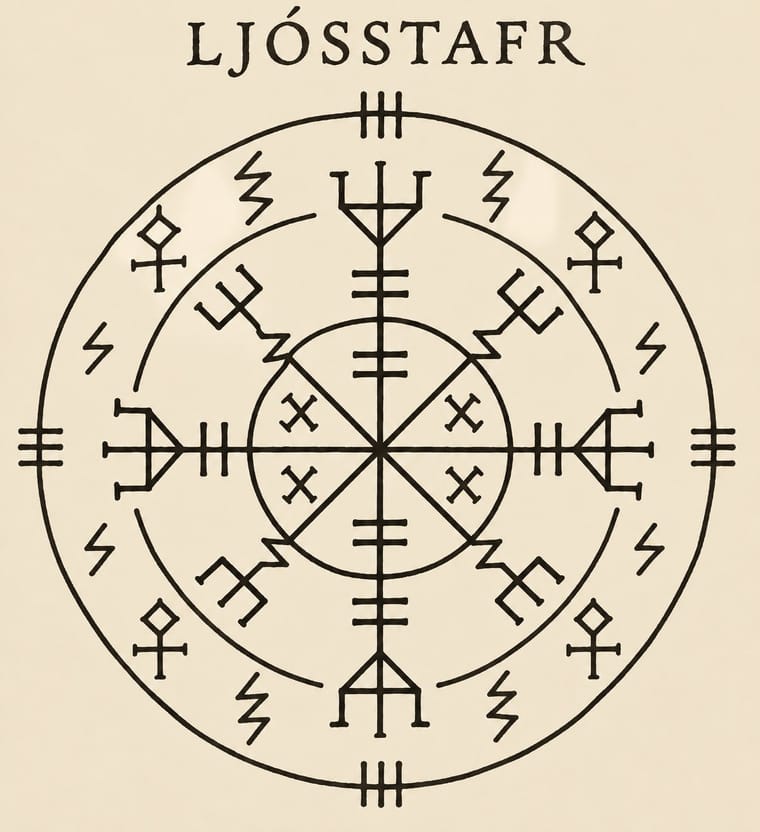
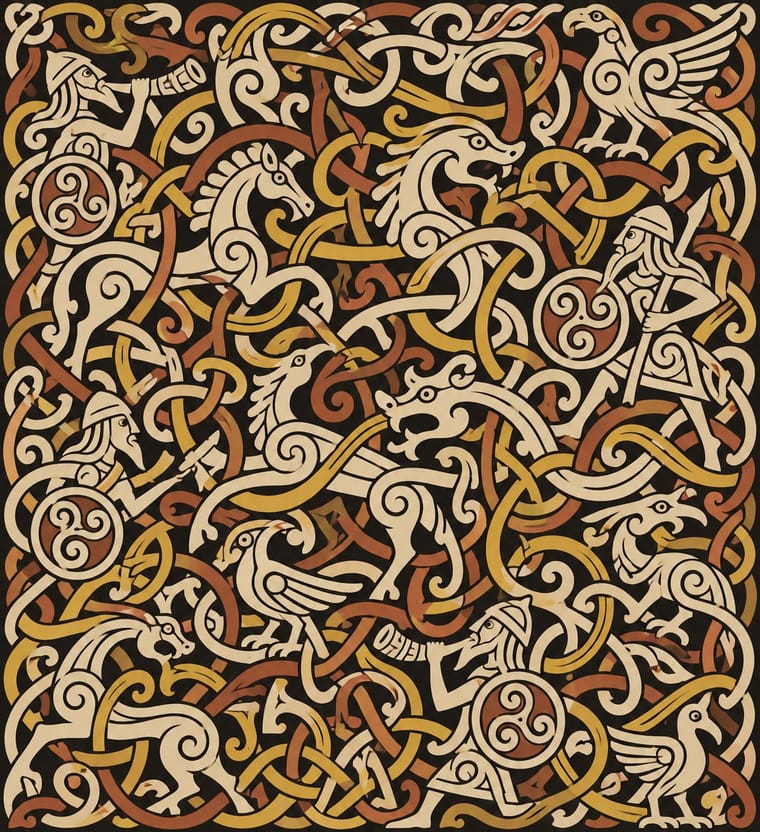
05
More combinations
With Icelandic Magical Staves
- European Heraldry Contrasts · Heraldry fixes an emblem by blazon and fills it with colour on a shield; a stave has no fixed form, no colour and no blazon.
- Thai Yantra (Yant) Diagrams Pairs well · Both are protective diagrams copied by hand for a named use; a yantra packs script into closed shapes, while a stave is one open line, so set them side by side to see how each encodes purpose.
With Viking Age Animal Styles
- Norwegian and Finnish National Romantic Graphics (Munthe & Karelianism) Pairs well · Its dragon-style revival reuses Urnes and Ringerike beasts for flat decorative graphics.
- Gothic Blackletter & Fraktur Tradition Contrasts · Pen-built Gothic letters against carved, coiling runic bands: two northern traditions with opposite line logic.
- Extreme Metal Band-Logo Lettering Pairs well · Tangled, band-shaped lines bring a Norse register to illegible logo lettering.