Rational modernism · 1951–1975 · Southern Europe, Central Europe
Zagreb Modernist Graphics (EXAT 51 to Teatar &TD)
Also known as EXAT 51 graphic design, Croatian modernist graphic design, Yugoslav modernist graphic design (Zagreb)
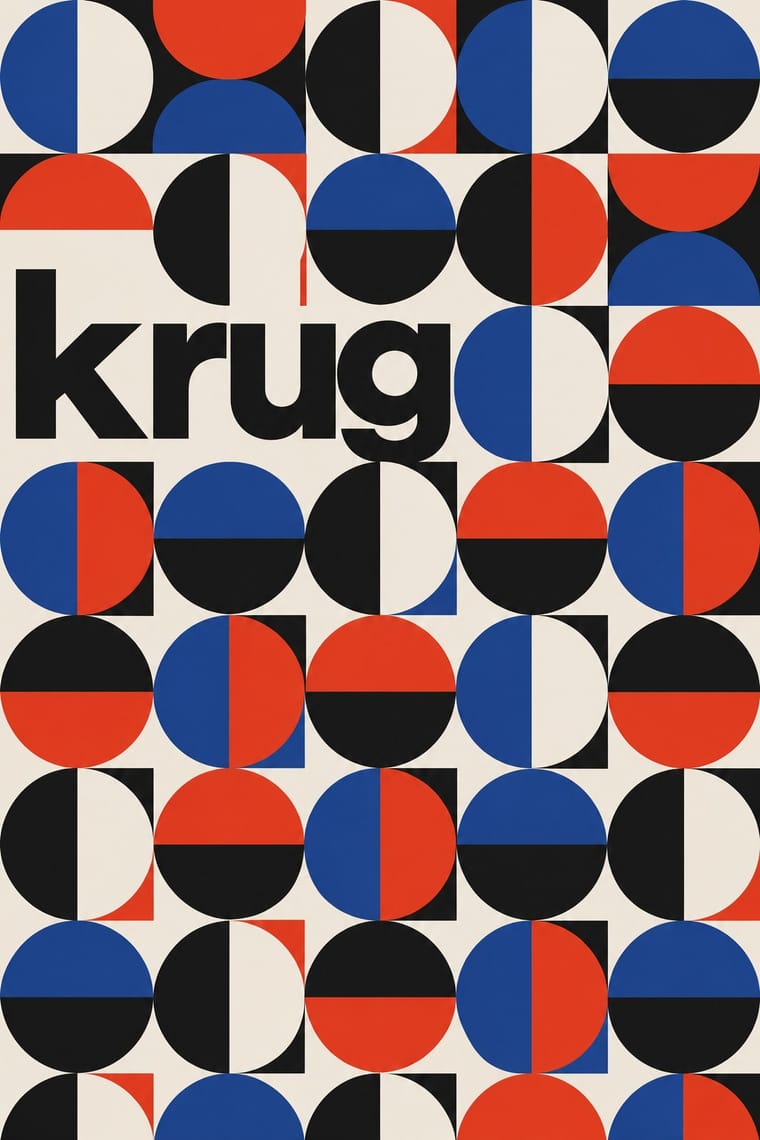
Zagreb graphic design grown from the EXAT 51 manifesto (1951), which tied abstract art to visual communication. Ivan Picelj's screenprinted posters for the Gallery of Contemporary Art and its New Tendencies shows (1961–1973) multiply one geometric unit or a few letters across the sheet, and Mihajlo Arsovski made letters, collage and quotation the identity of Teatar &TD. Later, Boris Ljubičić's Mediterranean Games circles (1979) kept to signs, while Boris Bućan's huge 1980s screenprints for Split's theatre borrowed Egyptian, Secession and Expressionist idioms around his own patterned figures.
Make something in this styleGet advice in this styleMix it with another style
Use it with care
Picelj (died 2011), Arsovski (died 2020) and Bućan (died 2023) are recent and their posters remain in copyright, Arsovski's Teatar &TD logo is still in use, and Boris Ljubičić's 1979 circle symbol is the permanent emblem of the International Committee of the Mediterranean Games, so borrow the method (a multiplied unit, a lowercase credit line, a rebus title) rather than reproducing a particular poster or mark. Do not dress the style in red stars or party slogans as period decor: these designers worked for galleries and theatres in socialist Yugoslavia and deliberately avoided propaganda imagery.
01
How it works
- Build the sheet from one geometric unit, such as a circle, a disc within a disc or a group of letters, multiplied on a regular grid, and get movement by rotating or recolouring the unit, not by drawing. On many gallery posters the unit came from the exhibiting artist's own work, with Picelj laying out the sheet and its lowercase lettering.
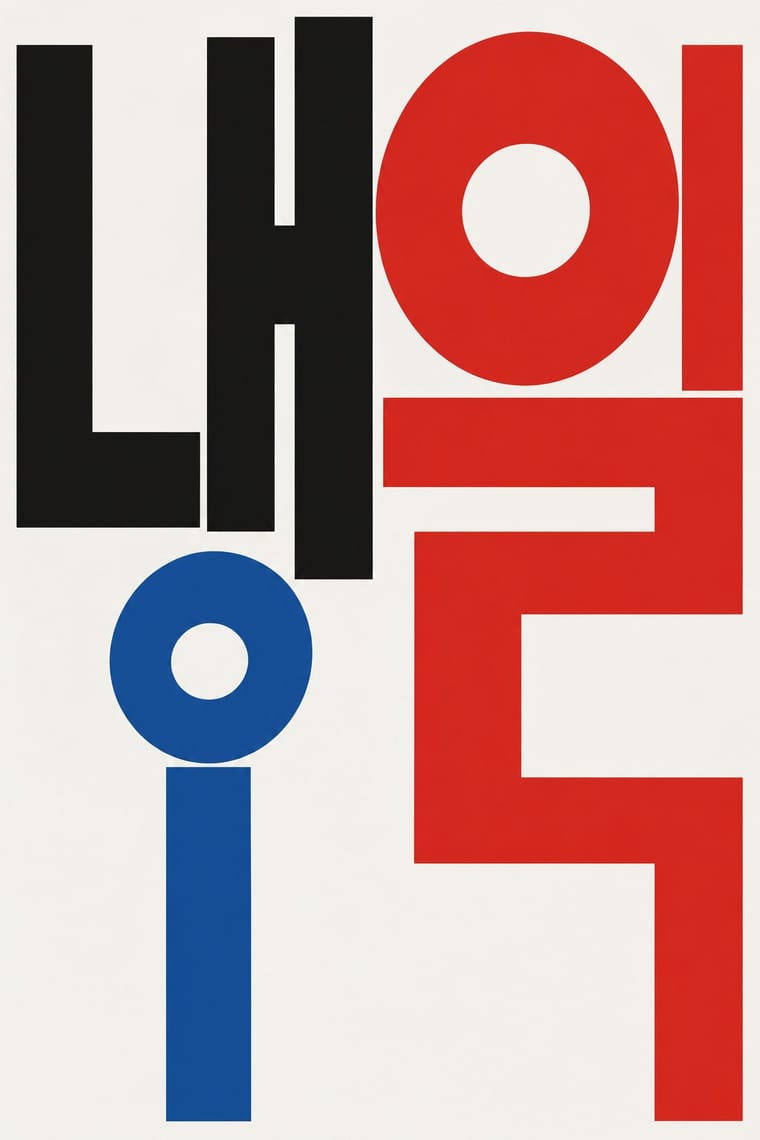
- Make the letters the picture: repeat the title's initials as an all-over pattern, blow up one word until it fills the sheet, or solve the title as a rebus.
- Screenprint a few opaque flat inks with no modelling: primaries, a vibrating pair such as green and blue on red, or black on metallic paper, and at the extreme an almost all-white sheet.
- Set titles and credits in lowercase grotesque on a plain band or strip kept apart from the field of repeated units, mostly flush left and small against the whole sheet.
- Design everything one institution issues, from poster and catalogue to invitation, ticket and interior, as one system, so the gallery or theatre is known by its graphics.
- Quote instead of illustrating: cut in art-history images, advertisements, photographs and comics, and recompose them with irony rather than propaganda symbols.
Zagreb, Croatia, then part of socialist Yugoslavia: the EXAT 51 group (Eksperimentalni atelje, active 1950–1956) of architects and painters (Bernardo Bernardi, Zdravko Bregovac, Ivan Picelj, Zvonimir Radić, Božidar Rašica, Vjenceslav Richter, Aleksandar Srnec, Vladimir Zaharović, also spelled Zarahović; Vlado Kristl from 1952) proclaimed its manifesto, written by Richter, at the annual plenum of ULUPUH on 7 December 1951, after Yugoslavia's break with the USSR. Picelj carried it into posters and catalogues for the Civic Gallery of Contemporary Art from 1957 and the New Tendencies exhibitions (1961–1973), screenprinted in Zagreb by Brano Horvat and the Student Centre's press; Mihajlo Arsovski, designing from 1959, built Teatar &TD's identity at the Student Centre, whose experimental scene he worked with until the mid-1970s
02
Its design choices
From Stylogeny’s vocabulary of design choices: defining choices make the style, characteristic ones are usual, occasional ones turn up now and then.
- Layout & composition
- Space & hierarchy
- Typography
- Colour
- Form & shape
- Surface & texture
- Ornament
- Imagery
- Medium & production
- Tone & intent
- Avoids
- Script, Blackletter, Naturalistic depiction, Painterly brushwork, Painterly illustration, Folk & sacred symbols, Agitational & persuasive, Luxurious & glamorous
Palette
#131313#f1ede4#e2402a#4a2c86#f0c419#2a4a9c
Typefaces
Lowercase neo-grotesque sans for titles and credits on Picelj's New Tendencies posters
'nove tendencije 2', 1963; 'nova tendencija 3', 1965; the five-language programme of 'tendencije 4', 1969
Akzidenz-Grotesk, Egyptienne Bold Condensed and Red Roses mixed on Arsovski's 1966 western posters for Kinematografi Zagreb
Arsovski's letterforms played as form against counterform on his letter-only exhibition and theatre posters
Seder, 1964; Ljubaf, 1966; Hamlet u selu Mrduša Donja, 1971
Known for
EXAT 51 manifesto, proclaimed at the annual plenum of ULUPUH (the Croatian association of applied artists), Zagreb, 7 December 1951
the study of the methods and principles of abstract art 'makes it possible to develop and enrich the field of visual communications'
Ivan Picelj, poster for Suvremena umjetnost 1 (Bloc–Pillet–Vasarely), 1957, the first poster for the Civic Gallery of Contemporary Art, Zagreb; by 2001 he had designed 53 posters and 87 catalogues for the museum (MSU Zagreb)
Ivan Picelj, posters
(100 x 70 cm) carrying Constructivist motifs by the artist shown and near-square catalogues (21 x 20 cm) for the Gallery of Contemporary Art's exhibitions of Constructivist and New Tendencies artists, each catalogue with a small serigraph by the exhibiting artist, printed by Brano Horvat (Susovski 1995)
Ivan Picelj, Nove tendencije 2 poster (1963, screenprint on metallic paper; MoMA, Tate P14475)
a grid of black discs, each holding a smaller off-centre gold disc turned to a different angle, with 'nove tendencije 2' in lowercase grotesque reversed out of a black band
Ivan Picelj, Nova tendencija 3 poster (1965, colour screenprint, lettered 'design i picelj 65 tisak studenski [sic] centar, zagreb.'; V&A E.618-1981, Tate P14476): the letters 'nt3' repeated in rows of alternating green and blue across a red field below a violet title band
Ivan Picelj, Tendencije 4 poster (1969, screenprint; Tate P14477)
a tall field of white rings and dots on a black ground, with the programme of exhibitions and the computers and visual research symposium set in five languages in small lowercase columns at the foot
Ivan Picelj, serigraph portfolios 8 serigrafija (1957), Oeuvre programmée N° 1 (Denise René, Paris, 1966, 12 plates) and Cyclophoria
1971
Mihajlo Arsovski, the complete identity of Teatar &TD over about ten years
(logo, posters, invitations, tickets, programmes, postcards, calendars and the interior), with letter-only posters such as Ljubaf (Murray Schisgal's Luv, 1966) and Predstava Hamlet u selu Mrduša Donja (1971), and the rebus poster Rosencrantz i Guildenstern su mrtvi (1971)
03
Make something in this style
Say what you need, and Stylogeny’s image studio draws it from Zagreb Modernist Graphics (EXAT 51 to Teatar &TD)’s design choices and checks it against them. It takes about a minute, and you get a link to share.
04
Where it comes from, and what it’s close to
Before it
The style it grew out of, and the styles it borrowed from.
After it
The styles that grew out of it.
No later style in the atlas grew out of it yet.
Alike in its design choices
Styles that make many of the same choices, related or not, besides those above.
- Seoul Independent Graphic Design (Small-Studio Scene)73% alike
05
Sources
- Marijan Susovski (ed.), Constructivism and Kinetic Art: Exat 51, New Tendencies, exhibition catalogue, Museum of Contemporary Art (Galerije grada Zagreba), Zagreb, 1995: https://monoskop.org/images/e/e1/Constructivism_and_Kinetic_Art_Exat_51_New_Tendencies_catalogue.pdf
- Reljefi Ivana Picelja / Reliefs by Ivan Picelj, exhibition catalogue, Museum of Contemporary Art, Zagreb, 2001: https://monoskop.org/images/e/ea/Picelj_Ivan_3_Reliefs_2001.pdf
- Hrvatska enciklopedija, 'EXAT 51': https://www.enciklopedija.hr/clanak/exat-51
- Hrvatska enciklopedija, 'Picelj, Ivan': https://www.enciklopedija.hr/clanak/picelj-ivan
- Hrvatska enciklopedija, 'Arsovski, Mihajlo': https://www.enciklopedija.hr/clanak/arsovski-mihajlo
- Hrvatska tehnička enciklopedija, 'EXAT 51': https://tehnika.lzmk.hr/exat-51/
- Hrvatska tehnička enciklopedija, 'Grafički dizajn': https://tehnika.lzmk.hr/graficki-dizajn/
- Victoria and Albert Museum, Boris Bućan, The Firebird and Petrushka (1983), O76128: https://collections.vam.ac.uk/item/O76128/
- Victoria and Albert Museum, Ivan Picelj, Nova Tendencija 3 poster (1965), O548963: https://collections.vam.ac.uk/item/O548963/
- Museum of Modern Art, Ivan Picelj, Nove Tendencije 2 (1963), screenprint on metallic paper: https://www.moma.org/collection/works/8063
- Orsat Franković, 'Between histories', Eye no. 25 (Summer 1997): https://eyemagazine.com/feature/article/between-histories
- Rick Poynor, 'Socialism and Modernity: A Hidden History', Design Observer (2009): https://designobserver.com/socialism-and-modernity-a-hidden-history/
- Adrian Curry, 'Movie Poster of the Week: The Film Posters of Mihajlo Arsovski', MUBI Notebook (2023): https://mubi.com/en/notebook/posts/movie-poster-of-the-week-the-film-posters-of-mihajlo-arsovski
- Fonts In Use, Kinematografi Zagreb Western movie posters (1966): https://fontsinuse.com/uses/64491/kinematografi-zagreb-western-movie-posters
- Hrvatska Wikipedija, 'Boris Bućan': https://hr.wikipedia.org/wiki/Boris_Bućan
- Tate, Ivan Picelj, 'New Tendencies' (1961), P14474: https://www.tate.org.uk/art/artworks/picelj-new-tendencies-p14474
- Tate, Ivan Picelj, 'New Tendencies 2' (1963), screenprint and metallic paper, P14475: https://www.tate.org.uk/art/artworks/picelj-new-tendencies-2-p14475
- Tate, Ivan Picelj, 'New Tendency 3' (1965), screenprint, P14476: https://www.tate.org.uk/art/artworks/picelj-new-tendency-3-p14476
- Tate, Ivan Picelj, 'Tendencies 4' (1969), screenprint, P14477: https://www.tate.org.uk/art/artworks/picelj-tendencies-4-p14477
- International Committee of the Mediterranean Games, 'Boris Ljubičić: The creator of the timeless symbol of the Mediterranean Games' (19 June 2025): https://cijm.org.gr/boris-ljubicic-the-creator-of-the-timeless-symbol-of-the-mediterranean-games/
How Stylogeny researches and checks a style: where the facts come from.