Avant-garde · 1907–1925 · Western Europe
Cubist Pictorial Space
Also known as Cubism, Analytic & Synthetic Cubism, Papier collé
The pictorial revolution of Picasso and Braque that shattered single-point perspective into overlapping, faceted planes seen from several viewpoints at once. Through papier collé and stencilled lettering it brought real printed matter and type onto the picture plane, handing graphic design the fragment, the shallow layered plane and collage as working tools.
Make something in this styleGet advice in this styleMix it with another style

01
How it works
- Break each object into faceted planes and show it from several viewpoints at once.
- Flatten depth: let planes overlap and slide into one another instead of receding to a vanishing point.
- Paste real printed matter (newsprint, labels, wallpaper, faux-bois paper) onto the surface as both texture and sign.
- Introduce stencilled or clipped letters as word fragments, cropped mid-word so they read as shapes and puns.
- Restrict colour to ochres, browns and greys, or, in the synthetic phase, to a few flat, opaque planes.
- Anchor the composition on a central scaffold of interlocking verticals, diagonals and arcs that dissolves toward the edges.
Paris (Montmartre and Montparnasse), France
02
Its design choices
From Stylogeny’s vocabulary of design choices: defining choices make the style, characteristic ones are usual, occasional ones turn up now and then.
- Layout & composition
- Typography
- Colour
- Form & shape
- Surface & texture
- Ornament
- Imagery
- Medium & production
- Avoids
- Illusion of depth, Naturalistic depiction, Central symmetry, Gloss & highlights, Fluorescent & neon, Abundant decoration
Palette
#8b6b3e#c9b48a#6e6a5e#2a241d#e6dcc3#3e5a6b
Typefaces
Sign-painters' stencilled capitals
Braque, from 1911
Clipped newspaper mastheads and headline grotesques
Le Journal
Didone newsprint text type in pasted fragments
Known for
Pablo Picasso
Still Life with Chair Caning, 1912
Georges Braque
Fruit Dish and Glass, 1912, the first papier collé; stencilled letters from 1911
Juan Gris
Fernand Léger
illustrations for Blaise Cendrars, La Fin du monde filmée par l'Ange N.-D., 1919
Sonia Delaunay & Blaise Cendrars
La Prose du Transsibérien, 1913
03
Make something in this style
Say what you need, and Stylogeny’s image studio draws it from Cubist Pictorial Space’s design choices and checks it against them. It takes about a minute, and you get a link to share.
04
Where it comes from, and what it’s close to
Before it
The style it grew out of, and the styles it borrowed from.
Nothing earlier is recorded: in the atlas it is a starting point.


Alike in its design choices
Styles that make many of the same choices, related or not, besides those above.
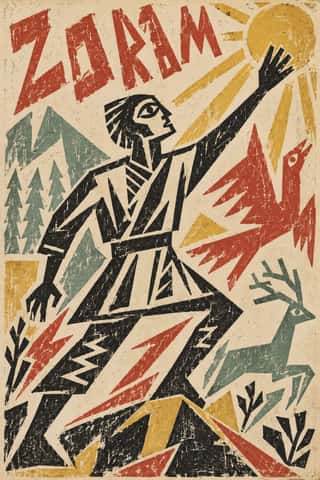
- Cartonera Books (Latin American Cardboard Publishing)55% alike




05
Real works
Artefacts in museums, libraries and archives that show the style, linked at their source.
- The Bottle of Anís del Mono (La bouteille d'anis)Juan Gris · 1914 (June) · Museo Nacional Centro de Arte Reina Sofía, Madrid (AD01818; image: Google Art Project via Wikimedia Commons)
- Fruit Dish and GlassGeorges Braque · Sorgues, autumn 1912 · The Metropolitan Museum of Art (Leonard A. Lauder Cubist Collection)
- La Fin du monde filmée par l'Ange N.-D. (cover)Fernand Léger (design), for Blaise Cendrars · 1919 · Wikimedia Commons (photograph by Francesco Bini of an exhibited copy; Commons places it in the Musée national d'art moderne, which no museum record confirms). The Art Institute of Chicago also holds the book (200435).
- The Bar (Le Comptoir)Louis Marcoussis · 1920 · The Cleveland Museum of Art


06
Sources
- Philip B. Meggs & Alston W. Purvis, Meggs' History of Graphic Design
- John Golding, Cubism: A History and an Analysis, 1907–1914 (1959)
- Johanna Drucker, The Visible Word: Experimental Typography and Modern Art, 1909–1923 (1994)
How Stylogeny researches and checks a style: where the facts come from.