Traditions & vernacular · 1850–present · Central Europe
Polish Wycinanki ( Kurpie & Łowicz Paper-Cut )
Also known as Wycinanki, Wycinanka ludowa, Wycinanka kurpiowska, Wycinanka łowicka, Polish folk paper-cutting
Polish regional paper-cut graphics made for decorating homes: pierced trees and roundels, flowers, birds and scenes of rural life. Kurpie includes angular geometric cutwork and finer vegetal leluje; Łowicz builds bright ornament and narrative kodry from coloured paper on a backing. Axial and radial repetition organise many cuts, while freely composed scenes arrange figures and household objects. Contemporary packaging adapts the ornament; a museum has also proposed its use on cloth bags.
Make something in this style Get advice in this style Mix it with another style
Use it with care
This is living regional cultural heritage, with identifiable makers and family practices, not an anonymous national stock-motif library. Commission, credit and compensate named cutters for commercial work rather than tracing their compositions, and distinguish Kurpie, Łowicz and individual practices instead of labelling every bright floral pattern authentic Polish folk art. Museum-publicised objects are appropriate for contextual study, but publication does not establish an open image licence or permission to reproduce a cutter's work. Some leluje include angels, crosses or monstrance imagery and belong to Christian festive and devotional contexts; do not turn these into generic secular product decoration or infer one fixed sacred meaning for every tree or bird. Keep historical originals separate from later copies and modern branding adaptations. The palette is an illustrative approximation, not a measured historical colour standard. Typography weights describe only the inspected packaging adaptation; the historical paper cuts are predominantly wordless. Vocabulary gap: scissor-cut connected silhouettes, pierced negative space and pasted coloured-paper construction; stand-in: medium.textile at 0.6 uses that trait's broad applied-craft sense, also consistent with the museum's announced cloth-bag application, while layout.collage at 0.6 describes layering. Neither claims that the original works were woven, embroidered or made by a printing process.
01
Make something in this style
Say what you need, and Stylogeny’s image studio draws it from Polish Wycinanki (Kurpie & Łowicz Paper-Cut)’s design choices and checks it against them. It takes about a minute, and you get a link to share.
02
How it works
Palette
-
#F7F2E8 -
#C91F27 -
#89298E -
#0879A5 -
#76A529 -
#EBCB35
Typefaces
-
Slab-serif Latin display capitals in contemporary packaging adaptation
Pierogerie wordmark; exact font unverified, not a historical paper-cut lettering tradition
-
Connected Latin script in contemporary packaging adaptation
Pierogerie's Heritage Pork & Super Grains line; exact font unverified, not a defining traditional hand
- Make the image from cut silhouettes and pierced openings; articulate leaves, petals and clothing with actual shape boundaries rather than painted modelling.
- Organise a Kurpie leluja around an upright stem and crown, or repeat cut units around the centre of a roundel; preserve the particular regional form rather than combining every format in one design.
- Build Łowicz ornament from smaller coloured cuts pasted onto larger shapes, keeping each colour distinct instead of blending it into a gradient.
- Repeat cuts to balance solid paper with openings; preserve coarse geometric diamond-and-triangle cutwork and finer vegetal cutting as regional alternatives, without inserting flowers into every roundel.
- Compose narrative kodry as non-mirrored scenes of households, work and festivities; distinguish these freely arranged figures from axial leluje and radial roundels rather than forcing every image into one symmetry.
- Keep the original cuts pictorial; when adapting their ornament to packaging, give product lettering its own readable area instead of claiming a universal traditional wycinanki typeface.
Kurpie and the Łowicz region, Poland; the start is an approximate mid-nineteenth-century date, supported for Kurpie by NIKiDW, not a documented invention year or a separately established Łowicz start. Leonard Strojnowski collected around Łowicz in 1901; Kurpie collecting followed in 1902–1903, as documented by Muzeum Kultury Kurpiowskiej. No descent from Swiss or Chinese paper-cutting is asserted.
Change it with an idea. Any of the 73 moves that make a design say something can go on this style.
03
Its design choices
From Stylogeny’s vocabulary of design choices: defining choices make the style, characteristic ones are usual, occasional ones turn up now and then.
- Layout & composition
- Space & hierarchy
- Colour
- Form & shape
- Surface & texture
- Ornament
- Imagery
- Medium & production
- Tone & intent
- Avoids
- Illusion of depth, Gradients, Naturalistic depiction, Ornament-free, Straight photography, Chrome & 3D render
How its pictures are made Systematic
Kind of picture: Systematic
Known for
-
Rozalia Jeziorkowska, leluja, Tatary, 1976, glossy red paper cut with sheep shears, Muzeum Kultury Kurpiowskiej, MOO/E/86
a pierced oval crown with a woman above a stem flanked by angels; museum photograph inspected
-
Kurpie roundel, Muzeum Etnograficzne im. Seweryna Udzieli w Krakowie
MEK/33176, published by Muzeum Kultury Kurpiowskiej in its account of the early-twentieth-century collection: inspected red radial pierced ornament with a small gold-coloured central piece; the page does not establish an individual maker or exact production year
-
Elżbieta Żaczek, W wiejskiej izbie
(In a rural room), Złaków Borowy, before 1948, glossy paper on card, Państwowe Muzeum Etnograficzne w Warszawie, PME 947; Childhood catalogue, Images section, note 187 and illustration 352, printed spread pp. 468–469 (PDF page 236), photograph by E. Koprowski. Inspected the reproduction: independently placed figures, cradle, window and tables form a non-mirrored domestic scene; narrow coloured strips articulate clothing and smaller coloured shapes build household and floral details on a pale backing
-
Janina Strycharska-Wawrykowicz, Karuzela
(The carousel), Łowicz, mid-twentieth century, glossy paper on paper, Państwowe Muzeum Etnograficzne w Warszawie, PME 10509; Childhood catalogue, Images section, note 195 and illustration 413, printed spread pp. 528–529 (PDF page 266), photograph by E. Koprowski. Inspected the reproduction: a pierced orange-and-pale carousel canopy with turquoise edging above separately posed riders and spectators, striped skirts and a patterned lower band. The figures are not exact bilateral counterparts. Replaces the metadata-only PME 18080 exemplar, for which no reproduction was located
-
Pierogerie, Heritage Pork and Super Grains Cabbage Rolls packaging
the commissioning company documented its deliberate wycinanki-inspired packaging and related brand graphics on 25 January 2022. Inspected the product photograph linked in that article: multicoloured floral borders around slab-serif branding, script and large product capitals. This is a contemporary adaptation, not a historical craft specimen; the designer and exact fonts are not identified
04
Where it comes from, and what it’s close to
Nothing earlier is recorded: in the atlas it is a starting point.
Polish Wycinanki (Kurpie & Łowicz Paper-Cut) 1850–present
No later style in the atlas grew out of it yet.
Alike in its design choices
05
Combine it with
Styles Polish Wycinanki (Kurpie & Łowicz Paper-Cut) pairs well with or plays against, from the research. Each is worked out as a combination: which style gives the type, the colours and the forms.
- Polish Poster School Contrasts · Use the contrast to choose between ornament built from repeated cut shapes and a single painterly metaphor with expressive title lettering; sharing a country does not establish an ancestral link.
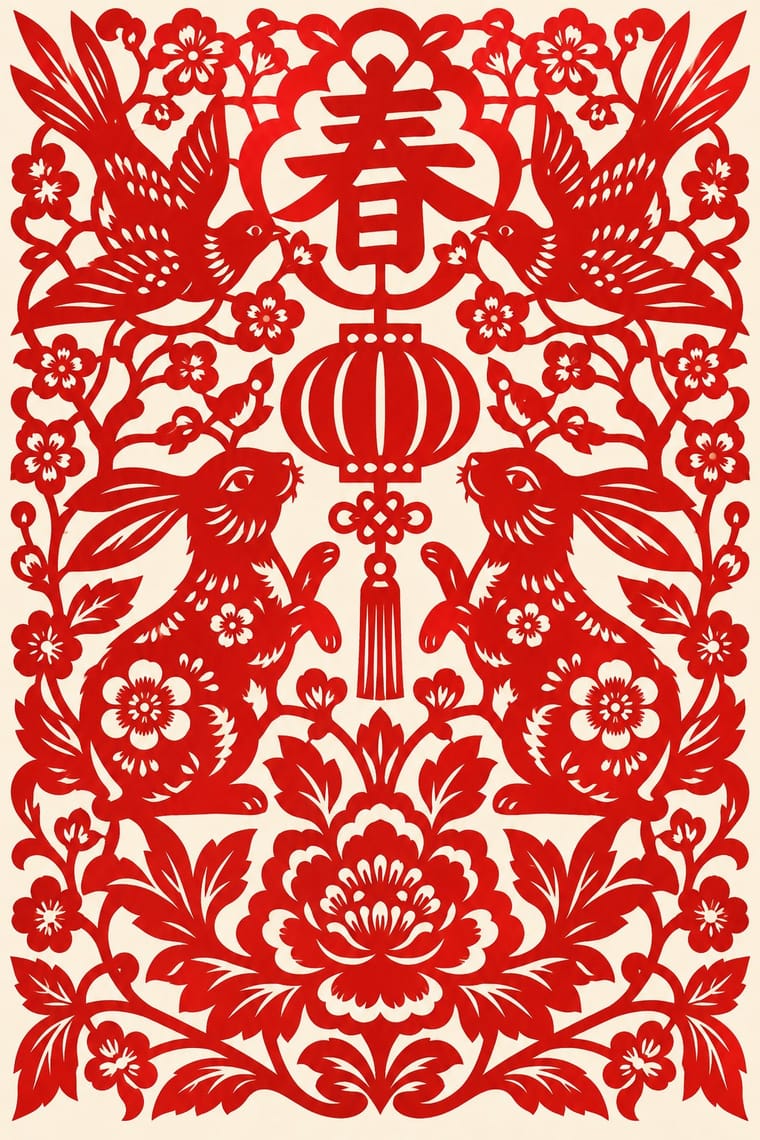
- Chinese Paper-Cut (Jianzhi) Contrasts · Both use pierced silhouettes and symmetry, and both have multicolour variants; distinguish these Polish regional formats and subjects from Chinese character-based and auspicious-image conventions rather than treating colour alone as the difference.
06
Often taken for
Polish Wycinanki has no real works recorded yet, so these are its nearest styles by its choices alone, with the choices that tell them apart.
-
Chinese Paper-Cut (Jianzhi)
Chinese Paper-Cut is one of Polish Wycinanki’s nearest styles by choices; no real work of either fits the other better.
Choices that tell Polish Wycinanki and Chinese Paper-Cut apart Choice Polish Wycinanki Chinese Paper-Cut Collage & layering characteristic — Hand-lettering — characteristic Measured density characteristic — Type as image — characteristic Architecture & signage — characteristic No shared descent in the atlas: they reached these choices separately.
-
Kanga (Swahili Message Cloth)
Kanga is one of Polish Wycinanki’s nearest styles by choices; no real work of either fits the other better.
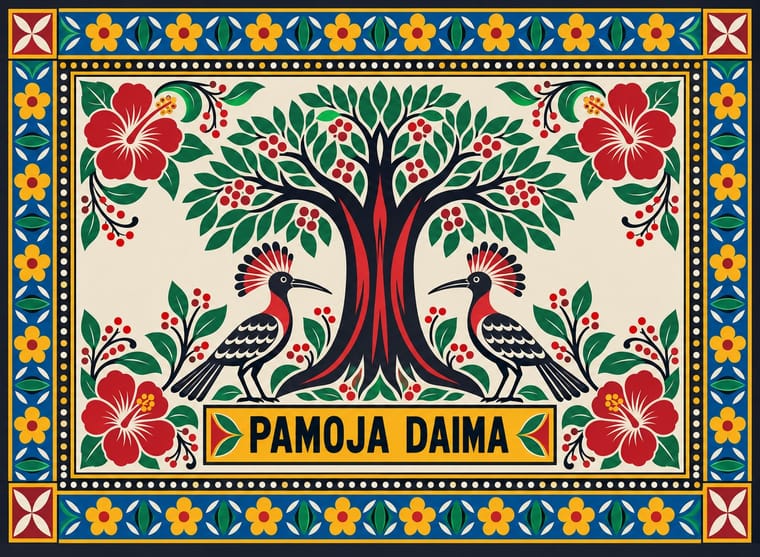
Choices that tell Polish Wycinanki and Kanga apart Choice Polish Wycinanki Kanga Dynamic asymmetry occasional avoids Naturalistic depiction avoids occasional Monochrome characteristic — Framed panels occasional defining Angular & zigzag characteristic — No shared descent in the atlas: they reached these choices separately.
-
Khayamiya (Cairene Tentmaker Appliqué)
Khayamiya is one of Polish Wycinanki’s nearest styles by choices; no real work of either fits the other better.
Choices that tell Polish Wycinanki and Khayamiya apart Choice Polish Wycinanki Khayamiya Abundant decoration defining — Framed panels occasional defining Dynamic asymmetry occasional avoids Earth & mineral — characteristic Monochrome characteristic — No shared descent in the atlas: they reached these choices separately.
-
Diné (Navajo) Weaving Design
Diné Weaving Design is one of Polish Wycinanki’s nearest styles by choices; no real work of either fits the other better.
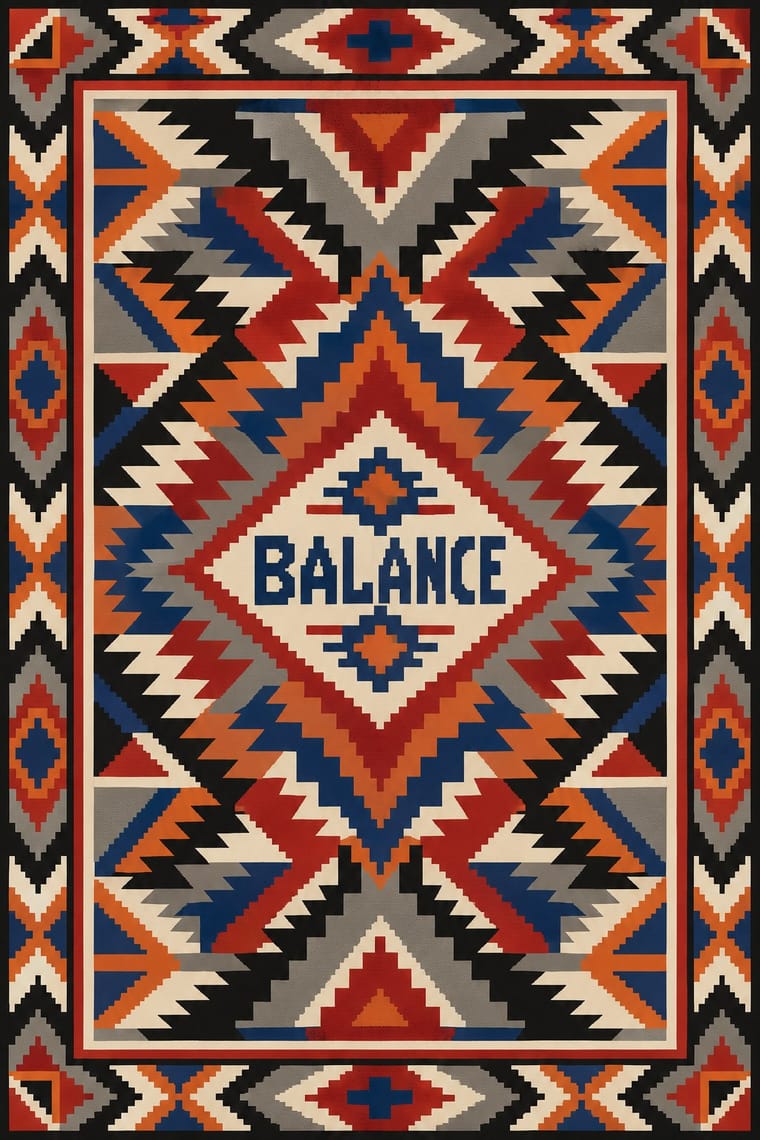
Choices that tell Polish Wycinanki and Diné Weaving Design apart Choice Polish Wycinanki Diné Weaving Design Biomorphic curves characteristic avoids Earth & mineral — defining Dynamic asymmetry occasional avoids Non-representational — defining Light ground characteristic — No shared descent in the atlas: they reached these choices separately.
— means the choice isn’t among the style’s recorded choices. Critics recorded each work’s choices with the styles’ descriptions in view, so this shows whether the descriptions hold together, not proof that they are right.
07
Sources
- Muzeum Kultury Kurpiowskiej, Wycinanka Rozalii Jeziorkowskiej wirtualnym obiektem listopada 2016, https://muzeum.ostroleka.pl/?p=1226 (text independently retrieved through the museum's WordPress API; MOO/E/86 maker, 1976 date, Tatary, sheep shears, red glossy paper, symmetry and religious context; inspected linked museum image).
- Muzeum Kultury Kurpiowskiej, Zdjęcia kurpiowskich wycinanek z krakowskiego muzeum znajdą się w albumie, https://muzeum.ostroleka.pl/?p=17269 (museum's account confirms Łowicz collecting in 1901 and Kurpie collecting in 1902–1903, regional variation and Kraków holdings; inspected linked MEK/33176 roundel, without inventing an individual date or maker).
- Państwowe Muzeum Etnograficzne w Warszawie, Dzieciństwo / Childhood. Catalogue of Collections, Warsaw 2021, Images section, notes 187, 195 and 206, printed pp. 554–559; https://ethnomuseum.pl/wp-content/uploads/2025/12/Dziecinstwo_Childhood_katalog_rozkladowki1.pdf (independently downloaded and text-extracted; rendered and visually inspected PDF page 236, printed spread pp. 468–469, illustration 352, PME 947, and PDF page 266, printed spread pp. 528–529, illustration 413, PME 10509; photographs credited to E. Koprowski. Note 187 verifies Elżbieta Żaczek, Złaków Borowy, before 1948; note 195 verifies Janina Strycharska-Wawrykowicz, Łowicz, mid-twentieth century, glossy paper on paper. These actual Łowicz reproductions support layered coloured shapes and non-mirrored narrative composition. Note 206 verifies PME 18080 metadata but its reproduction was not located, so it is no longer an exemplar. Note 188 explicitly identifies a 1959 copy of a 1919 cut and is not treated as a 1919 original. Museum publication is not an open exact-file image licence).
5 more sources
- Pierogerie, How we use Polish folk art in our brand design, 25 January 2022, https://pierogerie.ca/culture/folk-heritage-and-brand-design/ (independently retrieved first-party article through its public WordPress API and inspected the linked Cabbage-Rolls-small-package.jpg; supports commission, packaging and website application, not the article's speculative sheepskin origin narrative).
- Muzeum Kultury Kurpiowskiej, Zapraszamy na spotkanie z cyklu Etnodizajn po kurpiowsku, 31 July 2025, https://muzeum.ostroleka.pl/?p=18281 (independently retrieved via the museum's WordPress API; announces a workshop scheduled for 10 August 2025 to stencil Kurpie paper-cut motifs onto cloth shopping bags; evidence of an announced application, not verification that the event occurred or a claim that paper cuts are textiles).
- Joanna Radziewicz, Kurpiowska wycinanka ludowa, Narodowy Instytut Kultury i Dziedzictwa Wsi, 5 August 2022, https://archiwum.nikidw.edu.pl/2022/08/05/kurpiowska-wycinanka-ludowa/ (independently retrieved institutional article: dates Kurpie practice to the middle of the nineteenth century; distinguishes coarse Myszyniec diamond/triangle openings from finer Kadzidło vegetal, animal and human motifs; documents intergenerational teaching, communal domestic decoration, paper, sheep shears, glue and both single-colour and layered multicolour regional cuts; general Polona photo credit is not treated as an exact-file image licence).
- Muzeum Kultury Kurpiowskiej, Konsultacje merytoryczne w ramach stypendium MKiDN, https://muzeum.ostroleka.pl/?p=19087 (documents Halina Pajka's continuation of the Prusaczyk family's Kadzidło-style leluje, stars and birds; confirms continuing named family practice).
- Research limitation: the scout's Library of Congress finding aid returned HTTP 403 and the British Council education pack failed on HTTP/2 and timed out on an HTTP/1.1 retry. Their dates, item attributions and Jan Pienkowski claim are not counted as independently verified evidence in this draft.
How Stylogeny researches and checks a style: where the facts come from.