Traditions & vernacular · 1850–present · Sub-Saharan Africa
Fante Asafo Flags (Frankaa)
Also known as Asafo frankaa, Asafo company flags, Asafo battalion flags, Fante flags
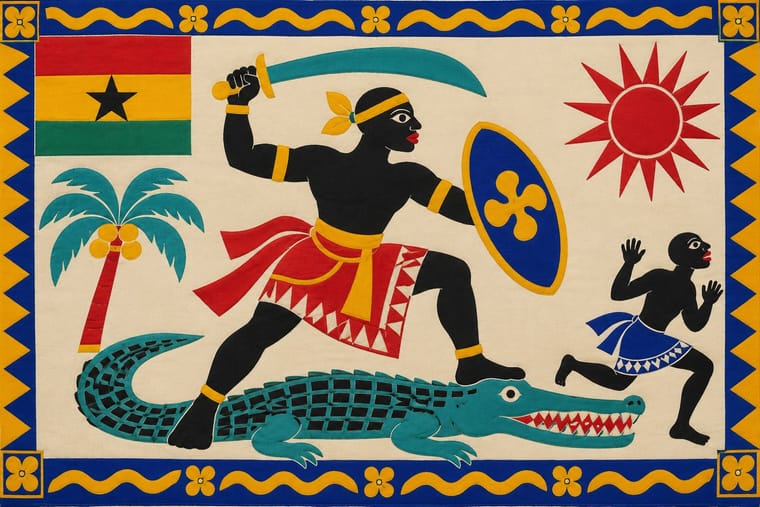
The company flags (frankaa) of the Fante asafo, the old warrior companies of Ghana's central coast, widely adopted from the mid-nineteenth century. Flag-makers cut flat silhouettes of animals, people and objects from coloured cotton and sew them onto a plain ground, often inside a border of checks or triangles, with a national flag in the upper hoist corner: a Union Jack until 1957, then Ghana's. Each flag stages one proverb, boast or taunt aimed at rival companies, and is danced, paraded and hung at the company shrine.
Make something in this styleGet advice in this styleMix it with another style
Use it with care
Asafo companies are living institutions of Fante towns: each flag belongs to its company, is commissioned when a new captain takes office, is danced at festivals and members' funerals and hung at the company shrine, and its image is often a taunt aimed at a particular rival company. Do not copy a company's flag or emblem for branding, learn what a motif says as a proverb before using it, since a scene can boast or insult, and do not pass off a new flag sewn with a Union Jack as a colonial-era piece: workshops have made flags for collectors and tourists in record numbers since the mid-1990s, including new flags made to look pre-independence. Company imagery has carried political stakes: under colonial rule the British administration imposed strict regulations on asafo companies and their arts. Commission and credit Fante flag-makers' workshops rather than printing imitations.
01
How it works
- Cut every figure as a flat silhouette in one colour of cotton and sew it onto a plain single-colour ground, adding eyes, scales, weapons or dress in embroidery or small appliquéd pieces, never in shading.
- Put a national flag in the upper hoist corner as a canton, freely pieced from patches of cloth: the Union Jack under colonial rule, the flag of Ghana after 1957.
- Stage one proverb, boast or taunt as a single scene (a beast seizing its prey, a crocodile over a pond of fish, a leader with his weapon and stool) and make the strongest figure the largest, floating on the ground with no horizon or perspective; animals such as crocodiles are often drawn in composite perspective, the body seen from above and the head in profile.
- Close the free edges with a border of contrasting squares or triangles, and often name the company by its number in stitched capitals or numerals.
- Sew the design on both faces of the cloth so it reads from either side when the flag is danced, carried in procession or hung around the company shrine.
- Take foreign emblems and remake them as signs of local proverbs: the griffin, borrowed from English imagery, and the many-headed dragon that Fante artists now often prefer in its place, a monster probably inspired by the mythical creatures of European heraldry.
Fante towns of Ghana's central coast, among them Elmina, Cape Coast, Anomabo, Saltpond and Kormantine, where flag-makers' family workshops sew the flags for the asafo companies
02
Its design choices
From Stylogeny’s vocabulary of design choices: defining choices make the style, characteristic ones are usual, occasional ones turn up now and then.
- Layout & composition
- Space & hierarchy
- Colour
- Form & shape
- Surface & texture
- Ornament
- Medium & production
- Tone & intent
- Avoids
- Gradients, Illusion of depth, Naturalistic depiction, Straight photography, All-over field, Modular grid
Palette
#f0e9d8#1b1b1b#c62a2f#1e3a8a#f2b31b#3a9a9a
Typefaces
Embroidered block capitals and numerals naming the company
off-white 'No 4 COMP' on a blue appliqué tab, Brooklyn Museum 2009.39.2
Company numbers such as 'Nº1' and 'Nº2' in a contrasting cloth or thread, set in the field or along an arm of a large cross that divides the field ('NºI' in red on the bottom arm of a wide golden-yellow cross, Flags of the World 'Crocodiles and moon' flag)
Known for
Akwa Osei, flag of No. 2 Company, Kormantine, c. 1900; cotton and rayon, embroidery and appliqué
Honolulu Museum of Art 5886.1
Kweku Kakanu (b. 1910; worked in Saltpond), Asafo company flag with griffin, c. 1940s
a black winged griffin with a duiker in its beak hunting two grasscutters, the griffin being tied to the proverb 'Will you fly or will you vanish? Either way you can't escape us'; cotton, 99.1 × 161.3 cm (shown at the Harn Museum of Art, loan from Kenneth and Bonnie Brown)
After Kweku Kakanu, Asafo company flag with crocodile, after 1950
a crocodile watching over a pond of fish with frogs and birds nearby, for the proverb 'Fish grow fat for the benefit of the crocodile'; cotton, 95.3 × 165.1 cm (shown at the Harn Museum of Art). Both Harn flags were collected in Accra in 1993, and Micots judges from its crocodile, fish and border, which do not match Kakanu's patterns, that this one probably comes from a contemporary workshop making flags for sale rather than from Kakanu's own
Asafo flag (frakaa), 1940s, acquired in Cape Coast
two standing men holding yellow discs flank a red bottle-shaped object on a black field, with a Union Jack inserted top left and a border of black and white triangles (Nelson-Atkins Museum of Art 2013.59.1)
Asafo company flag (frankaa), early to mid-20th century
an ungulate stamping on a snake that is eating a horse-like animal, a purple rodent under a patchwork Union Jack canton, and 'No 4 COMP' embroidered on a blue appliqué tab (Brooklyn Museum 2009.39.2)
Asafo flag (frankka), mid-20th century
a leader marked by his weapon and stool and a message-bearer with an elongated headdress beside a large bowl read as a never-empty pot of food or palm wine; cotton appliqué, 112 × 168 cm (The Textile Museum, George Washington University, 1999.39.1)
Appliquéd battalion flag with the proverb 'Don't speak if you drink palm wine', a saying normally used to admonish impertinent and inexperienced children, on which the company plays; made 1930–1985 (Museum Natur und Mensch, Freiburg, I/2622)
Asafo flag used by No. III Company, Anomabo, early 20th century
British Museum Af1978,22.724
03
Make something in this style
Say what you need, and Stylogeny’s image studio draws it from Fante Asafo Flags (Frankaa)’s design choices and checks it against them. It takes about a minute, and you get a link to share.
04
Where it comes from, and what it’s close to


After it
The styles that grew out of it.
No later style in the atlas grew out of it yet.
Alike in its design choices
Styles that make many of the same choices, related or not, besides those above.


- Sápmi Graphic Identity (Duodji & Gákti Colour Code)60% alike


05
Sources
- Courtnay Micots, 'Griffins, Crocodiles, and the British Ensign: Kweku Kakanu's Asafo Flags and Followers', in Susan Cooksey, ed., Africa Interweave: Textile Diasporas (Gainesville: Samuel P. Harn Museum of Art, 2011), pp. 142–144 (a painted flag reported in 1693, but flags widely adopted by the asafo only in the mid-nineteenth century; the British ensign added in the upper corner in the colonial period and replaced by the Ghanaian flag at independence in 1957; the British administration imposed strict regulations on asafo companies and their arts; flags about 3 by 5 feet, coloured cloth sewn to a typically monochromatic cotton ground with embroidered details; the cloth and many of the motifs imported; griffins borrowed from English mythical imagery, the Fante now preferring a multiheaded dragon in place of the griffin in many of their arts; the crocodile drawn in composite perspective, body from above and head in profile; Kweku Kakanu, b. 1910, worked in Saltpond; the Harn crocodile flag's crocodile, fish and border do not match Kakanu's patterns, both Harn flags were collected in Accra in 1993, and the crocodile flag likely came from a contemporary workshop; Ross has identified eight workshops and record production for sale since the mid-1990s, including new flags with the British ensign mimicking pre-independence flags): https://cssah.famu.edu/departments-and-centers/visual-arts-humanities-and-theatre/visual-arts/pdf/micots-courtnay-pdfs/Micots%20Courtnay%20-%20Griffins%20Crocodiles%20and%20the%20British%20Ensign%20-%20Harn%20Catalog.pdf
- Doran H. Ross, Fighting with Art: Appliquéd Flags of the Fante Asafo (Los Angeles: UCLA Museum of Cultural History, 1979), abstract in eHRAF World Cultures, Yale (flags of the exhibition made 1935–1978; earliest record of company flags in Ghana around 1600; companies extremely competitive, flags provocative declarations of courage and prowess; most flags refer to well-known proverbs): https://ehrafworldcultures.yale.edu/cultures/fe12/documents/046
- Doran H. Ross, 'First Word: True Colours, Faux Flags, and Tattered Sales', African Arts 43, no. 2 (2010): 1–7 (as cited and summarised by Micots)
- Peter Adler and Nicholas Barnard, Asafo! African Flags of the Fante (London: Thames and Hudson, 1992) (cited by Micots and by TRC Leiden)
- The Textile Museum, George Washington University, collection story on Asafo flag 1999.39.1 (flag-makers usually men in family workshops; a new leader commissions and helps design a new flag; appliqué on both sides of cotton trade cloth with embroidered details; a simplified Union Jack before independence and the flag of Ghana after 1957; motifs for proverbs, maxims, jokes, warnings, insults and folktales; still used in parades, dances, festivals and to decorate the company shrine): https://collectionstories.museum.gwu.edu/?p=3988
- Textile Research Centre Leiden, 'Asafo Appliqués' (a form of the Union Jack in one corner from 1874 to 1957; locally designed and produced; geometric, often checked, patterns with people, animals, boats and plants; each company with its own number; British Museum Af1978,22.724): https://trc-leiden.nl/trc-needles/regional-traditions/sub-saharan-africa/asafo-appliques
- Nelson-Atkins Museum of Art, Asafo flag (Frakaa), 1940s, 2013.59.1: https://art.nelson-atkins.org/objects/61023/asafo-flag
- Brooklyn Museum, Asafo Company Flag (Frankaa), early to mid-20th century, 2009.39.2: https://www.brooklynmuseum.org/opencollection/objects/188918
- Brooklyn Museum, Asafo Company Flag (Frankaa), early to mid-20th century, 2009.39.1 (a three-headed winged monster over a decapitated corpse on a black field, a patchwork Union Jack canton, a border of red and beige triangles; 'The three-headed monster here was probably inspired by the mythical creatures of European heraldry'): https://www.brooklynmuseum.org/objects/188917
- Wikimedia Commons, 'Asafo Flag, No. 2 Company; created by Akwa Osei; Ghana, Fante people; c. 1900', Honolulu Museum of Art 5886.1 (Kormantine): https://commons.wikimedia.org/wiki/File:Asafo_Flag,_No._2_Company;_created_by_Akwa_Osei;_Ghana,_Fante_people;_c._1900,_Cotton_and_rayon,_embroidery_and_appliqu%C3%A9.jpg
- Museum Natur und Mensch, Museen Freiburg, Appliquéd Battalion Flag Asafo (Frankaa), I/2622, text by Doris Kubisch, via Deutsche Digitale Bibliothek: https://ccc.deutsche-digitale-bibliothek.de/en/item/VLNXA2IO7D2CNJPZLVZXLTDY2IGL35N7
- Wikipedia: Asafo (each company headed by a tufohen with its own flag; the ten companies of Elmina): https://en.wikipedia.org/wiki/Asafo
- Wikipedia: Asafo Flags (Akan proverbs combined with European heraldic tradition; flags hung around the posuban shrine and carried at annual festivals and members' funerals; collected abroad since the 1990s): https://en.wikipedia.org/wiki/Asafo_Flags
- Flags of the World, 'Asafo flags (Ghana)' (canton variants, borders of contrasting squares or triangles, company numbers in the field; the 'Crocodiles and moon' flag: a pink field with a wide golden-yellow cross, 'NºI' in red on its bottom arm, and crocodiles seen from above): https://crwflags.com/FOTW/flags/gh_asaf1.html

How Stylogeny researches and checks a style: where the facts come from.