Style combination · Contrasts
Chinese Paper-Cut × Polish Wycinanki
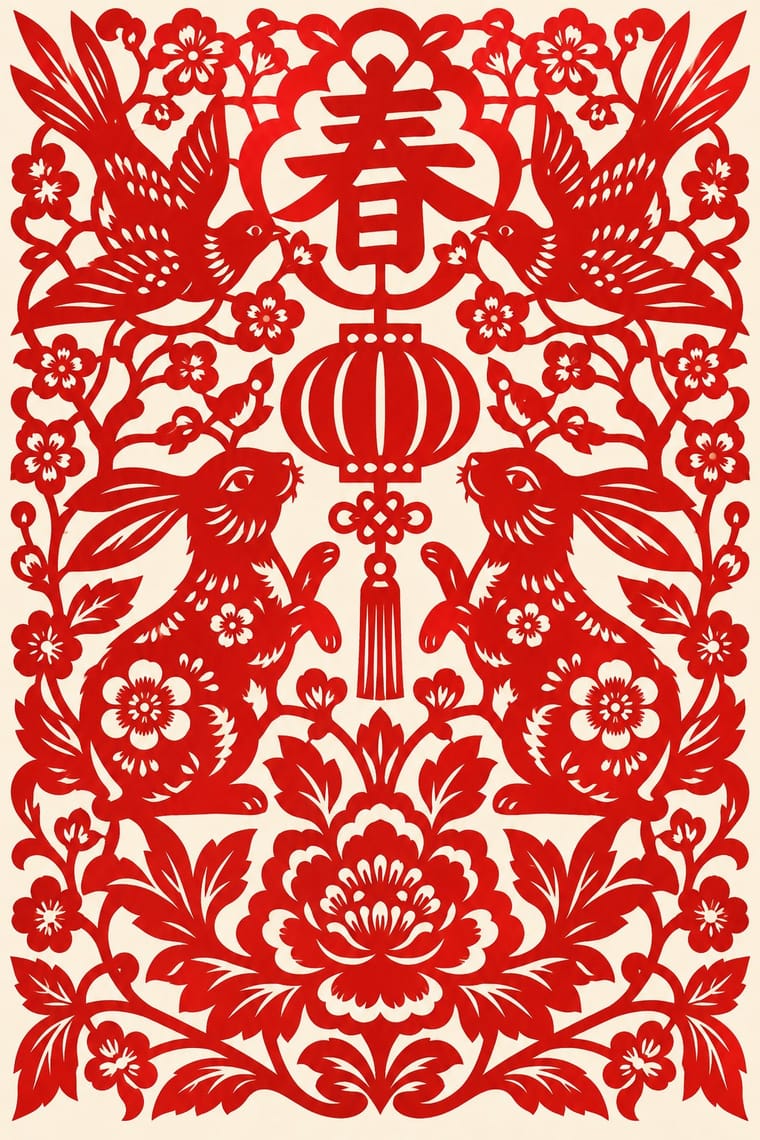
Both use pierced silhouettes and symmetry, and both have multicolour variants; distinguish these Polish regional formats and subjects from Chinese character-based and auspicious-image conventions rather than treating colour alone as the difference.
Mix them and make something Chinese Paper-Cut Polish Wycinanki
01
What each style brings
Each part of the design comes from the style with the stronger say in it, and each style gives at least two.
Chinese Paper-Cut (Jianzhi) Polish Wycinanki (Kurpie & Łowicz Paper-Cut)
- Type from Chinese Paper-Cut
- Colour from Chinese Paper-Cut
- Form from Chinese Paper-Cut
- Composition from Polish Wycinanki
- Surface from Polish Wycinanki
02
The type
Open fonts standing in for each style’s own type, which is often hand-drawn or commercial.
Display · Chinese Paper-Cut
Square
Shippori Mincho; Chinese Paper-Cut used Double happiness (囍) cut from folded red paper for weddings, the doubled character mirrored across the fold and Fu (福) and other auspicious characters cut as solid, bridged glyphs for the New Year
Text · Polish Wycinanki
Polish regional paper-cut graphics made for decorating homes: pierced trees and roundels, flowers, birds and scenes of rural life. Kurpie includes angular geometric cutwork and finer vegetal leluje; Łowicz builds bright ornament and narrative kodry from coloured paper on a backing. Axial and radial repetition organise many cuts, while freely composed scenes arrange figures and household objects. Contemporary packaging adapts the ornament; a museum has also proposed its use on cloth bags.
Archivo; Polish Wycinanki used Slab-serif Latin display capitals in contemporary packaging adaptation and Connected Latin script in contemporary packaging adaptation
03
The colours
The ground and leading colours come from Chinese Paper-Cut, with a counter-accent from Polish Wycinanki. The ink reads on the ground at 4.5:1 or more.
Chinese Paper-Cut (Jianzhi) Polish Wycinanki (Kurpie & Łowicz Paper-Cut)
-
#f5f0e6ground · 36% -
#c8161dink · 14% -
#c9a227accent · 18% -
#ebcb35accent · 14% -
#e0558aaccent · 10% -
#0879a5accent · 8%
As CSS
:root {
  --ground: #f5f0e6;
  --ink: #c8161d;
  --accent-1: #c9a227;
  --accent-2: #ebcb35;
  --accent-3: #e0558a;
  --accent-4: #0879a5;
  --font-display: "Shippori Mincho", serif;
  --font-text: "Archivo", sans-serif;
}
Use it with care
Chinese Paper-Cut (Jianzhi): Paper-cutting is a living craft, practised mostly by rural women who learn it from their mothers, and some cuts serve ritual ends, from invoking rain and warding off evil to calling back the spirit of the dead at funerals. Commission, buy from or credit named cutters and regional workshops rather than tracing their designs, keep auspicious characters correct and legible, do not use funerary or ritual cuts as festive decoration, and treat Miao embroidery-pattern cuts as part of a minority community's dress rather than a free motif bank. Use 囍 (double happiness) only for weddings, not as a generic Chinese luck motif; a 福 hung upside down at New Year is deliberate (倒福, a pun on 'fortune arrives'), so do not correct it, and do not flip other characters.
Polish Wycinanki (Kurpie & Łowicz Paper-Cut): This is living regional cultural heritage, with identifiable makers and family practices, not an anonymous national stock-motif library. Commission, credit and compensate named cutters for commercial work rather than tracing their compositions, and distinguish Kurpie, Łowicz and individual practices instead of labelling every bright floral pattern authentic Polish folk art. Museum-publicised objects are appropriate for contextual study, but publication does not establish an open image licence or permission to reproduce a cutter's work. Some leluje include angels, crosses or monstrance imagery and belong to Christian festive and devotional contexts; do not turn these into generic secular product decoration or infer one fixed sacred meaning for every tree or bird. Keep historical originals separate from later copies and modern branding adaptations. The palette is an illustrative approximation, not a measured historical colour standard. Typography weights describe only the inspected packaging adaptation; the historical paper cuts are predominantly wordless. Vocabulary gap: scissor-cut connected silhouettes, pierced negative space and pasted coloured-paper construction; stand-in: medium.textile at 0.6 uses that trait's broad applied-craft sense, also consistent with the museum's announced cloth-bag application, while layout.collage at 0.6 describes layering. Neither claims that the original works were woven, embroidered or made by a printing process.
04
The two styles
05
More combinations
With Chinese Paper-Cut
- Guna Mola Contrasts · Molas cut through stacked layers of cloth and stitch the edges, so colour builds in echo bands; paper-cut stays one flat layer of colour seen against light.
- Stencil Street Art Pairs well · Both depend on bridges that hold every island of the design to the sheet; give a spray stencil the paper-cut's folded symmetry and saw-tooth texture.
- Kamon (Japanese Family Crests) Contrasts · Kamon reduce an emblem to a spare roundel silhouette; paper-cut fills the same roundel with saw-tooth texture and pierced pattern, so set restraint against abundance.
- Nianhua & Chinese Folk Print Pairs well · Both dress the home for the New Year; hang a single red window cut beside a dense, keylined door-god print so flat void and crowded colour work together.
- Guochao (China-Chic National Trend) Pairs well · Guochao packaging borrows red cut-paper silhouettes; keep the real cut logic (joined lines, folded symmetry, correct auspicious characters) instead of a generic filigree texture.
- Swedish Painted Wall Hangings (Dalmålning, Bonadsmålning and Kurbits) Pairs well · A looser parallel: domestic wall decoration filled with symbolic flora, though cut paper rather than painted.
- Mithila (Madhubani) Painting Contrasts · Both are folk arts made mostly by rural women for weddings and other rites, with fish and lotus among their auspicious signs, but paper-cut is a silhouette, usually red, cut from one sheet and folded for mirror symmetry, while Mithila draws an outline and fills it with colour, hatching or rings until no ground is left. Use one of them, not a blend of the two.
- Javanese Wayang Kulit (Tatah Sungging) Contrasts · Both draw with holes cut through a flat sheet, but paper-cuts are usually folded, symmetrical and one-coloured, while a wayang figure is in profile, painted and gilded on both faces, and made to move.