Traditions & vernacular · 1886–present · Sub-Saharan Africa
Kanga (Swahili Message Cloth)
Also known as Khanga, Leso, Lesso
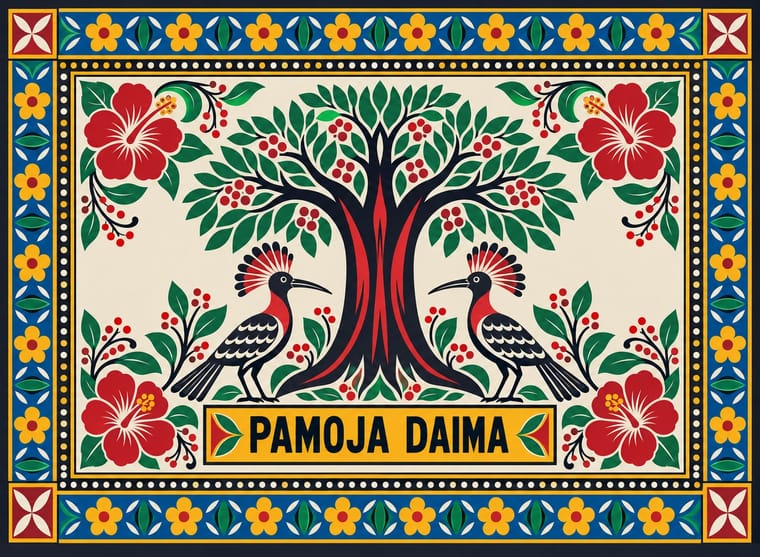
Printed cotton wraps worn by women of the Swahili coast and its hinterland since the late nineteenth century, bought in pairs. Each kanga is one composition, not cloth by the yard: a wide border (pindo) frames a central field (mji) holding one motif or an even repeat, and a short Swahili saying (jina) in capitals sits in a box at the foot of the field. Woodblock-printed at first and industrially printed since, flat in a few bold colours, the cloth is chosen and worn for what its words say: proverbs, barbs, blessings and slogans.
Make something in this styleGet advice in this styleMix it with another style
Use it with care
Kanga is the living dress of East African, especially Swahili, women: it wraps newborns, shrouds the dead and carries messages between neighbours, spouses and rivals, so its words matter more than its pattern. Never fill the text box with invented pseudo-Swahili or decorative Arabic letters (set Arabic script only when it spells a real, checked saying); use the brief's own words, or a real saying checked by a Swahili speaker with its translation, because a careless phrase can insult and some sayings invoke God. Some designs carry meanings of their own: the kisutu is bridal wear, in green or blue for a second or third marriage. Do not reuse portraits of real politicians or party emblems from campaign kangas out of context, and credit and commission East African designers and mills rather than presenting a generic 'African print'.
01
How it works
- Design one cloth, not yardage: a landscape rectangle about 150 by 110 cm with a wide, continuous border (pindo) on all four sides around a central field (mji).
- Fill the border with a close repeat of one or two motifs (cashew-shaped paisley, flowers, vines, diamonds or stripes) and close the cloth with a plain dark edge band.
- Put one centred motif in the field (a sofa, a ship, a fruit, a medallion or a portrait) and mirror the layout about the vertical axis, with matching motifs in the corners; or fill the field with an even repeat of dots or small figures.
- Set one short saying (the jina: a Swahili proverb, riddle, blessing or barb) in plain capitals inside a ruled box or ribbon at the lower centre of the field, so the cloth can be read like a sign.
- Print flat, opaque colour in a few inks, a black or navy key with one to three saturated colours such as marigold, red, green or sky blue, with no shading, gradients or texture, except the screened photo portrait in a commemorative medallion.
- For a commemoration or campaign, swap the motif for a portrait medallion, flag, emblem or date, and let the saying congratulate, thank or urge.
Swahili coast of East Africa, chiefly Zanzibar and Mombasa, where coastal traders commissioned the designs; printed in Europe, India and Japan until the mid-20th century, and after independence, above all from the 1970s, also in Kenyan and Tanzanian mills
02
Its design choices
From Stylogeny’s vocabulary of design choices: defining choices make the style, characteristic ones are usual, occasional ones turn up now and then.
- Layout & composition
- Space & hierarchy
- Colour
- Form & shape
- Surface & texture
- Ornament
- Imagery
- Medium & production
- Tone & intent
- Avoids
- Dynamic asymmetry, Diagonal axis, Full bleed, Ornament-free, Gradients, Illusion of depth, Experimental & distorted
Palette
#1b1c26#f0b323#c4262e#2e9a4e#1f70a6#f1ece2
Typefaces
Plain sans capitals
the jina, set in a ruled box at the foot of the field
Hand-drawn block capitals
drawn with the design before digital layout
Arabic script
early inscriptions, which wrote Swahili in Arabic letters; use it only for a real, checked saying, never as decorative lettering
Capitals on an arc or ribbon
commemorative kangas: 'HONGERA BARACK OBAMA' round a portrait
Known for
Kaderdina Hajee Essak ('Abdulla'), a Mombasa trader whose kangas, marked 'K.H.E. – Mali ya Abdulla', often added a Swahili proverb
Wikipedia, Kanga
Kanga, Zanzibar, early or mid-20th century
an even field of red and black moon-like dots on marigold inside a black and red border of paisley, with an Arabic-script inscription catalogued by the museum as Swahili ('Say what you will but he is mine'), printed in red in a box at lower centre (Art Institute of Chicago 2022.1491)
Kassamali Gulamhussein
(Zanzibar, 1912–2011), kanga with a red sofa centred on a yellow field in a border of flowers and vines, inscribed 'AHSANTE SOFA LA WAHISHIMIWA WETU' (Thank you for the sofa for our honorable ones), 1950s, from his hand-drawn and painted design; with his brother Hassanali he ran a kanga network across Zanzibar, Dar es Salaam and Mombasa from 1928 to 1964 and had kangas printed in Japan by Daido-Senko (Art Institute of Chicago 2022.1490)
Commemorative kanga, Kenya, 1945
a warship on a sea of dashes in a striped border with red roundels at the corners, inscribed 'Ahsante Bwana Churchill' (Thank you, Mr Churchill) (Art Institute of Chicago 2022.1488)
Tanganyika independence kanga, Dar es Salaam, 1961
an oval medallion reading 'UHURU 9 DECEMBER 1961' under green bunting on a white field, with 'ONGERA MWANANGU ONGERA' (Congratulations, my child, congratulations) on a ribbon below (Art Institute of Chicago 2022.1489)
Obama kanga, Dar es Salaam, 2008
a portrait in an oval ringed by 'HONGERA BARACK OBAMA' between two maps of Africa, in a border of blue diamond rosettes, with 'UPENDO NA AMANI AMETUJALIA MUNGU' below (Art Institute of Chicago 2024.313)
Kisutu, perhaps the oldest type of kanga
black speckled with red and white hearts, crosses and dots in a patterned field between broad borders, with or without a text at the foot; worn by brides at their weddings, in green for a second marriage and blue for a third (TRC Leiden, Boerma 2024)
Ziddi Msangi, artist-designed kangas in printed cotton, designed and made in the United States, among them 'My cooperation will come at a price. Carrier Corps 1914-1918' (2012) and 'My strength is my blood' (2021) (Victoria and Albert Museum T.41-2023, T.40-2023)
03
Make something in this style
Say what you need, and Stylogeny’s image studio draws it from Kanga (Swahili Message Cloth)’s design choices and checks it against them. It takes about a minute, and you get a link to share.
04
Where it comes from, and what it’s close to
Before it
The style it grew out of, and the styles it borrowed from.
Nothing earlier is recorded: in the atlas it is a starting point.

After it
The styles that grew out of it.
No later style in the atlas grew out of it yet.
Alike in its design choices
Styles that make many of the same choices, related or not, besides those above.


05
Sources
- Wikipedia: Kanga (African garment) (about 150 by 110 cm, sold in pairs; pindo, mji and jina; Kaderdina Hajee Essak's 'K.H.E. – Mali ya Abdulla' kangas with Swahili proverbs; inscriptions first in Arabic script, later in Roman letters; printed mainly in India, the Far East and Europe until the mid-20th century; today made by mills such as MeTL (Tanzania), Rivatex and Thika Cloth Mills (Kenya); political kangas): https://en.wikipedia.org/wiki/Kanga_(African_garment)
- National Museums of Kenya, 'Kanga: A Cloth That Unites', curated by Philemon Nyamanga, on Google Arts & Culture (earliest designs block printed; produced largely in Europe and India, with British, American, Dutch and Japanese imports dominating through the 20th century; textile mills set up in Kenya in the 1970s; Tanzania one of the largest producers by 1985): https://artsandculture.google.com/story/UQXRRgiEQNcJLA
- MacKenzie Moon Ryan, 'Kanga Textile Design, Education, and Production in contemporary Dar es Salaam, Tanzania', Textile Society of America Symposium Proceedings (2016), abstract (introduction in 1886; worn from southern Somalia to Mozambique; birth, initiation, brides' kitchen parties and burial uses; Obama kangas of 2008 and 2013; the standard composition of mji, pindo and jina): https://digitalcommons.unl.edu/tsaconf/1002
- MacKenzie Moon Ryan, 'Converging Trades and New Technologies: The Emergence of Kanga Textiles on the Swahili Coast in the Late Nineteenth Century', in Pedro Machado, Sarah Fee and Gwyn Campbell (eds), Textile Trades, Consumer Cultures, and the Material Worlds of the Indian Ocean (Palgrave Macmillan, 2018), as summarised by Things That Talk, Leiden University (Portuguese leso handkerchiefs sewn together; European printers answering with large rectangular cloths): https://thingsthattalk.net/nl/t/ttt:TNakjG/m/the-swahili-cloth/details
- Caroline Stone, 'Kangas', Textile Research Centre Leiden blog (2021) (earliest kangas woodblock printed, then soon produced industrially; many early to mid-20th-century kangas made in Japan; UK imports usually in two colours, ending in the 1950s; early Swahili phrases in Arabic script; border, phrase and large central motif; fruit, flowers and paisley shaped like a mango or a cashew): https://www.trc-leiden.nl/trc/index.php/en/blog/1186-kangas-by-caroline-stone
- Houston Community College, HCC Fashion Archive, 'Multicolored Cotton Kanga', Tanzania, 2000–2009 (donor note: 'Tanzanian hand screen printed red, gold, black and white Kanga'): https://hccfashion.omeka.net/items/show/436
- Marije Boerma, 'The kisutu: the longest living kanga and its deadly origin story', Textile Research Centre Leiden blog (2024) (central field framed by a border; the jina at the bottom; a kanga without text called kanga bubu; cloths named after their motif; the kisutu, perhaps the oldest type of kanga, black speckled with red and white hearts, crosses and dots, worn by brides, in green or blue for a second or third marriage, with or without a text): https://trc-leiden.nl/trc/index.php/en/blog/1626-the-kisutu-the-longest-living-kanga-and-its-deadly-origin-story
- Art Institute of Chicago, kanga records read through api.artic.edu, with inscriptions, translations and curatorial texts: 2022.1491 (https://www.artic.edu/artworks/262765), 2022.1490 by Kassamali Gulamhussein (https://www.artic.edu/artworks/262762), 2022.1488 (https://www.artic.edu/artworks/262764), 2022.1489 (https://www.artic.edu/artworks/262763; its 'my children' corrected to the singular, since mwanangu is 'my child', Wiktionary: https://en.wiktionary.org/wiki/mwanangu), 2024.313 (https://www.artic.edu/artworks/269179)
- Victoria and Albert Museum, Ziddi Msangi kangas T.39-2023, T.40-2023 and T.41-2023, records read through api.vam.ac.uk ('Printed cotton, designed and made by Ziddi Msangi in the United States'; e.g. https://collections.vam.ac.uk/item/O1743711/)
- Bard College, Textiles That Talk: East African Kangas and Their Meanings (inscriptions addressed to spouses, rivals or the public; proverbs, political slogans and public information; Kawira Mwirichia's LGBTQ kanga designs): https://eh.bard.edu/projects/textiles-that-talk-east-african-kangas-and-their-meanings/
How Stylogeny researches and checks a style: where the facts come from.