Traditions & vernacular · 1867–present · Middle East & North Africa
Khayamiya ( Cairene Tentmaker Appliqué )
Also known as Egyptian tentmaker appliqué, Khayamiyya, Khedival khayamiya, Tentmakers of Cairo
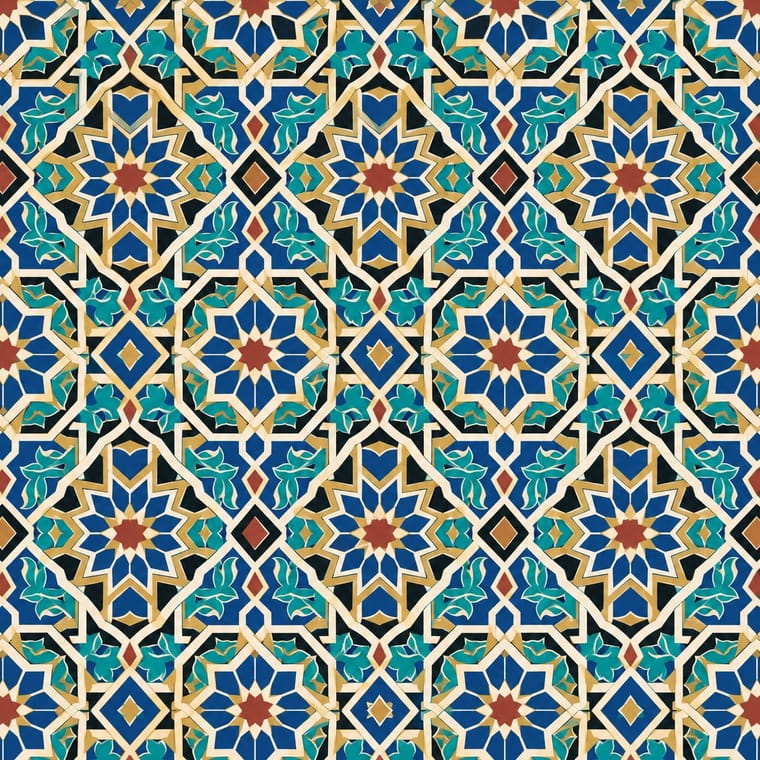
Cairo's tentmakers cut and hand-stitch coloured cotton shapes onto a heavy cotton backing to make large vertical panels and pavilion screens: bordered fields, repeat patterns and arabesques whose stepped, turned cloth edges are the drawing line. Khedival panels, touristic pieces and contemporary works differ in repertoire, from geometry and calligraphy to Pharaonic and folkloric scenes.
Use it with care
Khayamiya is a living community's craft: the Cairo tentmakers are named individuals and workshops who compete on original designs and protect them from copying, and some panels carry sacred calligraphy or a mihrab. Commission and credit named makers, do not copy a distinctive personal design or devotional text, do not generate imitations of devotional text, do not mix traditional handmade panels with mass-printed imitations, and use only publicly documented objects with verified image rights.
01
How it works
Palette
-
#f1e4cb -
#1f3a68 -
#b5342a -
#2f6b4f -
#e3a72f -
#2b2622
Typefaces
-
Arabic calligraphy cut as appliqué
Qur'anic and devotional text on calligraphic panels, treated with respect
-
Hand-cut Arabic and Latin name labels on touristic panels
- Build every shape from cut and turned pieces of flat-coloured cotton stitched onto a heavy backing, so that the stitched edge is the line.
- Divide the panel into a bordered field and compartments, with repeat units sized for hanging vertically as a screen.
- Let large repeat patterns and arabesques fill the field evenly; place no single picture-style focal point in a geometric panel.
- Keep colours as flat, saturated cloth blocks and let the seams separate them instead of outlines or gradients. The historical Khedival core is limited-spot (indigo, red and white on beige); green, yellow and a wider palette belong to later touristic and contemporary work.
- Credit the individual tentmaker and treat calligraphy and original designs as a living maker's property: commission rather than copy.
Where and when Cairo, Egypt: the Street of the Tentmakers (Shari'a al-Khayamiyya) in the Qasaba of Radwan Bey, a covered market near Bab Zuwayla.
Cairo, Egypt: the Street of the Tentmakers (Shari'a al-Khayamiyya) in the Qasaba of Radwan Bey, a covered market near Bab Zuwayla. Wikipedia dates the Khedival category to 1867-1914; tentmaking itself is older, and its earlier history is not covered here. Sam Bowker's paper, 'The symmetry of khayamiya and quilting: International relations of the Egyptian tentmakers' (Craft + Design Enquiry 6, 2014, pp. 29-60), is the research anchor and concerns the tentmakers' patronage and international relations. Panels range from Khedival architectural screens through touristic figurative pieces to contemporary indoor panels, and are distinct from mass-printed imitation khayamiya.
02
Its design choices
From Stylogeny’s vocabulary of design choices: defining choices make the style, characteristic ones are usual, occasional ones turn up now and then.
- Layout & composition
- Space & hierarchy
- Colour
- Form & shape
- Surface & texture
- Ornament
- Medium & production
- Tone & intent
- Avoids
- Gloss & highlights, Frosted glass, Gradients, Straight photography, Naturalistic depiction, Illusion of depth, Ornament-free, Dynamic asymmetry, Fluorescent & neon, Pastel
How its pictures are made Systematic
Kind of picture: Systematic
Known for
-
Khedival khayamiya panels and pavilion screens illustrated in Sam Bowker's paper
see the paper's illustrations; figure numbers and attributions not verified here
-
Contemporary tentmaker panels and a mihrab illustrated in the same paper
a sacred-context research anchor, not a prompt for imitation
-
Street of the Tentmakers, Cairo
the workshops and shops in the Qasaba of Radwan Bey near Bab Zuwayla
03
Where it comes from, and what it’s close to
Khayamiya (Cairene Tentmaker Appliqué) 1867–present
No later style in the atlas grew out of it yet.
Alike in its design choices
04
Often taken for
Khayamiya has no real works recorded yet, so these are its nearest styles by its choices alone, with the choices that tell them apart.
-
Portuguese Azulejo Pattern & Panel Graphics
1 of Portuguese Azulejo Pattern & Panel Graphics’s 1 real works fits Khayamiya’s choices as well as its own: 12 x 12 pattern module (Marvila pattern).
Choices that tell Khayamiya and Portuguese Azulejo Pattern apart Choice Khayamiya Portuguese Azulejo Pattern Earth & mineral characteristic — Gloss & highlights avoids characteristic Non-representational characteristic — Monochrome — defining Biomorphic curves characteristic — No shared descent in the atlas: they reached these choices separately.
-
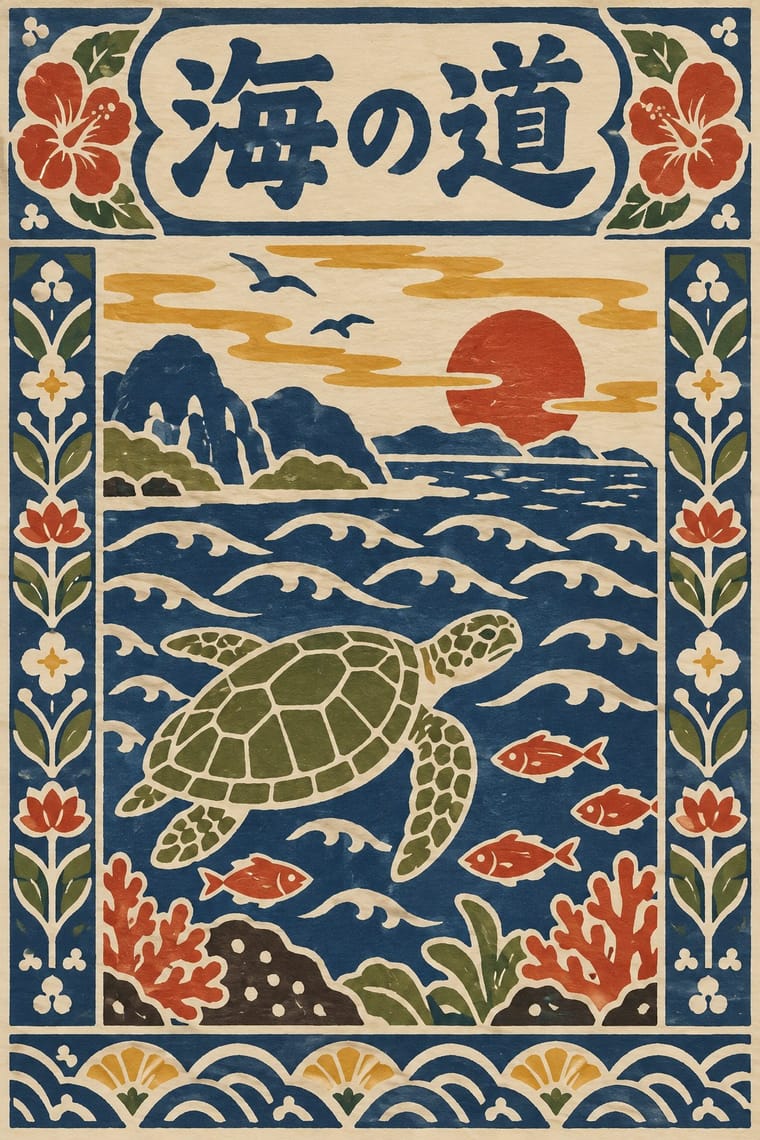
Serizawa Katazome and Mingei Stencil-Dye Graphics
Serizawa Katazome and Mingei Stencil-Dye Graphics is one of Khayamiya’s nearest styles by choices; no real work of either fits the other better.
Choices that tell Khayamiya and Serizawa Katazome and Mingei Stencil-Dye Graphics apart Choice Khayamiya Serizawa Katazome and Mingei Stencil-Dye Graphics Non-representational characteristic — Stylised figuration occasional defining Geometric tessellation characteristic — Hand-lettering occasional defining Architecture & signage characteristic — No shared descent in the atlas: they reached these choices separately.
-
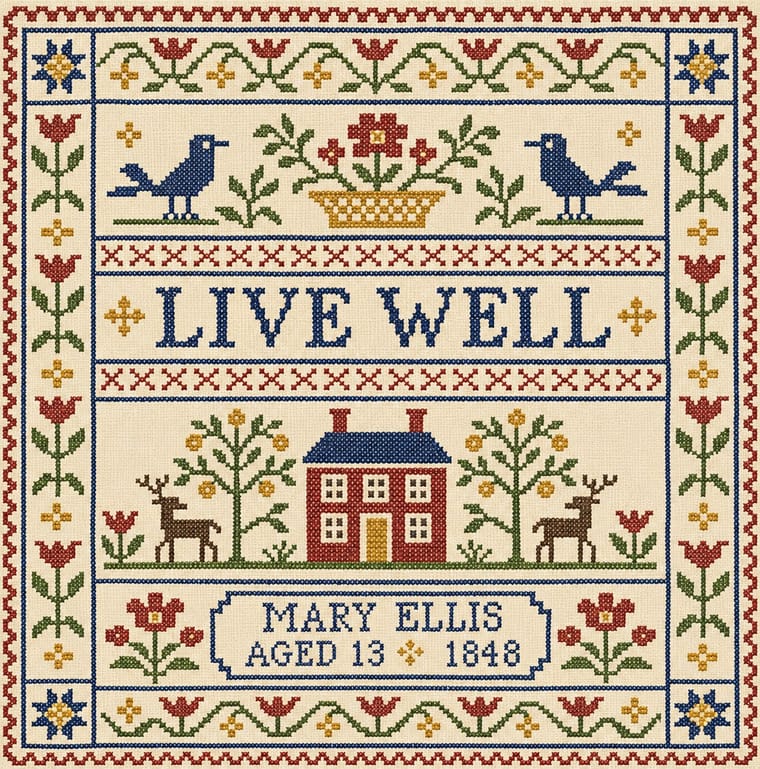
Needlework Sampler Lettering
Needlework Sampler Lettering is one of Khayamiya’s nearest styles by choices; no real work of either fits the other better.
Choices that tell Khayamiya and Needlework Sampler Lettering apart Choice Khayamiya Needlework Sampler Lettering Earth & mineral characteristic — Naturalistic depiction avoids occasional Non-representational characteristic — Rectilinear occasional defining Biomorphic curves characteristic — No shared descent in the atlas: they reached these choices separately.
-
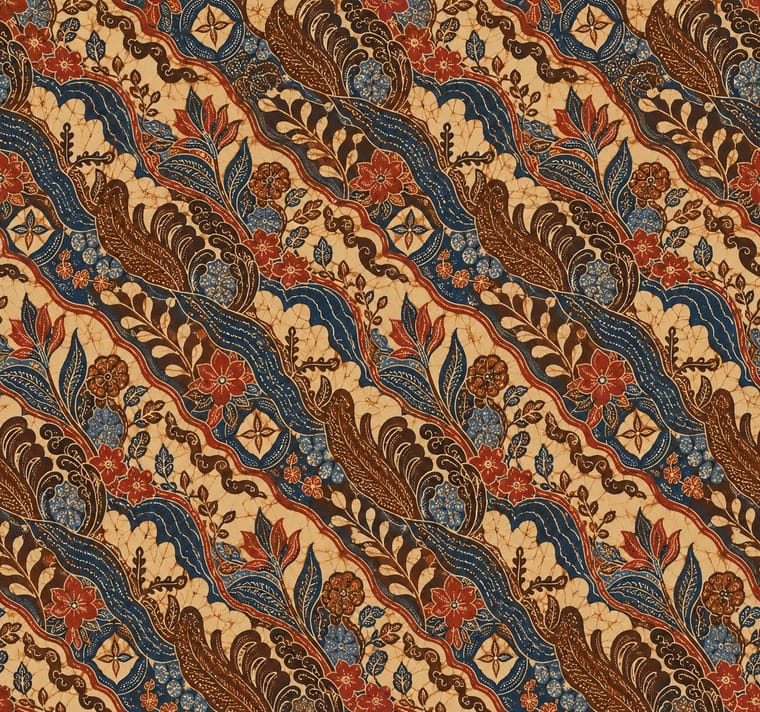
Sápmi Graphic Identity (Duodji & Gákti Colour Code)
Sápmi Graphic Identity is one of Khayamiya’s nearest styles by choices; no real work of either fits the other better.
Choices that tell Khayamiya and Sápmi Graphic Identity apart Choice Khayamiya Sápmi Graphic Identity Framed panels defining occasional Primary triad — defining Limited spot colours characteristic — Folk & sacred symbols occasional defining Biomorphic curves characteristic — No shared descent in the atlas: they reached these choices separately.
— means the choice isn’t among the style’s recorded choices. Critics recorded each work’s choices with the styles’ descriptions in view, so this shows whether the descriptions hold together, not proof that they are right.
05
Sources
- Sam Bowker, 'The symmetry of khayamiya and quilting: International relations of the Egyptian tentmakers', Craft + Design Enquiry 6, ANU Press, 2014, pp. 29-60, DOI 10.22459/CDE.06.2014.03 (https://press-files.anu.edu.au/downloads/press/p288791/pdf/The-symmetry-of-khayamiya.pdf)
- Wikipedia: 'Khayamiya' (https://en.wikipedia.org/wiki/Khayamiya: Street of the Tentmakers, appliqué technique on heavy cotton backing, Khedival period 1867-1914, touristic, street and contemporary types; some claims there are tagged citation needed)
How Stylogeny researches and checks a style: where the facts come from.