Traditions & vernacular · 1600–present · Southeast Asia
Batik Pattern Tradition
Also known as Batik tulis, Batik cap, Javanese wax-resist textile
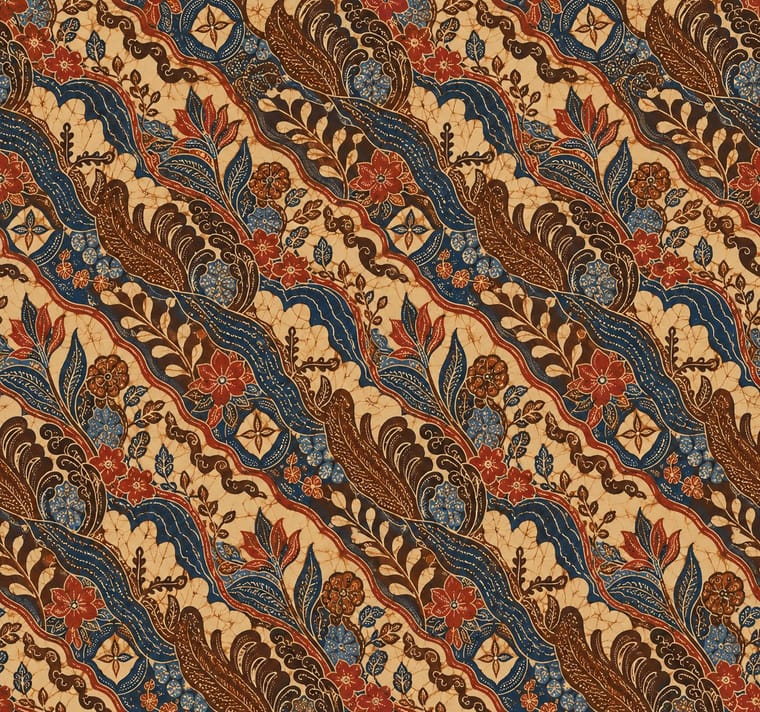
The Javanese wax-resist textile tradition in which hot wax is drawn with a canting or stamped with a copper cap, then dyed in successive baths to build layered all-over patterns. Court batik of Yogyakarta and Surakarta keeps to indigo, soga brown and cream with diagonal parang and four-lobed kawung repeats; north-coast batik absorbs Chinese, Dutch and Arab motifs in brighter colour.
Make something in this styleGet advice in this styleMix it with another style
Use it with care
Batik is inscribed by UNESCO as Indonesian intangible cultural heritage (2009), and some court motifs such as parang rusak were historically reserved for royalty and carry philosophical meanings. Learn a motif's meaning before using it, credit the region and makers, and do not market printed batik-look fabric as hand-drawn or stamped batik.
01
How it works
- Cover the whole cloth with a repeating pattern and fill every motif with fine isen-isen dots and lines.
- Build colour in layers from light to dark, protecting each stage with wax so colours stack rather than mix.
- Let the crackle of the wax and the slight wobble of the hand-drawn line remain as part of the finish.
- Structure the repeat on a diagonal band (parang) or a four-lobed lattice (kawung), with a distinct head panel and borders on sarongs.
- Choose between restrained court colour (indigo, soga brown, cream) and bright coastal polychrome rather than mixing the two.
Central Javanese court cities (Yogyakarta, Surakarta) and north-coast pesisir towns (Pekalongan, Lasem, Cirebon), Indonesia
02
Its design choices
From Stylogeny’s vocabulary of design choices: defining choices make the style, characteristic ones are usual, occasional ones turn up now and then.
- Layout & composition
- Typography
- Colour
- Form & shape
- Surface & texture
- Ornament
- Imagery
- Medium & production
- Tone & intent
- Avoids
- Generous white space, Single focal point, Isolated object, Fluorescent & neon, Naturalistic depiction, Straight photography
Palette
#6b3e1e#1f2f4f#ecdcbc#2a1c14#a6322b#2c6aa0
Typefaces
Arabic calligraphy of batik besurek (Bengkulu) and Cirebon
Signed Latin script of batik Belanda workshops
Known for
Kraton batik of Yogyakarta and Surakarta
Eliza van Zuylen
Pekalongan, batik Belanda, early 20th c.
Oey Soe Tjoen workshop
Kedungwuni, peranakan batik
Go Tik Swan / K.R.T. Hardjonagoro
Batik Indonesia
Iwan Tirta
Mega mendung cloud batik of Cirebon
Trusmi
03
Make something in this style
Say what you need, and Stylogeny’s image studio draws it from Batik Pattern Tradition’s design choices and checks it against them. It takes about a minute, and you get a link to share.
04
Where it comes from, and what it’s close to
Before it
The style it grew out of, and the styles it borrowed from.
Nothing earlier is recorded: in the atlas it is a starting point.

Alike in its design choices
Styles that make many of the same choices, related or not, besides those above.


05
Real works
Artefacts in museums, libraries and archives that show the style, linked at their source.
- Kain Panjan (Skirt)1800s · The Cleveland Museum of Art
- Wearing Cloth1800s · The Cleveland Museum of Art
- Sarongmid-1800s · The Cleveland Museum of Art
- Heupdoek (Sarung) with geometric and floral motifsc. 1875 – c. 1925 · Rijksmuseum, Amsterdam (on loan from the Vereniging van Vrienden der Aziatische Kunst), via Wikimedia Commons
- Sarong (batik Belanda, bouquet design)Eliza van Zuylen · early 20th century · Honolulu Museum of Art (accession 5143.1); gallery photograph on Wikimedia Commons

06
Sources
- https://publications.artgallery.yale.edu/indonesian-textiles/catalogue/4-Java/Java-intro
- Inger McCabe Elliott, Batik: Fabled Cloth of Java (1984)
- https://ich.unesco.org/en/RL/indonesian-batik-00170
How Stylogeny researches and checks a style: where the facts come from.