Traditions & vernacular · c. 1450–present · Southern Europe
Portuguese Azulejo Pattern & Panel Graphics
Also known as Azulejo Português, Portuguese azulejaria, Portuguese tile-painting tradition
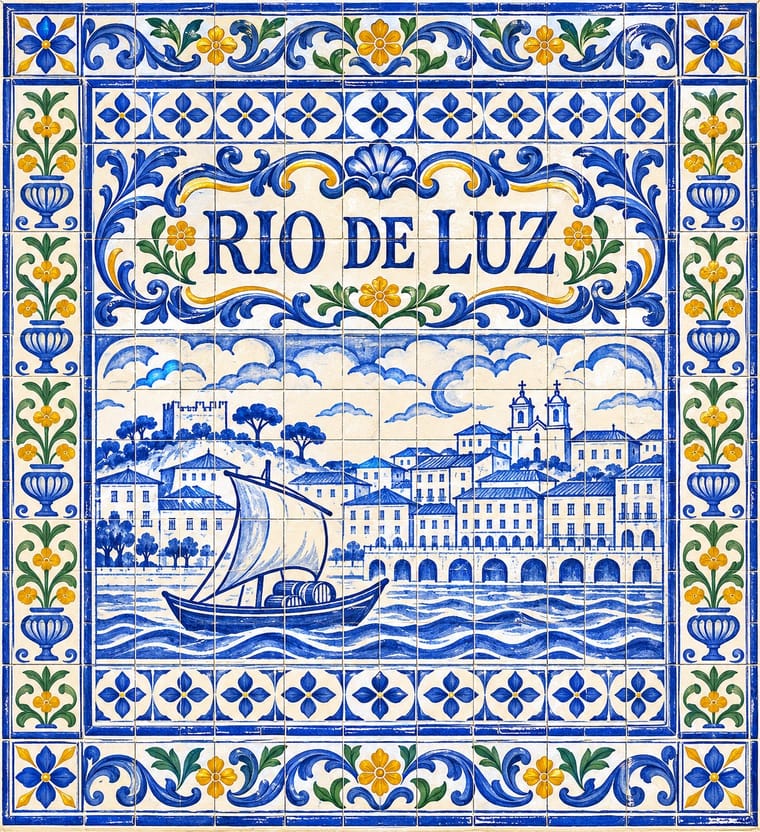
Portugal's glazed-tile tradition: square modules combined into carpet-like repeats framed by borders and friezes, in blue-on-white or blue, green and yellow, alongside hand-painted figurative panels. Its graphic afterlife turns tile pattern and narrative into packaging, city identities and colour fonts.
Make something in this style Get advice in this style Mix it with another style
Use it with care
Many panels were commissioned by the Church and nobility, and some adapted European engravings or showed colonial scenes; do not strip devotional or colonial narratives of context and use them as plain ornament. Azulejo painting and manufacture remain living craft: distinguish a printed pattern from a hand-painted glazed tile, and credit contemporary makers and workshops.
01
Its picture in other colours
Change a colour and every picture on this page follows. It happens in your browser, from the same pictures: nothing new is made or saved.
Choose a colour to change it
-
#f4f1ea -
#1f3d8f -
#2f5fb3 -
#3f7d4e -
#d9a521
A faded colour isn’t in these pictures, so changing it changes nothing.
Light and dark stay where they are; greys hardly move.
More colours: any style’s, or your own
The pictures show the style’s own colours.
02
Make something in this style
Say what you need, and Stylogeny’s image studio draws it from Portuguese Azulejo Pattern & Panel Graphics’s design choices and checks it against them. It takes about a minute, and you get a link to share.
03
How it works
Palette
-
#f4f1eaground · 21% -
#1f3d8fink · 6% -
#2f5fb3accent · 19% -
#3f7d4eaccent · 1% -
#d9a521accent · 4%
Shares measured from its 2 pictures. The ground is what the pictures sit on (of the colours covering most, the most neutral), the ink stands out from it most, the rest are accents.
Typefaces
-
Hand-painted tile lettering and dedications
-
Painted inscriptions and cartouche lettering on panels
- Build the surface from square modules, then combine them into larger repeats such as 2x2, 4x4 or 6x6 units.
- Frame every pattern field with a border or frieze so the wall reads as a carpet.
- Paint in cobalt blue on white, or add green and yellow, as flat glazed colour.
- Let narrative panels sit inside ornamental frames, separate from the repeat pattern around them.
- Translate the tile into other media by keeping its module, outline and blue, not by imitating the glaze.
Portugal, especially Lisbon and Porto. Early wall coverings used imported Hispano-Moresque tiles; local production in Lisbon began in the second half of the 16th century, encouraged by Flemish artisans.
With an idea put on it
-
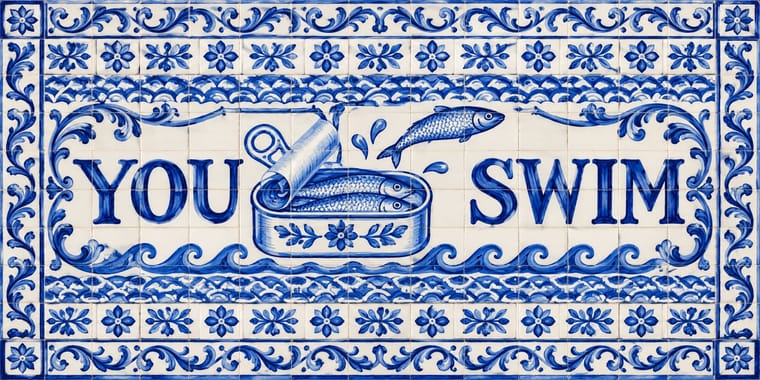
Rebus An open sardine can sits between the words YOU and SWIM in place of the missing word, so the panel reads aloud 'You can swim', with one sardine leaping out of the can as if diving into the pool.
AI-generated: Portuguese Azulejo Pattern & Panel Graphics with an idea put on it. Not a real or historical work.
Change it with an idea. Any of the 73 moves that make a design say something can go on this style.
04
Its design choices
From Stylogeny’s vocabulary of design choices: defining choices make the style, characteristic ones are usual, occasional ones turn up now and then.
- Layout & composition
- Space & hierarchy
- Typography
- Colour
- Form & shape
- Surface & texture
- Ornament
- Medium & production
- Tone & intent
- Avoids
- Dynamic asymmetry, Generous white space, Glitch, Straight photography, Fluorescent & neon, Experimental & distorted, Rebellious & subversive, Ornament-free
How its pictures are made Systematic
Kind of picture: Systematic
Known for
-
Museu Nacional do Azulejo, Lisbon, the national collection of azulejo panels
-
Nossa Senhora da Vida panel (1580), attributed to Marçal de Matos, about 1,498 tiles
-
Real Fábrica de Louça ao Rato (1765-1835) and Rafael Bordalo Pinheiro's Caldas da Rainha factory
-
Studio Eduardo Aires, Porto City Identity (2014)
icons inspired by narrative blue tiles
05
Where it comes from, and what it’s close to
Borrowed from
Portuguese Azulejo Pattern & Panel Graphics c. 1450–present
No later style in the atlas grew out of it yet.
Alike in its design choices
06
Combine it with
Styles Portuguese Azulejo Pattern & Panel Graphics pairs well with or plays against, from the research. Each is worked out as a combination: which style gives the type, the colours and the forms.
- Art Nouveau Pairs well · Rafael Bordalo Pinheiro's Caldas da Rainha ceramics are the Portuguese point of contact; Art Nouveau's whiplash florals suit the border and frieze.
- Islamic Geometric & Calligraphic Tradition Pairs well · Borrow its tessellation logic for the repeat module, but keep Portuguese framing, floral motifs and narrative panels.
- Estado Novo Folk Modernism (SPN) Contrasts · Shares Portuguese national imagery but not its propaganda, heraldry or rural costume; avoid sliding into the regime's version.
07
Often taken for
Stylogeny checks the choices recorded in Portuguese Azulejo Pattern & Panel Graphics’s one real work against all 702 styles. None fits its own choices best.
One fits a close style’s choices as well or better, as below. That means the two styles share those choices, not that the work is misfiled.
-
Khayamiya (Cairene Tentmaker Appliqué)
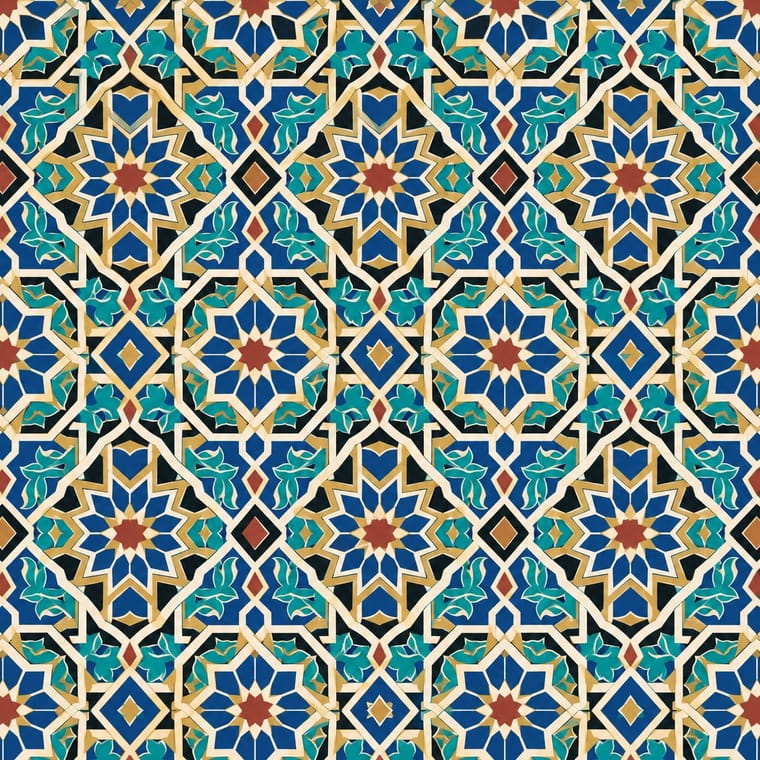
1 of its 1 real works fits Khayamiya’s choices as well as its own: 12 x 12 pattern module (Marvila pattern).
Choices that tell Portuguese Azulejo Pattern and Khayamiya apart Choice Portuguese Azulejo Pattern Khayamiya Gloss & highlights characteristic avoids Earth & mineral — characteristic Monochrome defining — Non-representational — characteristic Modular grid defining — No shared descent in the atlas: they reached these choices separately.
-
West African Barbershop & Hair Salon Signs
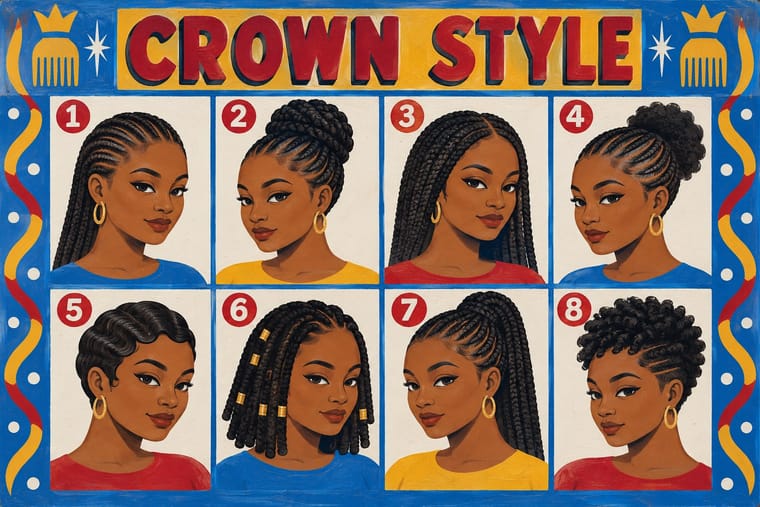
West African Barbershop & Hair Salon Signs is one of Portuguese Azulejo Pattern & Panel Graphics’s nearest styles by choices; no real work of either fits the other better.
Choices that tell Portuguese Azulejo Pattern and West African Barbershop apart Choice Portuguese Azulejo Pattern West African Barbershop Monochrome defining — Stylised figuration occasional defining Pattern & repeat defining — Painterly illustration occasional defining Light ground defining occasional No shared descent in the atlas: they reached these choices separately.
-
Al-Qatt Al-Asiri (Asiri Women's Wall Painting)
Al-Qatt Al-Asiri is one of Portuguese Azulejo Pattern & Panel Graphics’s nearest styles by choices; no real work of either fits the other better.
Choices that tell Portuguese Azulejo Pattern and Al-Qatt Al-Asiri apart Choice Portuguese Azulejo Pattern Al-Qatt Al-Asiri Monochrome defining — Full polychrome occasional defining Modular grid defining — Earth & mineral — characteristic Limited spot colours characteristic — No shared descent in the atlas: they reached these choices separately.
-
Ndebele Geometric Painting
Ndebele Geometric Painting is one of Portuguese Azulejo Pattern & Panel Graphics’s nearest styles by choices; no real work of either fits the other better.
Choices that tell Portuguese Azulejo Pattern and Ndebele Geometric Painting apart Choice Portuguese Azulejo Pattern Ndebele Geometric Painting Monochrome defining — Angular & zigzag — defining Modular grid defining — Central symmetry — defining Limited spot colours characteristic — No shared descent in the atlas: they reached these choices separately.
— means the choice isn’t among the style’s recorded choices. Critics recorded each work’s choices with the styles’ descriptions in view, so this shows whether the descriptions hold together, not proof that they are right.
08
Real works
Artefacts in museums, libraries and archives that show the style, linked at their source.
- 12 x 12 pattern module (Marvila pattern) 1622/1674 · Museu Nacional do Azulejo, Lisbon; photograph on Wikimedia Commons
09
Sources
- Museu Nacional do Azulejo, The Azulejo in Portugal. An identitary art. A world heritage.: https://artsandculture.google.com/story/agUB70vTvN7aIg
- Museu Nacional do Azulejo: https://mnazulejo.gov.pt/museu
- Studio Eduardo Aires, Porto City Identity: https://www.eduardoaires.com/projects/project/porto.html
How Stylogeny researches and checks a style: where the facts come from.