Pictorial & machine age · 1965–present · Sub-Saharan Africa
Congolese Bande Dessinée ( Kinshasa Comics Scene )
Also known as BD congolaise, Kinshasa BD, Congolese comics
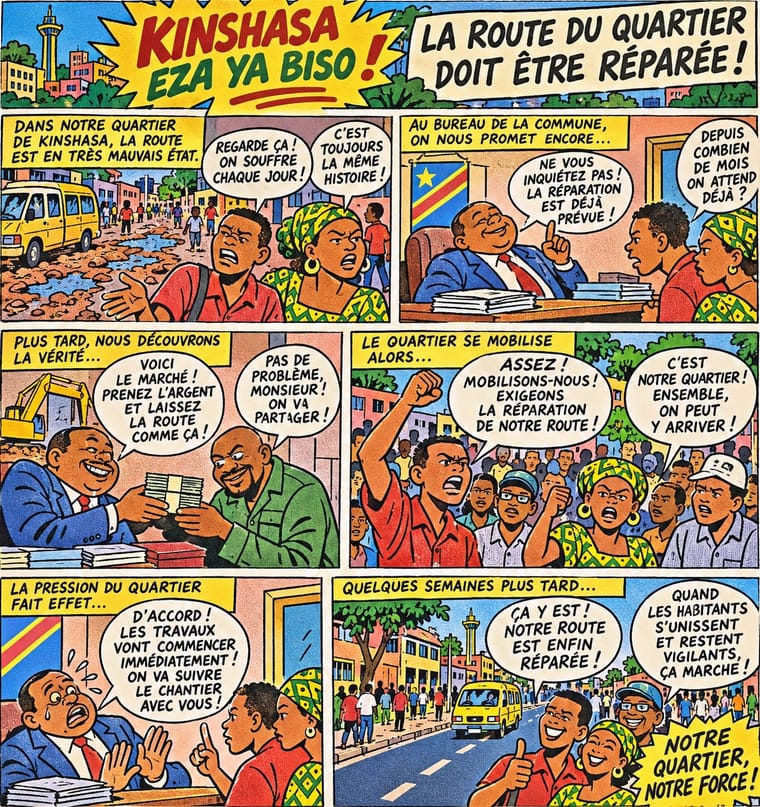
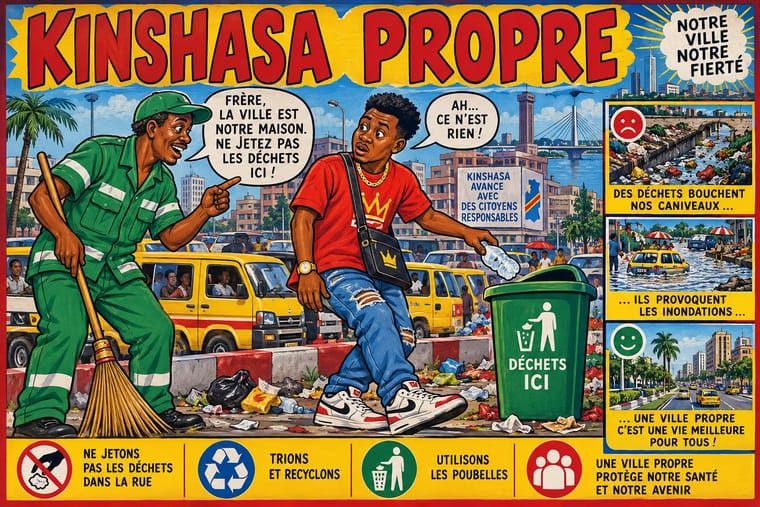
The comics of Congolese cartoonists, set in Kinshasa street life and politics and written in Lingala and French. It takes the Franco-Belgian page grammar of framed panels, balloons and clear outline-and-flat-colour drawing, then bends it with caricatured figures, local dress and satire, printed on cheap paper or in artisanal fascicles sold at markets.
Make something in this style Get advice in this style Mix it with another style
Use it with care
This is the living, signed work of Congolese cartoonists such as Barly Baruti and Pat Masioni, and of Mfumu'eto's creator, whose manuscripts are held at the University of Florida: borrow the method, not their characters, pages or lettering, and credit or commission Congolese artists where you can. The satire is self-critique from inside Kinshasa aimed at power and money; never reuse the colonial caricature of Tintin au Congo, never exaggerate racial features for a laugh, and never fill balloons with invented pseudo-Lingala: have a speaker write the text.
01
Its picture in other colours
Change a colour and every picture on this page follows. It happens in your browser, from the same pictures: nothing new is made or saved.
Choose a colour to change it
-
#f1e6c8 -
#1a1a1a -
#c8372d -
#e0a526 -
#2f7a4a -
#2c5d8f
A faded colour isn’t in these pictures, so changing it changes nothing.
Light and dark stay where they are; greys hardly move.
More colours: any style’s, or your own
The pictures show the style’s own colours.
02
Make something in this style
Say what you need, and Stylogeny’s image studio draws it from Congolese Bande Dessinée (Kinshasa Comics Scene)’s design choices and checks it against them. It takes about a minute, and you get a link to share.
03
How it works
Palette
-
#f1e6c8accent · 11% -
#1a1a1aink · 1% -
#c8372daccent · 13% -
#e0a526ground · 23% -
#2f7a4aaccent · 12% -
#2c5d8faccent · 8%
Shares measured from its picture. The ground is what the pictures sit on (of the colours covering most, the most neutral), the ink stands out from it most, the rest are accents.
Typefaces
-
Hand-lettered balloon capitals
-
Hand-drawn titling in the Franco-Belgian BD tradition
-
Stencil and photocopy-cut headline lettering on Mfumu'eto fascicles
Wikipedia, Revue Mfumu'eto
- Tell the story in framed panels read in sequence, with balloons and captions in real Lingala or French.
- Draw people and streets in clean outline with flat colour, then exaggerate faces and gestures for satire.
- Set stories in Kinshasa's own streets, dress, signage and politics rather than a borrowed European setting.
- Make the page cheaply: inexpensive paper, with some titles (Mfumu'eto) self-produced with stencils and photocopiers and others printed as offset albums, sold where readers already shop.
- Aim the joke at power, money and daily survival, from inside the community.
Kinshasa, DR Congo: magazines such as Jeunes pour jeunes (begun 1965 as Gento oye, renamed 1968), Bédé Afrique (1986) and the artists' association ACRIA (early 1990s), with part of the scene publishing in Europe from the 1990s
Change it with an idea. Any of the 73 moves that make a design say something can go on this style.
04
Its design choices
From Stylogeny’s vocabulary of design choices: defining choices make the style, characteristic ones are usual, occasional ones turn up now and then.
- Layout & composition
- Space & hierarchy
- Form & shape
- Surface & texture
- Ornament
- Medium & production
- Tone & intent
- Avoids
- Central symmetry, Generous white space, Didone, Script, Straight photography, Gloss & highlights, Frosted glass, Calm & contemplative, Luxurious & glamorous
How its pictures are made Drawn & painted
Kind of picture: Drawn & painted
Known for
-
Barly Baruti
trained at Angoulême and the Studios Hergé; Eva K, Mandrill; co-founder of ACRIA
-
Pat Masioni
Rwanda 94; The Unknown Soldier for Vertigo
-
Revue Mfumu'eto
Papa Mfumu'Eto 1er, Kinshasa, from 1990
-
Mongo Sisé
published in Spirou in 1980 and 1982
-
Bédé Afrique
1986
-
Jeunes pour jeunes magazine
begun 1965 as Gento oye, renamed 1968
-
ACRIA's five Kinshasa comics salons
1991-2005
05
Where it comes from, and what it’s close to
Grew out of
Borrowed from
Congolese Bande Dessinée (Kinshasa Comics Scene) 1965–present
No later style in the atlas grew out of it yet.
Alike in its design choices
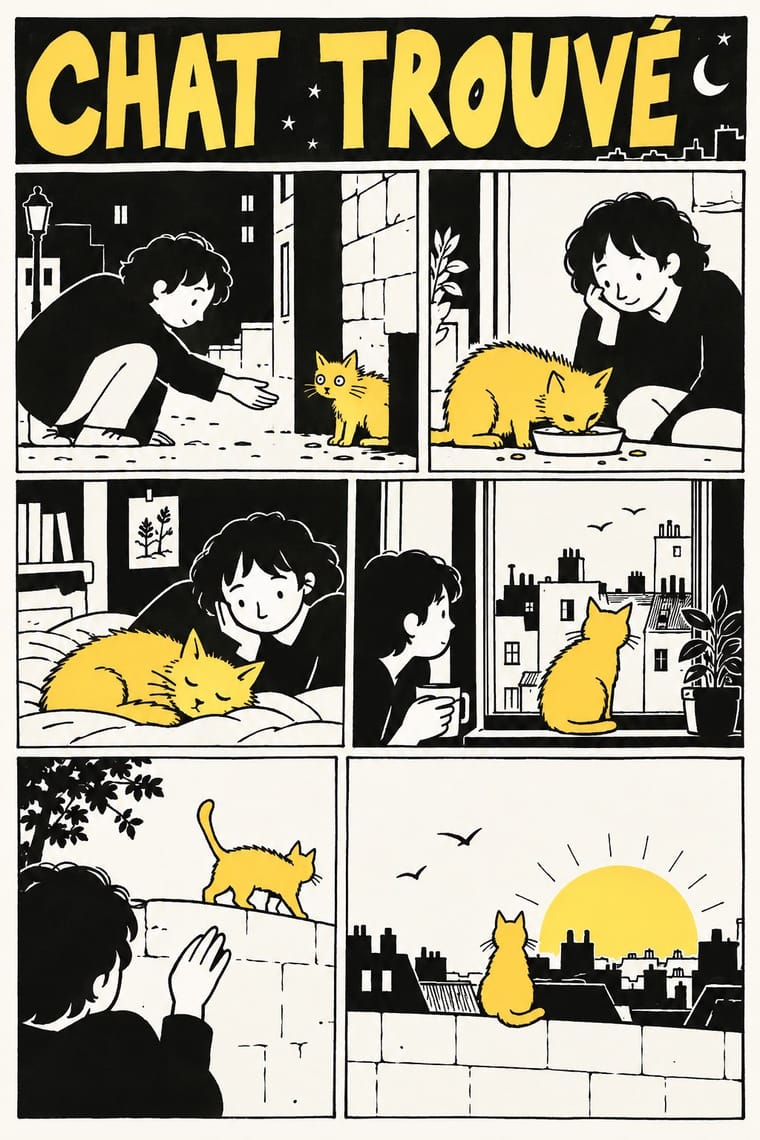
06
Combine it with
Styles Congolese Bande Dessinée (Kinshasa Comics Scene) pairs well with or plays against, from the research. Each is worked out as a combination: which style gives the type, the colours and the forms.
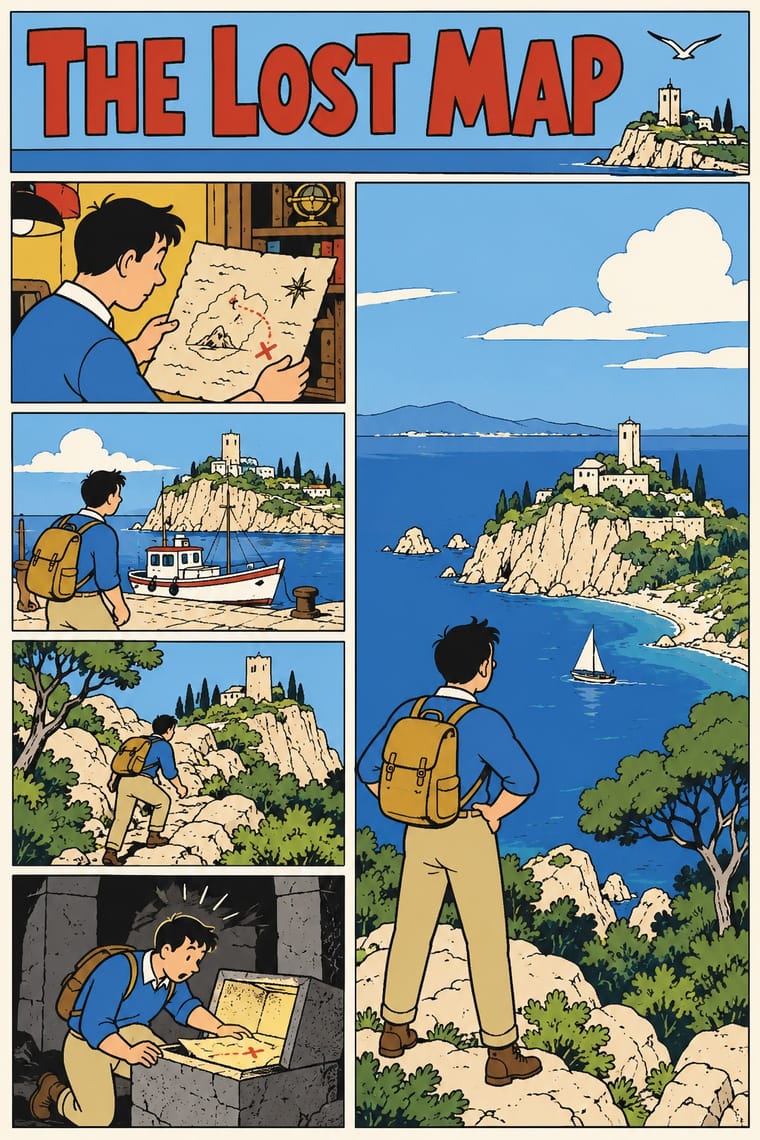
- Ligne Claire (Franco-Belgian Clear Line) Contrasts · The same clear outline and flat colour, but rough, local and satirical against Hergé-school polish and nostalgia. The ligne-claire parentage fits the Europe-trained strand (Baruti, Studios Hergé) only; Mfumu'eto and the market fascicles are far rougher.
- American Four-Colour Comic Book (Golden to Bronze Age) Pairs well · Take its balloon and caption mechanics, then keep the clear outline and local setting instead of superhero spectacle.
- Kinshasa Popular Painting Pairs well · Borrow its words-inside-the-scene captions and saturated colour to push a panel page toward Kinshasa's street satire.
- Sani and Swahili Humour-Magazine Comics Pairs well · Both are African urban comic lineages; borrow its page craft but do not assume Sani shares its format.
07
Often taken for
Congolese Bande Dessinée has no real works recorded yet, so these are its nearest styles by its choices alone, with the choices that tell them apart.
-
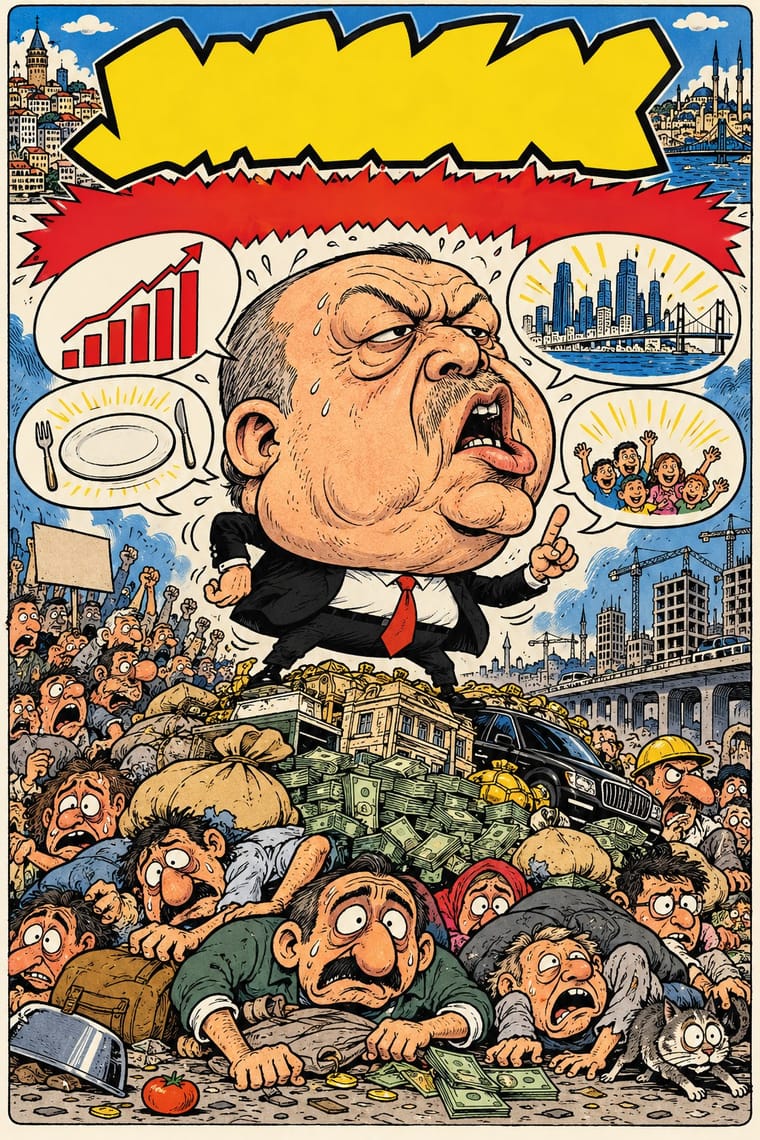
Turkish Weekly Humour Magazines (Gırgır to Uykusuz)
Turkish Weekly Humour Magazines is one of Congolese Bande Dessinée’s nearest styles by choices; no real work of either fits the other better.
Choices that tell Congolese Bande Dessinée and Turkish Weekly Humour Magazines apart Choice Congolese Bande Dessinée Turkish Weekly Humour Magazines Single focal point — defining Limited spot colours — characteristic Full bleed — characteristic Extreme scale contrast — characteristic Ornamented display — characteristic No shared descent in the atlas: they reached these choices separately.
-
Sani and Swahili Humour-Magazine Comics
Sani and Swahili Humour-Magazine Comics is one of Congolese Bande Dessinée’s nearest styles by choices; no real work of either fits the other better.
Choices that tell Congolese Bande Dessinée and Sani and Swahili Humour-Magazine Comics apart Choice Congolese Bande Dessinée Sani and Swahili Humour-Magazine Comics Light ground characteristic — Ornament-free — characteristic Horror vacui characteristic — Agitational & persuasive characteristic — Rebellious & subversive characteristic — No shared descent in the atlas: they reached these choices separately.
-
L'Association and French Alternative Comics
L'Association and French Alternative Comics is one of Congolese Bande Dessinée’s nearest styles by choices; no real work of either fits the other better.
Choices that tell Congolese Bande Dessinée and L'Association and French Alternative Comics apart Choice Congolese Bande Dessinée L'Association and French Alternative Comics Full polychrome characteristic avoids Monochrome — defining Layered information characteristic — Generous white space avoids occasional Agitational & persuasive characteristic — No shared descent in the atlas: they reached these choices separately.
-
Bitterkomix (Afrikaans Underground Comics)
Bitterkomix is one of Congolese Bande Dessinée’s nearest styles by choices; no real work of either fits the other better.
Choices that tell Congolese Bande Dessinée and Bitterkomix apart Choice Congolese Bande Dessinée Bitterkomix Communal & popular characteristic — Monochrome — defining Limited spot colours — characteristic Modular grid — characteristic Ornament-free — characteristic Both descend from Ligne Claire in the family tree.
— means the choice isn’t among the style’s recorded choices. Critics recorded each work’s choices with the styles’ descriptions in view, so this shows whether the descriptions hold together, not proof that they are right.
08
Sources
- Wikipedia, Barly Baruti (https://en.wikipedia.org/wiki/Barly_Baruti)
- Wikipedia, Revue Mfumu'eto (https://en.wikipedia.org/wiki/Revue_Mfumu%27eto)
- Christophe Cassiau-Haurie, Esquisse pour une histoire de la BD en République démocratique du Congo, Africine, 2010 (https://www.africine.org/analyse/esquisse-pour-une-histoire-de-la-bd-en-republique-democratique-du-congo/9446)
2 more sources
- Christophe Cassiau-Haurie, Histoire de la bande dessinée congolaise (L'Harmattan)
- Palette: indicative, not taken from a source
How Stylogeny researches and checks a style: where the facts come from.