Style combination · Pairs well
Congolese Bande Dessinée × Sani and Swahili Humour-Magazine Comics
Both are African urban comic lineages; borrow its page craft but do not assume Sani shares its format.
Mix them and make something Congolese Bande Dessinée Sani and Swahili Humour-Magazine Comics
01
What each style brings
Each part of the design comes from the style with the stronger say in it, and each style gives at least two.
Congolese Bande Dessinée (Kinshasa Comics Scene) Sani and Swahili Humour-Magazine Comics
- Type from Congolese Bande Dessinée
- Colour from Sani and Swahili Humour-Magazine Comics
- Form from Sani and Swahili Humour-Magazine Comics
- Composition from Congolese Bande Dessinée
- Surface from Congolese Bande Dessinée
02
The type
Open fonts standing in for each style’s own type, which is often hand-drawn or commercial.
Display · Congolese Bande Dessinée
Okay
Agbalumo; Congolese Bande Dessinée used Hand-lettered balloon capitals and Hand-drawn titling in the Franco-Belgian BD tradition
Text · Sani and Swahili Humour-Magazine Comics
A Swahili-language humour-magazine comic tradition from Dar es Salaam, built on caricatured characters such as Madenge. Framed panels and hand-lettered balloons stage urban-rural jokes. Unlike Bruguera it works in Swahili with Tanzanian social types; the one documented Asterix adaptation is a single serial, Katembo's Komredi Kipepe (Sani 65-71, 2000-01). Madenge and Kipepe also appear in other magazines. Start year 1980 is from Beez, unconfirmed.
Archivo; Sani and Swahili Humour-Magazine Comics used Hand-lettered Swahili balloon capitals and Hand-drawn comic title lettering
03
The colours
The ground and leading colours come from Sani and Swahili Humour-Magazine Comics, with a counter-accent from Congolese Bande Dessinée. The ink reads on the ground at 4.5:1 or more.
Congolese Bande Dessinée (Kinshasa Comics Scene) Sani and Swahili Humour-Magazine Comics
-
#f1e9d6ground · 36% -
#1b1b1bink · 14% -
#e3b23caccent · 18% -
#c8382baccent · 14% -
#2f6f8faccent · 10% -
#2f7a4aaccent · 8%
As CSS
:root {
  --ground: #f1e9d6;
  --ink: #1b1b1b;
  --accent-1: #e3b23c;
  --accent-2: #c8382b;
  --accent-3: #2f6f8f;
  --accent-4: #2f7a4a;
  --font-display: "Agbalumo", cursive;
  --font-text: "Archivo", sans-serif;
}
Use it with care
Congolese Bande Dessinée (Kinshasa Comics Scene): This is the living, signed work of Congolese cartoonists such as Barly Baruti and Pat Masioni, and of Mfumu'eto's creator, whose manuscripts are held at the University of Florida: borrow the method, not their characters, pages or lettering, and credit or commission Congolese artists where you can. The satire is self-critique from inside Kinshasa aimed at power and money; never reuse the colonial caricature of Tintin au Congo, never exaggerate racial features for a laugh, and never fill balloons with invented pseudo-Lingala: have a speaker write the text.
Sani and Swahili Humour-Magazine Comics: Caricature of rural and ethnic types and of gender carries stereotypes that should be audited, not copied as a cultural signature; this is a living commercial comic culture whose artists' rights are uncleared, so credit the makers and do not reproduce their characters without permission.
04
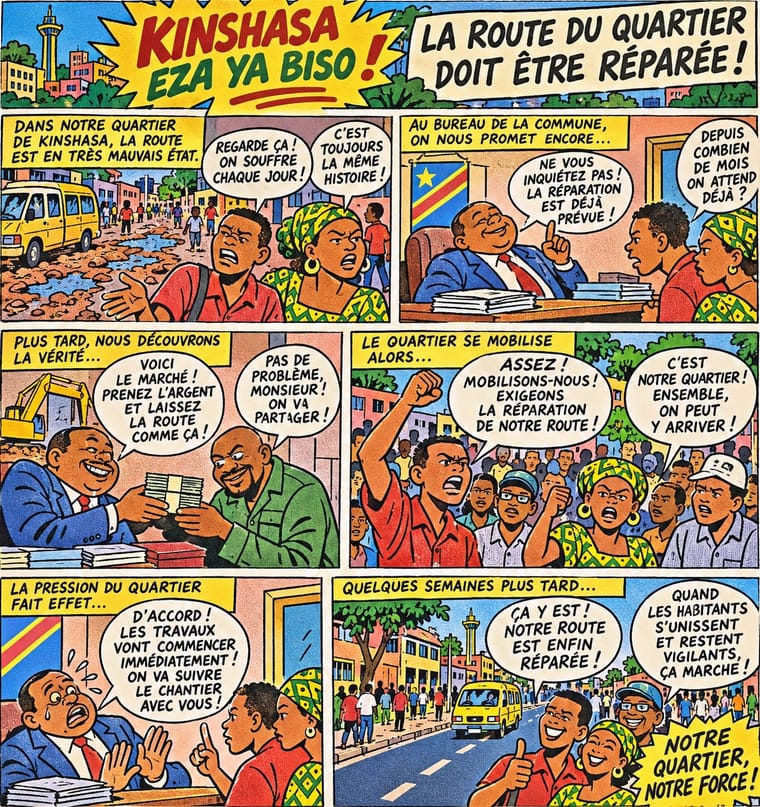
The two styles
05
More combinations
With Congolese Bande Dessinée
- Ligne Claire (Franco-Belgian Clear Line) Contrasts · The same clear outline and flat colour, but rough, local and satirical against Hergé-school polish and nostalgia. The ligne-claire parentage fits the Europe-trained strand (Baruti, Studios Hergé) only; Mfumu'eto and the market fascicles are far rougher.
- American Four-Colour Comic Book (Golden to Bronze Age) Pairs well · Take its balloon and caption mechanics, then keep the clear outline and local setting instead of superhero spectacle.
- Kinshasa Popular Painting Pairs well · Borrow its words-inside-the-scene captions and saturated colour to push a panel page toward Kinshasa's street satire.
With Sani and Swahili Humour-Magazine Comics
- Escuela Bruguera (Spanish Humour Comics) Pairs well · Another humour-magazine comic tradition of framed panels and caricature; Sani differs in language, social types and its serial reworking of a Franco-Belgian model.
- Tingatinga Painting Contrasts · Tanzanian too, but painted, flat and image-led; narrative panels and dialogue govern reading here.