Style combination · Pairs well
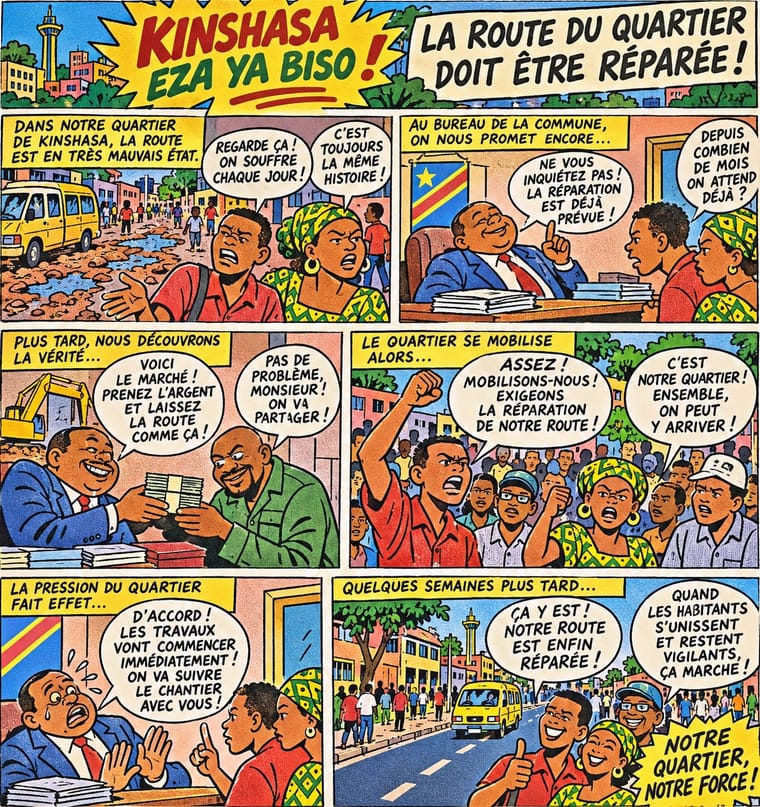
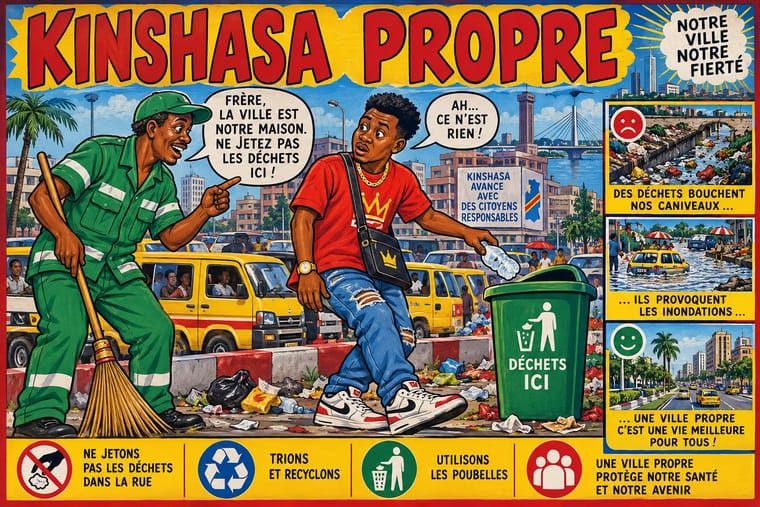
Congolese Bande Dessinée × Kinshasa Popular Painting
Borrow its words-inside-the-scene captions and saturated colour to push a panel page toward Kinshasa's street satire.
Mix them and make something Congolese Bande Dessinée Kinshasa Popular Painting
01
What each style brings
Each part of the design comes from the style with the stronger say in it, and each style gives at least two.
Congolese Bande Dessinée (Kinshasa Comics Scene) Kinshasa Popular Painting
- Type from Kinshasa Popular Painting
- Colour from Kinshasa Popular Painting
- Form from Congolese Bande Dessinée
- Composition from Congolese Bande Dessinée
- Surface from Congolese Bande Dessinée
02
The type
Open fonts standing in for each style’s own type, which is often hand-drawn or commercial.
Display · Kinshasa Popular Painting
Wow.
Londrina Solid, standing in for Sign painter's hand-lettered capitals for painted titles and banners
Text · Congolese Bande Dessinée
The comics of Congolese cartoonists, set in Kinshasa street life and politics and written in Lingala and French. It takes the Franco-Belgian page grammar of framed panels, balloons and clear outline-and-flat-colour drawing, then bends it with caricatured figures, local dress and satire, printed on cheap paper or in artisanal fascicles sold at markets.
Archivo; Congolese Bande Dessinée used Hand-lettered balloon capitals and Hand-drawn titling in the Franco-Belgian BD tradition
03
The colours
The ground and leading colours come from Kinshasa Popular Painting, with a counter-accent from Congolese Bande Dessinée. The ink reads on the ground at 4.5:1 or more.
Congolese Bande Dessinée (Kinshasa Comics Scene) Kinshasa Popular Painting
-
#121212ground · 36% -
#f6f1e3ink · 14% -
#f4c20daccent · 18% -
#d7262eaccent · 14% -
#1d72b8accent · 10% -
#2e9e4faccent · 8%
As CSS
:root {
  --ground: #121212;
  --ink: #f6f1e3;
  --accent-1: #f4c20d;
  --accent-2: #d7262e;
  --accent-3: #1d72b8;
  --accent-4: #2e9e4f;
  --font-display: "Londrina Solid", cursive;
  --font-text: "Archivo", sans-serif;
}
Use it with care
Congolese Bande Dessinée (Kinshasa Comics Scene): This is the living, signed work of Congolese cartoonists such as Barly Baruti and Pat Masioni, and of Mfumu'eto's creator, whose manuscripts are held at the University of Florida: borrow the method, not their characters, pages or lettering, and credit or commission Congolese artists where you can. The satire is self-critique from inside Kinshasa aimed at power and money; never reuse the colonial caricature of Tintin au Congo, never exaggerate racial features for a laugh, and never fill balloons with invented pseudo-Lingala: have a speaker write the text.
Kinshasa Popular Painting: This is the signed work of named Congolese painters, not anonymous folk art: Chéri Samba and younger painters such as JP Mika are living, and the work of the late Moké, Bodo and Chéri Chérin is still exhibited and sold, as in Magnin-A's 2024 Moké show. Borrow the method of words inside a painted scene, but do not copy a particular painter's self-portrait, signature or 'artiste populaire' tag. The caricature is self-critique from inside Kinshasa, aimed at conduct, money and power: never exaggerate racial features or sexualise Black bodies for a laugh, the colonial cartoon language of Tintin au Congo, which Zairian newspapers reissued as a serial in the 1970s, just as this school began. Never fill balloons and captions with invented pseudo-Lingala; write real French or Lingala checked by a speaker, and commission Congolese artists where you can.
04
The two styles
05
More combinations
With Congolese Bande Dessinée
- Ligne Claire (Franco-Belgian Clear Line) Contrasts · The same clear outline and flat colour, but rough, local and satirical against Hergé-school polish and nostalgia. The ligne-claire parentage fits the Europe-trained strand (Baruti, Studios Hergé) only; Mfumu'eto and the market fascicles are far rougher.
- American Four-Colour Comic Book (Golden to Bronze Age) Pairs well · Take its balloon and caption mechanics, then keep the clear outline and local setting instead of superhero spectacle.
- Sani and Swahili Humour-Magazine Comics Pairs well · Both are African urban comic lineages; borrow its page craft but do not assume Sani shares its format.
With Kinshasa Popular Painting
- Ligne Claire (Franco-Belgian Clear Line) Pairs well · Chéri Samba learned to draw by copying the Congolese comic magazine Jeunes pour jeunes, and his line recalls Hergé's clear line; use its even outline and flat colour to keep a crowded, text-heavy painted scene readable. The debt is entangled: Nancy Rose Hunt traces how Tintin and other Belgian comics shaped Congolese comics, for or against them, and Tintin au Congo was reissued as a serial in Zairian newspapers in the 1970s. Take the clear line, never its colonial caricature.
- Jamaican Dancehall Signs & Sleeve Art Contrasts · Same sign-painter parent, opposite balance: dancehall makes the lettering the picture, while Kinshasa paints a scene of city life and lets the words comment on it.
- ROSTA Windows Pairs well · Both are hand-painted satire with words in the picture for a street audience; borrow ROSTA's panel sequence to break a Kinshasa-style scene and caption into a strip.
- Mexican Popular Graphics (Posada) Pairs well · Posada's broadsheets and Kinshasa canvases are both topical, moralising pictures with long texts for ordinary readers; pair a Posada-style headline with a painted, captioned scene.
- Ghanaian Movie Poster Contrasts · Same sign-painter roots, opposite use of words: Ghanaian posters letter only a film title to sell a lurid scene, while Kinshasa paintings fill the scene with commentary to be read.
- Tingatinga Painting Contrasts · Both are African urban popular painting in bright, outlined colour, and Congolese paintings sold in Dar es Salaam may have spurred Tingatinga; but Kinshasa painting argues in painted titles, captions and speech balloons, while Tingatinga floats near-wordless animals on one glossy ground.