Pictorial & machine age · 1972–2025 · Middle East & North Africa
Turkish Weekly Humour Magazines (Gırgır to Uykusuz)
Also known as Gırgır school (Gırgır ekolü), Turkish mizah dergileri, Turkish satirical cartoon weeklies, LeMan, Penguen and Uykusuz
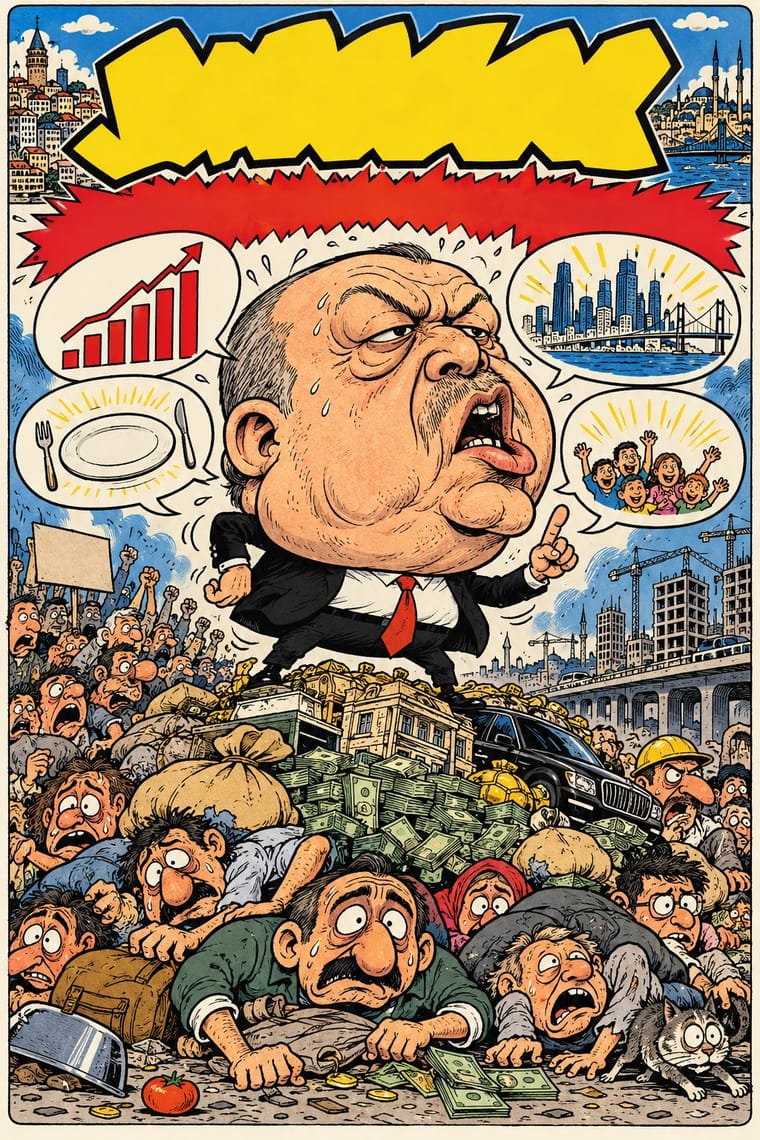
Istanbul's weekly cartoon magazines, from the Aral brothers' Gırgır (1972), which sold up to about half a million copies, through the chain of breakaways that followed it: Limon, LeMan, Penguen and Uykusuz. Each issue was made by a cartoonists' collective: a cover with one big caricature of the week's politics under a huge outlined masthead, then signed corners, strips, serials, joke columns and readers' cartoons, hand-lettered in street Turkish. The leaders it caricatured answered with bans, lawsuits and prosecutions.
Make something in this styleGet advice in this styleMix it with another style
Use it with care
Avanak Avni, Penguen's penguin trying to fly, Uykusuz's man in a vest and the magazines' mastheads belong to their makers and publishers: draw your own characters and masthead, never ask an image model for a named cartoonist's hand or a real magazine's cover, and do not present a generated cover as an issue of Gırgır, LeMan, Penguen or Uykusuz. This satire has cost its makers dearly (Penguen's Bahadır Baruter faced a one-year prison sentence in 2011 over words drawn on a mosque wall, and LeMan's editors were detained in 2025 over a cartoon read as depicting the Prophet Muhammad), and it carried its own prejudices: Uykusuz and Gırgır caricatures that turned Erdoğan into Obama drew their humour from exaggerating Obama's racial features (Çetintaş 2023), and gag strips such as Otisabi on Uykusuz's back cover made comedy of a man's manipulative seduction of women, which a 2026 study reads as objectifying them, even as it finds the strips also critique and subvert those norms. Do not reproduce either. Aim the satire at power and its pomposity, not at faith, ethnicity, gender or the bodies of the powerless: the swollen head belongs to the leader. Remember too that caricaturing a Turkish head of state has repeatedly brought lawsuits.
01
How it works
- Give the cover to one big caricature of the week's political news: a single scene filling the page under a huge outlined masthead and a headline band, with the powerful drawn as swollen heads on small bodies and made to speak in hand-lettered balloons that parody their own phrases.
- Let the cover speak for the whole collective and give every cartoonist a signed corner inside: a recurring page, column, strip, serial or stock character in their own hand, so that each issue reads as an anthology of styles.
- Write and letter in the street's Turkish: slang, sex, neighbourhood life and catchphrases instead of the polite satire of older magazines, in crowded hand-drawn capitals.
- Mix the forms in every issue, with balloons and photomontage in the manner of Mad: single-panel gags, tiers of strip panels, serials with stock characters, mock interviews and joke columns, and a page for readers' amateur cartoons.
- Print cheaply on a weekly deadline in offset, as Gırgır did in yellow, black and white; on the later weeklies' colour covers, keep price, issue number, date and barcode in small type around the masthead and the magazine's mascot emblem.
- Answer a ban or lawsuit on the cover itself by repeating the forbidden image, with several cartoonists each drawing the leader again: Penguen replied to the damages awarded against Musa Kart for drawing the prime minister as a cat with a cover of him as eight animals.
Istanbul. Oğuz Aral's quarter-page corner in the newspaper Gün became the free supplement Gırgır on 13 August 1972 (both Wikipedias give 26 August 1972 as the first issue) and, at Haldun Simavi's request, an independent weekly in 1973, led by Oğuz and Tekin Aral until 1989; it took its balloons and photomontage from the American satirical magazine Mad (Servantie, after Marcella). In 1989 the Simavi family sold it to Ertuğrul Akbay and its whole staff changed; Akbay's Gırgır, a different magazine under the old name, closed in 1993 and came out again, was given away with the newspaper Sözcü from 16 May 2015 and stopped printing on 17 February 2017. The Aral-era cartoonists broke away to found Limon (1985, from which LeMan grew on 21 November 1991), Hıbır (spring 1989) and Aral's Avni (1990–1996); Penguen (25 September 2002 – 18 May 2017) was founded by cartoonists who left LeMan, and Uykusuz (5 September 2007 – 25 January 2023) by cartoonists who left Penguen. LeMan, the last of the line, went fortnightly in 2024; Wikipedia gives its issue of 26 June 2025, which led to detentions and an access ban, as its final issue, and no later issue could be confirmed.
02
Its design choices
From Stylogeny’s vocabulary of design choices: defining choices make the style, characteristic ones are usual, occasional ones turn up now and then.
- Layout & composition
- Space & hierarchy
- Typography
- Colour
- Form & shape
- Surface & texture
- Imagery
- Medium & production
- Tone & intent
- Avoids
- Non-representational, Typography only, Generous white space, Calm & contemplative, Luxurious & glamorous, Authoritative & institutional, 3D render
Palette
#f4efe2#141414#f2d21b#d6262b#2f5ea8#e8b48c
Typefaces
Hand-lettered capitals in speech balloons and caption blocks, with the Turkish İ, Ş, Ğ and Ç drawn in
the Uykusuz cover of 12 November 2008, the Gırgır cover of 10 August 2011
Hand-drawn outlined masthead logos whose colours change from week to week
GIRGIR in fat yellow capitals with a black or red outline, UYKUSUZ in swollen red or orange capitals with a white or dark outline, PENGUEN in heavy grotesque capitals (white on a black band under the penguin emblem in 2009, dark or white on red in 2011 and 2016), LeMan in mixed letters, some boxed in red (covers reproduced in Çetintaş 2023)
A bold sans-serif headline band under the masthead that quotes or paraphrases a politician
Gırgır, 10 August 2011: 'ERDOĞAN: SURİYE BİZİM İÇ MESELEMİZDİR!'
Small typeset cover text for the news summary, price, date, issue number and barcode, with 'Haftalık' above Penguen's title and 'haftalık mizah dergisi' on Uykusuz
Known for
Gırgır (Oğuz and Tekin Aral), first issue 26 August 1972
an independent weekly from 1973 with a first print run of 40,000, about 300,000 a week in the late 1970s and up to about 500,000 in 1981–1983 (English Wikipedia gives up to 450,000, Lambiek 600,000 in the 1980s); printed offset in yellow, black and white
Oğuz Aral, Avanak Avni (Gırgır no. 42, 23 May 1973)
a big-nosed, big-eared boy from the Istanbul slums, later the title character of Aral's own magazine Avni (1990–1996)
Gırgır's front page of 19 July 1981
the singer Müşerref Akay in a dress made of the Turkish flag, which brought a prosecution for insulting the flag and a four-week ban under the military regime
Gırgır's series and reader pages
Utanmaz Adam, En Kahraman Rıdvan, Beter Hamdi, İpsiz Osman, Behiç Pek's soldier series 'Bir az da savaşalım' (so spelled by Servantie; the title could not be confirmed elsewhere), İrfan Sayar's Rube Goldberg-like Zihni Sinir Proceleri, and a page of readers' cartoons that carried one or two drawings by prisoners in each issue after the 1980 coup
Penguen no. 127 (24 February 2005), 'Tayyipler Âlemi' (The World of Tayyips)
eight cartoonists drew Prime Minister Erdoğan as an elephant, giraffe, monkey, camel, frog, snake, cow and duck, in protest at the damages awarded against Musa Kart for drawing him as a cat; Erdoğan sued for 40,000 new lira, and the court dismissed the case
Covers on Obama's first visit to Turkey
LeMan, 8 April 2009, Obama as Uncle Sam in a turban pointing out of the page, beside a stacked 'I WANT YOU' in heavy black serif capitals after Flagg's recruiting poster, with a column of small typeset commentary at the right; Penguen, 9 April 2009, Erdoğan as a frightened child asking to sleep between Barack and Michelle Obama
Uykusuz cover, 12 November 2008
the whole staff crowded round a table of back issues, swearing in a block of hand-lettered capitals not to pun on Barack Obama's name
Uykusuz (5 September 2007 – 25 January 2023; founded by Yiğit Özgür, Ersin Karabulut, Oky, Umut Sarıkaya, Uğur Gürsoy and Memo Tembelçizer)
16 pages every Thursday, a cover caricaturing the week's news, a two-page opening on the national agenda, the cartoonists' own corners and strips, humour writing and the amateur page 'Gelen Kutusu'
03
Make something in this style
Say what you need, and Stylogeny’s image studio draws it from Turkish Weekly Humour Magazines (Gırgır to Uykusuz)’s design choices and checks it against them. It takes about a minute, and you get a link to share.
04
Where it comes from, and what it’s close to
Before it
The style it grew out of, and the styles it borrowed from.
Nothing earlier is recorded: in the atlas it is a starting point.

After it
The styles that grew out of it.
No later style in the atlas grew out of it yet.
Alike in its design choices
Styles that make many of the same choices, related or not, besides those above.


05
Sources
- Wikipedia (en): 'Gırgır' (https://en.wikipedia.org/wiki/G%C4%B1rg%C4%B1r: founded 1972 by Oğuz and Tekin Aral as a newspaper insert, first issue 26 August 1972; 'one of the best selling cartoon magazines in Europe in the 1970s', up to 450,000 copies; 'temporarily banned' after the 12 September 1980 coup over a cartoon deemed insulting to Turkish national identity; contributors left in the mid-1980s to found Limon, and another group founded Hıbır; taken over in 1989 and folded in 1993; İrfan Sayar's 'Rube-Goldberg-like' Zihni Sinir Proceleri)
- Wikipedia (tr): 'Gırgır (dergi)' (https://tr.wikipedia.org/wiki/G%C4%B1rg%C4%B1r_(dergi): began as a quarter-page corner in Gün, a free supplement from 13 August 1972 (first issue 26 August 1972 in the infobox), independent in 1973 at Haldun Simavi's request; about 45,000 copies at the end of the first year, about 280,000 around 1978 ('1978'lerde') and about 500,000 in 1981–1983; broke with the elitist tone of earlier magazines for slang, sexuality and neighbourhood life ('sulu mizah'); 'kendinden sonra gelen bütün mizah dergilerinin tarzını belirleyen bir ekol'; Limon 1985, Hıbır spring 1989, Aral's departure to found Avni in November 1989; the sale by the Simavi family to Ertuğrul Akbay, after which 'tüm kadrosu değişen Gırgır, aynı ismi taşısa da bambaşka bir dergiye dönüştü'; closed in 1993 and came out again, 'bu yeni Gırgır da aslında Ertuğrul Akbay'ın 1989'dan sonraki Gırgırı'dır'; given away free with Sözcü from 16 May 2015; printing stopped by the publisher on 17 February 2017)
- Lambiek Comiclopedia, 'Oğuz Aral' (https://www.lambiek.net/artists/a/aral-oguz.htm: 'The yellow/black colored Gırgır paper soon became more popular than the already existing Akbaba'; independent magazine with an initial print run of 40,000 in 1973; 'in the 1980s this weekly publication achieved a circulation of 600,000 issues'; Avanak Avni launched in Gırgır no. 42, 23 May 1973, a big-nosed, big-eared boy from the Istanbul slums; Utanmaz Adam 1959; Avni magazine 1990–1996; 'a tutor to almost an entire generation of Turkish comic artists')
- Alain Servantie, 'Note sur les caricaturistes turcs', EIRIS (https://www.eiris.eu/wp-content/uploads/2024/01/Marcellina.pdf), a review of Valentina Marcella, Laughing Matters: Graphic Satire Reckoning with the 1980 Coup in Turkey (Rome: Istituto per l'Oriente C. A. Nallino, 2022): 'Gırgır était publié en offset, aux couleurs jaune, noir et blanc'; balloons and photomontages 'sur le mode du satirique américain Mad'; a page of readers' amateur cartoons, with one or two prisoners' drawings per issue after the coup; about 20% text; the series Utanmaz Adam, En Kahraman Rıdvan, Beter Hamdi, İpsiz Osman and Behiç Pek's 'Bir az da savaşalım'; the front-page drawing of Müşerref Akay of 19 July 1981 and the four-week ban; 'tirant 300.000 copies par semaine, jusqu'à 500.000 copies après le coup d'État'; 'Gırgır a survécu jusqu'en 2017'
- Wikipedia (en): 'LeMan (magazine)' (https://en.wikipedia.org/wiki/LeMan_(magazine): founded 21 November 1991 by Mehmet Çağçağ and Tuncay Akgün as an independent magazine, with roots in Limon (1985); 1000th issue in 2010; announced fortnightly publication in 2024 because of paper costs; the cartoon of 26 June 2025, the detentions of the publisher, editor-in-chief and managing editor, and the blocked website; infobox final issue 26 June 2025)
- Wikipedia (en): 'Penguen' (https://en.wikipedia.org/wiki/Penguen: founded by Metin Üstündağ, Selçuk Erdem, Erdil Yaşaroğlu and Bahadır Baruter, first issue 25 September 2002, last issue 18 May 2017; sued by Erdoğan in March 2005 and acquitted; Baruter's one-year sentence in 2011; circulation about 70,000 in 2010)
- Wikipedia (tr): 'Penguen (dergi)' (https://tr.wikipedia.org/wiki/Penguen_(dergi): founded by cartoonists who left LeMan, from the Gırgır school; the 'Tayyipler Âlemi' cover showing Erdoğan as various animals in answer to his suit against Musa Kart, Erdoğan's suit rejected by the court; cover cartoons usually on a current event in Turkey; 'Haftalık' above the title; emblem of a penguin trying to fly by Selçuk Erdem; 24 pages from issue 661, 21 May 2015; the final cover 'Her şey için teşekkürler!')
- Bianet, 'Magazine Sued for Erdogan Caricatures' (25 March 2005, https://bianet.org/haber/magazine-sued-for-erdogan-caricatures-57272: Penguen of 24 February 2005, issue 127, a page titled 'The Tayyip World' showing Erdoğan as an elephant, giraffe, monkey, camel, frog, snake, cow and duck, drawn by eight caricaturists in protest at Musa Kart's conviction; suit for 40,000 new Turkish liras) and Hürriyet Daily News, 'Penguen on trial for poking fun at the PM' (18 May 2005, https://hurriyet.com.tr/gundem/penguen-on-trial-for-poking-fun-at-the-pm-38729914)
- Bianet, 'Penguen'den "Allah Yok" Karikatürüyle İlgili Açıklama' (15 February 2011, https://bianet.org/haber/penguen-den-allah-yok-karikaturuyle-ilgili-aciklama-127898: 'sadece kapağı Penguen dergisinin ortak görüşünü yansıtır'; 'Köşelerdeki karikatürler çizerlerin şahsi fikirleridir')
- Wikipedia (tr): 'Uykusuz (dergi)' (https://tr.wikipedia.org/wiki/Uykusuz_(dergi): first issue 5 September 2007, last 25 January 2023; founded by Yiğit Özgür, Ersin Karabulut, Oky, Umut Sarıkaya, Uğur Gürsoy and Memo Tembelçizer after leaving Penguen; 'Kapak; gündemi belirleyen siyasi, ekonomik ya da sosyal olayları karikatürize eder'; a two-page opening on the agenda, then 'çizerlerin kişisel karikatür köşeleri ve çizgi romanları ile mizah yazılarını barındırır'; the amateur section 'Gelen Kutusu'; emblem by Yiğit Özgür of a man in a vest and striped pyjamas; 16 pages, out on Thursdays)
- Sıla Çetintaş, Caricaturizing Representations of the United States during the Barack Obama and Donald Trump Administrations in Turkish Humor Magazines, MA thesis, Bilkent University, 2023 (http://hdl.handle.net/11693/112327: cover caricatures of Gırgır, LeMan, Penguen and Uykusuz, 2008–2021, are 'generally single panels or splash pages' summarising the week's agenda, citing Demir 2016; speech bubbles mimic politicians' speech patterns; 1970s caricatures began to use expressive speech bubbles; reproduced covers: LeMan 8 April 2009 (a stacked 'I WANT YOU' in heavy serif capitals at the left, a column of typeset text at the right), 30 March 2016 and 6 April 2016; Penguen 9 April 2009 (white PENGUEN on a black band under the penguin emblem, the scene staged in a bedroom), 22 September 2011 (dark PENGUEN on red, modelled faces) and 7 April 2016 (white PENGUEN on red, modelled faces on a stage before a red curtain); Uykusuz 12 November 2008 and 28 March 2013; Gırgır 24 November 2010 (yellow GIRGIR with a black outline over a graded blue sky) and 7 September 2011, 10 August 2011, 24 October 2012, 4 and 14 September 2013, and one captioned 10 October 2017 (yellow with a red outline); p. 91: on Uykusuz and Gırgır pictures of Erdoğan turned into Obama, 'The humor arises from the exaggeration of Obama's racial features adopted on Erdoğan's face'; 2015 distribution figures)
- D. Tüfekçi Can and A. Serdar, '"If we are not going to movies, then what about having sex?": Exploring gender in the Turkish context through Otisabi comic strips', Feminist Media Studies, 2026, doi:10.1080/14680777.2026.2684506 (abstract at https://avesis.hacettepe.edu.tr/yayin/0d4966c3-df49-4e4a-b109-7d346fdd80f7/if-we-are-not-going-to-movies-then-what-about-having-sex-exploring-gender-in-the-turkish-context-through-otisabi-comic-strips: Yılmaz Aslantürk's Otisabi ran on the back cover of Uykusuz from 2007 to 2023; 'The narratives portray Otisabi's manipulative strategies for seducing women', often implying that some women 'deserve such treatment'; keywords include female objectification and male dominance; the strips also 'critique and subvert' these norms)
- Fazıla Mat, 'Turkish humor', OBC Transeuropa (8 April 2010, https://www.balcanicaucaso.org/en/?p=238165: Limon 'openly leftwing'; Penguen about 70,000 copies a week and LeMan 50,000, with Uykusuz close behind, all staffed by former Limon members; 'These magazines' covers usually depict a political event')
How Stylogeny researches and checks a style: where the facts come from.