Traditions & vernacular · 1800–present · Middle East & North Africa
Al-Qatt Al-Asiri ( Asiri Women's Wall Painting )
Also known as Al-Qatt Al-Asiri, Nagsh, Al-Zayyaan, Asir interior wall painting
The interior wall painting of the women of Asir, south-west Saudi Arabia: guest parlours and corridors plastered and then painted freehand in bands, triangles, squares, diagonals and tree-like shapes, in bright red, green, yellow and brown. Its patterns appear to be adapted from local textile and weaving patterns. It is traditionally made by women and their female relatives together, though men and designers now also practise it, and a family's pride and wealth show in how vivid the walls are. Its date of origin is unknown.
Use it with care
Al-Qatt Al-Asiri is a living craft of the women of Asir, passed down by painting together in the home, and it is recognised by UNESCO as the heritage of that community. Credit the Asiri women and named masters such as Fatima Abou Gahas, learn what a household's walls mean before copying them as generic 'Arabian' or 'tribal' decoration, and do not present machine-made or AI-generated pattern as the work of Asiri painters; a souvenir or brand using the look should work with Asiri artists.
01
How it works
Palette
-
#e8dcc4 -
#c1272d -
#2e8b3f -
#f2b705 -
#7a4a2b -
#a8743a
Typefaces
-
No script
the style is pure pattern, with no calligraphy or inscriptions as part of the design
-
Where lettering appears on souvenirs and signage it is ordinary hand-painted or printed Arabic and Latin lettering placed beside the pattern, not part of the Asiri tradition itself
- Fill the whole wall as one continuous surface with no single focal point, running the pattern in horizontal tiers and bands from skirting to ceiling the way a woven textile is built.
- Paint freehand with spontaneous, slightly irregular hand-drawn lines and heavy outlines rather than ruled or stencilled precision, and let each woman's wall differ from her neighbour's.
- Build every motif from a small vocabulary of lines, triangles, squares, diagonals and tree-like forms, repeated and varied to make rhythm rather than representing things.
- Choose bright flat colours, red, green, yellow and brown, laid against one another in solid fields on a pale plaster ground.
- Make the painting a shared, social act of the home: invite female relatives of several ages to paint together and let the finished room show the household's skill and pride to its guests.
Where and when Asir region, south-west Saudi Arabia: women plaster and paint the walls, corridors and ceilings of their homes, above all the front parlour where guests are received, on a base that is usually white gypsum.
Asir region, south-west Saudi Arabia: women plaster and paint the walls, corridors and ceilings of their homes, above all the front parlour where guests are received, on a base that is usually white gypsum. UNESCO calls it an ancient art form and inscribed it on the Representative List of the Intangible Cultural Heritage of Humanity in 2017 (12.COM, file 01261); the sources consulted give no date of origin, so the start year 1800 is only a low-confidence placeholder (the schema needs a number) and the true origin is unknown. The painted houses of the adjacent Yemeni highlands are a related tradition not covered here
02
Its design choices
From Stylogeny’s vocabulary of design choices: defining choices make the style, characteristic ones are usual, occasional ones turn up now and then.
- Layout & composition
- Space & hierarchy
- Typography
- Colour
- Form & shape
- Surface & texture
- Ornament
- Imagery
- Medium & production
- Tone & intent
- Avoids
- Radial & concentric, Brush & pen calligraphy, Naturalistic depiction, Gradients, Illusion of depth, Straight photography, Luxurious & glamorous
How its pictures are made Systematic
Kind of picture: Systematic
Known for
-
UNESCO Representative List inscription, 'Al-Qatt Al-Asiri, female traditional interior wall decoration in Asir, Saudi Arabia', 2017
12.COM, file 01261
-
Fatima Abou Gahas (1920-2010), born in Rijal Almaa, who learned the art from her mother, taught it in a workshop at Qasr Bader; one of her wall paintings was featured in the Ithra collection in 2023
-
Painted guest parlours (majlis) of Asiri homes, whose walls and ceilings carry the band-and-triangle tiers described by UNESCO
-
Miniature 'Asiri house' souvenirs sold to city-dwellers in Saudi Arabia, a reduction of the style into a tourist product
03
Where it comes from, and what it’s close to
Nothing earlier is recorded: in the atlas it is a starting point.
Al-Qatt Al-Asiri (Asiri Women's Wall Painting) 1800–present
No later style in the atlas grew out of it yet.
Alike in its design choices

04
Often taken for
Al-Qatt Al-Asiri has no real works recorded yet, so these are its nearest styles by its choices alone, with the choices that tell them apart.
-
Ndebele Geometric Painting
Ndebele Geometric Painting is one of Al-Qatt Al-Asiri’s nearest styles by choices; no real work of either fits the other better.
Choices that tell Al-Qatt Al-Asiri and Ndebele Geometric Painting apart Choice Al-Qatt Al-Asiri Ndebele Geometric Painting All-over field defining occasional Central symmetry — defining Flat hierarchy characteristic — Hard offset shadow — characteristic Pen, brush & ink characteristic — No shared descent in the atlas: they reached these choices separately.
-
Bògòlanfini Mud Cloth
Bògòlanfini Mud Cloth is one of Al-Qatt Al-Asiri’s nearest styles by choices; no real work of either fits the other better.
Choices that tell Al-Qatt Al-Asiri and Bògòlanfini Mud Cloth apart Choice Al-Qatt Al-Asiri Bògòlanfini Mud Cloth Full polychrome defining avoids Dark ground — defining Light ground characteristic — Limited spot colours — characteristic Rectilinear characteristic — No shared descent in the atlas: they reached these choices separately.
-
Khayamiya (Cairene Tentmaker Appliqué)
Khayamiya is one of Al-Qatt Al-Asiri’s nearest styles by choices; no real work of either fits the other better.
Choices that tell Al-Qatt Al-Asiri and Khayamiya apart Choice Al-Qatt Al-Asiri Khayamiya Geometric primitives characteristic — Brush & pen calligraphy avoids occasional Horror vacui characteristic — Framed panels occasional defining Painterly brushwork characteristic — No shared descent in the atlas: they reached these choices separately.
-
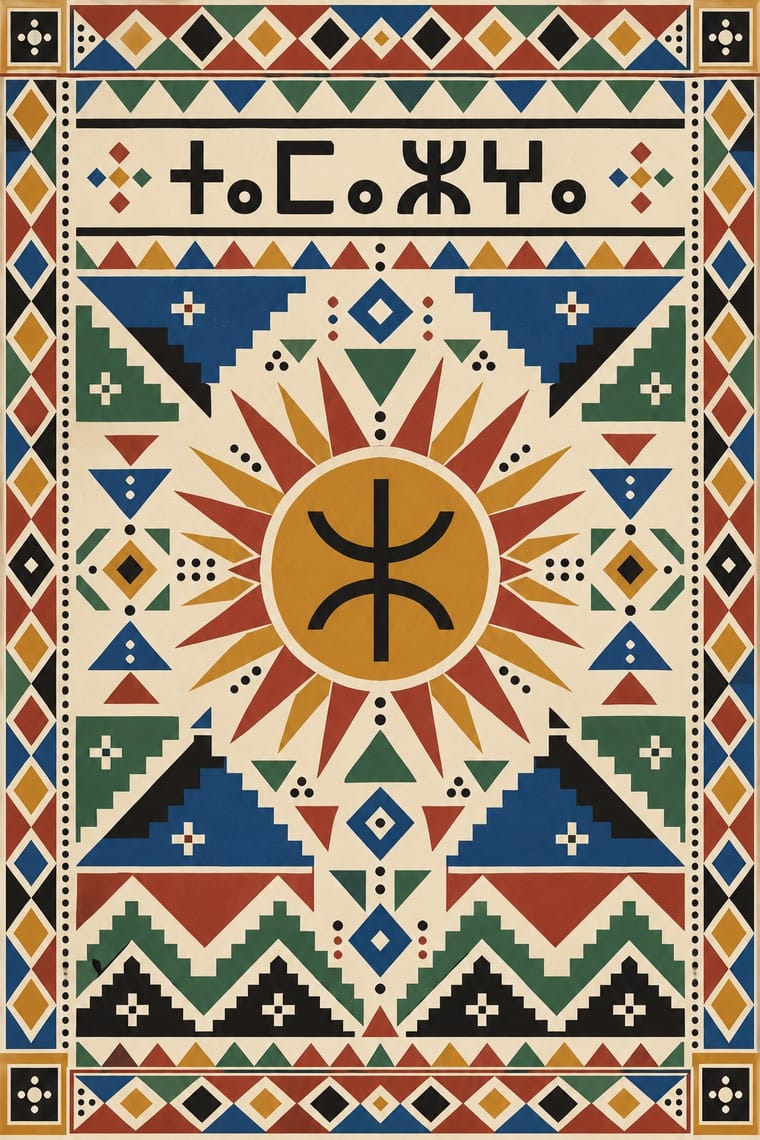
Amazigh Sign System & Tifinagh
Amazigh Sign System & Tifinagh is one of Al-Qatt Al-Asiri’s nearest styles by choices; no real work of either fits the other better.
Choices that tell Al-Qatt Al-Asiri and Amazigh Sign System apart Choice Al-Qatt Al-Asiri Amazigh Sign System Full polychrome defining occasional Limited spot colours — characteristic Rectilinear characteristic — Pictogram — characteristic Horror vacui characteristic — No shared descent in the atlas: they reached these choices separately.
— means the choice isn’t among the style’s recorded choices. Critics recorded each work’s choices with the styles’ descriptions in view, so this shows whether the descriptions hold together, not proof that they are right.
05
Sources
- UNESCO Intangible Cultural Heritage, 'Al-Qatt Al-Asiri, female traditional interior wall decoration in Asir, Saudi Arabia', inscribed 2017 (https://ich.unesco.org/en/RL/al-qatt-al-asiri-female-traditional-interior-wall-decoration-in-asir-saudi-arabia-01261: white gypsum base, geometric shapes and symbols, spontaneous technique, guest rooms, women relatives of various ages painting together, transmission by observation and practice, men and designers now also practise it)
- Wikipedia, 'Al-Qatt Al-Asiri' (https://en.wikipedia.org/wiki/Al-Qatt_Al-Asiri: lines, triangles, squares, diagonals and tree-like shapes; adaptation from textiles and weaving; red, green, yellow and brown; neighbours competing for vivid designs; wealth shown through the paintings; miniature Asiri houses as souvenirs)
- Wikipedia, 'Fatima Abou Gahas' (https://en.wikipedia.org/wiki/Fatima_Abou_Gahas: 1920-2010, born in Rijal Almaa, learned from her mother, taught at Qasr Bader, Abha Award 1997, Janadriyah 2007, Ithra collection 2023)
How Stylogeny researches and checks a style: where the facts come from.