Traditions & vernacular · 1900–present · Sub-Saharan Africa
Adire Indigo Resist Cloth Patterns ( Yoruba )
Also known as Adire eleko, Adire oniko, Adire alabere, Abeokuta adire
Yoruba women's resist-dyed indigo cloth from southwestern Nigeria, in which cassava-paste stencils (eleko), tied raffia (oniko) or stitched raffia (alabere) hold back the dye. Repeated dips give white patterns on deep blue-black grounds, covered edge to edge in named geometric, figural and letter motifs.
Use it with care
Adire is a living craft of Yoruba women, with patterns passed from mother to daughter and many motifs carrying names and meanings. Learn a pattern's name and meaning before reusing it, credit Yoruba makers and the town of origin, and do not pass printed indigo-look fabric off as hand-resisted adire.
01
How it works
Palette
-
#0f1b3d -
#1c2f66 -
#34508f -
#e9e4d6 -
#f7f3ea
Typefaces
-
Letter-motif adire cloths, with letters resisted in paste
-
Hand-cut stencil and hand-drawn paste lettering used on eleko cloth
- Work in two tones only: reserve the pattern in white and let repeated indigo dips deepen the ground towards blue-black.
- Cover the whole cloth in an all-over field of repeated, named motifs rather than a single central image.
- Choose the resist for the effect: tied raffia for soft-edged white circles, stitching for linear reserves, paste stencils for crisp repeated figures.
- Draw motifs from plants, animals, tools and letters, and reduce them to flat, schematic marks.
- Let the cloth's own irregularities, paste cracks and uneven tying stay visible as the maker's hand.
Yoruba women of Abeokuta (Egba, Ogun State) and Ibadan, Nigeria. Indigo resist dyeing in West Africa is centuries older; 1900 marks the early-20th-century boom in adire made on imported shirting cloth.
02
Its design choices
From Stylogeny’s vocabulary of design choices: defining choices make the style, characteristic ones are usual, occasional ones turn up now and then.
- Layout & composition
- Space & hierarchy
- Typography
- Colour
- Form & shape
- Surface & texture
- Ornament
- Imagery
- Medium & production
- Tone & intent
- Avoids
- Full polychrome, Fluorescent & neon, Gradients, Straight photography, Generous white space, Single focal point, Isolated object, Gloss & highlights
How its pictures are made Systematic
Kind of picture: Systematic
Known for
-
Named designs
Jubilee, Olokun, Sunbebe and Ibadandun
-
Eleko cassava-paste stencilled cloth of Abeokuta and Ibadan
-
Oniko tied-resist cloth
-
Alabere stitched-resist cloth
-
Nike Davies-Okundaye
renewing the idiom
-
Amaka Osakwe
renewing the idiom
03
Where it comes from, and what it’s close to
Nothing earlier is recorded: in the atlas it is a starting point.
Adire Indigo Resist Cloth Patterns (Yoruba) 1900–present
No later style in the atlas grew out of it yet.
Alike in its design choices
04
Often taken for
Adire Indigo Resist Cloth Patterns has no real works recorded yet, so these are its nearest styles by its choices alone, with the choices that tell them apart.
-
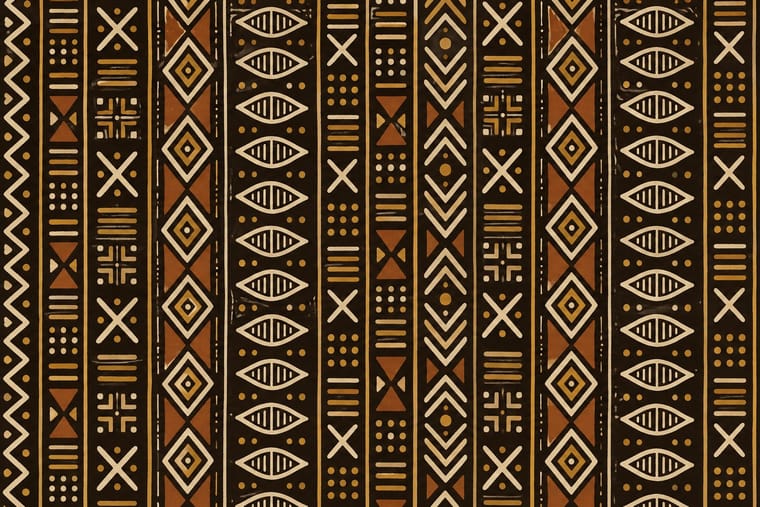
Bògòlanfini Mud Cloth
Bògòlanfini Mud Cloth is one of Adire Indigo Resist Cloth Patterns’s nearest styles by choices; no real work of either fits the other better.
Choices that tell Adire Indigo Resist Cloth Patterns and Bògòlanfini Mud Cloth apart Choice Adire Indigo Resist Cloth Patterns Bògòlanfini Mud Cloth Monochrome defining — Limited spot colours — characteristic Stylised figuration characteristic — Angular & zigzag — characteristic Pen, brush & ink characteristic — No shared descent in the atlas: they reached these choices separately.
-
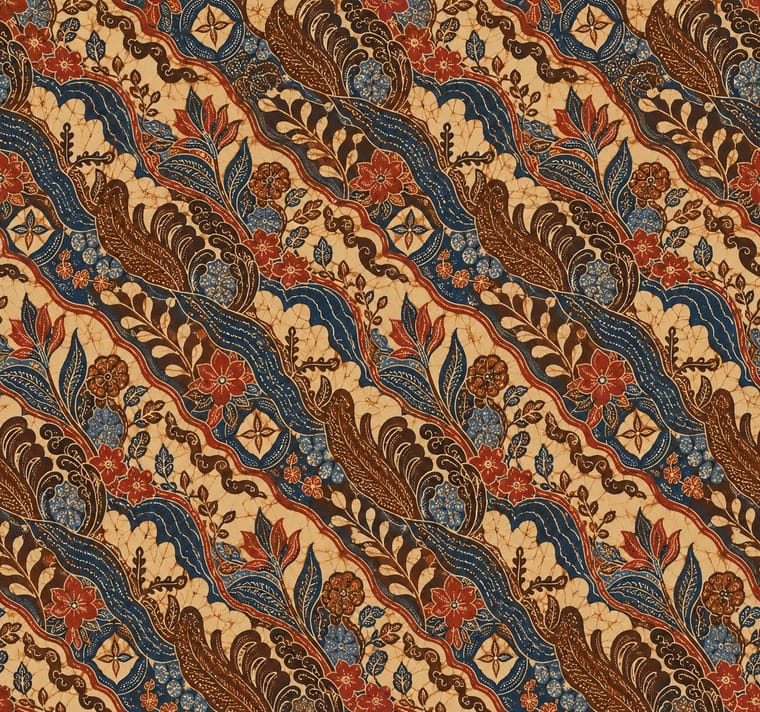
Batik Pattern Tradition
Batik Pattern Tradition is one of Adire Indigo Resist Cloth Patterns’s nearest styles by choices; no real work of either fits the other better.
Choices that tell Adire Indigo Resist Cloth Patterns and Batik Pattern Tradition apart Choice Adire Indigo Resist Cloth Patterns Batik Pattern Tradition Monochrome defining — Abundant decoration — defining Dark ground defining occasional Full polychrome avoids occasional Warm & approachable characteristic — No shared descent in the atlas: they reached these choices separately.
-
Kōwhaiwhai & Toi Māori Design
Kōwhaiwhai & Toi Māori Design is one of Adire Indigo Resist Cloth Patterns’s nearest styles by choices; no real work of either fits the other better.
Choices that tell Adire Indigo Resist Cloth Patterns and Kōwhaiwhai apart Choice Adire Indigo Resist Cloth Patterns Kōwhaiwhai Dark ground defining — Limited spot colours — defining Monochrome defining — Biomorphic curves — defining Geometric tessellation characteristic — No shared descent in the atlas: they reached these choices separately.
-
Al-Qatt Al-Asiri (Asiri Women's Wall Painting)
Al-Qatt Al-Asiri is one of Adire Indigo Resist Cloth Patterns’s nearest styles by choices; no real work of either fits the other better.
Choices that tell Adire Indigo Resist Cloth Patterns and Al-Qatt Al-Asiri apart Choice Adire Indigo Resist Cloth Patterns Al-Qatt Al-Asiri Dark ground defining — Full polychrome avoids defining Monochrome defining — Light ground — characteristic Stylised figuration characteristic — No shared descent in the atlas: they reached these choices separately.
— means the choice isn’t among the style’s recorded choices. Critics recorded each work’s choices with the styles’ descriptions in view, so this shows whether the descriptions hold together, not proof that they are right.
05
Sources
How Stylogeny researches and checks a style: where the facts come from.