Traditions & vernacular · 1890–present · Latin America & Caribbean
Fileteado Porteño
Also known as Filete porteño, Fileteado
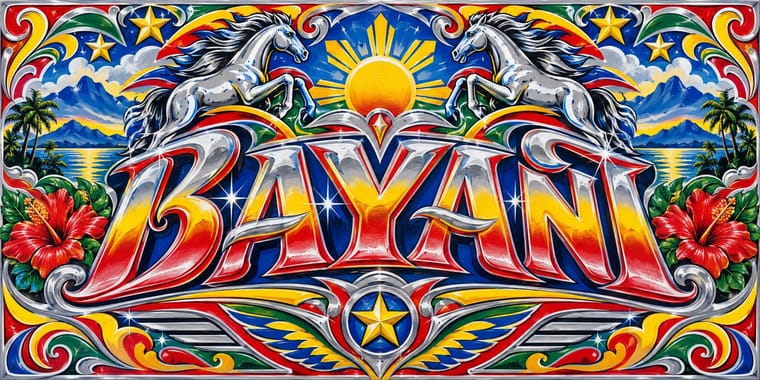
A Buenos Aires tradition of ornamental brush painting that began around 1900 on the grey-painted trade carts of Italian immigrant coachbuilders and spread to trucks, colectivo buses, shop signs and gallery panels. Mirror-symmetric spirals of acanthus, ribbons in the national colours, birds, dragons and flowers are modelled with layered highlights and shadows on dark grounds, framing a lettered name, initials or a witty refrán.
Make something in this styleGet advice in this styleMix it with another style

Use it with care
Filete porteño is UNESCO-listed intangible heritage (2015) and a living trade: commission or credit fileteadores rather than tracing their published panels, and keep its Argentine emblems and devotional images, such as the Virgin of Luján, in a respectful context.
01
How it works
- Build each panel on a mirror axis, spiralling acanthus volutes outward from a central motif or lettered name.
- Model every leaf, ribbon and letter in painted layers (ground, flat colour, shadow, drop shadow, light, highlight) so flat paint reads as carved relief.
- Lay saturated reds, yellows, greens and Argentine celeste over black or deep grounds, edging forms with fine pinstripe filetes.
- Letter a name, initials or a humorous refrán in shaded gothic or Roman capitals, carried on a ribbon banner or held in a cartouche.
- Draw from the fixed lexicon of acanthus, flowers, birds, dragons, cornucopias, horseshoes, jewels and flags rather than inventing new motifs.
- Fill the panel to its chamfered corners, closing the composition with a fine border line.
Buenos Aires, Argentina (cart-building workshops, later truck and colectivo bodyshops)
02
Its design choices
From Stylogeny’s vocabulary of design choices: defining choices make the style, characteristic ones are usual, occasional ones turn up now and then.
- Layout & composition
- Space & hierarchy
- Typography
- Form & shape
- Surface & texture
- Ornament
- Medium & production
- Tone & intent
- Avoids
- Ornament-free, Dynamic asymmetry, Generous white space, Grotesque & neo-grotesque, Flat, Straight photography, Pastel, Rational & objective
Palette
#141414#c8102e#f2b705#6cace4#2e7d32#f3ead3
Typefaces
Letra gótica
shaded blackletter capitals
Shaded Roman capitals with drop shadows
Letra inglesa
copperplate-derived brush script
Known for
Vicente Brunetti, Salvador Venturo and Cecilio Pascarella
first recorded fileteadores, c. 1900
Miguel Venturo
introduced birds, flowers, diamonds and dragons to the repertoire
Carlos Carboni
golden-age master
León Untroib
golden-age master
Alfredo Genovese
leading contemporary fileteador
Asociación de Fileteadores
founded 2012
03
Make something in this style
Say what you need, and Stylogeny’s image studio draws it from Fileteado Porteño’s design choices and checks it against them. It takes about a minute, and you get a link to share.
04
Where it comes from, and what it’s close to
Before it
The style it grew out of, and the styles it borrowed from.

After it
The styles that grew out of it.
No later style in the atlas grew out of it yet.
Alike in its design choices
Styles that make many of the same choices, related or not, besides those above.


05
Real works
Artefacts in museums, libraries and archives that show the style, linked at their source.
- 'Eterno en el alma y en el tiempo' (Carlos Gardel panel), Carlos Gardel Subte stationLeón Untroib · 1985 · Wikimedia Commons (photograph by Roberto Fiadone, 2007)
- La musa del tango (homage to Homero Manzi)Jorge Muscia · 1998 · Wikimedia Commons (released by the artist)
- 'Lo fui haciendo despacito para que saliera bonito' (shop sign, hardware store on Avenida Pueyrredón)Mariano Cappiello (signed on the panel) · by 2007 (photographed April 2007) · Wikimedia Commons (photograph, April 2007)
- Fileteado on a 1931 Ford Model AA truck (rear door)Unrecorded fileteador · truck 1931; painting undated (photographed November 2007) · Wikimedia Commons (photograph, November 2007)
- Carrito manicero 'La Paz' (peanut vendor's cart)Jorge Muscia · c. 2005–06 · Wikimedia Commons (released by the artist)


06
Sources
- UNESCO Intangible Cultural Heritage, ‘Filete porteño in Buenos Aires, a traditional painting technique’ (inscribed 2015)
- Gustavo Ferrari, ‘Fileteado porteño, past and present’, Eye magazine blog (eyemagazine.com)
- Gobierno de la Ciudad de Buenos Aires, ‘Fileteado porteño’ (buenosaires.gob.ar)
How Stylogeny researches and checks a style: where the facts come from.