Counterculture · 1979–1994 · East Asia
Minjung Woodcut Graphics (Korean People's Art)
Also known as Minjung printmaking, Minjung misul woodcuts, Minjoong print graphics, Minjung panhwa (민중 판화)
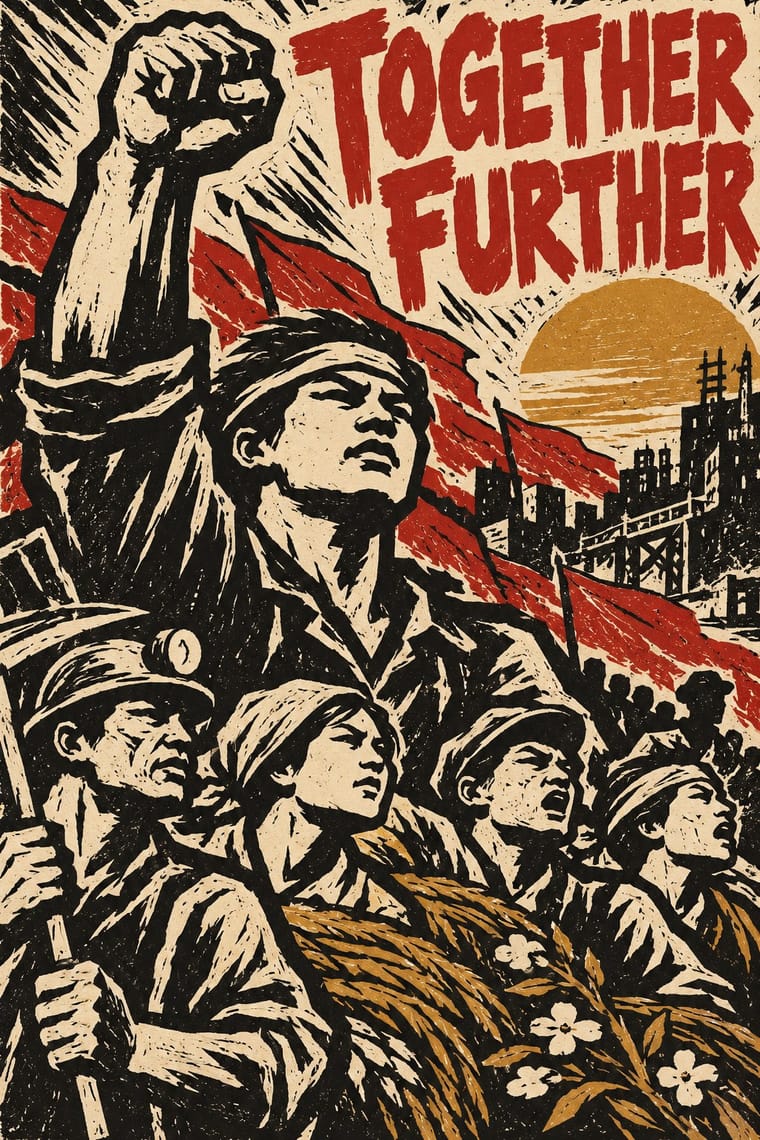
The reproducible graphic branch of Minjung misul (people's art), South Korea's art of the 1980s democracy and labour movements. After the Gwangju Uprising of May 1980, artists such as Oh Yoon and Hong Sung-dam took up the woodcut for the movement: bold, succinct black-line figures of workers, farmers, miners and dancers, cut in wood and reused on poetry-book covers, pamphlets, posters, chest badges and enlarged painted geolgae banners for rallies.
Make something in this style Get advice in this style Mix it with another style
Use it with care
Minjung prints were made for a living movement and many record the dead of the Gwangju Uprising; their makers or estates hold the rights, and the movement's exhibitions met police suppression (The Power of People in Their 20s, 1985). Their borrowings from shamanic gut, mask dance and Buddhist painting carry ritual meaning in Korea: do not lift those motifs as decorative 'Korean folk' texture, do not turn Gwangju imagery into generic protest branding, and credit the artists by name. The genome describes the reproducible woodcut branch of a wider movement that also painted, made banners, comics and photomontage.
01
How it works
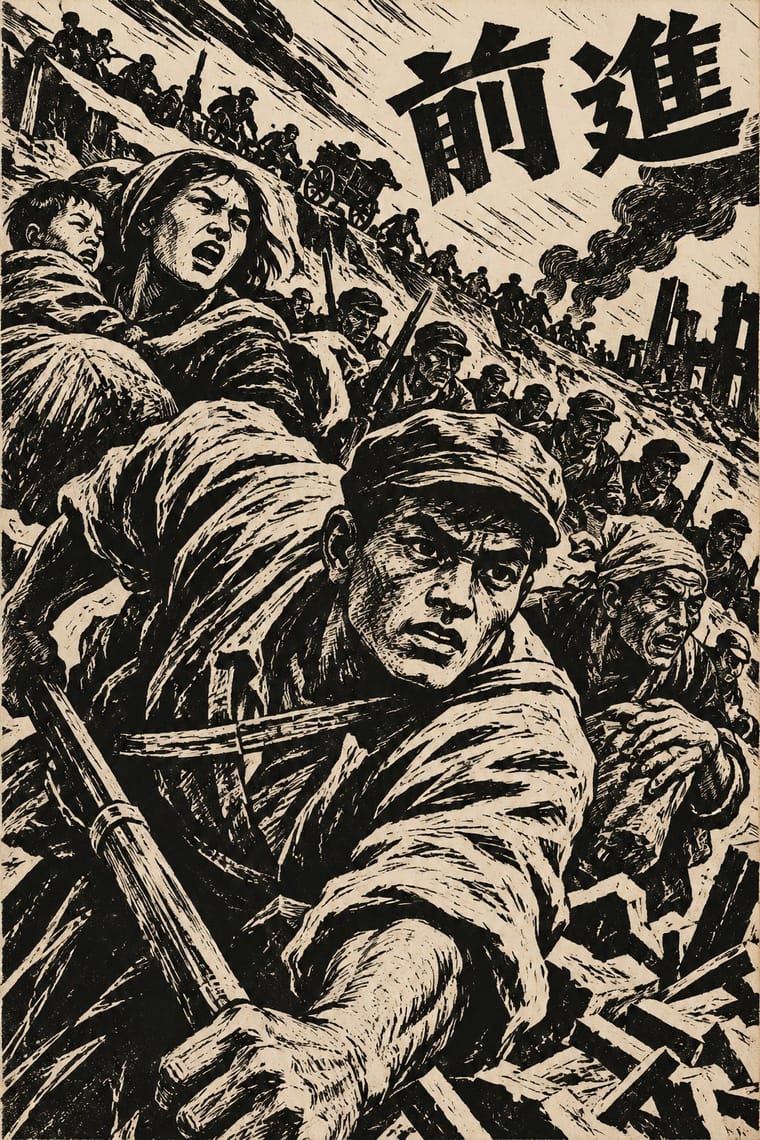
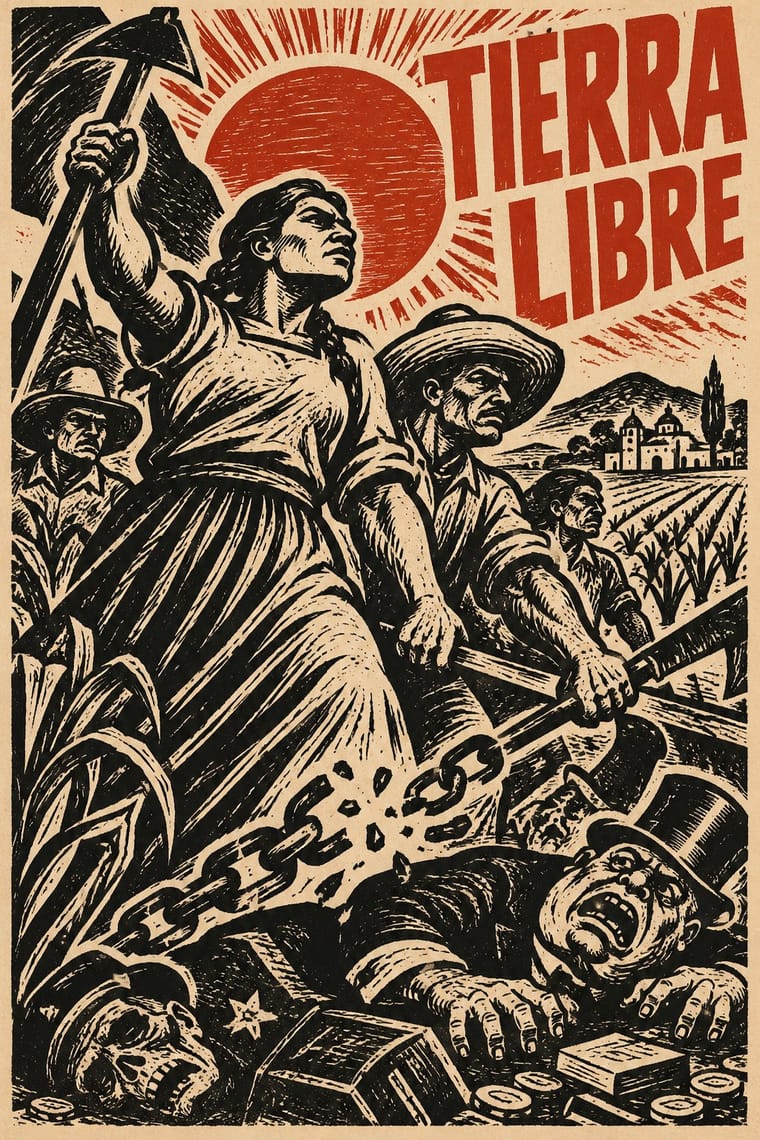
- Cut the image in wood with thick, decisive contours and broad solid blacks, and print it in black on Korean paper so the block can be pulled again and again.
- Build stocky, frontal workers, farmers, miners and dancers from a few simplified masses, borrowing the gestures of mask dance, gut ritual and folk painting.
- Record a collective event as a numbered series of plates, the way the Gwangju Uprising was told print by print.
- Let one image travel across scales and supports: a poetry-book cover, a pamphlet illustration, a poster, a print on cloth and an enlarged painted geolgae banner for the rally.
- Print mostly in black, with colour woodcuts using a few flat, folk-painting colours, and keep words to a short Hangul title or slogan carved or brushed into the image.
South Korea: Seoul's Reality and Utterance and the Gwangju Free Artists Association (both founded 1979), then print workshops and groups tied to the democracy and labour movements after the Gwangju Uprising of May 1980
02
Its design choices
From Stylogeny’s vocabulary of design choices: defining choices make the style, characteristic ones are usual, occasional ones turn up now and then.
- Layout & composition
- Space & hierarchy
- Colour
- Form & shape
- Surface & texture
- Medium & production
- Tone & intent
- Avoids
- Gradients, Fluorescent & neon, Gloss & highlights, Luxurious & glamorous, Non-representational, Eclectic mixing, Modular grid, Straight photography
Palette
-
#161412 -
#ece3cf -
#b5302a -
#c89a3c -
#7a5a3a
Typefaces
-
Hangul titles and slogans carved into the woodblock
-
Brush-written Hangul slogans on painted geolgae banners and posters
Known for
-
Oh Yoon (1946–1986), founding member of Reality and Utterance (1979)
The Song of Sword (1985; Fukuoka Asian Art Museum impression 1985/1997) and the woodblock print book Kal norae (1986)
-
Oh Yoon, Dawn of Labor (1985, listed by MMCA Research as a representative work), and woodblock covers and illustrations for Kim Jiha's Ojeok (Five Thieves; undated in the MMCA Research entry)
-
Hong Sung-dam (born 1955), founding member of the Gwangju Free Artists Association (1979)
Dawn, 49 woodcut prints on the May Resistance in Gwangju (1981–1988)
-
Hong Sung-dam, May-25
The World of Unity-1 (1984) and May-19: Let's Go to the Province Hall (1988, woodcut on paper, 40.8 × 54.5 cm), Fukuoka Asian Art Museum
-
Choi Byung-soo, Revive Hanyeol! (Hanyeol-ireul sallyeonaera, June 1987)
a woodcut printed overnight from the photograph of the wounded student Lee Han-yeol, for the bereaved and students to wear on their chests, then enlarged as a 7.5 × 10 m painted geolgae banner on cotton (banner in MMCA's collection)
-
Hwang Jai-hyoung, prints of miners' lives, and Choung Bi-pa, named by MMCA among the leading Minjung printmakers
-
15 Years of Minjung Art
1980–1994, MMCA Gwacheon, 5 February – 16 March 1994
03
Make something in this style
Say what you need, and Stylogeny’s image studio draws it from Minjung Woodcut Graphics (Korean People's Art)’s design choices and checks it against them. It takes about a minute, and you get a link to share.
04
Where it comes from, and what it’s close to
Before it
The style it grew out of, and the styles it borrowed from.
After it
The styles that grew out of it.
No later style in the atlas grew out of it yet.
Alike in its design choices
Styles that make many of the same choices, related or not, besides those above.
05
Sources
- National Museum of Modern and Contemporary Art, Korea (MMCA), Fifty Years of Korean Contemporary Printmaking (Metropolitan Museum of Manila, 2013): https://www.mmca.go.kr/exhibitions/exhibitionsDetail.do?exhId=201307240000093
- Tae Man Choi, 'The Meaning and Evaluation of 15 Years of Minjung Art: 1980–1994', in What Do Museums Change? Art and Democracy (MMCA, 2020): https://www.mmcaresearch.kr/essays/view.do?fid=2093
- MMCA Research, terms: Reality and Utterance / Oh Yoon: https://www.mmcaresearch.kr/terms/view.do?fid=1164
- Fukuoka Asian Art Museum, Blaze Carved in Darkness: Woodcut Movements in Asia 1930s–2010s (23 November 2018 – 20 January 2019), section 9 '1980s–2000s Korea: Woodcuts as icons of the democratization movement': https://faam.city.fukuoka.lg.jp/en/exhibition/7115
- Queens Museum, Resistance and Meditation: Hong Sung-dam (East Wind, with the Gwangju Art Museum): https://queensmuseum.org/2015/12/resistance-and-meditation
- Fukuoka Asian Art Museum, Blaze Carved in Darkness: Woodcut Movements in Asia 1930s–2010s, exhibition flyer (Oh Yoon, The Song of Sword, 1985/1997; Hong Sungdam, May-19: Let's Go to the Province Hall, 1988): https://faam.city.fukuoka.lg.jp/manager/wp-content/uploads/2019/08/Blaze-Carved-in-Darkness-Woodcut-Movements-in-Asia-1930s-2010s_flyer.pdf.pdf
- Fukuoka Asian Art Museum, Realities in Korean Art (19 December 2024 – 8 April 2025), list of works: https://faam.city.fukuoka.lg.jp/manager/wp-content/uploads/2024/02/Realities-in-Korean-_Leaflet.pdf
- Fukuoka Asian Art Museum, collection: Hong Sungdam (1955–), May-19: Let's Go to the Province Hall (1988): https://faam.city.fukuoka.lg.jp/en/collections/6721/
- Seoul Shinmun, 8 June 2017, on Choi Byung-soo's woodcut and banner 'Hanyeol-ireul sallyeonaera!' (1987): https://seoul.co.kr/news/society/2017/06/08/20170608800095
How Stylogeny researches and checks a style: where the facts come from.