Avant-garde · 1931–1949 · East Asia
Chinese Modern Woodcut Movement
Also known as New Woodcut Movement, Xinxing banhua yundong, Creative woodcut (chuangzuo banhua), Yan'an woodcut
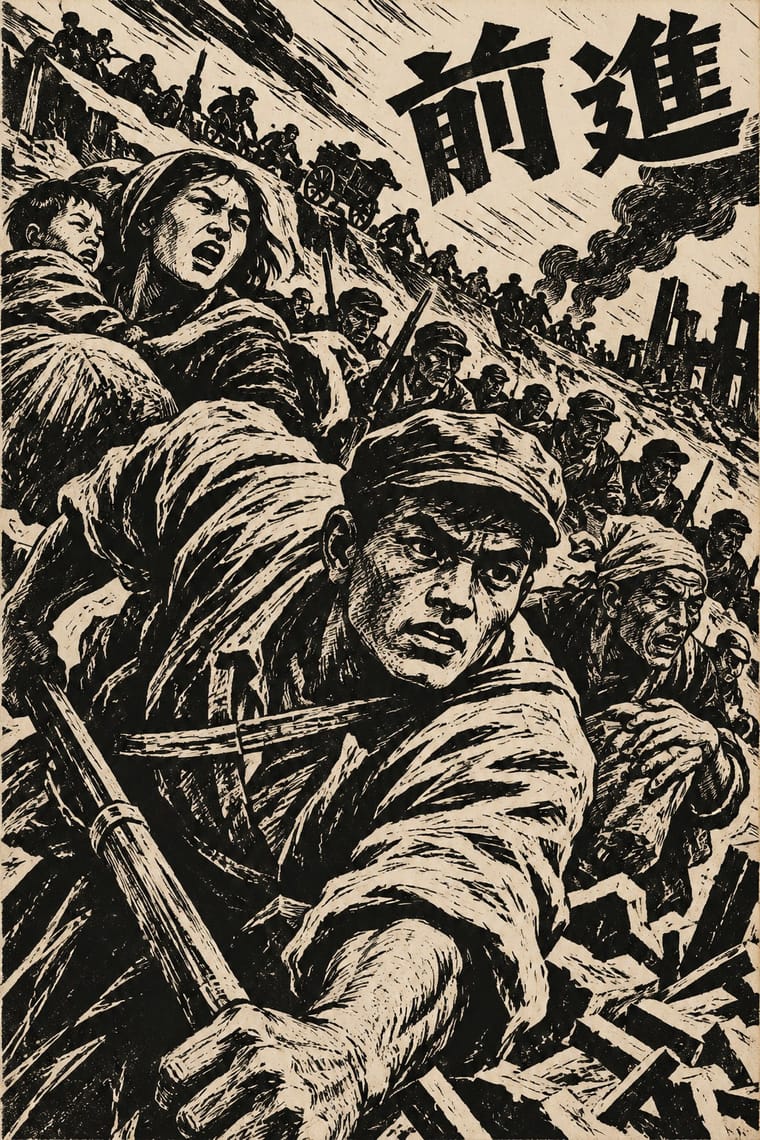
The leftist print movement launched by Lu Xun's 1931 Shanghai woodcut workshop, which made the self-cut black-and-white woodcut China's art of national crisis and revolution. Young artists learned from Käthe Kollwitz, Frans Masereel and Soviet woodcuts to gouge close-up, diagonal images of workers, refugees and resistance for journals, books and travelling exhibitions; in Yan'an after 1942 they adopted New Year print outlines and colour for peasant audiences.
Make something in this styleGet advice in this styleMix it with another style
01
How it works
- Cut the block yourself and leave the chisel's slashes visible: hard black masses broken by white gouge strokes.
- Show workers, refugees, soldiers and bound or shouting bodies close up, surging on diagonals toward the viewer.
- Print in black ink on thin paper at book, journal and broadsheet scale, so prints are cheap to pull and easy to send on travelling exhibitions.
- Keep words to a short hand-cut or brush-written title and let the image carry the argument.
- For rural audiences, soften heavy shadows into clear outlines and add flat New Year print colour and folk subjects.
Shanghai (Lu Xun's woodcut workshop, August 1931), then woodcut societies in Hangzhou and Guangzhou, the wartime rear areas and the Lu Xun Academy of Arts in Yan'an
02
Its design choices
From Stylogeny’s vocabulary of design choices: defining choices make the style, characteristic ones are usual, occasional ones turn up now and then.
- Layout & composition
- Space & hierarchy
- Typography
- Colour
- Form & shape
- Surface & texture
- Imagery
- Medium & production
- Tone & intent
- Avoids
- Gradients, Straight photography, Photomontage, Type as image, Eclectic mixing, Gloss & highlights, Luxurious & glamorous, Non-representational, Condensed display
Palette
#141414#efe7d4#8c7b62#b8312f#e0b23a
Typefaces
Hand-cut Chinese characters carved into the block
Brush-written kaishu titles on journal and book covers
Songti (Ming) letterpress type for journal text
Known for
Lu Xun
organiser; Shanghai woodcut workshop taught by Uchiyama Kakichi, August 1931
Hu Yichuan, To the Front!
1932
Li Hua, Roar, China!
1935; Modern Prints, Guangzhou
Yan Han, The Five Heroes of Langya Mountain
16-panel woodcut sequence
Gu Yuan
Lu Xun Academy of Arts, Yan'an
All-China Association of Anti-Enemy Woodcut Artists
founded 1938
China in Black and White (John Day, 1945), 82 woodcuts with commentary by Pearl S. Buck
03
Make something in this style
Say what you need, and Stylogeny’s image studio draws it from Chinese Modern Woodcut Movement’s design choices and checks it against them. It takes about a minute, and you get a link to share.
04
Where it comes from, and what it’s close to
Before it
The style it grew out of, and the styles it borrowed from.


After it
The styles that grew out of it.
No later style in the atlas grew out of it yet.
Alike in its design choices
Styles that make many of the same choices, related or not, besides those above.


05
Real works
Artefacts in museums, libraries and archives that show the style, linked at their source.
- Sanitation WorkerXia Peng (夏朋) · 1933 · National Art Museum of China, Beijing (image via Wikimedia Commons)
- Going Against the CurrentLuo Qingzhen (罗清桢) · 1935 · National Art Museum of China, Beijing (image via Wikimedia Commons)
- The Little BoatHe Baitao (何白涛) · 1935 · National Art Museum of China, Beijing (image via Wikimedia Commons)
- Production in the Eighth Road ArmyGu Yuan (古元) · 1930s and 1940s · The Metropolitan Museum of Art, New York (2022.396)


06
Sources
- Xiaobing Tang, Origins of the Chinese Avant-Garde: The Modern Woodcut Movement (University of California Press, 2008)
- Sixth Tone, 'Wartime Woodcuts: The Art That Helped China Fight Japan' (https://www.sixthtone.com/news/1017568)
- Smarthistory, 'Hu Yichuan, To the Front!' (https://smarthistory.org/hu-yichuan-to-the-front)
How Stylogeny researches and checks a style: where the facts come from.