Traditions & vernacular · 1776–present · East Asia
Chaekgeori & Minhwa Screen Painting
Also known as Chaekgeori (books and things), Chaekgado (bookshelf screens), Munbangdo, Munjado (pictorial ideographs), Minhwa (Korean folk painting)
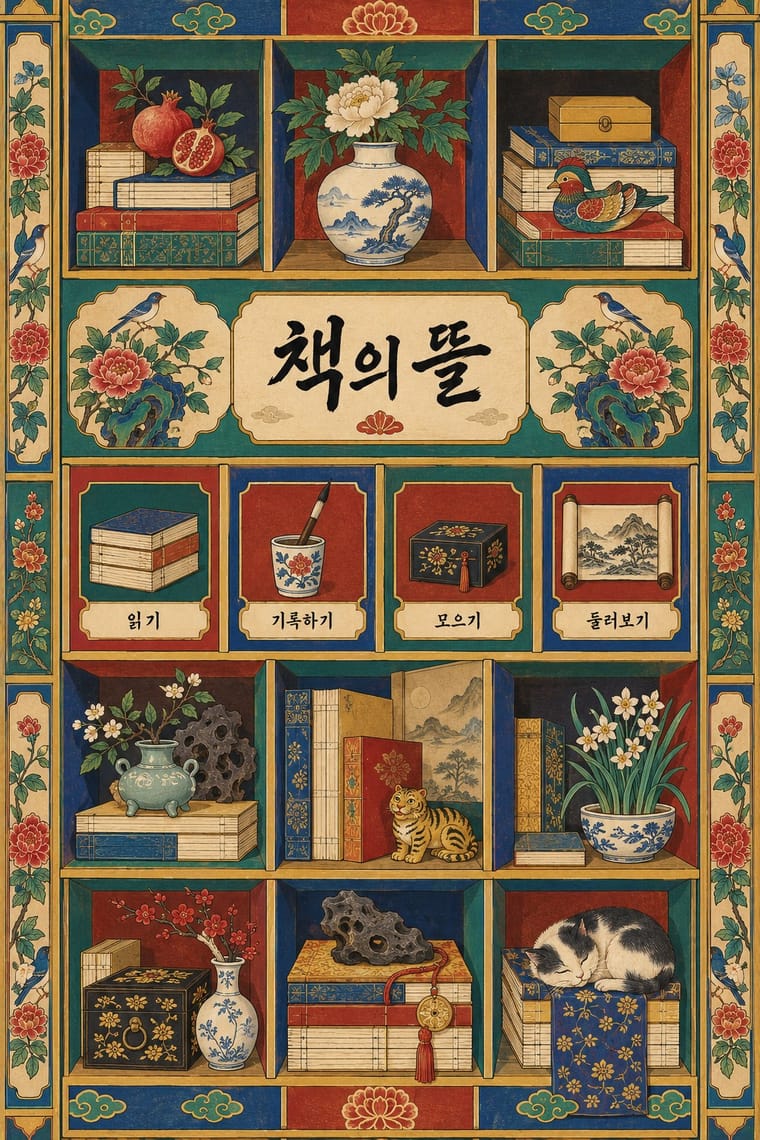
Korean painted folding screens of the late Joseon period. Chaekgeori ('books and things') stack books, bronzes, ceramics and scholar's tools, often in a grid of bookcase compartments drawn with Western-derived shading and several viewpoints at once. Promoted at court by King Jeongjo, the genre passed to anonymous folk painters (minhwa), who also made munjado screens in which one Confucian-virtue character is built from emblematic pictures.
Make something in this styleGet advice in this styleMix it with another style
01
How it works
- Divide the screen into a grid of shelf compartments and give each cell its own still life of books and precious objects.
- Model books and vessels with shading and recession borrowed from Jesuit-transmitted Western perspective, but let each compartment keep its own viewpoint so objects tilt towards the viewer.
- Design for a folding screen of tall panels that reads both as one continuous field and as a sequence.
- Let objects carry meaning: books for learning, Chinese bronzes and ceramics for connoisseurship, clocks and spectacles for worldliness, pomegranates for fertility.
- In munjado, let one Confucian-virtue character fill each panel and build its strokes from the emblems of its moral stories, such as the carp and bamboo shoots of filial piety.
- Paint in bright mineral colour on paper or silk; in folk versions, flatten the space and let objects float freely.
Joseon court in Hanyang (Seoul) under King Jeongjo (r. 1776–1800), spreading to aristocratic and then commoner households across Korea; minhwa revived since the 1980s
02
Its design choices
From Stylogeny’s vocabulary of design choices: defining choices make the style, characteristic ones are usual, occasional ones turn up now and then.
- Layout & composition
- Space & hierarchy
- Typography
- Colour
- Surface & texture
- Ornament
- Medium & production
- Tone & intent
- Avoids
- Monochrome, Generous white space, Non-representational, Ornament-free, Straight photography
Palette
#efe3c8#2e7d6b#2b4c8c#b8392b#d9a23a#2a2420
Typefaces
Haeseo (regular script) brush characters
Munjado pictorial ideographs built from emblematic motifs
Seal script on the painter's hidden seals
Known for
Yi Hyeong-rok (also signed Yi Eungrok and Yi Taekgyun, c. 1808–1883), court chaekgado screens with hidden seals
Cleveland Museum of Art; Asian Art Museum, San Francisco
King Jeongjo (r. 1776–1800), who promoted chaekgeori and reportedly had a book painting placed behind his throne in place of royal imagery
Anonymous minhwa painters' munjado screens of the eight Confucian virtues
filial piety, brotherly respect, loyalty, trust, propriety, righteousness, integrity, sense of shame
Chaekgeori
The Power and Pleasure of Possessions in Korean Painted Screens (Spencer Museum of Art and US tour, 2017; eds. Byungmo Chung and Sunglim Kim)
Knowledge in Trompe-l'œil, Korea (18th–20th century), Musée Guimet, Paris
2026–27
03
Make something in this style
Say what you need, and Stylogeny’s image studio draws it from Chaekgeori & Minhwa Screen Painting’s design choices and checks it against them. It takes about a minute, and you get a link to share.
04
Where it comes from, and what it’s close to
Before it
The style it grew out of, and the styles it borrowed from.


After it
The styles that grew out of it.
No later style in the atlas grew out of it yet.
Alike in its design choices
Styles that make many of the same choices, related or not, besides those above.
- Senegalese Sufi Devotional Imagery (Souwère Glass Painting and Amadou Bamba Portraits)61% alike

- Pakistani Truck Art49% alike


05
Real works
Artefacts in museums, libraries and archives that show the style, linked at their source.
- Books and Scholars' Accoutrements (chaekgado)Yi Taek-gyun (1808–after 1883) · late 1800s · The Cleveland Museum of Art
- Books and Scholarly AccoutrementsUnidentified artist · 19th century · The Metropolitan Museum of Art
- Books and Scholars' PossessionsUnidentified artist · early 20th century · The Metropolitan Museum of Art
- Munja-Chaekgeori Screen (Character-Books Screen)Unidentified artist · early 1900s · The Cleveland Museum of Art
06
Sources
- https://en.wikipedia.org/wiki/Chaekgeori
- Byungmo Chung & Sunglim Kim (eds.), Chaekgeori: The Power and Pleasure of Possessions in Korean Painted Screens (SUNY Press, 2017)
- https://amis-musee-cernuschi.org/en/du-raffinement-de-la-cour-a-limaginaire-populaire-le-paravent-coreen-aux-livres-chaekgeori/
- https://en.wikipedia.org/wiki/Minhwa
How Stylogeny researches and checks a style: where the facts come from.