Traditions & vernacular · 1871–1970 · Middle East & North Africa, Western Europe, Central Europe, North America
Egyptian Cigarette Packaging (Cairo Tobacco Houses)
Also known as Egyptian cigarette tins, Cigarettes égyptiennes, Orientalist cigarette packaging, Egyptian cigarette boxes
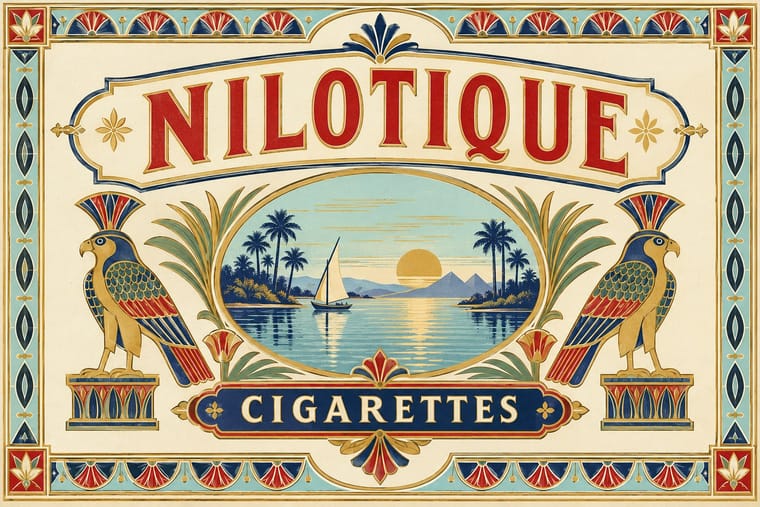
The flat tins and slide boxes in which Cairo's tobacco houses, most of them Greek-run, sold hand-made Egyptian cigarettes to the world. A symmetrical lid, framed in Greek-key or interlace bands, carries the maker's name in capitals of mixed faces, crowned monograms, crests and exhibition medals, an Arabic cartouche, small gold crescent-and-star devices, and one or two Orientalist vignettes: cross-legged pipe smokers, pharaonic statues, sphinxes or lotus. The tone is a trading house's guarantee of luxury, and the look was copied by American brands from Rameses II to Camel.
Make something in this style Get advice in this style Mix it with another style
Use it with care
These boxes sold an Orientalist fantasy of Egypt to Western smokers: the turbaned pipe smoker and the jewelled odalisque are stereotypes, and pharaonic gods and statues were turned into trade marks, so do not reuse them as neutral 'Egyptian' decoration or as a picture of Egyptian life. The crescent and star (an Ottoman and Egyptian state emblem, now widely read as a sign of Islam) and the Arabic inscriptions are state and religious signs, not ornament: do not scatter them or fake Arabic lettering as exotic texture. Tobacco branding is now restricted by advertising bans and plain-packaging laws in many countries, so do not use the style to make real cigarette packs look attractive, and Camel is a live trade mark: draw new marks rather than copying any brand's crest or name.
01
How it works
- Centre the lid on one axis: maker's name, crest and brand plaque stacked in the middle, matching vignettes or crests mirrored to either side.
- Frame the lid in a continuous geometric border band, or close it with matching end bands (Greek key, interlace or rosettes), printed in gold and one strong colour.
- Vouch for the product with heraldry and facts: crowned monograms, coats of arms, prize medals, 'Established 1873', the factory's quarter and the cities of its depots; the Kyriazi lids also scatter small gold crescent-and-star devices across the ground (see the caution before reusing them).
- Set nearly every line in capitals but change the face line by line, keep mixed case for a small ribbon or frame label ('Egyptian Cigarettes Manufactory', 'Registered trade mark'), and give the Arabic name its own oval cartouche beside the French or English.
- Keep the Egyptian or 'Oriental' picture small and contained, a seated smoker in an arched niche or a pharaonic statue in a gilt frame, on a calm pale ground.
- Print in a few flat inks plus gold on tinplate or card, and sometimes save a full-colour fantasy scene for the inside of the lid.
Cairo, where the Greek merchant Nestor Gianaclis, in Egypt from 1864, set up a cigarette factory in the Khairy Pasha palace in 1871, followed by Greek houses such as Kyriazi Frères (1873), Melachrino, Vafiadis and Dimitrino, alongside non-Greek makers such as Nicolas Soussa Frères and the Armenian Matossian brothers (Alexandria 1882, Cairo 1886); their hand-made cigarettes were sold in printed tins and boxes as a luxury export to Britain, Europe and the United States, imitated by American 'Egyptian' brands, until tastes turned to Virginia tobacco after the First World War. The houses also packed for and sold through depots and branches abroad (Melachrino in London and New York; Kyriazi factories in Amsterdam from 1922 and Hamburg from 1925, and in Berlin after the Second World War), so much of the surviving corpus was made for foreign markets. The Greek-run industry in Egypt was nationalised after the 1952 coup, but Kyriazi tins still marked 'Cairo (Egypt)' went on being made in Germany, by then under British American Tobacco, into the 1970s
02
Its design choices
From Stylogeny’s vocabulary of design choices: defining choices make the style, characteristic ones are usual, occasional ones turn up now and then.
- Layout & composition
- Space & hierarchy
- Typography
- Colour
- Surface & texture
- Ornament
- Medium & production
- Tone & intent
- Avoids
- Dynamic asymmetry, Collage & layering, Horror vacui, Lowercase only, Flush left, ragged right, Straight photography, Fluorescent & neon
Palette
-
#b9dcd4 -
#c8322a -
#1f2f5c -
#c9a23f -
#efe6cc -
#8fa58a
Typefaces
-
Shaded, outlined and spurred serif capitals for the maker's name
'M. MELACHRINO & Co.'
-
Bold sans-serif capitals reversed out of dark plaques for trade lines
'IMPORTERS & MANUFACTURERS OF TURKISH TOBACCO', 'EXPORTERS OF CIGARETTES AND TOBACCO'
-
Widely spaced roman capitals for the brand in a pointed plaque or ribbon
'FINAS', 'FERIK', 'APIS', 'CAIRO (EGYPT)'
-
Arabic calligraphic inscription of the maker's name in an oval cartouche
Kyriazi Frères
-
French label lines such as 'Cigarettes Egyptiennes'
Maspero Frères
Known for
-
Kyriazi Frères 'Ferik' cigarette tin, Cairo, 1925-1930, 13.5 x 11.2 cm (Museum Rotterdam 66609)
pale turquoise lid inside a gold rim, framed by a red interlace border, with two window-like niches, each holding a cross-legged man in Eastern dress, one with a Western pipe, the other with a water pipe; inside the lid a jewelled woman leans on a lion on a gold ground and the smoke of her cigarette forms the maker's name above its head, over a row of prize medals
-
Kyriazi Frères 'Apis' tin and 'Finas' box (photographs on Wikimedia Commons)
the same lid printed in red, navy and gold on pale grey or in blue and gold on cream, with a mixed-case 'Egyptian Cigarettes Manufactory' ribbon, crowned crest, 'Established 1873', 'Works at Tewfikieh Quarter' and a 'Cairo (Egypt)' ribbon on the Apis tin, the Arabic name in an oval under a spread eagle, small crescent-and-star devices on the ground, 'Importers & manufacturers of Turkish tobacco' plaques under the niches, and on the Apis lid the registration numbers '31261 KL. 38' and '9135 KL. 38'
-
M. Melachrino & Co. tin, 'Manufactory of the best Egyptian cigarettes' (Washington State History Museum, Tacoma)
sage-green lid with six crowned coats of arms in laurel wreaths, 'Grands Dépôts' in London, Cairo, Shanghai, New York and Montreal, Levant tobacco depots at Cavalla, Samsoun, Xanthie and Smyrna, two pharaonic statues in gilt arched niches either side of a larger gilt frame holding a Hathor cow statue, each marked 'Registered trade mark', and bands of gold rosettes on red at each end; a US tax stamp across the lid shows it was an American-market tin
-
Maspero Frères Ltd cardboard cigarette box, Cairo (UBC CNERS Artifact Collections)
label 'Maspero Frères Ltd, Cairo - Egypt, Cigarettes Egyptiennes' framed by lotus plants and a red and green Art Deco pattern, with a paper seal inscribed '22 Emir' and in Arabic
-
Poulides Brothers (tobacconist), cigarette box 'Egyptian Cigarettes Mignon', c. 1900, tin and colour-printed paper, 3.5 x 7.3 x 14 cm
Brooklyn Museum 2003.12
-
Kyriazi Frères tin for 25 cigarettes printed 'Zweigfabrik in Hamburg' and 'Kyriazi Frères Cairo (Egypt)', 1900/1930 (Deutsches Historisches Museum, AK 94/516.4050): the Cairo house's name on a tin from its German branch factory
-
Tin canister for Dimitrino's Egyptian Cigarettes with a decorative printed label
Princeton University Library, Graphic Arts Collection
-
American imitations
Stephano Bros.' Rameses II (Philadelphia, 1895), advertised with scarabs and the temple of Abu Simbel; S. Anargyros's Murad and Egyptian Deities (New York); and R. J. Reynolds's Camel (1913), with a camel, pyramids and a palm tree on the pack
03
Make something in this style
Say what you need, and Stylogeny’s image studio draws it from Egyptian Cigarette Packaging (Cairo Tobacco Houses)’s design choices and checks it against them. It takes about a minute, and you get a link to share.
04
Where it comes from, and what it’s close to
Before it
The style it grew out of, and the styles it borrowed from.

After it
The styles that grew out of it.
No later style in the atlas grew out of it yet.
Alike in its design choices
Styles that make many of the same choices, related or not, besides those above.
05
Sources
- Wikipedia, 'Tobacco industry in Egypt' (https://en.wikipedia.org/wiki/Tobacco_industry_in_Egypt): Nestor Gianaclis in Egypt from 1864 and his factory in the Khairy Pasha palace, Cairo, in 1871; Greek merchants escaping the Ottoman tobacco monopoly; British troops from 1882 and exports to the UK; output figures 1897-1901 with Kyriazi Frères the largest producer; the Camel packet (1913) with camel, pyramids and palm tree, and Egyptian-themed brands of S. Anargyros and Stephano Brothers; decline after the First World War and nationalisation after 1952
- Wikipedia, 'Kyriazi Freres' (https://en.wikipedia.org/wiki/Kyriazi_Freres): established 1873 'as advertised on all their products', Muski Street and the 1897 factory in the Tewfikieh district, brands Aris, Ferik, Finas, Special and others, exhibition awards, exports of over 103 million cigarettes by 1901
- Museum Rotterdam, object 66609, 'Sigarettenblik met "Kyriazi Frères"' (https://museumrotterdam.nl/collectie/item/66609; record and photograph reproduced on Wikimedia Commons, CC BY-SA 3.0): Cairo, 1925-1930, tinned iron with transfer print, description of lid and inside-lid scene
- Wikimedia Commons, 'M. Melachrino & Co. cigarettes 01.jpg' (photograph by Joe Mabel, 2012, of a tin at the Washington State History Museum), 'Melachrino.jpg', 'Kyriazi Frères, APis, cigarettes tin.JPG' and 'Kyriazi Frères Finas.JPG': lid layouts, inscriptions and colours
- Brooklyn Museum, 2003.12, Poulides Brothers (Tobacconist), Cigarette Box 'Egyptian Cigarettes Mignon', ca. 1900 (https://www.brooklynmuseum.org/opencollection/objects/164779)
- UBC CNERS Artifact Collections, 'Maspero Frères Egyptian Cigarette Box' (https://cnerscollections.omeka.net/items/show/122): label, lotus and Art Deco pattern, '22 Emir' seal; its bibliography cites Howard Cox, The Global Cigarette (2000), on Maspero Frères, and Chris Mullen, Cigarette Pack Art (1979), p. 78 (page returned 503 on 21 Oct 2026; record text read through the search index)
- Chris Mullen, Cigarette Pack Art (London, 1979), p. 78, as cited by UBC CNERS item 122: 'Egyptian style' cigarette boxes were made for the American and British export market rather than for Egyptian smokers
- Princeton University Library, Graphic Arts Collection, 'Egyptian Cigarette Box' (https://graphicarts.princeton.edu/2016/10/06/egyptian-cigarette-box): Dimitrino tin canister
- Stanford Research into the Impact of Tobacco Advertising, 'Early Orientalist' collections (https://tobacco.stanford.edu/cigarettes/early-orientalist/): Rameses (Stephano Bros., 1895), Murad and Deities (S. Anargyros)
- Relli Shechter, Smoking, Culture and Economy in the Middle East: The Egyptian Tobacco Market 1850-2000 (London: I.B. Tauris, 2006): general reference on the Egyptian tobacco market, its houses and its export trade (recommended reading in UBC CNERS item 122)
- Relli Shechter, 'Selling Luxury: The Rise of the Egyptian Cigarette and the Transformation of the Egyptian Tobacco Market, 1850-1914', International Journal of Middle East Studies 35, no. 1 (2003): 51-75, doi:10.1017/S0020743803000035
- German Wikipedia, 'Kyriazi' (https://de.wikipedia.org/wiki/Kyriazi): founded 1873 by Ioannis Kyriazis and his brothers; his sons opened factories in Amsterdam (1922) and Hamburg (1925); in 1960 Kyriazi's West German market share passed to British American Tobacco; brands including Finas and Egyptica
- Deutsches Historisches Museum, object KO305252, 'Blechdose für 25 Stück Zigaretten "Zweigfabrik in Hamburg KYRIAZI FRERES CAIRO - (EGYPT) KYRIAZI No 6"', 1900/1930, iron (https://objekt.db.dhm.de/objekt/KO305252)
- CIGABOX.DE, 'Kyriazi Freres Zigarettenfabrik' (http://cigabox.de/zigarettenfabriken/kyriazi/), collectors' reference: Amsterdam and Hamburg (1925) companies, a Berlin factory after the Second World War, BAT takeover in the 1960s, Egyptica made 1957-1972, and a 'Kyriazi No 6 Zweigfabrik in Hamburg' box of about 1936 with 'Kyriazi Cigarettes Cairo-Hamburg' inside the lid
- Freilichtmuseum Roscheider Hof on museum-digital: 'Zigarettenmarke "Finas" 10er und 50 Stück Blechpackung' (https://rlp.museum-digital.de/object/71046), tin with 'Egyptian Cigarettes Manufactory' and 'Kyriazi Frères Cairo (Egypt)', attributed to British American Tobacco, Hamburg, about 1965; and the 'Egyptica' tin (https://rlp.museum-digital.de/object/71045), about 1970, with a 'Kyriazi - Berlin' tax band (site returned 502 on 21 Oct 2026; record text read through the search index)
- Bluebird Maps, 'Armenians in Egypt' (https://bluebirdmaps.com/2017/11/12/armenians-in-egypt/): Matossian brothers' businesses in Alexandria (1882) and Cairo (1886), partnership 1896, merger with British American Tobacco 1927; and Armenian Numismatic Research, Matossian collection (https://www.armnumres.org/collections/show/117): the Matossians as Armenian immigrants from Tokat
- Wikipedia, 'Star and crescent' (https://en.wikipedia.org/wiki/Star_and_crescent): Ottoman state symbol, on the arms of the Khedivate and the flag of the Kingdom of Egypt, later reinterpreted as a symbol of Islam
How Stylogeny researches and checks a style: where the facts come from.