Pictorial & machine age · 1967–present · South Asia
Amar Chitra Katha Comics
Also known as ACK, Immortal picture stories, Indian mythological comics
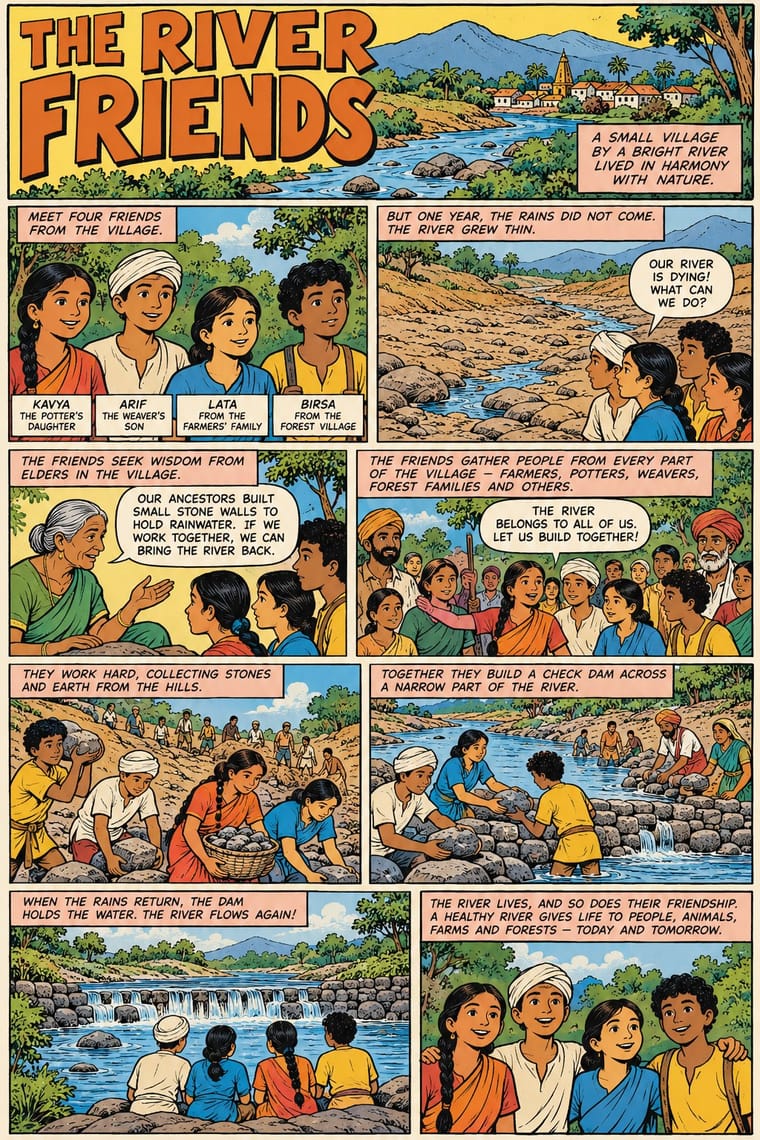
The Bombay comic-book series that from 1967 retold Hindu myth and epic, Buddhist and Jain tales, saints, folk legends, the jests of the court wits Birbal and Tenali Raman, and Indian history for children, in English and Indian languages, with well over 500 titles by the early 1990s. Each issue of about 32 pages tells one story, or a few short tales, in regular grids of ruled panels: brush-inked, idealised figures in flat colour, narration in tinted caption boxes, hand-lettered capitals, an iconography fixed from book to book, and a painted cover, often in the idiom of Indian calendar art.
Make something in this styleGet advice in this styleMix it with another style
Use it with care
The series, its covers, characters and sunburst logo belong to its publisher (Amar Chitra Katha Pvt Ltd) and its artists: draw your own figures, covers and badge, never ask an image model for an ACK title or a named artist's hand, and never present a generated page as an ACK comic. Many of its subjects are deities whom readers worship, so do not mock, crop or deface them. Scholars have criticised the series for giving heroes extremely fair skin while coding dark skin with violence, brutality and low caste, for casting Muslims as either secular heroes or zealous villains, for drawing the British as ugly caricatures, and for leaving women, Muslims and lower castes out of its history: give gods, demons, villains, Muslims, Dalit and Adivasi characters the same drawing care, never use skin colour, features or dress as markers of evil, caste or religion, draw people across the real range of South Asian skin tones rather than one pale, uniform type, and do not present one Hindu reading as the whole of India's past.
01
How it works
- Tell one self-contained story from myth, legend or history in about 32 pages: open on a large title panel lettered in heavy display capitals, then lay out the pages in regular tiers of ruled rectangular panels with white gutters, and let no figure break the frame (Pritchett knew of a single exception in the whole series, a radiant cosmic Krishna in The Gita, no. 127).
- Narrate in tinted rectangular caption boxes lettered in slanted capitals, keep the dialogue in round balloons lettered in upright capitals, and let the captions carry as much of the story as the pictures.
- Draw with a firm brush-and-pen contour and solid black shadows, then fill every shape with flat colour, from light leaf greens, pinks and sky blues to strong saffron, red and yellow, with no gradients and only a little pen hatching on foliage and ground.
- Keep the iconography constant from book to book: each god with fixed attributes and colour, such as blue-skinned Krishna with crown and peacock feather (a halo or radiance is kept for covers and moments of epiphany), heroes with idealised, classically proportioned bodies in a range of brown skin tones (the originals drew one uniform, fair-skinned type), and the costume and architecture of each period kept consistent from title to title.
- Paint the cover as one full-colour scene, often in the calendar-art idiom, a jewelled and often haloed hero or deity in a dramatic setting, sometimes a looser, expressive painting on a strong diagonal, with the title in a bold serif or a heavy sans-serif, often on a tinted band, and a corner box for a series badge, issue number and price; draw an invented badge (the originals carry the publisher's sunburst roundel).
- Teach as well as tell, as the later issues do: add an occasional footnote that defines an unfamiliar word and, as the mini-series of the 1980s did, a closing glossary (only the first six Mahabharata issues have one) or whole pages of documentary prose and a full-page map and chronology (the March to Freedom history titles), so the comic reads as a reliable lesson (the early books carried nothing but picture panels).
Bombay (Mumbai), India: an educational comic-book series launched in 1967 (by Anant Pai at India Book House; by Pai's account, after he watched a children's television quiz in Delhi on which a boy could not name Rama's mother, and a year after the firm failed with Hindi translations of Classics Illustrated; by the publisher's account the first ten titles were Western fairy tales, and the first on Indian myth, Krishna, no. 11, c. 1969–70, is credited to Ram Waeerkar; an Outlook account instead credits the idea to the Bangalore book salesman G. K. Ananthram and dates the first ten titles, in Kannada, to 1965), published in English and Indian languages (the earliest titles were planned in English, Hindi, Kannada, Gujarati, Telugu and Marathi at once; by the late 1980s each issue was produced first in English and then translated into Hindi, Marathi, Kannada, Bengali, Gujarati and others), and still in print (sold by India Book House in 2007; now published by Amar Chitra Katha Pvt Ltd)
02
Its design choices
From Stylogeny’s vocabulary of design choices: defining choices make the style, characteristic ones are usual, occasional ones turn up now and then.
- Layout & composition
- Space & hierarchy
- Typography
- Colour
- Surface & texture
- Ornament
- Imagery
- Tone & intent
- Avoids
- Broken grid, Collage & layering, Experimental & distorted, Lowercase only, Fluorescent & neon, Non-representational, Ironic & self-aware, Rebellious & subversive
Palette
#1e1c1a#f3ecd4#f0e062#6fa3d8#e8772e#b97a50
Typefaces
Heavy hand-drawn display title
bold capitals, outlined, slanted or solid, in the opening panel of each story, which can fill the top half of the first page or the whole of it
Upright hand-lettered capitals
dialogue in round speech balloons, evenly spaced and drawn by hand
Slanted hand-lettered capitals
narration in tinted rectangular caption boxes, set apart from the upright dialogue
Bold cover titles
a bold serif, often a heavy, bracketed Clarendon-like face, or a heavy sans-serif, in capitals or mixed case and often on a tinted band, beside the corner box with the series roundel, number and price
Indian-script hand-lettering
balloons relettered in Kannada, Devanagari and other scripts for the translated editions
Known for
Anant Pai (1929–2011), founder and editor, 'Uncle Pai' to readers
Krishna
no. 11, c. 1969–70, credited to Ram Waeerkar; the first title on Indian myth
The Mahabharata series
42 issues from March 1985, opening with Veda Vyasa, no. 329
The March to Freedom series
six issues from January 1986, with pages of documentary prose and a full-page map and chronology
Krishna and Shishupala
no. 177; painted cover signed by C. M. Vitankar
Amar Singh Rathor
1978; no. 681 in the reprint numbering; artwork by Pratap Mulick
Mahatma Gandhi
Father of the Nation (special issue, 2008, illustrations by Souren Roy)
Dilip Kadam and Yusuf Lien (Yusuf Bangalorewala), series illustrators
03
Make something in this style
Say what you need, and Stylogeny’s image studio draws it from Amar Chitra Katha Comics’s design choices and checks it against them. It takes about a minute, and you get a link to share.
04
Where it comes from, and what it’s close to
Before it
The style it grew out of, and the styles it borrowed from.
After it
The styles that grew out of it.
No later style in the atlas grew out of it yet.
Alike in its design choices
Styles that make many of the same choices, related or not, besides those above.
- Ethiopian Revolutionary Poster (Derg Era)65% alike
05
Sources
- Frances W. Pritchett, 'The World of Amar Chitra Katha', chapter 4 (from p. 76) of Lawrence A. Babb and Susan S. Wadley (eds), Media and the Transformation of Religion in South Asia (University of Pennsylvania Press, 1995): https://www.franpritchett.com/00fwp/published/amarchitrakatha.pdf (Pai's account of the Delhi quiz in 1967; IBH's failed Hindi Classics Illustrated; the earliest titles to be produced in 'English, Hindi, Kannada, Gujarati, Telugu and Marathi'; 'Every issue is first produced in English' and then translated into Hindi, Marathi, Kannada, Bengali, Gujarati and others; well over 500 titles; Tinkle apparently from November 1980; the 'Mahabharata in 60 volumes' from March 1985 closing at 42 issues; the six-issue March to Freedom of January 1986 with prose pages, a full-page map and chronology; pages that 'used to have nothing on them except picture panels', footnotes that 'now occur from time to time', last-page glossaries for the first six Mahabharata issues only ('after that, they disappear'); Guru Nanak, no. 47, drawn 'with a halo around his head from infancy, a distinction not accorded to Kabir or even Krishna'; reprints renumbered from 501, starting with Krishna (501); the one illustration that, 'as far as I know', breaks its frame, The Gita no. 127; a 'uniform, fair-skinned, blank-faced physical type', 'almost identical palaces', caricatured British; 32-page comic books)
- Karline McLain, India's Immortal Comic Books: Gods, Kings, and Other Heroes (Indiana University Press, 2009): https://iupress.org/9780253220523/indias-immortal-comic-books/ (based on fieldwork in the ACK production offices; chapters include 'Muslims as Secular Heroes and Zealous Villains')
- Nilakshi Goswami, 'Ideological History, Contested Culture, and the Politics of Representation in Amar Chitra Katha', Status Quaestionis 20 (2021), pp. 219–246: https://rosa.uniroma1.it/rosa03/status_quaestionis/article/view/17518 (quotes Nandini Chandra on the 'photographic realism' of its drawings; light skin tied to virtue and upper caste, dark skin coded with 'violence, brutality, and low caste status')
- Wikipedia, 'Amar Chitra Katha': https://en.wikipedia.org/wiki/Amar_Chitra_Katha (founded 1967 by Anant Pai with India Book House, given as predecessor, with Amar Chitra Katha Pvt. Ltd. as parent company; ACK's account that Pai first bought the rights to ten American fairy tales, then Krishna, no. 11, drawn by Ram Waeerkar; over 500 titles by 1995; illustrators Ram Waeerkar, Dilip Kadam, C. M. Vitankar, Pratap Mullick, Yusuf Lien a.k.a. Yusuf Bangalorewala; criticism by Pritchett and others; an Outlook account, at odds with Pai's, credits the idea to the Bangalore book salesman G. K. Ananthram and dates the first ten titles, in Kannada, to 1965; ownership stakes from 2010 to 2022)
- Wikipedia, 'Ram Waeerkar': https://en.wikipedia.org/wiki/Ram_Waeerkar (1936–2003; credited, without a citation, with drawing the first issue, Krishna, in 1969; nearly 90 ACK titles; 'quick brush strokes and sharp profiles')
- Michigan State University Libraries, Comic Art Collection reading room index, 'Amar Chitra Katha': https://comics.lib.msu.edu/rri/arri/amar.htm (colour comic books, 25 cm, about 30–32 pages; Shakuntala, no. 12, March 1970; Amar Singh Rathor, no. 681 (1978, 2010 printing), illustrations by Pratap Mulick; Krishna as no. 501 (1970, 2010 printing), numbers from 501 being reprint numbers, as Pritchett notes; Birbal the Witty, no. 152 (1979 printing), and other Birbal titles; Raman of Tenali, no. 523 (1978, 2010 printing), and Raman the Matchless Wit: The Adventures of a Unique Court Jester, no. 581 (1980, 2010 printing); Mahatma Gandhi: Father of the Nation, special issue, 2008, 61 pages, illustrations by Souren Roy)
- Melinda C. Shepherd, 'Pai Anant (1929–2011)', Encyclopædia Universalis: https://www.universalis.fr/encyclopedie/anant-pai/ (born 17 September 1929 in Karkala, died 24 February 2011 in Mumbai; issues written in English and translated into regional languages; 'India Book House vend la collection à un autre éditeur en 2007'; Tinkle created in 1980)
- Bharath Murthy, 'Graphic Novels in India: A Critical View of Artistic Styles', Sahapedia: https://www.sahapedia.org/graphic-novels-india-critical-view-of-artistic-styles (Ravi Varma 'utilized the realism of European oil painting and applied it to Hindu religious iconography', a strategy 'borrowed' by Amar Chitra Katha)
- Internet Archive scans examined for layout, lettering and colour: Krishna and Shishupala, no. 177, cover signed C. M. Vitankar with a haloed blue Krishna and a bold serif title, light flat interior fills, an interior Krishna with crown and peacock feather but no halo (e.g. printed pp. 8 and 10), and a first page whose top half is a title panel in outlined hand-drawn capitals (https://archive.org/details/wvqd-krishna-and-shishupala-no.-177-comic-amar-chitra-k); The Lord of Lanka, no. 67, a loose, expressive painted cover of Ravana on a strong diagonal, without a halo, under a heavy bracketed serif title in capitals, a full-page opening splash titled in slanted hand-drawn capitals, narration mostly in yellow caption boxes with some pink and pale blue, and saturated red, cyan and green interiors with drybrush blacks (https://archive.org/details/rcnv-the-lord-of-lanka-amar-chitra-katha-editor-anant-p); a Kannada Mahabharata issue, Kan. ACK 357, relettered in Kannada, with pen hatching on foliage, ground and buildings (https://archive.org/details/znku-mayaninda-sabhabhavanada-nirmana-mahabharata-15-by); Angulimala, no. 158, its cover title in heavy condensed serif capitals on a green band and its first page opening on a title panel (https://archive.org/details/angulimalaamarchitrakatha_222_a); The Kurus Routed, Mahabharata 38, no. 404, 1 August 1988, its cover title in heavy sans-serif capitals on an orange band (https://archive.org/details/eahk-the-kurus-routed-mahabharata-38-editor-anant-pai-m); Birbal the Genius, no. 332, its cover title in heavy sans-serif capitals, artwork by Ram Waeerkar, its first tale opening on a boxed title, 'How Akbar Met Birbal' (https://archive.org/details/qkxd-birbal-the-genius-how-akbar-met-birbal-and-other-t)
How Stylogeny researches and checks a style: where the facts come from.