Traditions & vernacular · 1845–present · Latin America & Caribbean
Cuban Tobacco Lithography (Habilitaciones & Marquillas)
Also known as Marquillas cigarreras, Habilitaciones de habanos (box dressings), Vistas, bofetones and anillas, Havana cigar labels, Cajetillas de lujo
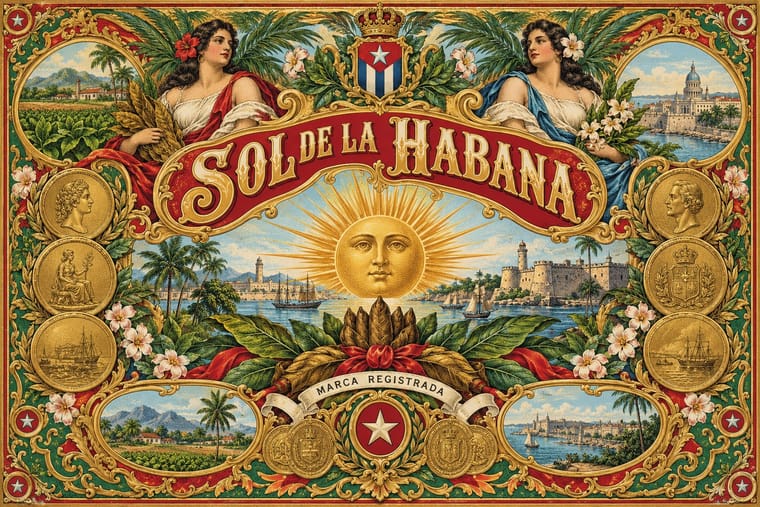
The chromolithographed dress of Havana tobacco. Cigar labels were lithographed in one ink from the late 1840s; from about 1860 La Honradez printed its cigarette wrappers (marquillas) in colour in-house: satirical scenes of Cuban life in collectible series, framed by an allegorical border and the firm's emblem. Cigar boxes got a matched set of labels (habilitación): a vista inside the lid, a bofetón over the cigars, edge strips, seals and cigar bands, with medals, royal arms, allegorical women and Havana views in many inks from the 1880s, and gold leaf and stamped relief from about 1890.
Make something in this styleGet advice in this styleMix it with another style
Use it with care
Many marquillas trade in racist caricature: series such as 'Vida y muerte de la mulata' sexualise mixed-race women and mock Black Cubans in bozal speech, and some labels show enslaved workers on tobacco estates or bare-breasted 'aboriginal' women as exotic decoration; do not reproduce these figures as period charm. Names and dressings such as H. Upmann, Partagás, Punch and Romeo y Julieta are live Habanos trademarks, so draw new marks rather than copying them, and treat images of the Virgen de la Caridad del Cobre, Cuba's patron saint, as devotional, not decorative.
01
How it works
- Dress the product as a matched set, not a single label: carry the brand name, emblem and colours across the vista inside the lid, the bofetón over the cigars, the edge strips, the seals and the band on each cigar.
- Prove quality with borrowed authority: crowd exposition medals, royal and civic arms, 'Marca Registrada' and a maker's guarantee around the brand name, and raise the medals in gold by bronzing and embossing.
- Hold everything in frames within frames: a patterned outer border, oval and shield cartouches for portraits and views, banners and scrolls for the name, with the brand lettered large on the central axis and an allegory, portrait or view on either side.
- Paint the pictures naturally in many lithographic inks with tonal skies and flesh: allegorical women, statesmen and poets, the factory and its medals, Havana harbour and El Morro, palms and tobacco fields.
- Mix lettering freely on one label: shaded and outlined display capitals for the brand, spaced capitals for the registration and quality lines, and an italic script for the maker's guarantee, all drawn on the stone.
- On a cigarette wrapper, tell a story in instalments: put a theatrical scene in the centre with a caption in street speech, an allegorical L-shaped border along the top and left, and the firm's emblem on the right, and title it as one piece of a numbered series to collect.
Havana, Cuba: lithographic workshops serving the cigar and cigarette factories, among them La Honradez's own press and, from 1907, the Compañía Litográfica de La Habana; some labels for Havana brands were printed in Germany and the United States
02
Its design choices
From Stylogeny’s vocabulary of design choices: defining choices make the style, characteristic ones are usual, occasional ones turn up now and then.
- Layout & composition
- Space & hierarchy
- Typography
- Colour
- Form & shape
- Surface & texture
- Ornament
- Imagery
- Medium & production
- Tone & intent
- Avoids
- Ornament-free, Generous white space, Flat, Non-representational, Lowercase only, Flush left, ragged right, Monochrome, Straight photography
Palette
#f2e8cc#c9a23f#b51f2e#2e5a3c#9ccbdc#4a2e1f
Typefaces
Shaded, outlined and inline display capitals drawn by the lithographers and marquistas on the stone; J. R. Bermúdez (La imagen constante, 2000, quoted by Calzadilla) credits their wide repertoire of letters and ornaments with influencing type founders and sign painters
Brand and factory names on banners, ribbons and cartouches
'Gran Fábrica de Tabacos Puros'
Widely spaced capitals for 'Marca Registrada' and quality lines
'La calidad de estos tabacos es garantizada'
Italic copperplate-style script for the maker's guarantee
'por el Fabricante'
Small roman captions on cigarette marquillas giving the scene's title and its dialogue in Havana street speech
Known for
Real Fábrica La Honradez (Luis Susini e Hijo; José Susini), Havana
chromolithographed cigarette marquillas from about 1860 until the late 1880s, when card packs replaced them; according to Alejandro Tapia y Rivera (1867, quoted by Calzadilla; Sepúlveda dates his account to the factory's 1865 edition), two in-house draughtsmen drew the designs and a steam-driven chromolithographic press printed them as 'cajetillas de lujo', while one-ink 'cajetillas comunes' came from the factory's typographic office
La Honradez series 'Una visita a la fábrica La Honradez' (eleven marquillas touring the factory's departments, in the Archivo Histórico of the Oficina del Historiador de La Habana) and 'Almanaque profético para el año 1866' (twelve marquillas, one per month; Biblioteca Nacional de España)
La Honradez, 'Cosas de La Habana' (early 1860s) and 'La cajetilla bocoy' (after 1867), with the firm's blindfolded figure of Justice on a globe as its emblem
La Charanga de Villergas (owned by Juan Martínez Villergas according to Sepúlveda, by Llaguno y Compañía according to Calzadilla), 'Vida y muerte de la mulata', a series of fifteen marquillas; the costumbrista illustrator Víctor Patricio de Landaluze collaborated with Villergas
Para Usted (later Eduardo Guilló), 'Historia de la mulata' marquilla series
Biblioteca Nacional de España, Madrid
a collection of 937 chromolithographed marquillas, 719 of them from La Honradez
Compañía Litográfica de La Habana
formed in 1907 by merging the workshops of Rosendo Fernández Gamoneda, Guerra Hermanos y Pérez, Estrugo y Maceda and José Manuel García y Hermano: vistas for H. Upmann (the factory with its trophies and medals in gold leaf and relief), Punch (Mr Punch with four vignettes of cigar making), Romeo y Julieta and La Corona
Labels for Havana brands printed in Germany, catalogued in El humo impreso
a Casten & Suhling (Bremen) vista for the Habanera factory with a lion and the crowned arms of Spain, and a Gebrüder Klingenberg (Detmold) vista for the Santa Rosa factory showing a tobacco village worked by enslaved Black labourers; the catalogue's years for them (1856, 1867) are probably the brands' dates rather than the prints', since it also gives founding years such as 1837 and 1850 to labels by the Compañía Litográfica de La Habana, formed in 1907
03
Make something in this style
Say what you need, and Stylogeny’s image studio draws it from Cuban Tobacco Lithography (Habilitaciones & Marquillas)’s design choices and checks it against them. It takes about a minute, and you get a link to share.
04
Where it comes from, and what it’s close to
Before it
The style it grew out of, and the styles it borrowed from.


After it
The styles that grew out of it.
No later style in the atlas grew out of it yet.
Alike in its design choices
Styles that make many of the same choices, related or not, besides those above.


05
Sources
- Yadira Calzadilla Riveira, 'The Cigarette Marquillas: Graphic Expressions of the Cuban National Identity Formation', VISUAL Review 7(2), 2020, pp. 173-184, doi:10.37467/gka-revvisual.v7.2490 (one-ink lithographed papeletas in the first cigar boxes, p. 175; the habilitación set regulated in 1884 and its parts; multi-ink lithography on cigar boxes from the 1880s, gold leaf and die-stamped relief from 1890; chromolithography introduced on cigarette packs in 1860 by José Susini; marquilla layout of orla, emblema and escena; La Honradez emblem a blindfolded Justice on the globe, p. 176; Bermúdez, La imagen constante, 2000, p. 12, on letters and ornaments influencing type founders and sign painters, quoted p. 176; Tapia Rivera 1867, p. 48, on two draughtsmen and a steam-driven chromolithographic press, quoted p. 178; La Charanga de Villergas 'de Llaguno y Compañía', p. 179; series titles; BNE collection of 937 marquillas): https://visualreview.net/revVISUAL/article/view/2490
- Asiel Sepúlveda, 'Humor and Social Hygiene in Havana's Nineteenth-Century Cigarette Marquillas', Nineteenth-Century Art Worldwide 14(3), Autumn 2015 (marquillas about 12 x 8.5 cm; La Honradez chromolithographic presses after 1861; Para Usted and La Charanga de Villergas; Landaluze's collaboration with Villergas; captions in vernacular and bozal speech): https://19thc-artworldwide.org/autumn15/sepulveda-on-havana-19th-century-cigarette-marquillas
- Joaquín Díaz and Teresa Pérez Daniel, El humo impreso: marquillas cigarreras, vistas, bocetones, vitolas y anillas (Fundación Joaquín Díaz, Valladolid, 2014), exhibition catalogue of the Teresa Pérez Daniel collection (first lithographed cigar labels 1845-1850; Allones and Susini as pioneers of habilitaciones; first chromolithographic machine 1861; formation of the Compañía Litográfica de La Habana in 1907; labels by Casten & Suhling, Gebrüder Klingenberg, American Lithographic Co. and Calvert Lithographic Co.): https://www.funjdiaz.net/imagenes/expos/humo/1404humo_impreso.pdf
- Habanos S.A., 'Dressing the box' (cubierta, vista, filete, papeleta, bofetón, anilla, larguero, costero, tapaclavo; vistas with gold, embossing, medals and royal arms; all labels applied by hand): https://www.habanos.com/en/dressing-the-box/
- Cooper Hewitt, Smithsonian Design Museum, Cigar Label, El Gran Mundo (The Great World), 1898-1920, 1975-74-2-21, lithograph with embossed bronze (possibly gold) powder and adhesive on rag paper; public-domain image with the museum's metadata: https://commons.wikimedia.org/wiki/File:Cigar_Label,_El_Gran_Mundo_(The_Great_World),_1898%E2%80%931920_(CH_18488753).jpg (the former object page, https://collection.cooperhewitt.org/objects/18488753, now redirects to the Smithsonian's Cooper Hewitt landing page)
- Cincinnati Art Museum, Cuban (cigar box label), early 20th century, Cole Litho Co. (American), colour lithograph with embossing: https://collection.cincinnatiartmuseum.org/objects/51760/cuban-cigar-box-label
- 'La Honradez, fábrica de tabacos de Susini e Hijo', reprint of an article from Aurora del Yumurí (Matanzas), September 1862, as republished by the factory in 1865 (a print shop with lithographic machines on the second floor; about 3,000 different pack designs): https://cubamemorias.com/la-honradez-fabrica-de-tabacos-de-susini-e-hijos
- University of Miami Libraries, Cuban Heritage Collection, Tobacco Art Collection (CHC5279), finding aid: https://atom.library.miami.edu/index.php/chc5279
How Stylogeny researches and checks a style: where the facts come from.