Pictorial & machine age · 1933–1949 · Southern Europe
Estado Novo Folk Modernism (SPN)
Also known as SPN/SNI graphics, Portuguese nationalist modernism
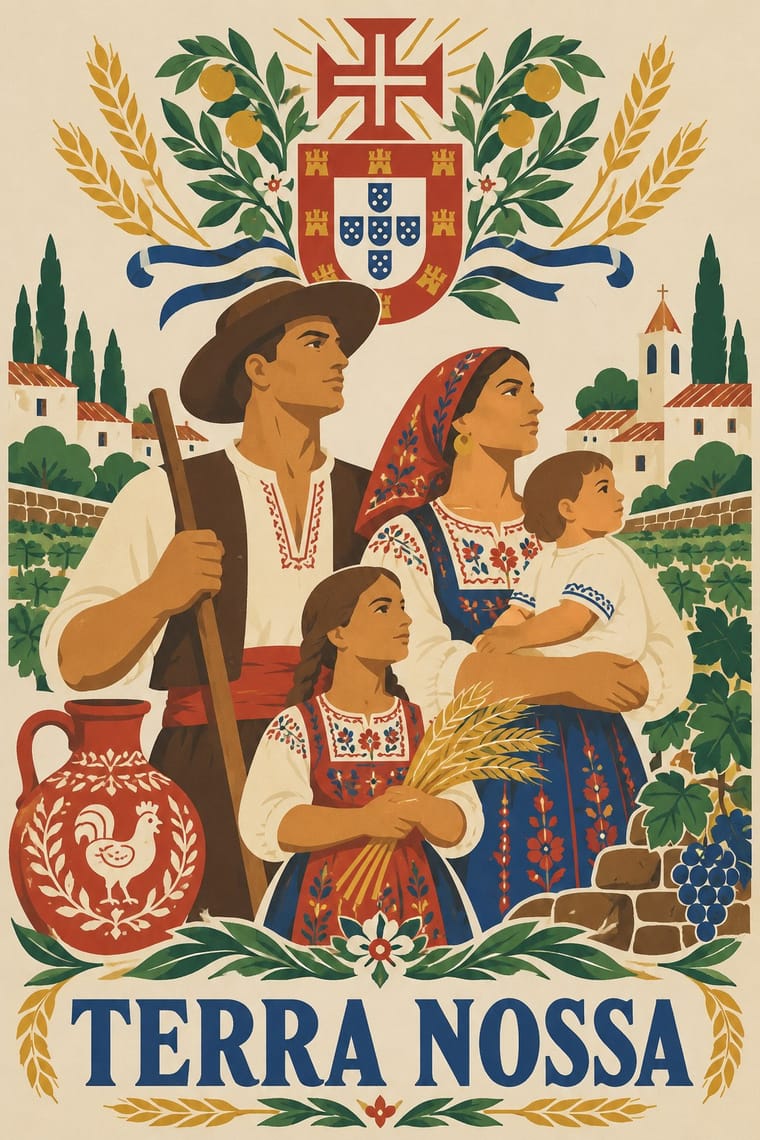
The official image of Salazar's Estado Novo, shaped by António Ferro's Secretariado de Propaganda Nacional (SPN, 1933; SNI from 1944). Modernists such as Almada Negreiros, Fred Kradolfer, Bernardo Marques and Tom gave rural families, regional costume, folk crafts and national emblems a simplified modern form. The regime fixed the subject more than the drawing, from Kradolfer's synthesis to Martins Barata's detailed school charts. Lithographed posters preached 'Deus, Pátria, Família' to a largely illiterate public; pavilions, photobooks and Panorama addressed literate and foreign audiences.
Make something in this styleGet advice in this styleMix it with another style
Use it with care
This was the official propaganda of an authoritarian dictatorship, whose idealised peasant served the myth of 'honoured poverty'. The crafts it staged, such as Barcelos clay figures, Viana do Castelo embroidery and regional costume, remain living community traditions. Do not present the regime's version of them as neutral heritage, or its Catholic and heraldic symbols as decoration. Its celebration of the Discoveries served a living colonial empire: the 1940 Exposição do Mundo Português showed 138 men, women and children recruited in the colonies, among reconstructed villages, as a 'human zoo'. Do not reuse its caravels, padrões and imperial slogans as innocent heritage.
01
How it works
- On street posters, let one large lithographed picture carry the message and cut the text to a short slogan; school charts and exhibition panels may carry captions and inscribed text.
- Cast the nation as a rural, Catholic family in regional dress, with village houses, folk pottery and embroidery around it.
- Seal every image with heraldry: the blue quinas, the gold castles and the Cross of the Order of Christ.
- Keep the composition static, sober and calm; reassure the viewer instead of rousing them. Where a diagonal appears, as in the before-and-after school charts, let it come to rest on a solid present.
- Draw colour from the flag and the land (green, red, ochre, brown) and set it on pale grounds, never dark ones; keep black to lettering and line.
- Present modern stylisation as continuity with tradition, faith and the age of the Discoveries.
Lisbon, Secretariado de Propaganda Nacional (SPN) under António Ferro
02
Its design choices
From Stylogeny’s vocabulary of design choices: defining choices make the style, characteristic ones are usual, occasional ones turn up now and then.
- Layout & composition
- Space & hierarchy
- Colour
- Surface & texture
- Imagery
- Medium & production
- Tone & intent
- Avoids
- Dark ground, Visual tension, Experimental & distorted, Typography only, Rebellious & subversive, Ironic & self-aware, Luxurious & glamorous
Palette
#efe6d2#2f6b3c#b8322a#d3a23b#2b4f98#7a5434
Typefaces
Hand-drawn poster capitals, lettered with the picture for lithographic printing
Roman inscriptional capitals with Cross-of-Christ word separators
text panels of the Exposição do Mundo Português, 1940
Known for
José de Almada Negreiros, 'Nós queremos um Estado forte' poster
a woman in a headscarf holding a naked child, with discreet cut-out quinas
SPN, 'Portugal 1934', a lavish photographic album
1934
Jaime Martins Barata, 'Deus, Pátria, Família: a trilogia da educação nacional', the single-image poster of the Ministry of National Education's seven-poster 'A Lição de Salazar' school series (1938); the descriptive, figurative end of the range
SPN-decorated Portuguese pavilions at Paris (1937, with photomontage displays), New York and San Francisco (1939), by Fred Kradolfer, Bernardo Marques, Carlos Botelho, Thomaz de Mello (Tom), José Rocha, Emmerico Nunes and Paulo Ferreira
Exposição do Mundo Português, Lisbon (23 June to 2 December 1940), chief architect Cottinelli Telmo, with Ferro as secretary of its national commission
Panorama
Revista Portuguesa de Arte e Turismo (SPN/SNI, from 1941), art-directed by Bernardo Marques in the 1940s
Museu de Arte Popular, Lisbon (opened 1948), interiors by Carlos Botelho, Estrela Faria, Manuel Lapa, Paulo Ferreira, Thomaz de Mello and Eduardo Anahory
03
Make something in this style
Say what you need, and Stylogeny’s image studio draws it from Estado Novo Folk Modernism (SPN)’s design choices and checks it against them. It takes about a minute, and you get a link to share.
04
Where it comes from, and what it’s close to
Before it
The style it grew out of, and the styles it borrowed from.
After it
The styles that grew out of it.
No later style in the atlas grew out of it yet.
Alike in its design choices
Styles that make many of the same choices, related or not, besides those above.
- Senegalese Sufi Devotional Imagery (Souwère Glass Painting and Amadou Bamba Portraits)71% alike
- Norwegian and Finnish National Romantic Graphics (Munthe & Karelianism)63% alike
05
Sources
- Helena Barbosa, Anna Calvera & Vasco Branco, 'O design do cartaz político português: duas políticas, dois discursos', Agitprop: Revista Brasileira de Design 42 (2011), whose fig. 5 attributes the 'Deus, Pátria, Família' poster to Martins Barata: https://www.idmais.org/pubs/HelenaBarbosa/2011/2011_Barbosa.Agitrop.pdf
- Carlos Bártolo, 'The use [and refuse] of "progress" and "technology" as ideals of the Portuguese Estado Novo regime: a possible analysis of Lições de Salazar posters, 1938', Universitas Humanas 12, no. 1-2 (2015): 59-68, on the Ministry of National Education's series, its authors (Martins Barata, Raquel Roque Gameiro, Emmerico Nunes), the SPN's 'Portugal 1934' album and the 1937 Paris pavilion: https://doi.org/10.5102/univhum.v12i1.3185
- Camila Azeredo Sampaio, 'A família Mau-Tempo no contexto da violência ditatorial salazarista', Anais do IX SAPPIL, Estudos de Literatura, UFF, no. 1 (2018), on the 1938 'A Lição de Salazar' posters: https://anaisdosappil.uff.br/index.php/IXSAPPIL-Lit/article/download/937/687
- Paula André, 'O valor patrimonial da fotografia impressa enquanto campo discursivo da MetaImagem de Portugal (1934-1948)', Revista InterFACES 28, no. 2 (2018), on photomontage in the 1937 Paris pavilion: https://revistas.ufrj.br/index.php/interfaces/article/view/28697
- Luís Filipe Raposo Pereira, 'Capítulo III: Museu de Arte Popular', Cadernos de Sociomuseologia 39 (2011): https://revistas.ulusofona.pt/index.php/cadernosociomuseologia/article/view/2670
- Nuno Medeiros, 'O SPN e o SNI na encruzilhada do livro: António Ferro e o campo oficial da edição no Estado Novo', in Projectos Editoriais e Propaganda (2021), on the SNI from 1944 and SPN/SNI photobooks: https://repositorio.ipl.pt/bitstreams/b569b18f-3575-481f-961e-af80ecee524d/download
- Cláudia Castelo, 'Simulação e dissimulação do império colonial português em Belém, Lisboa (1940/2020): a secção colonial e o jardim botânico tropical', Anais do Museu Histórico Nacional 54 (2021): 1-24: https://anaismhn.museus.gov.br/index.php/amhn/article/download/203/138/902
- Wikipédia (pt): Secretariado de Propaganda Nacional; António Ferro; Exposição do Mundo Português; Museu de Arte Popular (Portugal); Almada Negreiros; Fred Kradolfer; Bernardo Marques; Thomaz de Mello; Paulo Ferreira (pintor); Carlos Botelho
- Eduardo Portugal, photograph of a text panel at the Exposição do Mundo Português (1940), Arquivo Municipal de Lisboa PT/AMLSB/EDP/S00053, via Wikimedia Commons
How Stylogeny researches and checks a style: where the facts come from.