One of our own styles · made in 2026
By Airmail
Scenes screen-printed on brown parcel paper, where the goods grown or made nearby are flat sunflower yellow and every good that came from far away wears the slanted red, white and blue stripe of an airmail envelope's edge, wrapped round its own shape. At a glance a bold print of yellow and blazing stripes on brown; a second later a map of journeys: the bananas crossed an ocean, the apples came from down the road. For greengrocers, markets, cafés and ports.
Make something in this style Get advice in this style Mix it with another style
Use it with care
The stripe tells only that a thing travelled far: never use it to mark people, their clothes, food cultures or countries, never to shame a product or a shop, and never in place of real origin labelling or for a claim about a product's origin that is not checked. Show no real stamp, postmark, national flag, postal service's or airline's livery, brand or logo. Its pictures are made by an image model, are labelled as generated in their captions, and are never sold as hand-pulled screen prints.
01
More pictures in this style
3 pictures, AI-generated from its design choices: none is a real or historical work.
1 of 2
Try other colours
Change a colour and every picture on this page follows. It happens in your browser, from the same pictures: nothing new is made or saved.
Choose a colour to change it
-
#c99b62 -
#1d1a17 -
#ffc31f -
#e63a1e -
#1b2fa0 -
#f6f2e8
A faded colour isn’t in these pictures, so changing it changes nothing.
Light and dark stay where they are; greys hardly move.
More colours: any style’s, or your own
The pictures show the style’s own colours.
02
Make something in this style
Say what you need, and Stylogeny’s image studio draws it from By Airmail’s design choices and checks it against them. It takes about a minute, and you get a link to share.
03
How it works
Palette
-
#c99b62ground · 35% -
#1d1a17ink · 15% -
#ffc31faccent · 7% -
#e63a1eaccent · 4% -
#1b2fa0accent · 3% -
#f6f2e8accent · 3%
Shares measured from its 4 pictures. The ground is what the pictures sit on (of the colours covering most, the most neutral), the ink stands out from it most, the rest are accents.
Typefaces
-
Franklin Gothic
-
no lettering in the pictures
Who is in it. People of today, women and men from twenty to eighty of every build, skin and background, in their own work or everyday clothes, with lifelike proportions. Skin is bare brown paper shaded with black halftone, deeper skin in denser dots, and clothes are solid warm black; they are calm, capable and busy, eyes on their task, never posing or reacting to the stripes. People and clothes are never striped or yellow; a scene has only the people it names, and a scene that names nobody has nobody in it.
Direction
- What it says
- Every picture shows at a glance which of its things travelled far and which are from nearby, by the airmail stripe they wear or the plain yellow they keep, so an ordinary moment tells its journeys.
- Performance
- Whoever the scene names goes about the job as on any working day, hands busy with the thing the scene gives them, eyes on that thing, unhurried; nobody points at, admires or reacts to a stripe.
- Set
- Only the place the scene names, drawn whole and solid in black line and halftone on the bare brown paper, ground, water, sky and furniture alike; colour goes only to the goods the scene names, yellow or striped.
- Light
- Daylight from the left, shown only by the black halftone: dots grow dense on each thing's right-hand, shaded side and thin out on its lit side, over paper, yellow and striped things alike; no lamp, glow or coloured light.
- Camera
- Each scene is drawn as a normal lens sees it from the height, distance and angle the shot gives, with true perspective and upright verticals; never a slanted horizon, never a fisheye, never flattened into a pattern.
- Frame
- The print runs off every edge with no border; the telling exception, yellow among striped or striped among yellow, sits where the eye lands first and is never cut by an edge or hidden behind anything.
- Moment
- During the work the scene names, at the instant a thing is lifted, weighed, about to be cut or set down; never after an accident and never posed for the picture.
- Finish
- A real screen print in flat inks on kraft paper: coarse round halftone dots you can count, each ink a hair out of register with the black so a sliver of brown paper shows at an edge, paper fibres visible where the paper is bare, no gradient, gloss or texture laid on top.
- A set of pictures
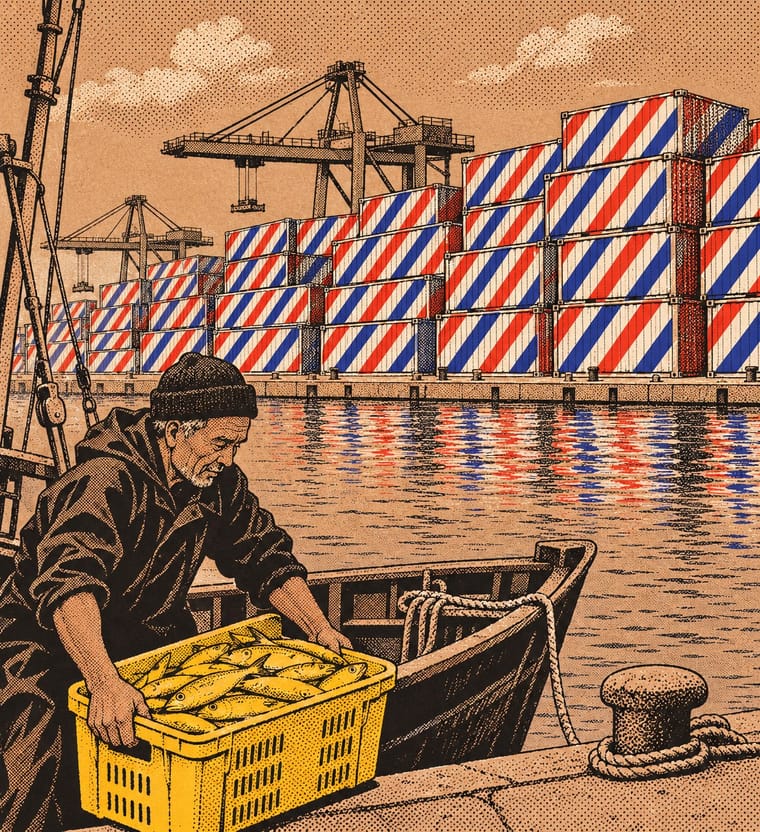
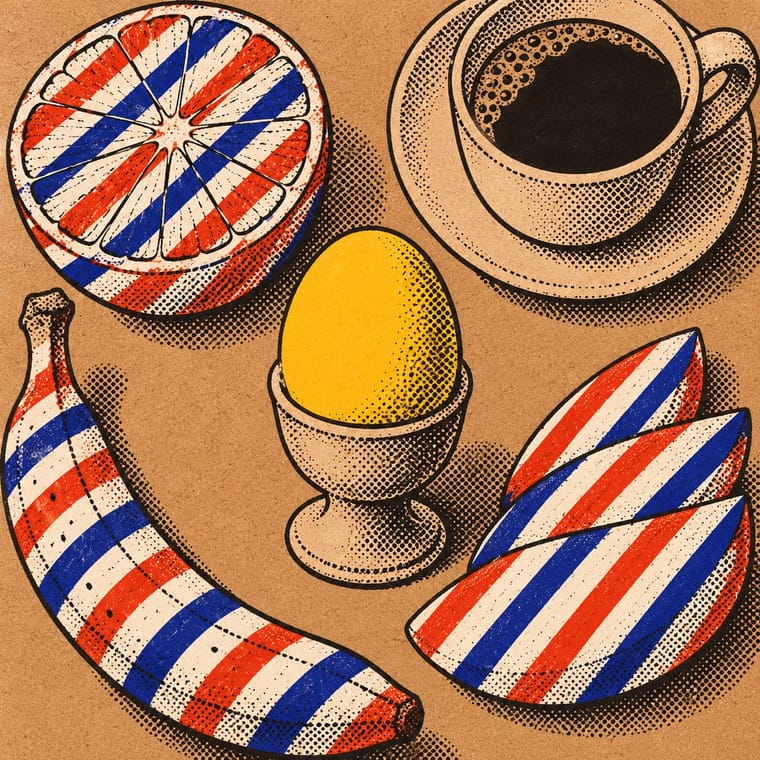
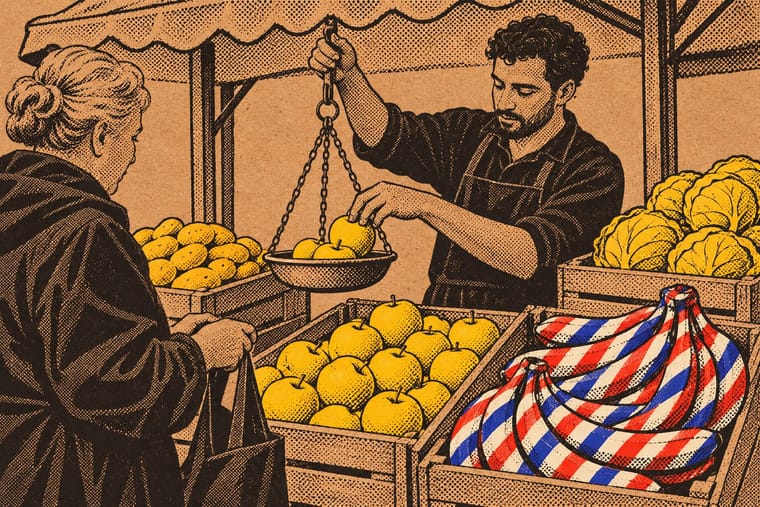
- Four prints at four distances and balances: a fish quay wide, walls of striped containers behind one crate of yellow fish; a market stall medium, all yellow but one crate of striped bananas; a juice-stall keeper close with one striped pineapple; a breakfast tray from above, all striped fruit but one yellow egg.
- Never
- No stamp, postmark, flag, country name, map, aeroplane, envelope, wrapper, label or lettering anywhere; no stripe or yellow on a person, on clothes, on a building, on the ground or the sky; no red, white or blue anywhere but in the stripe; no cut-paper or wrapping-paper look, no lifted edges, no green.
- Screen-print every scene on brown kraft parcel paper in flat inks. The place itself, its ground, water, sky and furniture, and every person, is drawn in warm black line and coarse black halftone on the bare brown paper, skin as shaded paper and clothes solid black. Colour goes only to the goods the scene names: what grew or was made nearby is a flat shape of sunflower yellow, outlined and shaded in black, and what came from far away wears the airmail stripe; red, white and blue appear nowhere else.
- The airmail stripe is the slanted band pattern of an airmail envelope's edge, laid over the whole far-travelled thing: equal bands of vermilion red, white, ultramarine blue and white, repeating in that order and slanted at 45 degrees, wide enough that the thing carries six to twelve of them across its width. The bands follow its surface like a printed sleeve, bending round a rounded thing and turning the corners of a boxy one, and the thing keeps its own black outline and its black halftone shadow printed over the bands on its shaded side, so its shape and size read at once and it never flattens into a pattern.
- Every scene has a clear majority, nearly all yellow or nearly all striped, and one telling exception of the other kind, set where the eye lands first. Print it as a real screen print with daylight from the left: flat inks with no gradient, round halftone dots large enough to see, each ink a hair out of register with the black so a sliver of brown paper shows at an edge, and no lettering, stamp, postmark, flag or label anywhere.
- Give every picture two readings. From across a room it is a bold black and brown print where yellow and red-and-blue things blaze; a second later it is an account of journeys, the striped bananas and the yellow apples, the striped containers and the yellow fish.
- Vary the balance and the distance from picture to picture: a wide view where the striped things are the crowd and one yellow thing stands out, a medium view where one striped thing stands out among yellow ones, a close view of a person about to cut one striped thing, a detail from above. Each picture is set somewhere else: a quay, a market, a station, a terrace table.
- For a client, stripe what the client wants people to see the journey of: a greengrocer's imported fruit on a window poster beside its local crates, a café's coffee beside its local milk, a juice bar's fruit.
A studio style: made by Stylogeny, not a documented movement.
With an idea put on it
-
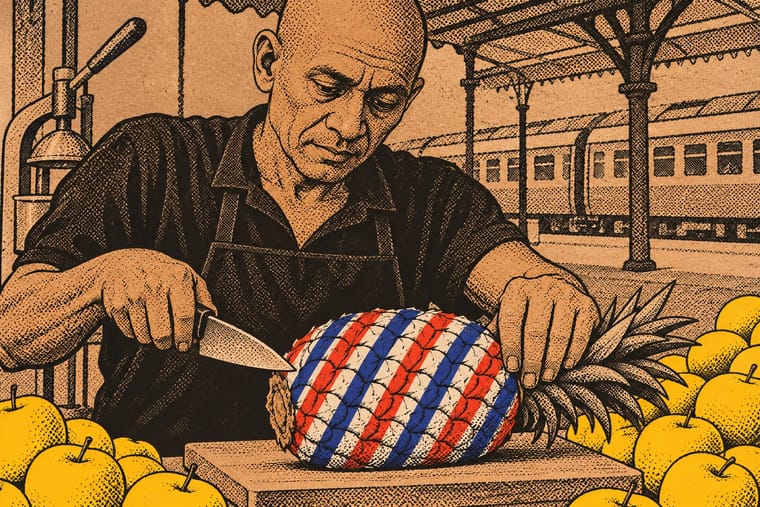
The moment before He is about to cut the one striped fruit on his stall among heaps of yellow apples, so we see which juice has come a long way before it is poured.
AI-generated: By Airmail with an idea put on it. Not a real or historical work.
Change it with an idea. Any of the 73 moves that make a design say something can go on this style.
04
Its design choices
From Stylogeny’s vocabulary of design choices: defining choices make the style, characteristic ones are usual, occasional ones turn up now and then.
- Layout & composition
- Space & hierarchy
- Typography
- Colour
- Form & shape
- Surface & texture
- Medium & production
- Tone & intent
- Avoids
- Straight photography, 3D render, Gradients, Pastel, Fluorescent & neon, Gloss & highlights, Chrome & 3D render
How its pictures are made Drawn & painted, light, pose, made with, figures
Kind of picture: Drawn & painted How they are made, from the questions Stylogeny asks of that kind:
- Light
-
- Raking side light defining
- Cast shadows as shapes occasional
- Pose
-
- Absorbed in a task defining
- Relaxed & natural characteristic
- Made with
-
- Pen & ink line characteristic
- Figures
-
- Lifelike proportions defining
What new pictures of it show
Subjects Stylogeny draws it with, each taken from a kind of real work the style was made for.
- poster A fish quay by a container port, striped unlettered containers stacked across the water, where a wiry fisherman of sixty in black oilskins lifts a crate of yellow fish ashore from a black-drawn boat
- art print A market greengrocer's stall, black-drawn crates of yellow potatoes, cabbages and apples and one of striped bananas; a grocer of 35 in black weighs apples on a hanging scale for a stout woman of 70
- postcard A juice-stall keeper at a station, a lean man of 55, shaved head, black apron, holds a striped pineapple on its side on a board by its crown, knife poised over its base, yellow apples heaped by it
- social media post A café terrace breakfast tray from above: a striped half orange, a striped banana, striped mango slices and a cup of black coffee drawn in black line, round a yellow boiled egg in a black-drawn eggcup
05
What it’s close to
One of our own styles: Stylogeny made it from its own design choices, so no earlier style is claimed.
By Airmail Made 2026
No later style in the atlas grew out of it yet.
Alike in its design choices
06
Often taken for
by-airmail has no real works recorded yet, so these are its nearest styles by its choices alone, with the choices that tell them apart.
-
Taller 4 Rojo (Bogotá Photo-Screenprint Posters)
Taller 4 Rojo is one of by-airmail’s nearest styles by choices; no real work of either fits the other better.
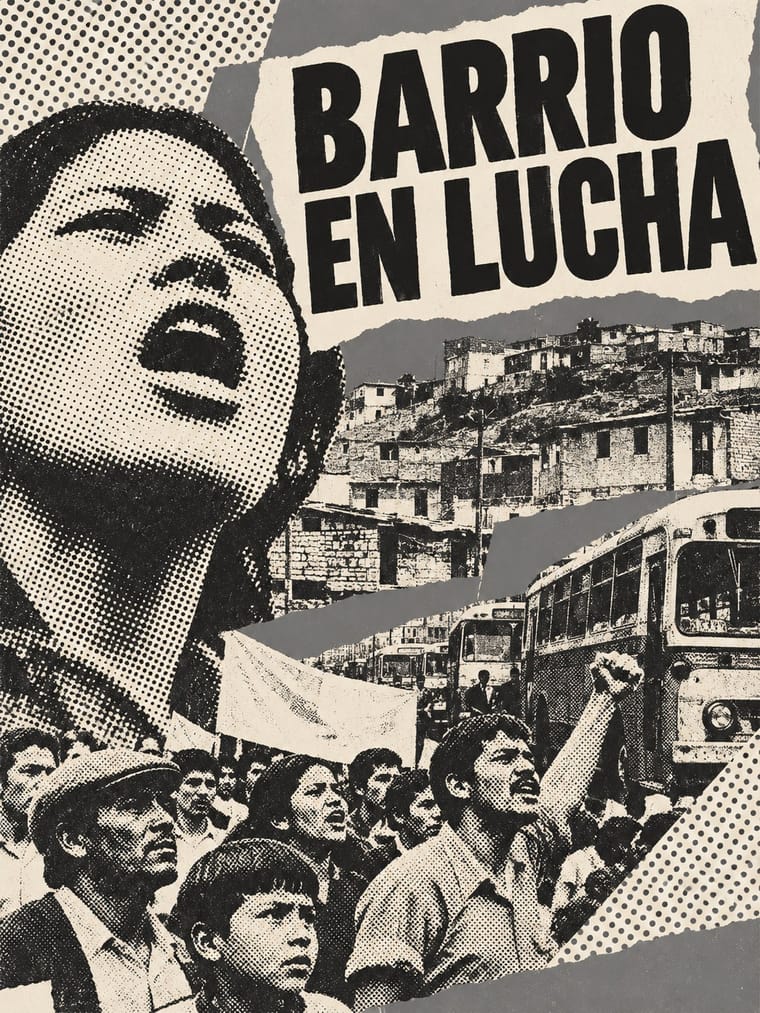
Choices that tell By Airmail and Taller 4 Rojo apart Choice By Airmail Taller 4 Rojo Primary triad defining — Photomontage — defining Line illustration defining — Treated photography — defining Flat fields characteristic — No shared descent in the atlas: they reached these choices separately.
-
Grafica di Pubblica Utilità (Italian Civic Graphic Design)
Grafica di Pubblica Utilità is one of by-airmail’s nearest styles by choices; no real work of either fits the other better.
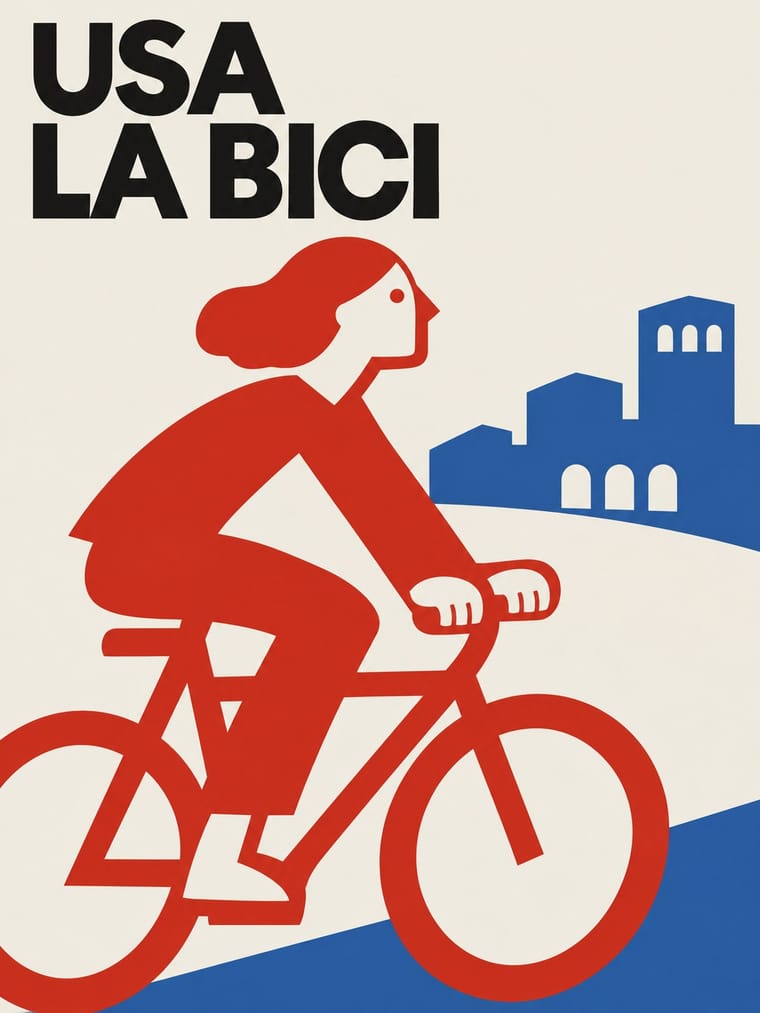
Choices that tell By Airmail and Grafica di Pubblica Utilità apart Choice By Airmail Grafica di Pubblica Utilità Primary triad defining — Flat — defining Halftone & Ben-Day dots defining — Single focal point occasional defining Line illustration defining occasional No shared descent in the atlas: they reached these choices separately.
-
West German Conceptual Film & Culture Poster (Hillmann and Rambow)
West German Conceptual Film & Culture Poster is one of by-airmail’s nearest styles by choices; no real work of either fits the other better.
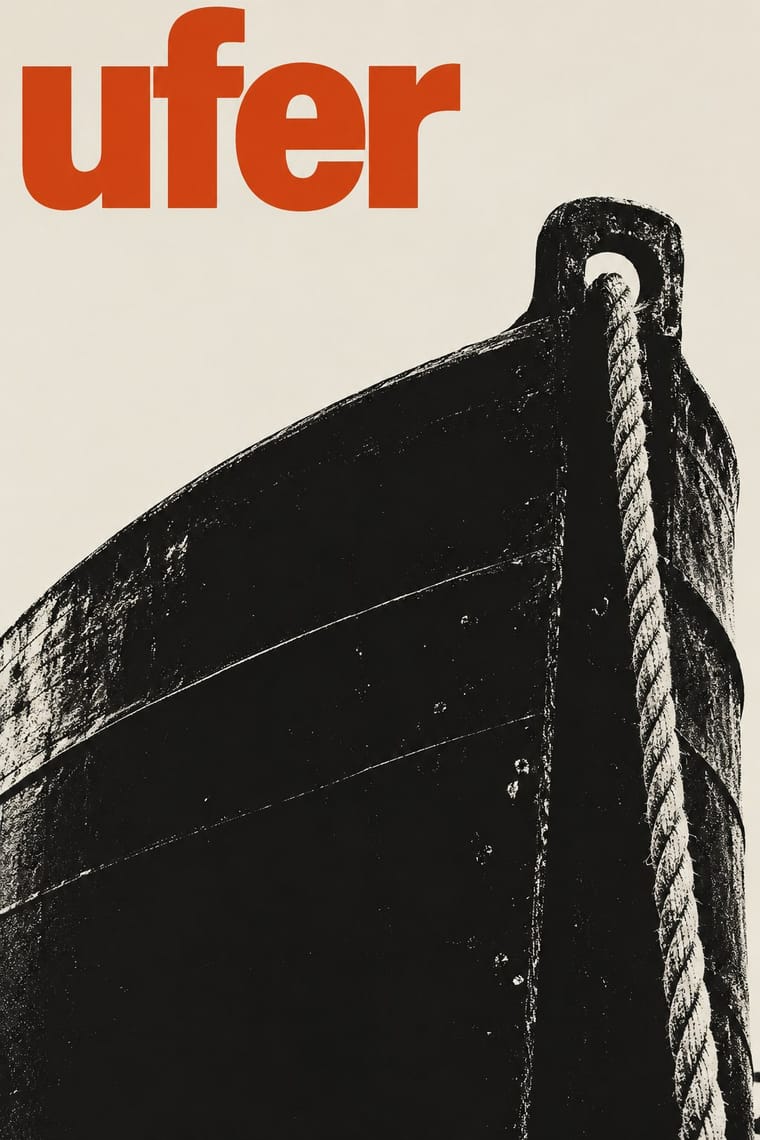
Choices that tell By Airmail and West German Conceptual Film apart Choice By Airmail West German Conceptual Film Primary triad defining — Straight photography avoids characteristic Halftone & Ben-Day dots defining — Isolated object — defining Line illustration defining occasional No shared descent in the atlas: they reached these choices separately.
-
Fluxus Graphics (Maciunas)
Fluxus Graphics is one of by-airmail’s nearest styles by choices; no real work of either fits the other better.
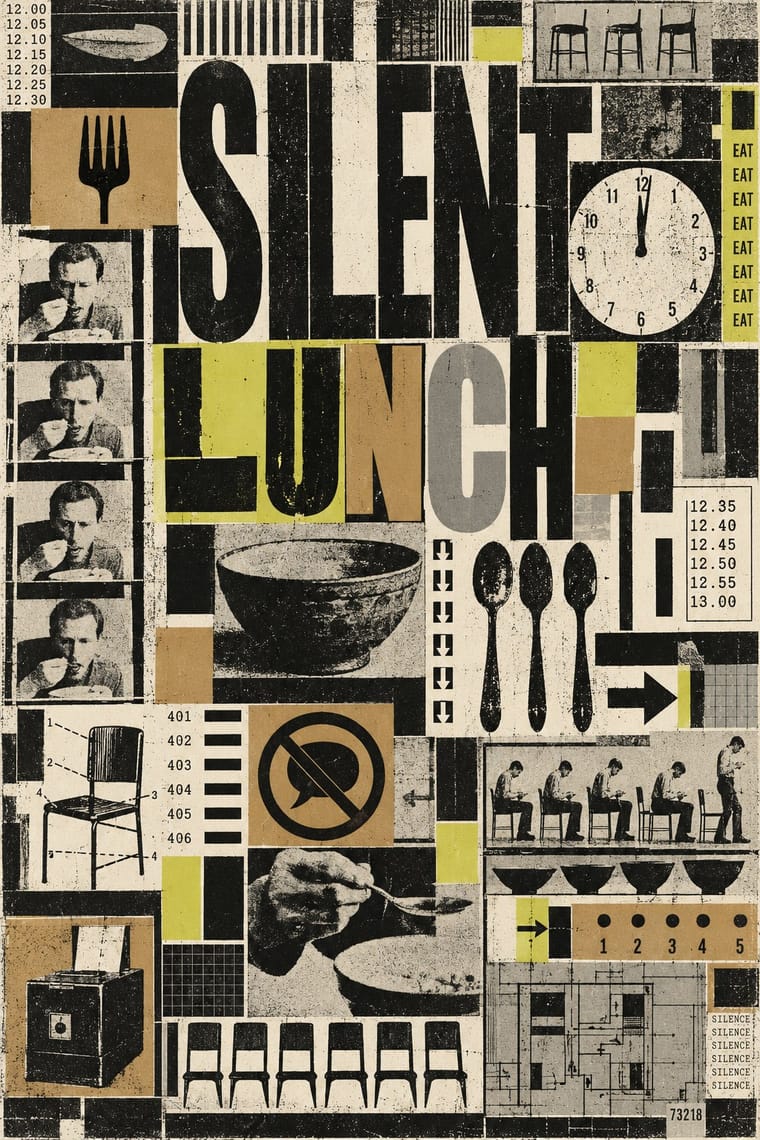
Choices that tell By Airmail and Fluxus Graphics apart Choice By Airmail Fluxus Graphics Primary triad defining — Monochrome — defining Halftone & Ben-Day dots defining occasional Found & vernacular imagery — defining Limited spot colours characteristic — No shared descent in the atlas: they reached these choices separately.
— means the choice isn’t among the style’s recorded choices. Critics recorded each work’s choices with the styles’ descriptions in view, so this shows whether the descriptions hold together, not proof that they are right.