Pictorial & machine age · 1953–1990 · Central Europe
West German Conceptual Film & Culture Poster (Hillmann and Rambow)
Also known as Neue Filmkunst posters, West German art-film poster, Hillmann film posters, Rambow + Lienemeyer photo posters, Kasseler Schule poster
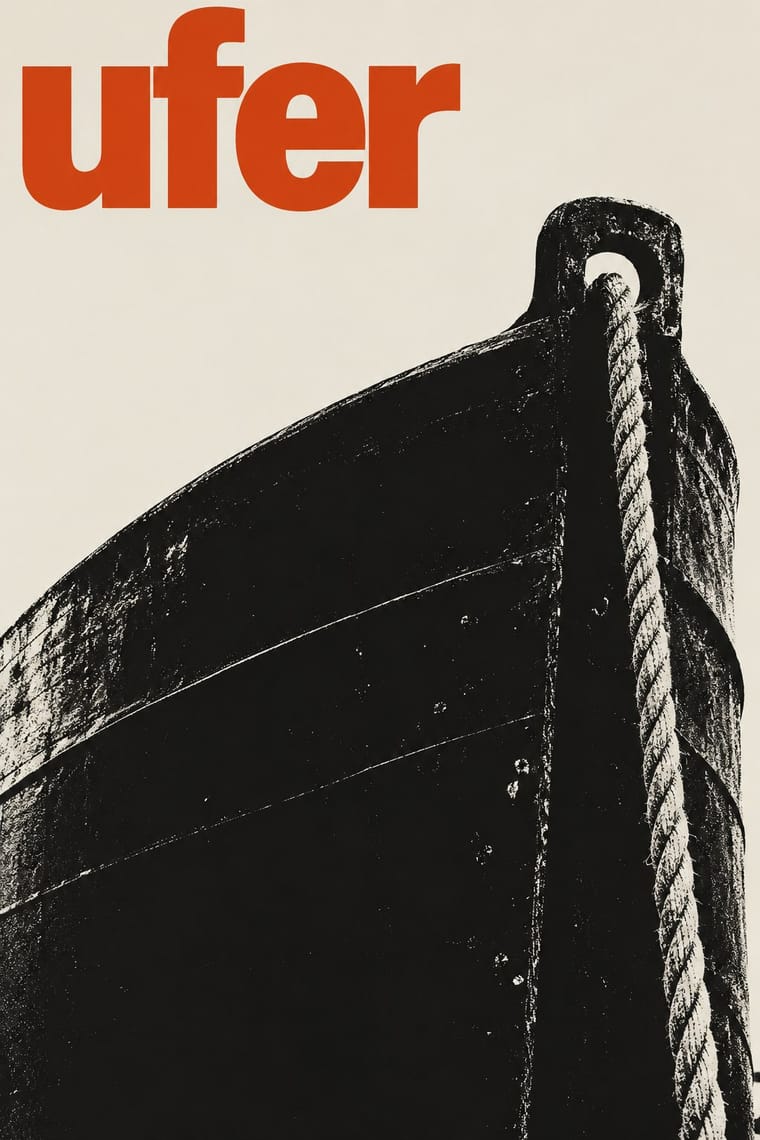
The art-film and culture poster Hans Hillmann developed from 1953 for the West German distributors Neue Filmkunst and Atlas Film, which his Kassel student Gunter Rambow took with Gerhard Lienemeyer into staged photo posters for theatre, publishers and protest. Instead of star portraits, each poster reduces a film or play to one sign taken from its content, a silhouette, a cropped grainy photograph or a photographed paradox, mostly in black and one or two flat inks (Rambow's staged objects also in full colour), with a set grotesque and small flush credits.
Make something in this styleGet advice in this styleMix it with another style
Use it with care
Some posters turn Nazi imagery against itself: a swastika of broken pencils over the 1938 member list of the exiled German PEN (P.E.N. im Exil, 1983) and an egg given Hitler's forelock and moustache (Sein oder Nichtsein, 1964). Displaying Nazi symbols is restricted by law in Germany and several other countries outside contexts such as art, satire, education and history, so keep any such sign unmistakably critical and check the rules where the work will be shown. Rambow's Othello poster (1978) appears to show a face in dark stage make-up, the blackface convention for the role that is now widely rejected: do not borrow it. The posters and their photographs (Hillmann, Rambow, Lienemeyer, van de Sand, Abisag Tüllmann) are in copyright: stage and photograph your own object or cut your own silhouette instead of recreating a poster.
01
How it works
- Reduce the film or play to one sign drawn from its content rather than its stars: a black figure in a top hat for Crime et châtiment (1962), a black falcon whose head is a revolver aimed at the viewer for Der Malteser Falke (1972), two black gun barrels slanting down across a white field above a solid black lower half for Panzerkreuzer Potemkin (1967), a figure whose body is a giant T for Traumulus (1969).
- Print with as few inks as possible: black and white alone, black and one flat colour, or two flat colours, such as black and yellow for Außer Atem and Traumulus (1969), red and black for Die Einsamkeit des Langstreckenläufers (1966) and red and blue for Eine Frau ist eine Frau (1970), on offset or screenprint, and leave the ground plain. Rambow's staged objects are the exception: photographed and printed in full colour on a pale ground (the potato of Egoißt, the bloodied fly of It's time, the pencils of P.E.N. im Exil), with only the type in a single flat ink.
- Treat the photograph as raw material: crop it to a fragment, push it to grainy high contrast, posterise it, lay another image over it or join it to a line drawing, like the dead leaves over a face for Das Irrlicht (1966), the coarse close-ups of Anna Magnani for Amore (1962) or the photographed hands tied to drawn lines for Archibaldo de la Cruz.
- Set the type rather than paint it and choose it anew for each film: a condensed or neo-grotesque sans for the title, the credits in a small flush or stacked block, and now and then let a letter or a block of names become part of the picture, as the T of Traumulus repeats the figure and the stacked names of Außer Atem fill the space between a hat brim and a cigarette.
- Stage the paradox in front of the camera and let the photograph vouch for the impossible: a potato with a window cut into it that shows a smaller potato (Rambow, Egoißt, 1967), a torn poster of a face hanging on a wire fence (Othello, 1978), a man's portrait torn away at the head to reveal the brick wall behind it (Die Hamletmaschine, 1980).
- Use the same quiet means for politics: one photographed object and one line of type, like the squashed fly under 'It's time' and the small line 'to fly to Hanoi' against the Vietnam War (1968), or broken pencils laid into a swastika over a typed 1938 members' list of the German PEN in exile (P.E.N. im Exil, 1983).
Göttingen, Kassel and Frankfurt am Main. Walter Kirchner founded the art-film distributor Neue Filmkunst in Göttingen in 1953 and asked Hans Leistikow, who had run the municipal graphics office of the Neues Frankfurt from 1925 to 1930 and led the graphics class at the Kassel academy from 1948 to 1959, for advice; Leistikow held a competition among his students and Hans Hillmann (1925–2014) won it. Hillmann designed more than 150 film posters for Neue Filmkunst Walter Kirchner and Atlas Film up to 1974, ran a team that included Isolde Baumgart and Wolfgang Schmidt, built some designs on photographs by Abisag Tüllmann, and taught at Kassel from about 1960 to 1989; the Museum Folkwang dates his first film posters to 1952, graphic and illustrative at first, with photographs from 1960. His student Gunter Rambow (b. 1938) worked with Gerhard Lienemeyer as Rambow + Lienemeyer in Kassel (1960–64), Stuttgart (1964–67) and Frankfurt (from 1967), and with Michael van de Sand as Rambow Lienemeyer van de Sand (1973–86), and carried the method into staged photographic posters for the Schauspiel Frankfurt, the publisher S. Fischer and political causes. Both belonged to the Kasseler Schule. The start year is the founding of Neue Filmkunst; the end year marks the end of West Germany rather than of the work itself: Hillmann's film posters stop in 1974 and the partnership with van de Sand in 1986, while Rambow's work continues
02
Its design choices
From Stylogeny’s vocabulary of design choices: defining choices make the style, characteristic ones are usual, occasional ones turn up now and then.
- Layout & composition
- Space & hierarchy
- Typography
- Colour
- Form & shape
- Surface & texture
- Ornament
- Imagery
- Medium & production
- Tone & intent
- Avoids
- Abundant decoration, Floral & vegetal, Horror vacui, Ornamented display, Blackletter, Gloss & highlights, Comic & cartoon, Luxurious & glamorous
Palette
#1b1b1b#ece7dc#d4441d#e3d34e#2f3f8f#908a82
Typefaces
Condensed bold grotesque for titles, set tight and often stacked
Panzerkreuzer Potemkin, 1967; Sturm über Asien; Der Malteser Falke, 1972; Rambow's Die Hamletmaschine, 1980
Neo-grotesque roman and italic for credits in small flush or columned blocks
Masculin – Feminin, 1966; Die Einsamkeit des Langstreckenläufers, 1966
Bold geometric sans with a round o
the stacked names of Außer Atem, 1969; Rambow's Othello, 1978
Heavy round-bowled grotesque for a title set in quotation marks
Eine Frau ist eine Frau, 1970
Hand-written or drawn letters merged with the picture
the brushed black 'Crime' in the white face-gap of the Crime et châtiment silhouette, 1962; the run-together title of Sein oder Nichtsein, 1964
Typewriter type used as found image under rough display capitals (Rambow's P.E.N. im Exil, 1983); in the 1950s also slab-serif display
Mr. Pickwick, 1958
Known for
Hans Hillmann, Mr. Pickwick oder
Die Abenteuer eines Junggesellen (Noel Langley's The Pickwick Papers), Verleih Neue Filmkunst, 1958: three caricatured top-hatted heads cut from red, violet and black shapes under a rough slab-serif title, offset in red, blue-violet and black by the Göttinger Druckerei- und Verlagsgesellschaft (Kunstbibliothek, Berlin, 14059972)
Hans Hillmann, Abend der Gaukler (Ingmar Bergman's Gycklarnas afton), Neue Filmkunst Walter Kirchner, 1958
a small black horse with a circus rider standing on its back, in a rough white spotlight on a black ground, linocut and letterpress printed by Domberger (Kunstbibliothek, Staatliche Museen zu Berlin, 14059974)
Hans Hillmann, Das verbrecherische Leben des Archibaldo de la Cruz (Luis Buñuel), Neue Filmkunst Walter Kirchner
two photographed hands joined to thin drawn lines on a pale ground, the title spread in condensed sans across the foot, offset in black; dated 1960 by the Kunstbibliothek, Berlin (14020294) and 1964 by AGI
Hans Hillmann, Crime et châtiment (Schuld und Sühne), 1962
the black silhouette of a figure in a top hat with 'Crime' brushed in black script into the white gap where the face would be, screenprint in black printed by Domberger, Frankfurt (Kunstbibliothek, Berlin, 14020550)
Hans Hillmann, Amore (Roberto Rossellini, with Anna Magnani), 1962
cropped, coarse-grained black-and-white close-ups of Magnani's face, screenprint by Domberger (Kunstbibliothek, Berlin, 14020483)
Hans Hillmann, Sein oder Nichtsein (Ernst Lubitsch's To Be or Not to Be), Neue Filmkunst, 1964
a photographed egg given Hitler's black brushed forelock and moustache, the shell cracking over running red and blue legs, the title run together in a condensed sans (AGI; also shown by the Museum Folkwang)
Hans Hillmann, Das Irrlicht (Louis Malle's Le Feu follet), Neue Filmkunst, 1966
a black-and-white portrait covered with dead leaves, the title and credits in red sans (AGI)
Hans Hillmann, Masculin – Feminin oder
die Kinder von Marx und Coca-Cola (Jean-Luc Godard), Neue Filmkunst Walter Kirchner, 1966: flat pink, red and black shapes, the credits in a neo-grotesque roman and italic in columns across the top (AGI)
03
Make something in this style
Say what you need, and Stylogeny’s image studio draws it from West German Conceptual Film & Culture Poster (Hillmann and Rambow)’s design choices and checks it against them. It takes about a minute, and you get a link to share.
04
Where it comes from, and what it’s close to
Before it
The style it grew out of, and the styles it borrowed from.
After it
The styles that grew out of it.
No later style in the atlas grew out of it yet.
Alike in its design choices
Styles that make many of the same choices, related or not, besides those above.
05
Sources
- Hans Hillmann, German Wikipedia: born 1925 in Nieder Mois, Silesia, died 2014 in Frankfurt; Werkakademie Kassel under Hans Leistikow 1949–52; professor in Kassel from 1959; more than 150 film posters for Neue Filmkunst Walter Kirchner and Atlas Film up to 1974; 'drastisch reduzierter Stil' against star portraits, with photomontage, distortion, changing typefaces and few colours or black and white; photographs by Abisag Tüllmann; Toulouse-Lautrec Prize, Paris 1962; documenta III 1964; Fliegenpapier 1982, https://de.wikipedia.org/wiki/Hans_Hillmann
- Gunter Rambow, German Wikipedia: born 1938 in Neustrelitz; studied under Hillmann in Kassel until 1964; Rambow + Lienemeyer in Kassel 1960–64, Stuttgart 1964–67, Frankfurt from 1967; Michael van de Sand from 1973, partnership to 1986; Kohlkunstverlag 1967; the photo poster 'It's time' against the Vietnam War; AGI member from 1974; Kasseler Schule, https://de.wikipedia.org/wiki/Gunter_Rambow
- Hans Leistikow, German Wikipedia: head of the Frankfurt city graphics office under Ernst May 1925–1930 in the style of the Neue Sachlichkeit, layout of das neue frankfurt from 1926, co-founder of the Kasseler Schule and head of the Kassel graphics class 1948–1959, https://de.wikipedia.org/wiki/Hans_Leistikow
- Museum Folkwang (Deutsches Plakat Museum), exhibition 'The Title Is Continued in the Picture', 11 May–1 September 2013: about 90 Hillmann film posters 1952–1974 for Neue Filmkunst Walter Kirchner and Atlas Filmverleih; graphic and illustrative from 1952, photography from 1960 first as backgrounds and then in photomontage; drew on the 1920s and avoided Nazi-era forms and Wirtschaftswunder loudness; films named include Storm over Asia (1961), Seven Samurai (1962), To Be or Not to Be (1964), The Loneliness of the Long Distance Runner (1966), Battleship Potemkin (1967), A Woman Is a Woman (1970), https://museum-folkwang.de/en/exhibition/title-continued-picture
- Kunstbibliothek, Staatliche Museen zu Berlin, via museum-digital: Hillmann posters with printer, technique and inks, e.g. Außer Atem 1969 (14059970, offset black and yellow), https://smb.museum-digital.de/object/69332; Eine Frau ist eine Frau 1970 (14059971, offset red and blue), https://smb.museum-digital.de/object/69320; Traumulus 1969 (14059973), https://smb.museum-digital.de/object/69304; Abend der Gaukler 1958 (14059974, linocut and letterpress), https://smb.museum-digital.de/object/69397; Die Einsamkeit des Langstreckenläufers 1966 (14020551, screenprint red and black), https://smb.museum-digital.de/object/70957; Das verbrecherische Leben des Archibaldo de la Cruz 1960 (14020294), https://smb.museum-digital.de/object/71130; Amore 1962 (14020483), https://smb.museum-digital.de/object/71176; Crime et châtiment 1962 (14020550), https://smb.museum-digital.de/object/70922; Der Malteser Falke 1972 (14020304), https://smb.museum-digital.de/object/71134; Panzerkreuzer Potemkin 1967 (14055037, screenprint, WMG Siebdruck, Frankfurt), https://smb.museum-digital.de/object/71212; Mr. Pickwick oder: Die Abenteuer eines Junggesellen 1958 (14059972, offset red, blue-violet and black, Göttinger Druckerei- und Verlagsgesellschaft), https://smb.museum-digital.de/object/69400
- Alliance Graphique Internationale, Hans Hillmann (member from 1961): studied in Kassel 1948–53, freelance from 1953, professor in Kassel 1961–89; posters Sturm über Asien (1964), Sein oder Nichtsein (1964), Das verbrecherische Leben des Archibaldo de la Cruz (1964), Das Irrlicht (1966), Masculin – Feminin (1966), Die Einsamkeit des Langstreckenläufers, https://a-g-i.org/user/hanshillmann/view/projects/ ; Sein oder Nichtsein image, https://a-g-i.org/design/seinodernichstein
- Alliance Graphique Internationale, Gunter Rambow: Egoisst (1967, client 'Egoisst Magazine, Adam Seide'), It's time (1968), Othello, Schauspiel Frankfurt (1978), Die Hamletmaschine (1980), PEN im Exil (1983, client Deutsche Bibliothek Frankfurt); the images show Egoißt, It's time and PEN im Exil as full-colour photographs and Othello as a black-and-white photograph, https://a-g-i.org/user/gunterrambow@web.de/view/projects/ ; https://a-g-i.org/design/egoisst ; https://a-g-i.org/design/its-time-1 ; https://a-g-i.org/design/pen-in-exile ; https://a-g-i.org/design/othello-theatre-poster-schauspiel-frankfurt
- Adam Seide, German Wikipedia: published the magazines Yardbird, Der Egoist and Der neue Egoist, Hannover and Frankfurt, 1958–1976, https://de.wikipedia.org/wiki/Adam_Seide
- Walker Art Center, Minneapolis: Gunter Rambow, Posters for S. Fischer Publishing House, 1976–1979 (Das Turbuch, 1976, offset, 1986.36; Image of book and hand in book, 1976, screenprint, 1986.34; Image of Wall with Window, 1979, offset, 1986.29; Das Fensterbuch, Das Schreibende Buch), gift of Rambow, Lienemeyer and van de Sand, 1986, https://www.walkerart.org/collections/artist/gunter-rambow/
- AIGA Eye on Design, 'The Unexpected Mid-century Cinema Posters of Germany's Isolde Monson-Baumgart': Neue Filmkunst founded 1953 by Walter Kirchner; Leistikow's student competition won by Hillmann, who became design director; Baumgart and Wolfgang Schmidt among his designers; free rein after a brief and no house style, https://eyeondesign.aiga.org/the-unexpected-mid-century-cinema-posters-of-germanys-isolde-monson-baumgart/
- Niedersächsische Bibliographie, person record Walter Kirchner (1923–2009): founder and owner of the distributor Neue Filmkunst in Göttingen and head of the university film club, https://personen.niedersaechsische-bibliographie.de/person/export/1949994538
- René Grohnert, 'Die "Neue Filmkunst" und Walter Kirchner: Avantgarde-Filme und -Plakate für die junge Bundesrepublik', in Hollywood an der Leine – Film in Göttingen, Marburg: Schüren, 2026, pp. 133–137 (cited as the biographical source in the Niedersächsische Bibliographie record for Walter Kirchner; not consulted directly)
- Design Reviewed: Rambow + Lienemeyer, Jean Cocteau, Die kleine Filmkunstreihe 19, film programme for Neue Filmkunst Walter Kirchner, Göttingen, 1961, https://designreviewed.com/artefacts/jean-cocteau-die-kleine-filmkunstreihe-19/
- Heinrich Klotz and Alain Weill (eds.), Gunter Rambow 1960–1996, Hatje Cantz, 1996 (publisher's description: more than 150 works, mostly posters), https://www.hatjecantz.de/en/products/28362-gunter-rambow-19601996
How Stylogeny researches and checks a style: where the facts come from.