Traditions & vernacular · 1700–present · Sub-Saharan Africa
Adinkra & Kente Symbol Systems
Also known as Adinkra cloth, Kente (nwentoma), Akan textile symbols
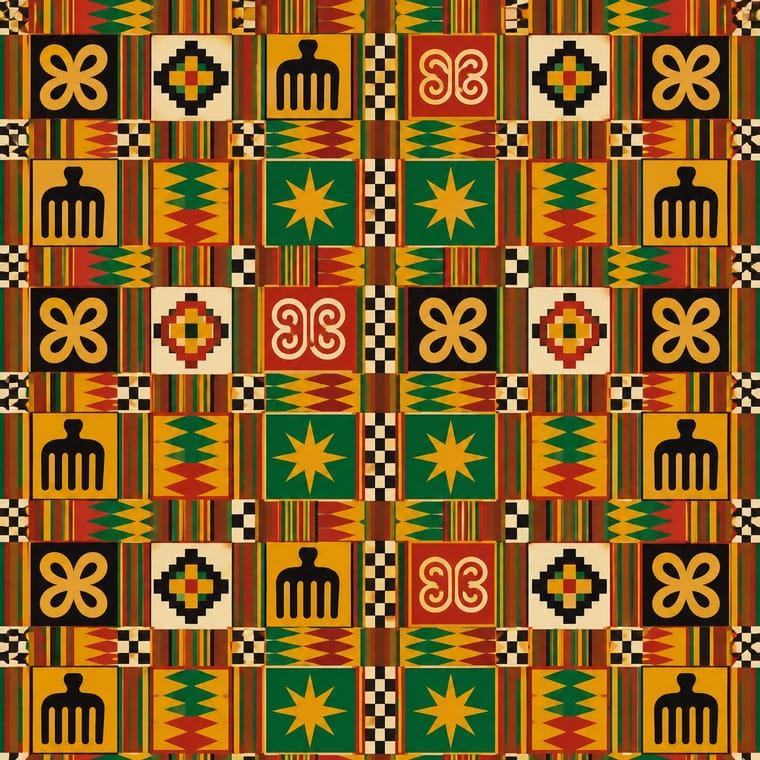
The Akan textile languages of Ghana. In adinkra, named symbols carrying proverbs (Gye Nyame, Sankofa, Dwennimmen) are stamped in black with carved calabash stamps on cloth ruled into squares; kente is narrow-strip cloth woven in named warp-faced blocks of gold, green, red and blue and sewn into checkerboards. Pattern is a vocabulary: each motif and colour is chosen for its meaning.
Make something in this style Get advice in this style Mix it with another style
Use it with care
Adinkra symbols and kente patterns are named, proverb-bearing Akan heritage, and some kente designs were historically reserved for the Asantehene and royal lineages. Learn each symbol's meaning before use, keep sacred signs such as Gye Nyame out of trivial or demeaning contexts, and commission or credit Ghanaian stampers and weavers (for example in Ntonso and Bonwire) rather than printing faux kente.
01
How it works
- Rule the field into a grid of squares with combed bands and fill each square with one repeated stamped symbol.
- Choose each symbol for its named proverb or meaning and keep its canonical silhouette.
- Build kente fields from narrow strips of interlocking warp-faced blocks, offsetting alternate strips into a checkerboard.
- Work in saturated gold, green, red and black, choosing colours for their symbolic associations.
- Stamp motifs in a single dark dye so they read as crisp silhouettes against the cloth.
Asante kingdom (Kumasi, Ntonso, Bonwire) and Ewe weaving towns, Ghana
02
Its design choices
From Stylogeny’s vocabulary of design choices: defining choices make the style, characteristic ones are usual, occasional ones turn up now and then.
- Layout & composition
- Space & hierarchy
- Typography
- Colour
- Form & shape
- Surface & texture
- Ornament
- Medium & production
- Tone & intent
- Avoids
- Dynamic asymmetry, Naturalistic depiction, Illusion of depth, Generous white space, Gradients, Straight photography
Palette
-
#e3a51c -
#1d7a3c -
#b52a1f -
#151412 -
#7d3a1f -
#efe2c4
Typefaces
-
Adinkra stamped glyphs as a pictographic set
-
Ghanaian hand-painted sign lettering for accompanying text
Known for
-
Adinkra cloth collected by Thomas E. Bowdich in Kumasi, 1817
British Museum
-
Ntonso adinkra stampers, Ashanti Region
-
Bonwire kente weavers, Ashanti Region
-
Ewe kente weavers of Agotime-Kpetoe and Agbozume
-
Kwame Nkrumah's kente at Ghana's independence
1957
-
El Anatsui
kente-inspired metal 'cloths'
03
Make something in this style
Say what you need, and Stylogeny’s image studio draws it from Adinkra & Kente Symbol Systems’s design choices and checks it against them. It takes about a minute, and you get a link to share.
04
Where it comes from, and what it’s close to
Before it
The style it grew out of, and the styles it borrowed from.
Nothing earlier is recorded: in the atlas it is a starting point.
After it
The styles that grew out of it.
No later style in the atlas grew out of it yet.
Alike in its design choices
Styles that make many of the same choices, related or not, besides those above.
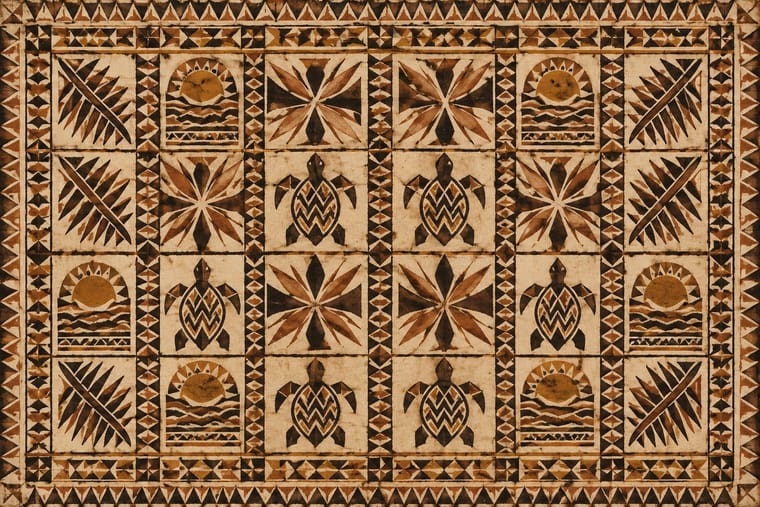
05
Real works
Artefacts in museums, libraries and archives that show the style, linked at their source.
- Adinkra cloth with the Dutch royal arms Unknown Asante (Akan) adinkra stamper and painter · before 1825 (sent from Elmina to The Hague in 1825) · Wereldmuseum Leiden, RV-360-1700 (via Wikimedia Commons)
- Cloth (adinkra) collected by Thomas Edward Bowdich in Kumase Unknown Asante adinkra stamper (the British Museum catalogues it as Asante/Dagomba) · before 1817 (collected in 1817) · British Museum, Af1818,1114.23
- Man's kente (prestige cloth) Asante-Akan artist · 19th century · The Metropolitan Museum of Art
- Cotton wrapper with stamped adinkra squares (Katoenen wikkeldoek met geometrische motieven) Unknown Asante adinkra stamper · before 1975 (museum dating) · Wereldmuseum Amsterdam (Tropenmuseum), TM-4254-5 (photograph on Wikimedia Commons)

06
Sources
- https://britishartstudies.ac.uk/issues/28/adinkra-from-kumase-to-the-british-museum/
- Doran H. Ross, Wrapped in Pride: Ghanaian Kente and African American Identity (UCLA Fowler Museum, 1998)
- W. Bruce Willis, The Adinkra Dictionary (1998)
How Stylogeny researches and checks a style: where the facts come from.