Traditions & vernacular · 1670–1900 · East Asia
Ukiyo-e Woodblock Prints
Also known as Pictures of the floating world, Nishiki-e, Edo woodblock prints
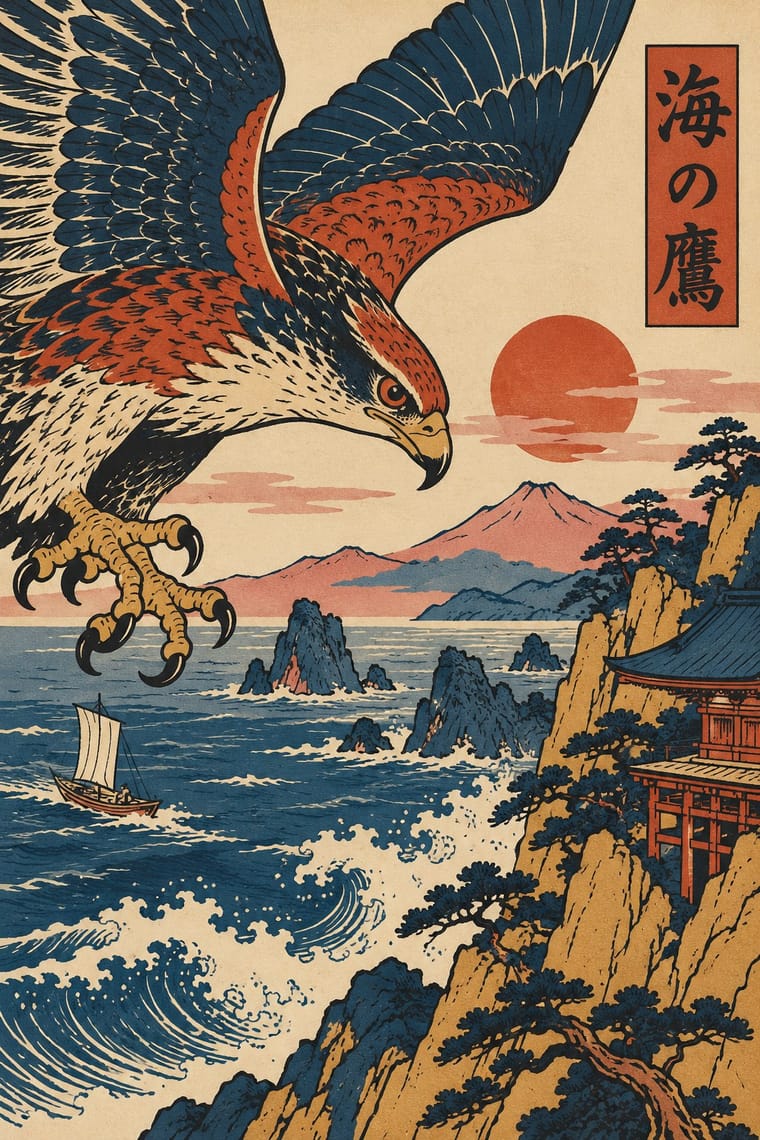
Mass-produced Edo-period woodblock prints of actors, courtesans, legends and landscapes, designed by an artist, cut and printed by specialist craftsmen and sold cheaply by commercial publishers. Flat colour blocks inside a carved keyline, bold cropping, high or oblique viewpoints and diagonal compositions, with titles in small cartouches, later handed Europe a new model for the poster.
Make something in this styleGet advice in this styleMix it with another style
01
How it works
- Bound every colour area with a confident carved keyline and fill it with flat, unmodulated ink.
- Crop figures and objects boldly at the frame edge and push a large foreground element against a distant view.
- Compose on diagonals and from high or oblique viewpoints rather than along a central axis.
- Place title, series name and signature in small cartouches inside the picture instead of a separate text block.
- Reserve bokashi gradation for sky, water and horizon, and keep everything else flat.
- Plan colour as a handful of separate blocks registered with kentō marks, not as continuous painting.
Edo (Tokyo), with Kyoto and Osaka, Japan
02
Its design choices
From Stylogeny’s vocabulary of design choices: defining choices make the style, characteristic ones are usual, occasional ones turn up now and then.
- Layout & composition
- Space & hierarchy
- Colour
- Form & shape
- Medium & production
- Tone & intent
- Avoids
- Central symmetry, Modular grid, Straight photography, Typography only, Painterly brushwork
Palette
#efe5cf#1e3b5c#c64a2d#d98c8c#d4a64a#1d1b18
Typefaces
Brush-written kana and kanji titles
gyōsho and sōsho hands
Kantei-ryū kabuki lettering
Carved cartouche inscriptions and artist signatures
Known for
Hishikawa Moronobu
illustrated books and early single-sheet prints, 1670s–90s
Suzuki Harunobu
full-colour nishiki-e, from 1765
Kitagawa Utamaro
bijin-ga portraits of women
Tōshūsai Sharaku
actor prints, 1794–95
Katsushika Hokusai, Thirty-six Views of Mount Fuji
c. 1830–32
Utagawa Hiroshige, Fifty-three Stations of the Tōkaidō
1833–34
Tsutaya Jūzaburō
publisher
03
Make something in this style
Say what you need, and Stylogeny’s image studio draws it from Ukiyo-e Woodblock Prints’s design choices and checks it against them. It takes about a minute, and you get a link to share.
04
Where it comes from, and what it’s close to
Before it
The style it grew out of, and the styles it borrowed from.


Alike in its design choices
Styles that make many of the same choices, related or not, besides those above.


05
Real works
Artefacts in museums, libraries and archives that show the style, linked at their source.
- Under the Wave off Kanagawa (The Great Wave), from the series Thirty-six Views of Mount FujiKatsushika Hokusai · ca. 1830–32 · The Metropolitan Museum of Art
- Sudden Shower over Shin-Ōhashi Bridge and Atake, from the series One Hundred Famous Views of EdoUtagawa Hiroshige · 1857 · The Metropolitan Museum of Art
- Kabuki Actor Ōtani Oniji III as Yakko EdobeiTōshūsai Sharaku · 1794 · The Metropolitan Museum of Art
- Hour of the Rat: Mistress, from the series Women's Daily Customs (Fūzoku bijin tokei)Kitagawa Utamaro · 1790 · The Metropolitan Museum of Art
- The Watchers and the WatchedSuzuki Harunobu · 1764–72 · The Metropolitan Museum of Art
- Street Scene in YoshiwaraHishikawa Moronobu · late 17th century · The Metropolitan Museum of Art
06
Sources
- Richard Lane, Images from the Floating World: The Japanese Print (1978)
- Timothy Clark (ed.), Hokusai: Beyond the Great Wave (British Museum, 2017)
- Philip B. Meggs & Alston W. Purvis, Meggs' History of Graphic Design
How Stylogeny researches and checks a style: where the facts come from.