Traditions & vernacular · 1700–present · Oceania
Pacific Barkcloth (Tapa) Design
Also known as Tapa, Ngatu (Tonga), Siapo (Samoa), Masi (Fiji), Kapa (Hawai'i), Hiapo (Niue)
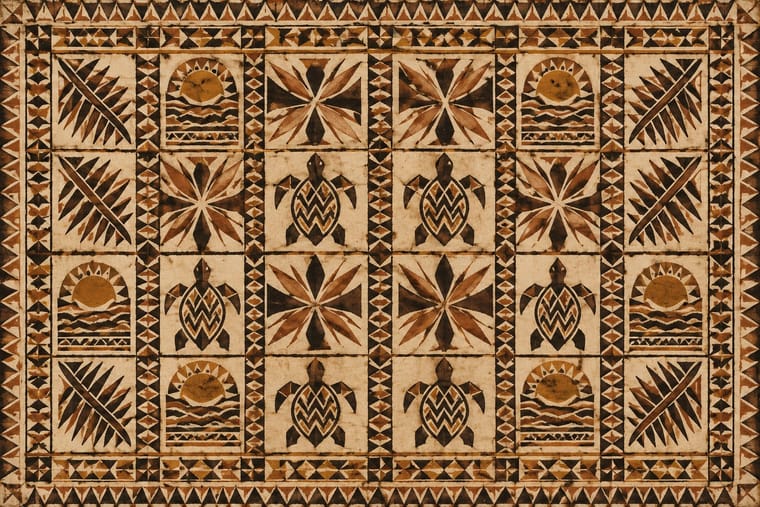
Barkcloth beaten from paper-mulberry inner bark and decorated across Polynesia and Fiji for gift exchange at weddings, funerals and chiefly investitures. Motifs are transferred rather than simply drawn: rubbed over pattern boards in Tonga and Samoa, stencilled in Fiji, stamped in Hawai'i, then sharpened by hand. The palette is earth browns and soot black on cream bark, inside ruled squares and bands on cloths that can run past twenty metres.
Make something in this styleGet advice in this styleMix it with another style
Use it with care
Tapa is women's ceremonial wealth, made collectively and presented at weddings, funerals and the investiture of chiefly titles; particular motifs commemorate events, lineages and royalty, and some designs belong to families, villages or chiefly lines. Commission and pay tapa makers and their work groups (such as the koka'anga in Tonga), credit the island and the maker, and do not lift motifs from museum cloths onto products or treat Tongan, Samoan, Fijian and Hawaiian traditions as one interchangeable 'Polynesian' pattern.
01
How it works
- Rule the cloth into squares or bands first and fill each with one repeated motif.
- Transfer motifs indirectly, by rubbing dye over relief pattern boards, stencilling or stamping, and accept the soft, broken edges this gives.
- Overpaint key lines freehand to sharpen the transferred design, adding borders, numerals or commemorative emblems.
- Restrict colour to earth browns, red-brown and soot black on the cream bark ground.
- Work at monumental, communal scale: one presentation cloth made by a women's work group can run to dozens of metres.
Western Polynesia and Fiji (Tonga, Samoa, Fiji), with Hawai'i, Niue, Tahiti, the Cook Islands, Futuna and 'Uvea
02
Its design choices
From Stylogeny’s vocabulary of design choices: defining choices make the style, characteristic ones are usual, occasional ones turn up now and then.
- Layout & composition
- Space & hierarchy
- Typography
- Colour
- Form & shape
- Surface & texture
- Ornament
- Imagery
- Medium & production
- Tone & intent
- Avoids
- Full polychrome, Fluorescent & neon, Gradients, Naturalistic depiction, Illusion of depth, Straight photography, Gloss & highlights
Palette
#e9dcc0#8a3b1f#3b2416#161311#b9772f
Typefaces
Freehand-painted numerals and capitals on ngatu, from length markers to commemorative inscriptions
Faces with full support for Tongan, Samoan, Fijian and Hawaiian orthographies (ʻokina and macrons), e.g. Noto Sans, for accompanying text
Known for
Tongan ngatu made by koka'anga women's work parties over kupesi pattern boards
Te Papa collection
Fijian masi kesa decorated with cut stencils
Museum of Archaeology and Anthropology, Cambridge
Samoan siapo 'elei rubbed on upeti boards and freehand siapo mamanu; Mary Jewett Pritchard
American Samoa
Hawaiian kapa stamped with 'ohe kapala bamboo stamps
Alexander Shaw, A Catalogue of the Different Specimens of Cloth Collected in the Three Voyages of Captain Cook
1787
John Pule and Nicholas Thomas, Hiapo
Past and Present in Niuean Barkcloth (2005)
03
Make something in this style
Say what you need, and Stylogeny’s image studio draws it from Pacific Barkcloth (Tapa) Design’s design choices and checks it against them. It takes about a minute, and you get a link to share.
04
Where it comes from, and what it’s close to
Before it
The style it grew out of, and the styles it borrowed from.
Nothing earlier is recorded: in the atlas it is a starting point.

After it
The styles that grew out of it.
No later style in the atlas grew out of it yet.
Alike in its design choices
Styles that make many of the same choices, related or not, besides those above.


05
Real works
Artefacts in museums, libraries and archives that show the style, linked at their source.
- Panel (Masi Kesa)mid- to late 19th century · The Metropolitan Museum of Art
- Ngatu fuatanga (tapa cloth)Ungatea Faiva, with the Mofuike Women's Work Group · 1978 · Museum of New Zealand Te Papa Tongarewa (FE010739)
- Panelearly 1800s · The Cleveland Museum of Art
- Wedding Tapa (Gatu Vakaviti)20th century · Los Angeles County Museum of Art (M.2010.160); image via Wikimedia Commons
- Ngatu fuatangaOta'ota Fahina Society · 2014 · Museum of New Zealand Te Papa Tongarewa (FE013023)
06
Sources
- Museum of New Zealand Te Papa Tongarewa, Ngatu (Tongan barkcloth): https://collections.tepapa.govt.nz/topic/1114
- Museum of Archaeology and Anthropology, Cambridge, Masi: https://maa.cam.ac.uk/masi
- Wikipedia: Tapa cloth
How Stylogeny researches and checks a style: where the facts come from.