Traditions & vernacular · 1945–present · Eastern Europe
Gzhel Cobalt Ceramic Painting
Also known as Gzhel painting, Гжельская роспись, Modern blue-and-white Gzhel
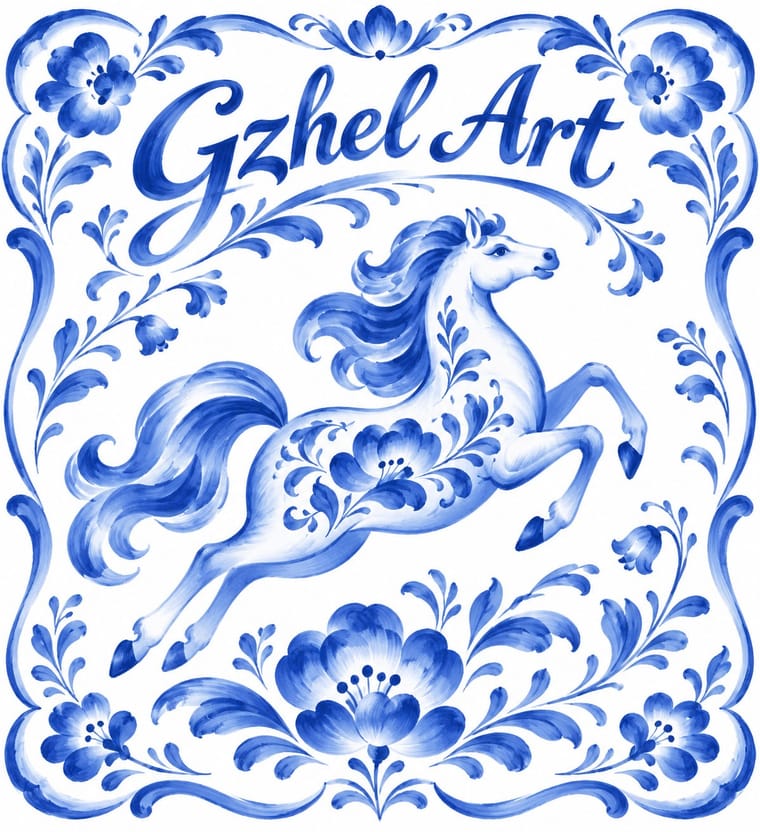
A living regional painting language of cobalt flowers, leaves and curling stems on white porcelain, rebuilt in the mid-1940s from older Gzhel ceramics. Dark-to-light brushstrokes shape petals without losing their decorative silhouette; white reserves separate floral clusters and rhythmic edge bands. Its graphic extension includes illustrated game components, not just ceramic objects or generic blue-and-white ornament.
Make something in this style Get advice in this style Mix it with another style
Use it with care
Gzhel is a living regional craft associated with named artists, workshops and local makers, not an anonymous national pattern bank. Credit the Gzhel region and the actual maker when known; distinguish the designer of a ceramic form from the painter of its decoration. Obtain permission before reproducing an individual artist's composition, signature or a workshop's mark, and do not imply authentic Gzhel manufacture for unrelated printed or digital goods. Describe adaptations as adaptations and distinguish hand-painted decoration from mechanically reproduced imagery. The cobalt-only scope here does not erase older polychrome Gzhel or the wider practice. Do not infer sacred meanings from ordinary flowers, or generalise occasional Soviet commemorative inscriptions into the intent of all Gzhel painting. Public museum display is not an open-image licence: no exact-file reuse permission was established for the museum photographs, and the game rulebook explicitly reserves reproduction rights. These sources are references only. The palette is an illustrative range, not an official pigment specification.
01
Its picture in other colours
Change a colour and every picture on this page follows. It happens in your browser, from the same pictures: nothing new is made or saved.
Choose a colour to change it
-
#FFFFFF -
#192C68 -
#25489A -
#528BC3 -
#B0D4E8
A faded colour isn’t in these pictures, so changing it changes nothing.
Light and dark stay where they are; greys hardly move.
More colours: any style’s, or your own
The pictures show the style’s own colours.
02
Make something in this style
Say what you need, and Stylogeny’s image studio draws it from Gzhel Cobalt Ceramic Painting’s design choices and checks it against them. It takes about a minute, and you get a link to share.
03
How it works
Palette
-
#FFFFFFground · 45% -
#192C68ink · 1% -
#25489Aaccent · 5% -
#528BC3accent · 17% -
#B0D4E8accent · 26%
Shares measured from its picture. The ground is what the pictures sit on (of the colours covering most, the most neutral), the ink stands out from it most, the rest are accents.
Typefaces
-
Bold blue sans-serif Cyrillic capitals in Suprematika's Obedinenie Gzhel identity, whose rebranding began in 2022
the inspected ГЖЕЛЬ wordmark combines straight stems and sharp diagonals with rounded inner corners, a curved lower-left stroke on Л and a rounded bowl on Ь. A contemporary ceramic-brand lettering treatment, not a traditional painted alphabet or a general rule for Gzhel ornament; no font-family identification is asserted
-
Tall condensed decorative Latin capitals in the Gzhel board game's logo and headings (Hobby World, 2025), visually checked in its English rulebook. This is a contemporary application, not a traditional ceramic alphabet; no font-family identification is asserted
- Keep cobalt blue as the single hue and let the white ground function as the second colour, rather than filling every interval.
- Shade petals and leaves within the brushstroke, moving from a loaded dark edge into a pale blue wash instead of relying on uniform flat fills.
- Build flowers from rounded, simplified petal masses; connect them with fine curling stems, buds and tapered leaves rather than botanical realism.
- Anchor a floral cluster or garland to the available surface and preserve white breathing room between the ornament and its boundaries.
- Mark rims and edges with repeated dots, strokes, scallops or narrow bands, keeping these accents subordinate to the main flowers.
- In a credited graphic adaptation, preserve shaded blue motifs and white reserves; treat display lettering and game grids as application-specific additions, not historical rules of ceramic painting.
Gzhel ceramic villages, Moscow region, Russia. This entry begins with the 1945–1949 revival by Natalia Bessarabova, Alexander Saltykov and local makers, drawing on nineteenth-century Gzhel semifaience; it does not date the invention of blue-and-white ceramics or the district's much older pottery industry.
Change it with an idea. Any of the 73 moves that make a design say something can go on this style.
04
Its design choices
From Stylogeny’s vocabulary of design choices: defining choices make the style, characteristic ones are usual, occasional ones turn up now and then.
- Layout & composition
- Space & hierarchy
- Surface & texture
- Ornament
- Imagery
- Medium & production
- Tone & intent
- Avoids
- Full polychrome, Fluorescent & neon, Dark ground, Carved line, Photomontage, Ornament-free
How its pictures are made Drawn & painted, Systematic
Kind of picture: Drawn & painted · Systematic
Known for
-
Natalia Bessarabova, Jug and mug, design dated 1945, museum objects identified in the catalogue's structured description as a 1972 repeat
underglaze cobalt on porcelain, State Russian Museum, Г-3619 and Г-3617. The inspected photograph shows large stylised flowers, fine stems, white reserves and dotted/scalloped rim decoration; these are not original 1945 objects
-
L. P. Azarova, Jug from a three-piece kvass set
1963, underglaze cobalt on porcelain, State Russian Museum, Г-2232. The museum photograph shows broad, shaded blue flowers linked by fine curved stems on a white body, with a dark rim and handle; the catalogue credits Azarova but does not separately identify a decoration painter
-
Hobby World, Gzhel board game, English rulebook copyright 2025
printed flower tokens, pattern cards, figurine pads and floral page corners. Artwork: Mariya Stankevich and Kristina Soozar; design and layout: Kristina Soozar. A contemporary graphic interpretation, not a historic ceramic specimen
05
Where it comes from, and what it’s close to
Nothing earlier is recorded: in the atlas it is a starting point.
Gzhel Cobalt Ceramic Painting 1945–present
No later style in the atlas grew out of it yet.
Alike in its design choices
06
Combine it with
Styles Gzhel Cobalt Ceramic Painting pairs well with or plays against, from the research. Each is worked out as a combination: which style gives the type, the colours and the forms.
- Lubok Popular Print Contrasts · Choose between floral cobalt painting with white reserves and a captioned, contour-led narrative print; a shared Russian context does not establish a parent relationship.
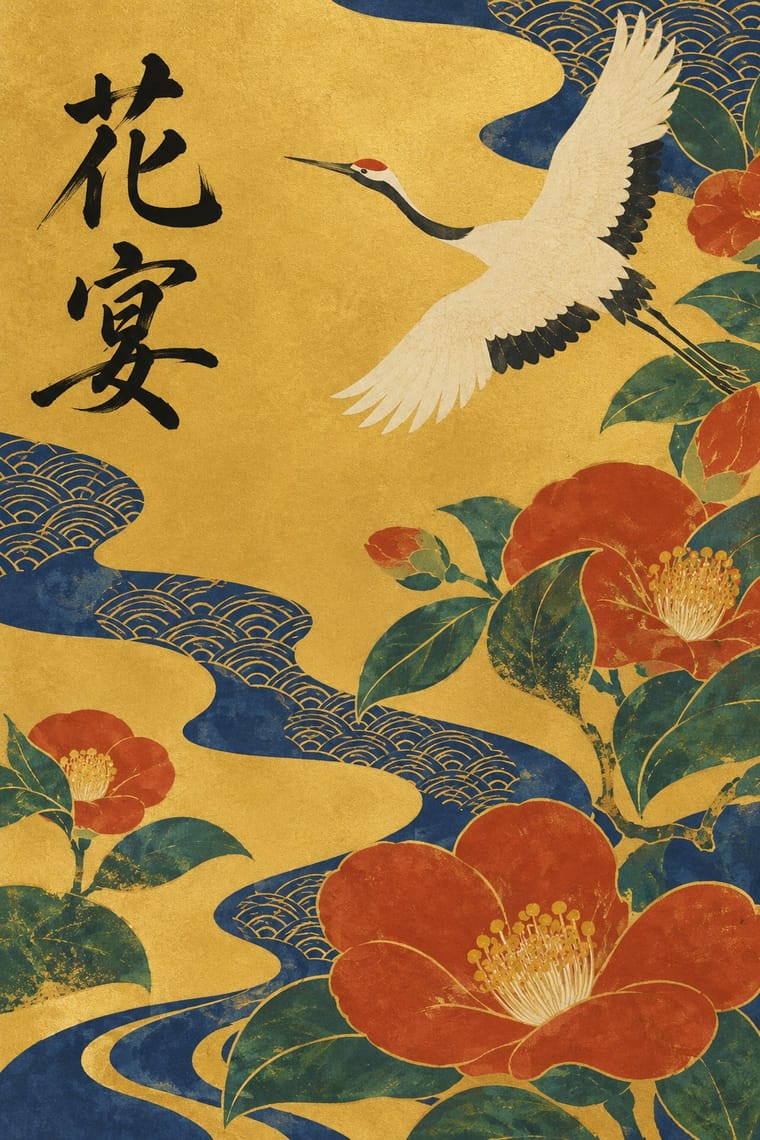
- Rinpa & Saga-bon Contrasts · Compare plant clusters and painterly marks while keeping Gzhel's cobalt-on-white shading distinct from Rinpa's gold grounds and pooled colour; do not collapse the traditions into interchangeable floral assets.
- Arts & Crafts Movement Contrasts · Compare shared floral ornament but distinguish Gzhel's shaded blue strokes and open white ground from the atlas's Kelmscott-oriented heavy type, carved line and compact bordered page; similarity is not descent.
07
Often taken for
Gzhel Cobalt Ceramic Painting has no real works recorded yet, so these are its nearest styles by its choices alone, with the choices that tell them apart.
-
Rinpa & Saga-bon
Rinpa & Saga-bon is one of Gzhel Cobalt Ceramic Painting’s nearest styles by choices; no real work of either fits the other better.
Choices that tell Gzhel Cobalt Ceramic Painting and Rinpa apart Choice Gzhel Cobalt Ceramic Painting Rinpa Light ground defining occasional Jewel & metallic — defining Monochrome defining occasional Brush & pen calligraphy — defining Radial & concentric characteristic — No shared descent in the atlas: they reached these choices separately.
-
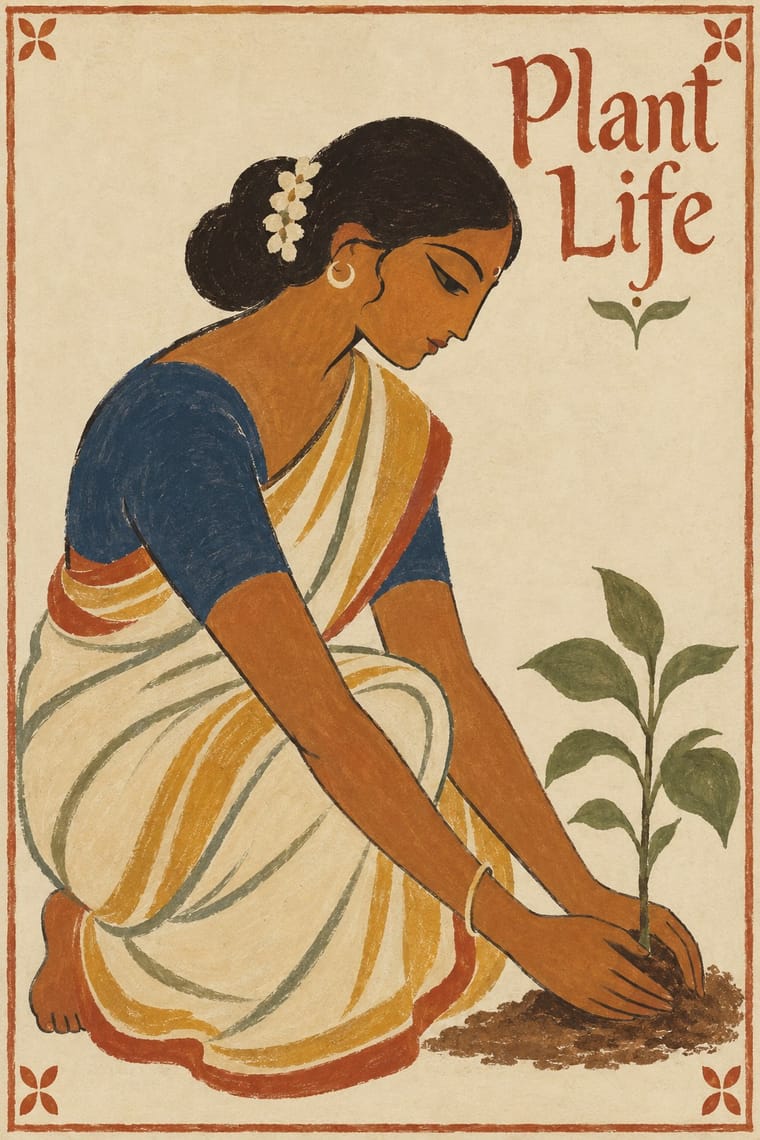
Santiniketan & Bengal School Graphics
Santiniketan & Bengal School Graphics is one of Gzhel Cobalt Ceramic Painting’s nearest styles by choices; no real work of either fits the other better.
Choices that tell Gzhel Cobalt Ceramic Painting and Santiniketan apart Choice Gzhel Cobalt Ceramic Painting Santiniketan Organic flow defining — Carved line avoids characteristic Monochrome defining occasional Earth & mineral — defining Floral & vegetal defining occasional No shared descent in the atlas: they reached these choices separately.
-
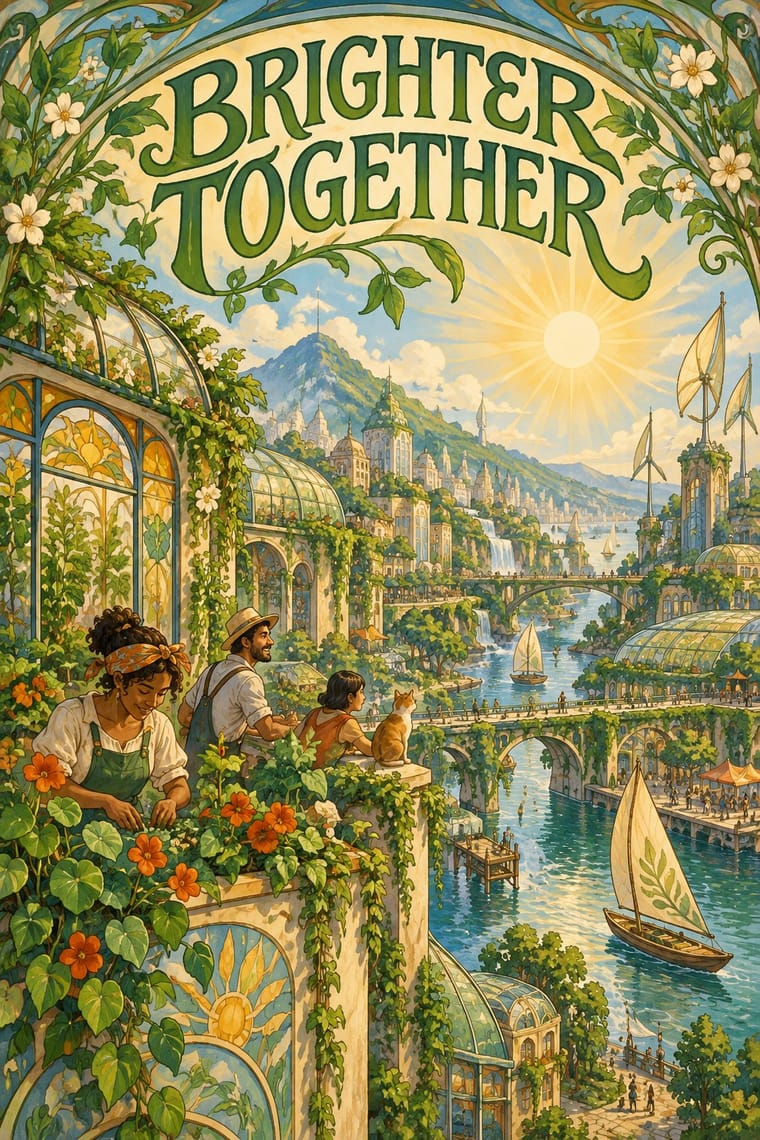
Solarpunk
Solarpunk is one of Gzhel Cobalt Ceramic Painting’s nearest styles by choices; no real work of either fits the other better.
Choices that tell Gzhel Cobalt Ceramic Painting and Solarpunk apart Choice Gzhel Cobalt Ceramic Painting Solarpunk Monochrome defining — Illusion of depth — defining Light ground defining occasional Analogous harmony — characteristic Pattern & repeat characteristic — No shared descent in the atlas: they reached these choices separately.
-
Modern Calligraphy and Brush Lettering
Modern Calligraphy and Brush Lettering is one of Gzhel Cobalt Ceramic Painting’s nearest styles by choices; no real work of either fits the other better.
Choices that tell Gzhel Cobalt Ceramic Painting and Modern Calligraphy and Brush Lettering apart Choice Gzhel Cobalt Ceramic Painting Modern Calligraphy and Brush Lettering Condensed display occasional avoids Central symmetry — defining Organic flow defining occasional Brush & pen calligraphy — defining Stylised figuration characteristic — No shared descent in the atlas: they reached these choices separately.
— means the choice isn’t among the style’s recorded choices. Critics recorded each work’s choices with the styles’ descriptions in view, so this shows whether the descriptions hold together, not proof that they are right.
08
Sources
- https://rusmuseumvrm.ru/data/collections/folk_art/g_3619_g_3617/index.php?lang=en — State Russian Museum, Bessarabova, Jug and mug, Г-3619; Г-3617. Catalogue and photograph inspected. The page's JSON-LD description explicitly says 1972 repeat and gives the 1945–1949 revival account, although the visible date heading says 1945; preserve that distinction.
- https://rusmuseumvrm.ru/data/collections/folk_art/g-2232/index.php?lang=en — State Russian Museum, Jug from a three-piece kvass set, L. P. Azarova, 1963, Г-2232. Catalogue and linked photograph inspected for attribution, material, date and painted floral treatment.
- https://gzhellux.ru/proizvodstvo/xudozhniki/bessarabova-nataliya-ivanovna/ — Gzhel Lux, Natalia Bessarabova biography. Craft-sector account of white reserves, dark-to-light blue transitions, simplified flowers, garlands and the two 1947 inscribed goblets. Used as a commercial practitioner account, not independent museum authentication of those goblets; their images were not confirmed.
3 more sources
- https://unesco.ru/en/news/gjel37/ — G. Yampolskaya, The Cradle of Russian Ceramics, Russian Federation Commission for UNESCO, 31 October 2018. Supports nineteenth-century blue-painted semifaience antecedents and the modern shaded brushstroke vocabulary; this national-commission article is not evidence of UNESCO heritage inscription.
- https://hobbyworldint.com/wp-content/uploads/2025/04/Gzhel_rules-ENG.pdf — Hobby World, Gzhel, English rules, copyright 2025, version 1.0. Pages 1, 14 and 16 visually inspected: floral tokens and borders, printed pattern examples, condensed display lettering and credits. Primary evidence of graphic application; all rights reserved. Neither a printing process nor a font family is identified here.
- https://suprematika.ru/portfolio/gzhel/ — Suprematika, Obedinenie Gzhel branding and packaging, primary agency case study. Identifies the rebranding's launch in 2022 and describes lettering mixing rounded and angular elements. Visually inspected its linked wordmark detail https://suprematika.ru/wp-content/uploads/2023/01/artArtboard-1_2.jpg and logo https://suprematika.ru/wp-content/uploads/2023/01/artArtboard-1-copy.jpg: blue Cyrillic sans-serif capitals with straight strokes, sharp diagonals and rounded inner corners. Evidence of this named contemporary ceramic brand's graphic treatment, not historical ceramic lettering. Reference-only images; no exact-file open licence established.


How Stylogeny researches and checks a style: where the facts come from.