Traditions & vernacular · 1600–present · East Asia
Rinpa & Saga-bon
Also known as Rimpa, Kōrin school (Kōrin-ha), Sōtatsu–Kōrin school (Sōtatsu Kōrin-ha), Kōetsu school (Kōetsu-ha), Saga-bon (Kōetsu-bon, Suminokura-bon), Kōrin patterns (Kōrin moyō)
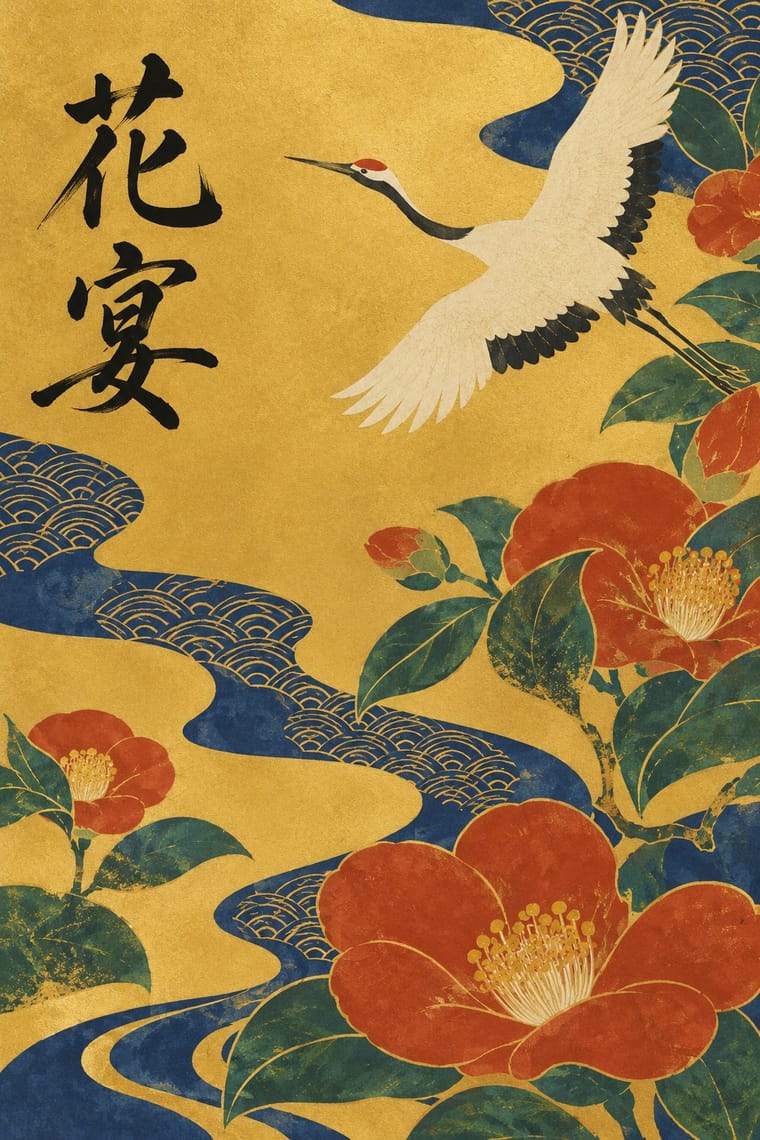
A Kyoto school of decorative design that revived the poetry and court painting of the Heian period, begun around 1600 by the calligrapher Hon'ami Kōetsu and the painter Tawaraya Sōtatsu and carried on less by teaching than by admiration across generations: Ogata Kōrin, Sakai Hōitsu, Kamisaka Sekka. A few plants, waves or birds are enlarged, simplified, cropped and repeated across open gold or silver grounds, colour is pooled wet into wet (tarashikomi), poems are brushed over decorated paper, and the same motifs pass to screens, fans, lacquer, kimono and the movable-type Saga-bon books.
Make something in this styleGet advice in this styleMix it with another style
Use it with care
Poems on Rinpa works and Saga-bon pages are real Japanese texts: have any kana or kanji written or set and checked by a fluent reader, and never fill a design with pseudo-calligraphy as texture. Do not present a generated gold screen as a historical work or as a copy of a named National Treasure. A Kōrin-style plum or wave can be crest-like, but keep it free of any real family's, shrine's or temple's mon.
01
How it works
- Choose a few seasonal motifs (irises, plum, autumn grasses, waves, cranes, deer) and enlarge, simplify and crop them at the edge, so each reads as an emblem rather than a scene: an emblem of a season or of a classical poem or tale, as Kōrin's irises, with or without the plank bridge, call up the Yatsuhashi episode of the Tales of Ise.
- Lay them on an open field of gold or silver and leave much of it bare: let the metal be the space, with no horizon or perspective, and run one composition across all the folds of a screen; where there are frames, as in the painted fans the Tawaraya studio scattered over gold screens, scatter them over the field instead of locking them into a grid.
- Repeat the motif in a rhythm (a flock of cranes along a scroll, clumps of irises along a screen) until the picture becomes a pattern that can pass to a fan, a lacquer box or a kimono, as Kōrin's patterns passed into kosode pattern books.
- Model forms with tarashikomi rather than shading: drop wet ink or pigment into a layer that is still wet, so the colour pools and mottles inside a crisp silhouette.
- Write over the picture: brush poems across paper decorated in gold, silver or mica-printed patterns, and in print set flowing kana in wooden type that joins two to four characters on one sort, as the Saga-bon did.
- Quote the masters openly: repaint an earlier Rinpa work in your own hand, as Kōrin and Hōitsu each repainted Sōtatsu's Wind God and Thunder God, since the line passes by admiration, not apprenticeship.
Kyoto, from about 1600: the calligrapher Hon'ami Kōetsu (1558–1637), who founded a community of craftsmen at Takagamine in 1615, and the painter Tawaraya Sōtatsu, who ran a painting shop (eya) under the name Tawaraya, selling fans, screens and kimono patterns, and painted the gold and silver underpaintings for Kōetsu's poem scrolls. The merchant Suminokura Soan printed the Saga-bon at his press in Saga from 1608 into the 1620s, seeking to recapture the elegance of Heian court culture in editions of classics beginning with the Tales of Ise; tradition credits Kōetsu with the hand behind the type and Sōtatsu with covers and papers, but Kōetsu's part is attributed rather than documented, and some scholars doubt it. Ogata Kōrin (1658–1716) and his brother Kenzan (1663–1743), sons of a Kyoto textile merchant, revived the manner in the Genroku era (1688–1704); Sakai Hōitsu (1761–1828), born in Edo to the Sakai family of Himeji, which had once paid Kōrin a stipend, revived it in Edo in the early nineteenth century, and Kamisaka Sekka (1866–1942) carried it into modern Kyoto design. In the twentieth century Tanaka Ikkō (1930–2002) drew many posters of the 1960s and 1970s from Rinpa and has been called 'a 20th-century Rimpa artist'; for Rinpa's 400th anniversary the ginza graphic gallery in Tokyo commissioned '21st Century Rimpa Posters' from ten Japanese graphic designers in 2015. The line passed by admiration (shishuku), not from teacher to pupil, and 'Rinpa', from the 'rin' of Kōrin, is a modern name
02
Its design choices
From Stylogeny’s vocabulary of design choices: defining choices make the style, characteristic ones are usual, occasional ones turn up now and then.
- Layout & composition
- Space & hierarchy
- Typography
- Colour
- Form & shape
- Ornament
- Medium & production
- Tone & intent
- Avoids
- Illusion of depth, Horror vacui, Modular grid, Ornament-free, Straight photography
Palette
#c9a447#1f3f7a#3e7a5c#b0412e#8e8f8a#1c1a17
Typefaces
Kōetsu's brush hand
the calligraphy of Hon'ami Kōetsu, one of the 'three brushes of the Kan'ei era', written over Sōtatsu's gold and silver underpaintings
Saga-bon wooden movable type
flowing hiragana mixed with kanji, cut mostly as single characters but also as linked sorts of two, three and four characters, after a hand in Kōetsu's manner
Cursive (sōsho) kana and kanji for waka and haikai poems inscribed on Rinpa paintings and fans
Known for
Tawaraya Sōtatsu (painting) and Hon'ami Kōetsu (calligraphy), Anthology with Crane Design, handscroll with cranes in gold and silver, singly and in flocks, along its whole length, 17th century, 34 × 1356 cm, Important Cultural Property (Kyoto National Museum, AK364)
Ise monogatari, the first Saga-bon, printed by Suminokura Soan in movable wooden type with illustrations, colophon dated Keichō 13 (1608); about 2,100 sorts were cut for it, some joining two to four characters (British Museum 1979,0305,0.1.1–2; University of Illinois Library)
Tawaraya Sōtatsu, Wind God and Thunder God, pair of two-panel screens in colour on gold-ground paper, National Treasure (Kennin-ji, Kyoto, on deposit at the Kyoto National Museum); Kōrin's copy is in the Tokyo National Museum and Hōitsu's in the Idemitsu Museum of Arts
Tawaraya studio (attributed to Tawaraya Sōtatsu and Tōshichirō), Painted Fans Mounted on a Screen
(Senmen chirashi-zu byōbu), pair of eight-panel screens with 48 fans, three to a panel, in ink, colours and gold on paper, mostly scenes from the Hōgen and Heiji war tales, others from the Tales of Ise or of birds and flowers, in the imperial collection since they were made in the 1620s (Sannomaru Shōzōkan, Museum of the Imperial Collections, Tokyo); the Freer's Screen with Scattered Fans (F1900.24, 'Tatō' seal) scatters 42 fans at various angles over gold
Ogata Kōrin, Irises (Kakitsubata-zu), pair of six-panel screens, ink and colour on gold-foiled paper, 18th century, National Treasure (Nezu Museum, Tokyo, 10301), with clumps of irises in blue and green set rhythmically across the gold
Ogata Kōrin, Irises at Yatsuhashi (Eight Bridges), pair of six-panel screens, ink and colour on gold-foiled paper, 1710s, with irises and a zigzag plank bridge that call up the Yatsuhashi episode (section 9) of the Tales of Ise (Metropolitan Museum of Art, New York)
Ogata Kōrin, Red and White Plum Blossoms (Kōhakubai-zu), pair of two-panel screens, the two trees facing each other across a stream laid in silver against the gold ground, 18th century, National Treasure (MOA Museum of Art, Atami)
Sakai Hōitsu, Flowering Plants of Summer and Autumn, painted on the back of Kōrin's Wind God and Thunder God screens
Tokyo National Museum
03
Make something in this style
Say what you need, and Stylogeny’s image studio draws it from Rinpa & Saga-bon’s design choices and checks it against them. It takes about a minute, and you get a link to share.
04
Where it comes from, and what it’s close to
Before it
The style it grew out of, and the styles it borrowed from.
Nothing earlier is recorded: in the atlas it is a starting point.

After it
The styles that grew out of it.
No later style in the atlas grew out of it yet.
Alike in its design choices
Styles that make many of the same choices, related or not, besides those above.



05
Sources
- Kotobank, '琳派' (Nipponica, Murashige Yasushi; Heibonsha Kaitei shinban Sekai daihyakka jiten, Kōno Motoaki; Digital Daijisen; Mypedia; Yamakawa Nihonshi shōjiten; Kyodo news glossary) (https://kotobank.jp/word/琳派)
- Kotobank, '俵屋宗達' (Heibonsha Kaitei shinban Sekai daihyakka jiten, Kōno Motoaki; Nipponica, Murashige Yasushi; Digital Daijisen) (https://kotobank.jp/word/俵屋宗達)
- Kotobank, '嵯峨本' (Heibonsha Kaitei shinban Sekai daihyakka jiten, Shōji Sensui; Nipponica, Kaneko Kazumasa; Digital Daijisen; Mypedia) (https://kotobank.jp/word/嵯峨本)
- Kotobank, '光琳模様' (Nipponica, Mura Motoo; Seisenban Nihon kokugo daijiten; Digital Daijisen) (https://kotobank.jp/word/光琳模様)
- JAANUS (Japanese Architecture and Art Net Users System), 'sagabon' (https://projects.mcah.columbia.edu/jaanus/node/1617)
- ja.wikipedia, '嵯峨本' (https://ja.wikipedia.org/wiki/嵯峨本)
- Wikipedia, 'Rinpa school' (https://en.wikipedia.org/wiki/Rinpa_school)
- Wikipedia, 'Tawaraya Sōtatsu' (https://en.wikipedia.org/wiki/Tawaraya_S%C5%8Dtatsu)
- Wikipedia, 'Tarashikomi' (https://en.wikipedia.org/wiki/Tarashikomi)
- Wikipedia, 'Kamisaka Sekka' (https://en.wikipedia.org/wiki/Kamisaka_Sekka)
- Kyoto National Museum, Anthology with Crane Design, AK364 (https://www.kyohaku.go.jp/eng/collection/meihin/kinsei/item02/)
- Nezu Museum, Ogata Kōrin, Irises, 10301 (https://www.nezu-muse.or.jp/en/collection/detail.php?id=10301)
- British Museum, Ise monogatari (Saga-bon), 1979,0305,0.1.1 (https://www.britishmuseum.org/collection/object/A_1979-0305-0-1-1)
- Metropolitan Museum of Art, Sakai Hōitsu, One Hundred Paintings by Kōrin (Kōrin hyakuzu) (https://www.metmuseum.org/art/collection/search/57810)
- Cleveland Museum of Art, Kamisaka Sekka, Flowers of a Hundred Worlds (Momoyogusa), Vol. 3, 1988.23.3 (https://www.clevelandart.org/art/1988.23.3)
- John T. Carpenter, Designing Nature: The Rinpa Aesthetic in Japanese Art (Metropolitan Museum of Art, 2012)
- Kotobank, '酒井抱一' (Seisenban Nihon kokugo daijiten; Nipponica; Britannica kokusai daihyakka jiten; Heibonsha Kaitei shinban Sekai daihyakka jiten) (https://kotobank.jp/word/酒井抱一)
- Wikipedia, 'Irises screen' (https://en.wikipedia.org/wiki/Irises_screen)
- Wikipedia, 'Ikko Tanaka' (https://en.wikipedia.org/wiki/Ikko_Tanaka)
- Freer|Sackler, Sōtatsu: Making Waves, Painted Fans Mounted on a Screen (https://asia-archive.si.edu/exhibition/painted-fans-mounted-on-a-screen/)
- Freer|Sackler, Sōtatsu: Making Waves, exhibition image list with captions for Painted Fans Mounted on a Screen and Screen with Scattered Fans, F1900.24 (https://asia-archive.si.edu/wp-content/uploads/2018/07/Sotatsu-Images-with-Permissions-10.14.15.pdf)
- Canon Tsuzuri Project, Tawaraya Sōtatsu, Screen with Scattered Fans (https://global.canon/en/tsuzuri/works/semmenchirashizu/)
- DNP Foundation for Cultural Promotion, ginza graphic gallery, 21st Century Rimpa Posters: Competitive Works by 10 Graphic Designers, 350th exhibition, 2015 (https://www.dnpfcp.jp/gallery/ggg/eng/00000666)
- DNP Foundation for Cultural Promotion, kyoto ddd gallery, 21st Century Rimpa Posters, 207th exhibition (https://dnpfcp.jp/gallery/ddd/eng/00000672)
- Nippon Design Center, 21st Century Rimpa Posters, and Jellyfish Painting (https://ndc.co.jp/en/projects/21st-century-rimpa-posters; https://ndc.co.jp/en/projects/21st-century-rimpa-posters_kurage-zu)
- Tamamushi Satoko, '光琳観の変遷 1815–1915' (Transitions in the Image of Kōrin, 1815–1915), Bijutsu kenkyū 371 (1999), 1–70 (https://tobunken.repo.nii.ac.jp/records/6247)
How Stylogeny researches and checks a style: where the facts come from.