Style combination · Contrasts
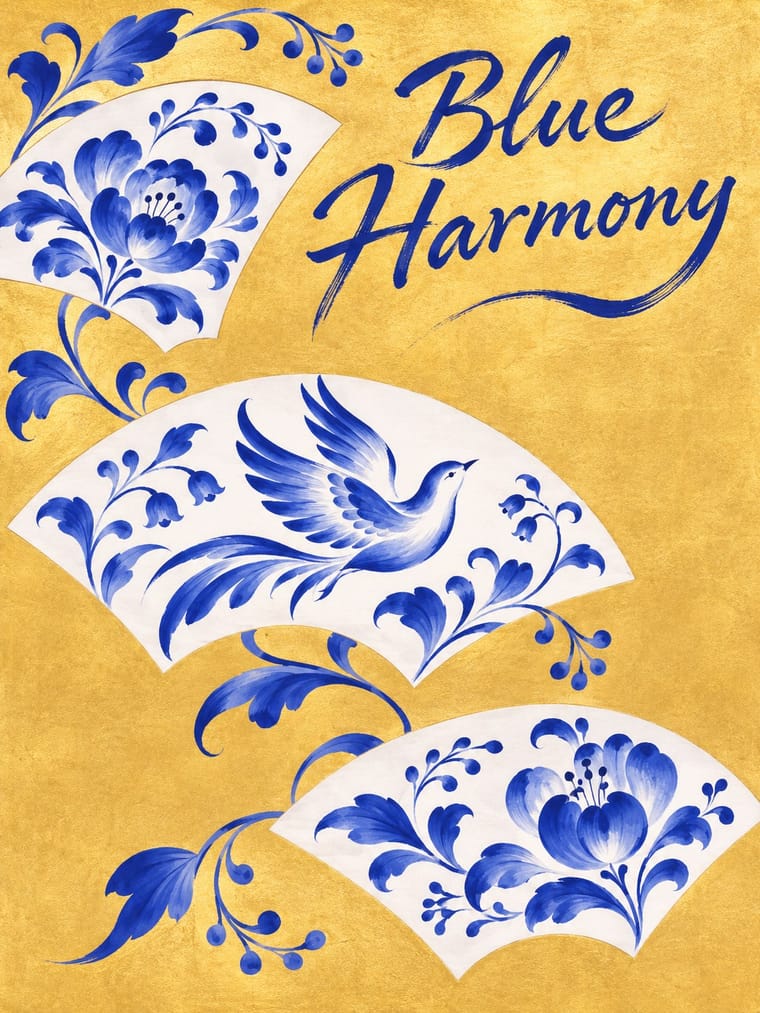
Gzhel Cobalt Ceramic Painting × Rinpa
Compare plant clusters and painterly marks while keeping Gzhel's cobalt-on-white shading distinct from Rinpa's gold grounds and pooled colour; do not collapse the traditions into interchangeable floral assets.
Mix them and make something Gzhel Cobalt Ceramic Painting Rinpa
01
What each style brings
Each part of the design comes from the style with the stronger say in it, and each style gives at least two.
Gzhel Cobalt Ceramic Painting Rinpa & Saga-bon
- Type from Rinpa
- Colour from Gzhel Cobalt Ceramic Painting
- Form from Gzhel Cobalt Ceramic Painting
- Composition from Rinpa
- Surface from Rinpa
02
The type
Open fonts standing in for each style’s own type, which is often hand-drawn or commercial.
Display · Rinpa
Memory
Shippori Mincho, standing in for Saga-bon wooden movable type: flowing hiragana mixed with kanji, cut mostly as single characters but also as linked sorts of two, three and four characters, after a hand in Kōetsu's manner
Text · Gzhel Cobalt Ceramic Painting
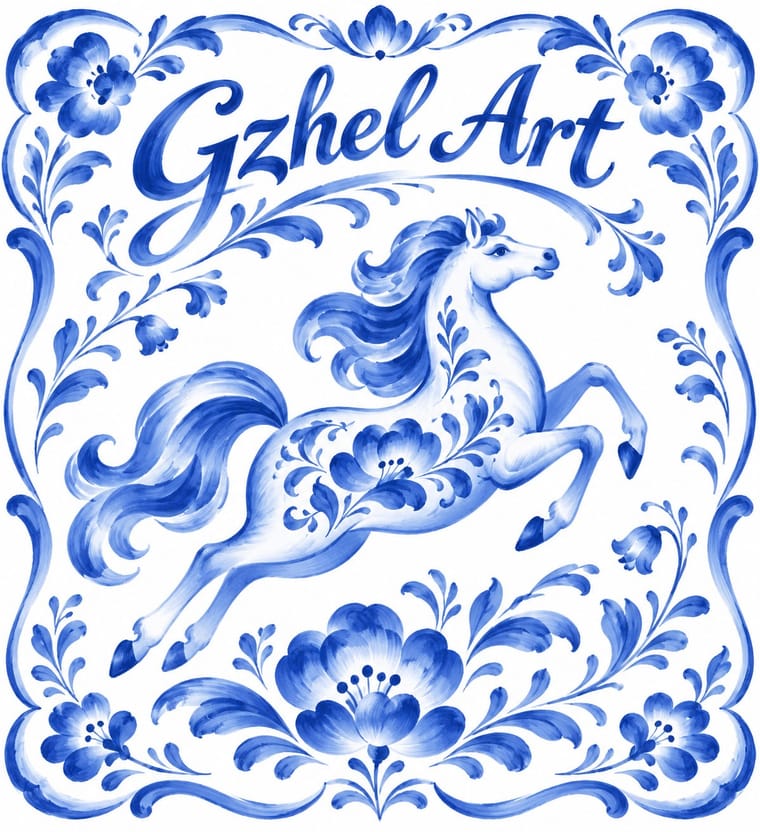
A living regional painting language of cobalt flowers, leaves and curling stems on white porcelain, rebuilt in the mid-1940s from older Gzhel ceramics. Dark-to-light brushstrokes shape petals without losing their decorative silhouette; white reserves separate floral clusters and rhythmic edge bands. Its graphic extension includes illustrated game components, not just ceramic objects or generic blue-and-white ornament.
Archivo; Gzhel Cobalt Ceramic Painting used Bold blue sans-serif Cyrillic capitals in Suprematika's Obedinenie Gzhel identity, whose rebranding began in 2022 and Tall condensed decorative Latin capitals in the Gzhel board game's logo and headings (Hobby World, 2025), visually checked in its English rulebook. This is a contemporary application, not a traditional ceramic alphabet; no font-family identification is asserted
03
The colours
The ground and leading colours come from Gzhel Cobalt Ceramic Painting, with a counter-accent from Rinpa. The ink reads on the ground at 4.5:1 or more.
Gzhel Cobalt Ceramic Painting Rinpa & Saga-bon
-
#ffffffground · 36% -
#192c68ink · 14% -
#25489aaccent · 18% -
#b0412eaccent · 14% -
#528bc3accent · 10% -
#3e7a5caccent · 8%
As CSS
:root {
  --ground: #ffffff;
  --ink: #192c68;
  --accent-1: #25489a;
  --accent-2: #b0412e;
  --accent-3: #528bc3;
  --accent-4: #3e7a5c;
  --font-display: "Shippori Mincho", serif;
  --font-text: "Archivo", sans-serif;
}
Use it with care
Gzhel Cobalt Ceramic Painting: Gzhel is a living regional craft associated with named artists, workshops and local makers, not an anonymous national pattern bank. Credit the Gzhel region and the actual maker when known; distinguish the designer of a ceramic form from the painter of its decoration. Obtain permission before reproducing an individual artist's composition, signature or a workshop's mark, and do not imply authentic Gzhel manufacture for unrelated printed or digital goods. Describe adaptations as adaptations and distinguish hand-painted decoration from mechanically reproduced imagery. The cobalt-only scope here does not erase older polychrome Gzhel or the wider practice. Do not infer sacred meanings from ordinary flowers, or generalise occasional Soviet commemorative inscriptions into the intent of all Gzhel painting. Public museum display is not an open-image licence: no exact-file reuse permission was established for the museum photographs, and the game rulebook explicitly reserves reproduction rights. These sources are references only. The palette is an illustrative range, not an official pigment specification.
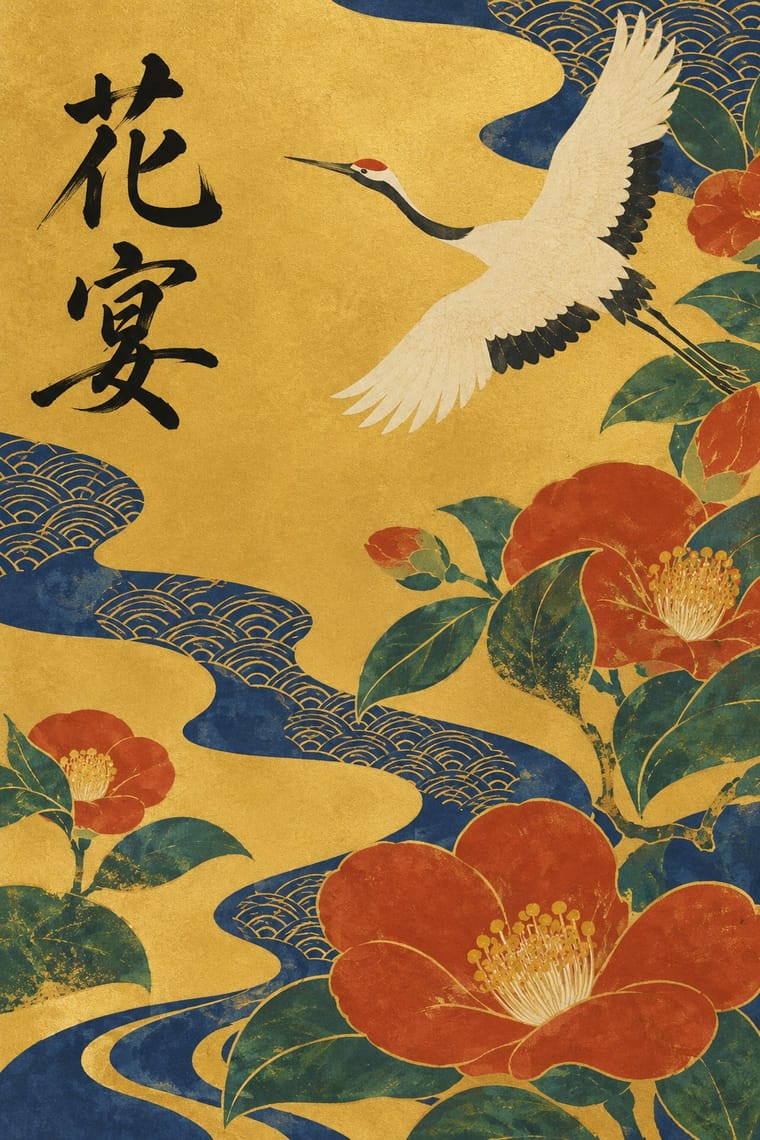
Rinpa & Saga-bon: Poems on Rinpa works and Saga-bon pages are real Japanese texts: have any kana or kanji written or set and checked by a fluent reader, and never fill a design with pseudo-calligraphy as texture. Do not present a generated gold screen as a historical work or as a copy of a named National Treasure. A Kōrin-style plum or wave can be crest-like, but keep it free of any real family's, shrine's or temple's mon.
04
The two styles
05
More combinations
With Gzhel Cobalt Ceramic Painting
- Lubok Popular Print Contrasts · Choose between floral cobalt painting with white reserves and a captioned, contour-led narrative print; a shared Russian context does not establish a parent relationship.
- Arts & Crafts Movement Contrasts · Compare shared floral ornament but distinguish Gzhel's shaded blue strokes and open white ground from the atlas's Kelmscott-oriented heavy type, carved line and compact bordered page; similarity is not descent.
With Rinpa
- Kamon (Japanese Family Crests) Pairs well · Kōrin patterns reduce a plum or a wave to an emblem much as a mon does; pair a crest-like Rinpa motif with a large open ground for packaging, keeping it free of any real family's crest.
- Art Nouveau Pairs well · Kamisaka Sekka was sent to Glasgow in 1901 and came back influenced by Art Nouveau, which he joined to Rinpa subjects; pair Rinpa's cropped irises and waves with Art Nouveau's floral lettering for a botanical label or poster.
- Ma & Wabi-sabi Aesthetics Contrasts · Both come from Kyoto's tea culture (Kōetsu also made Raku tea bowls), but wabi-sabi wants rough clay and empty paper where Rinpa wants gold leaf and malachite; one bare field can serve either, so choose the material that fills it.
- Japanese Postwar Modernism Pairs well · Tanaka Ikkō drew many 1960s–70s posters from Rinpa and has been called a 20th-century Rinpa artist, and in 2015 ten Japanese graphic designers made Rinpa posters, Hara Kenya's on real gold leaf: add a gold ground and a single cropped seasonal motif to a modernist grid for warmth and seasonality.
- Finnish Bold Print (Marimekko Modernism) Pairs well · Both enlarge a plant motif, crop it at the edge and repeat it across cloth; take Rinpa's metallic ground and pooled colour into a bold printed textile.
- Song–Ming Woodblock Book Typography (Songti / Mincho) Contrasts · The Ming/Mincho book letter is upright, separate and set square in a ruled grid; Saga-bon type is flowing kana linked across sorts on decorated paper. Use Mincho for running text and a Saga-bon-like hand for titles and poems.
- Vienna Secession Contrasts · Both set flat figures and pattern on gold, but the Secession locks them into frames and grids while Rinpa leaves the gold open and lets one motif drift across it; decide whether the gold should be a frame or a field.
- Ukiyo-e Woodblock Prints Contrasts · Ukiyo-e carves a keyline, prints in editions for the city and depicts actors and courtesans; Rinpa paints pooled colour on gold for a few patrons and depicts plants, waves and birds. Choose between the street print and the gilded screen before settling a Japanese look.