One of our own styles · made in 2026
Dawn Amphora
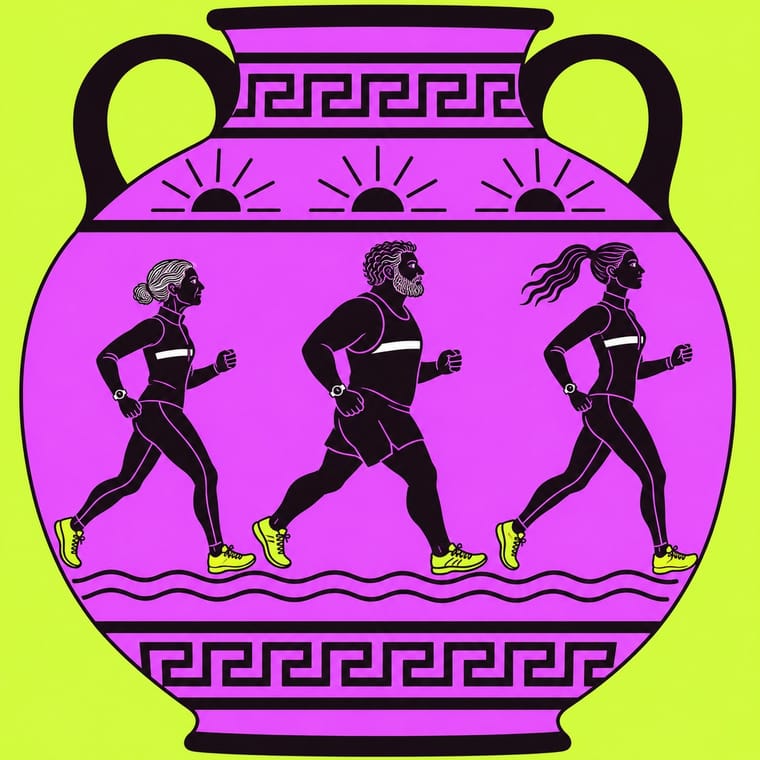
The six o'clock run club painted on clay pots in the black-figure way, because a painted pot was always a picture of people running. Runners from twenty-five to seventy-five, in tights, running tops, head torches and laced running shoes, stand out in gloss black on violet-pink clay, every hem and lace scratched through to the clay; only their shoes shine yellow-green and their reflective strips white. Each picture shows a different vessel, or a different part of one. For run clubs, races, sports shops and physios.
Make something in this style Get advice in this style Mix it with another style
Use it with care
Copy no surviving pot or painter's scene, and leave gods, heroes, myths and ancient athletes out: its runners are people of today, always dressed in running kit. Never make a figure a caricature of age, size or slowness. Its pictures are made by an image model: label them as generated, and never pass one off as an excavated or museum piece.
01
Its picture in other colours
Change a colour and every picture on this page follows. It happens in your browser, from the same pictures: nothing new is made or saved.
Choose a colour to change it
-
#cf63ff -
#120c16 -
#d6ff3a -
#ffffff
A faded colour isn’t in these pictures, so changing it changes nothing.
Light and dark stay where they are; greys hardly move.
More colours: any style’s, or your own
The pictures show the style’s own colours.
02
Make something in this style
Say what you need, and Stylogeny’s image studio draws it from Dawn Amphora’s design choices and checks it against them. It takes about a minute, and you get a link to share.
03
How it works
Palette
-
#cf63ffground · 40% -
#120c16ink · 18% -
#d6ff3aaccent · 13% -
#ffffffaccent · 1%
Shares measured from its 4 pictures. The ground is what the pictures sit on (of the colours covering most, the most neutral), the ink stands out from it most, the rest are accents.
Typefaces
-
No lettering
-
None
a pot's inscription band, where it has one, stays blank
Who is in it. Members of a dawn run club, women and men from twenty-five to seventy-five, tall, short, broad and slight, each in running tights or shorts, a running top and laced running shoes. Every body is the same black, and grey or white hair is drawn as close fine scratched lines through the black, so it reads lighter than dark hair; age shows by hair and posture, never by a stoop or frailty. They do the one task the scene names, calm and capable, eyes open, never posing or looking at us.
Direction
- What it says
- Ordinary early risers get the painted pot that once honoured champions, and on it the slowest and the oldest run as tall as anyone.
- Performance
- Each runner does the scene's one action at their own pace, with their own build and gait, fully dressed in running kit, eyes open and on the way ahead or the task in hand; nobody poses, flexes, waves at us or reacts to being on a pot.
- Set
- Only the place the painted scene names, told in a few flat black signs on the bare clay, and nothing more: no sky colour, no scenery drawn in depth.
- Light
- There is no light in the picture: no shading, highlight or cast shadow on the figures, only flat black and flat clay. A sun, a torch beam or a breath the scene names is drawn in thin black painted lines on the bare clay, and a lit head-torch lamp is a small white dot.
- Camera
- The painted surface is seen square-on and flat, as a catalogue drawing lays it out, the vessel whole or in part as the shot names; never three-quarter, never photographed in a room, on a plinth, under a window or behind glass.
- Frame
- The figures are large and fill the painted field between its black bands, with bare clay between every two of them; a vessel seen whole stands centred on a plain flat yellow-green field with no floor line or shadow.
- Moment
- The middle of the scene's one action, at its fullest, never before it starts or after it is over.
- Finish
- Flat black, even and without sheen or highlight, on bright violet-pink clay, fine scratched lines showing the clay through the black, yellow-green only on shoes and round a vessel seen whole, white only on reflective strips and lamps; the pot new and unchipped, with no grain, crackle, wear, gradient or shading.
- A set of pictures
- A wide of a whole clay storage jar with three runners and a dog on its belly; a medium of a clay bowl's band rolled out flat, three clapping the last one home; a close into a clay cup's round middle, one runner knotting a shoe; a detail of a small clay oil pot's shoulder, one head mid-breath.
- Never
- No runner without running kit, no figure in ancient dress, armour or a wreath, no god, temple or column, no crack, chip, sherd or museum, no two figures or things touching or overlapping, apart from the ground under a foot and what a hand holds, no lettering, logo or brand.
- Every picture is the painted surface of a freshly fired clay pot in the black-figure way, seen square-on and flat: runners and ornament in solid flat black, even and without sheen or highlight, on bright violet-pink clay, and every inner line, a hem, a seam, a lace, an eye, a finger, scratched through the black so the clay shows in a fine line; the pot is whole and new, never cracked, chipped or worn.
- Every runner wears today's running kit, drawn on the black figure by scratched lines: fitted running tights or shorts, a fitted long-sleeved running top or vest, laced running shoes and a wristwatch, with a cap, a headband or a bare head as the scene gives and a head torch only where the scene names one. The running shoes are bright yellow-green and one reflective strip across each runner's top is white; nothing else on a figure has colour.
- Four flat colours only: violet-pink clay, flat black, yellow-green on the shoes and as the plain field round a vessel seen whole, and white on reflective strips and lamps; no shading, gradient, shadow or room. A black meander band runs along at least one edge of every picture. The runners are few and large, and no two figures or things touch or overlap, apart from the ground a foot stands on and what a hand holds: bare clay shows between every runner and thing.
- From across the room a picture reads as a bold black and violet-pink pot painting; a second look finds head torches, laced shoes, a wristwatch and a club of every age, and that this is not the past.
- Scenes vary in the vessel and how much of it is seen, in the action, in the number of runners and in the place: a pack on a jar's belly, a finish on a bowl's band, a lone runner in a cup's round middle, one head on a flask's shoulder.
- The style honours its people: the slowest and the oldest are drawn as tall and as proud as the fastest, and nobody is a joke.
A studio style: made by Stylogeny, not a documented movement.
With an idea put on it
-
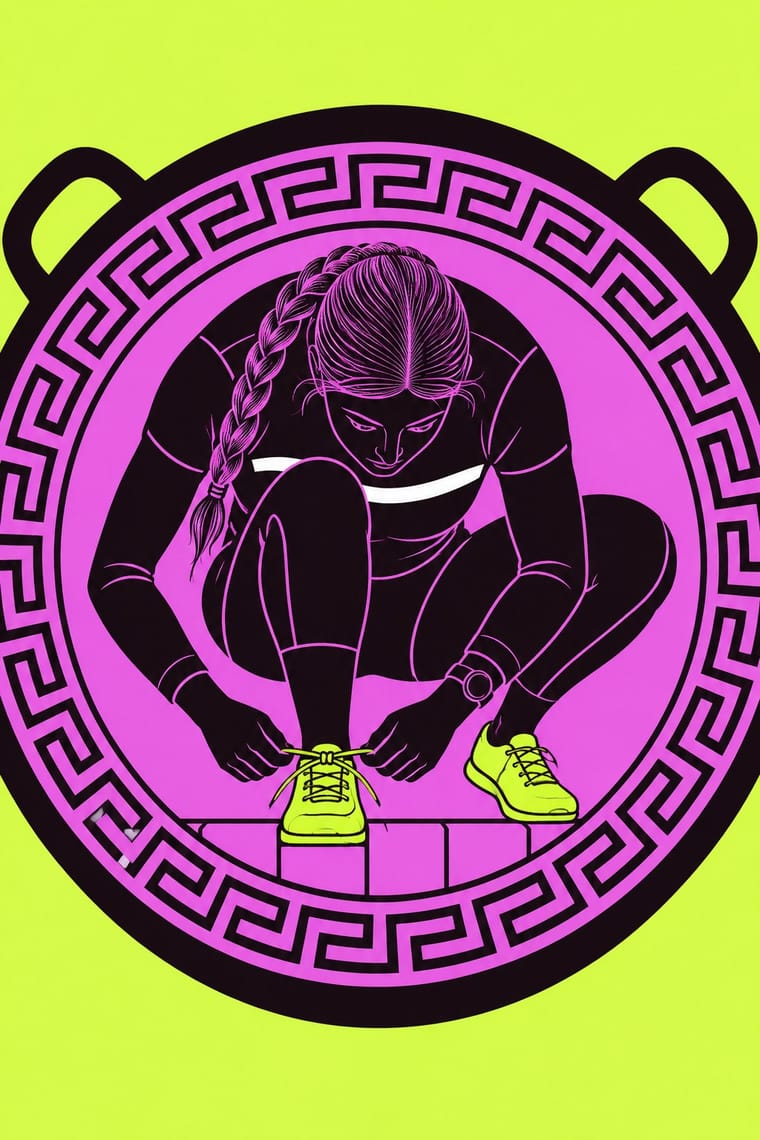
Frame within a frame The round middle of the cup fits her crouch exactly, as if it were made for the knot that starts every run. -
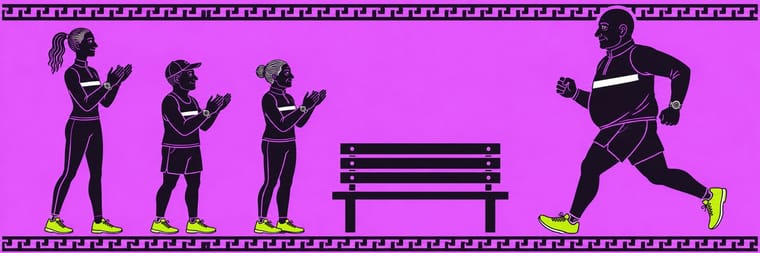
Size by rank The last man home is drawn a head taller than the three who clap him in, as a pot draws its winner. -
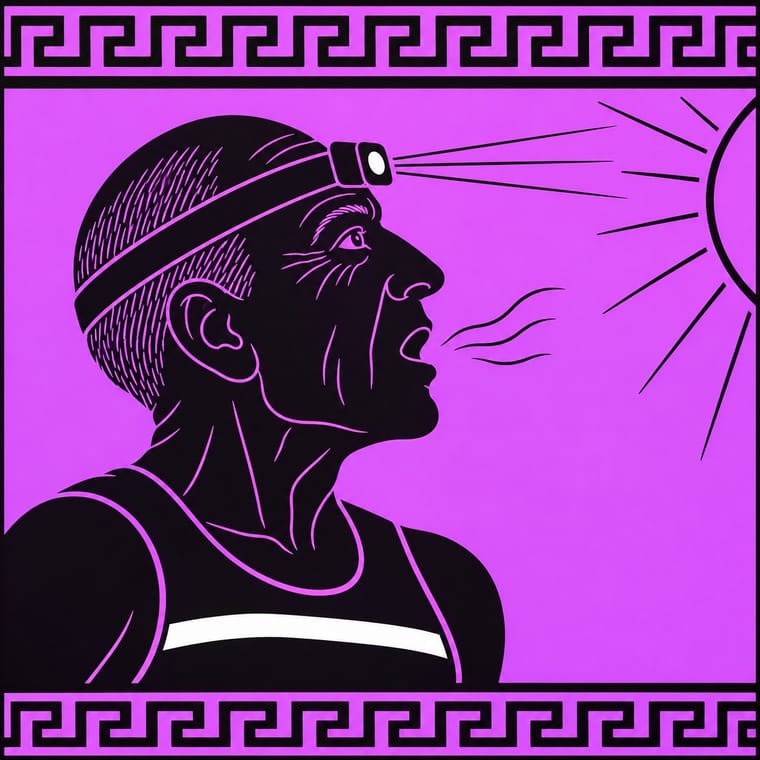
Looking ahead His eye and his head torch point ahead and a little up, to a sun only just rising at the very edge of the pot.
AI-generated: Dawn Amphora with an idea put on it. Not a real or historical work.
Change it with an idea. Any of the 73 moves that make a design say something can go on this style.
04
Its design choices
From Stylogeny’s vocabulary of design choices: defining choices make the style, characteristic ones are usual, occasional ones turn up now and then.
- Layout & composition
- Space & hierarchy
- Typography
- Colour
- Form & shape
- Surface & texture
- Ornament
- Imagery
- Medium & production
- Tone & intent
- Avoids
- Straight photography, 3D render, Chrome & 3D render, Gradients, Illusion of depth
How its pictures are made Drawn & painted, light, viewpoint, pose, made with, figures
Kind of picture: Drawn & painted How they are made, from the questions Stylogeny asks of that kind:
- Light
-
- Flat form defining
- Shadowless defining
- Viewpoint
-
- Flattened planes defining
- Middle distance occasional
- Pose
-
- Side-on profile defining
- Absorbed in a task characteristic
- Fast, full-body movement occasional
- Made with
-
- Brush & ink characteristic
- Engraved & etched line characteristic
- Figures
-
- Silhouette figures defining
- Lifelike proportions characteristic
What new pictures of it show
Subjects Stylogeny draws it with, each taken from a kind of real work the style was made for.
- poster A whole two-handled clay storage jar on a yellow-green field; across its belly a slight grey-haired woman of 75, a broad bearded man of 40 and a tall woman of 25 run a canal path in one line
- art print A clay bowl's painted band rolled out flat: a tall woman of 30, a short man of 50 and a grey-bunned woman of 70 stand by a park bench clapping in the last one home, a stout bald man of 65
- postcard Straight down into the round middle of a wide shallow clay drinking cup: one runner, a woman of forty with a long braid, crouched on a kerb pulling a double knot tight in her running shoe
- album cover The shoulder of a small round clay oil pot, near: head and shoulders of one bald man of seventy in profile, head torch on his brow, mouth open on a breath, a rising sun's rim at the edge ahead of him
- flyer A clay water jar's painted panel: two runners, a tall woman of thirty and a short broad man of fifty-five, refill their bottles side by side at a park drinking fountain
05
What it’s close to
One of our own styles: Stylogeny made it from its own design choices, so no earlier style is claimed.
Dawn Amphora Made 2026
No later style in the atlas grew out of it yet.
Alike in its design choices
06
Often taken for
dawn-amphora has no real works recorded yet, so these are its nearest styles by its choices alone, with the choices that tell them apart.
-
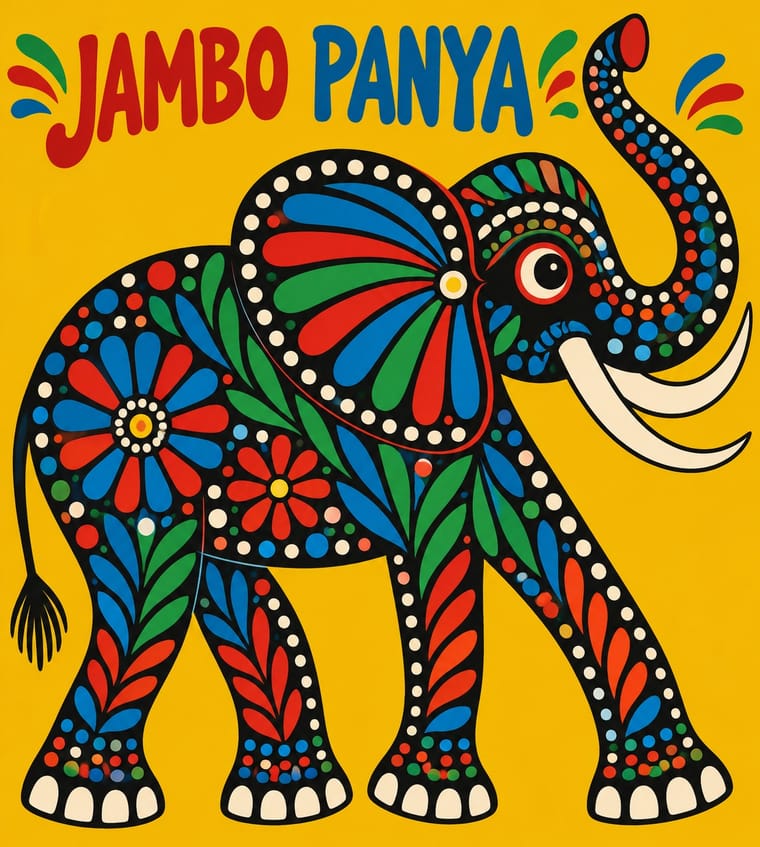
Tingatinga Painting
Tingatinga Painting is one of dawn-amphora’s nearest styles by choices; no real work of either fits the other better.
Choices that tell Dawn Amphora and Tingatinga Painting apart Choice Dawn Amphora Tingatinga Painting Light ground characteristic — Full polychrome — defining Limited spot colours characteristic — Isolated object — defining Fluorescent & neon characteristic — No shared descent in the atlas: they reached these choices separately.
-
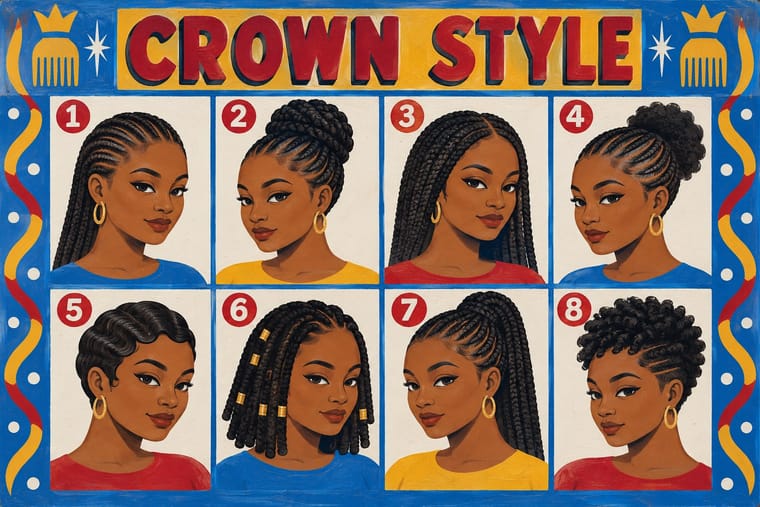
West African Barbershop & Hair Salon Signs
West African Barbershop & Hair Salon Signs is one of dawn-amphora’s nearest styles by choices; no real work of either fits the other better.
Choices that tell Dawn Amphora and West African Barbershop apart Choice Dawn Amphora West African Barbershop Borders & frames defining occasional Modular grid — defining Complementary clash characteristic — Hand-lettering — defining Limited spot colours characteristic — No shared descent in the atlas: they reached these choices separately.
-
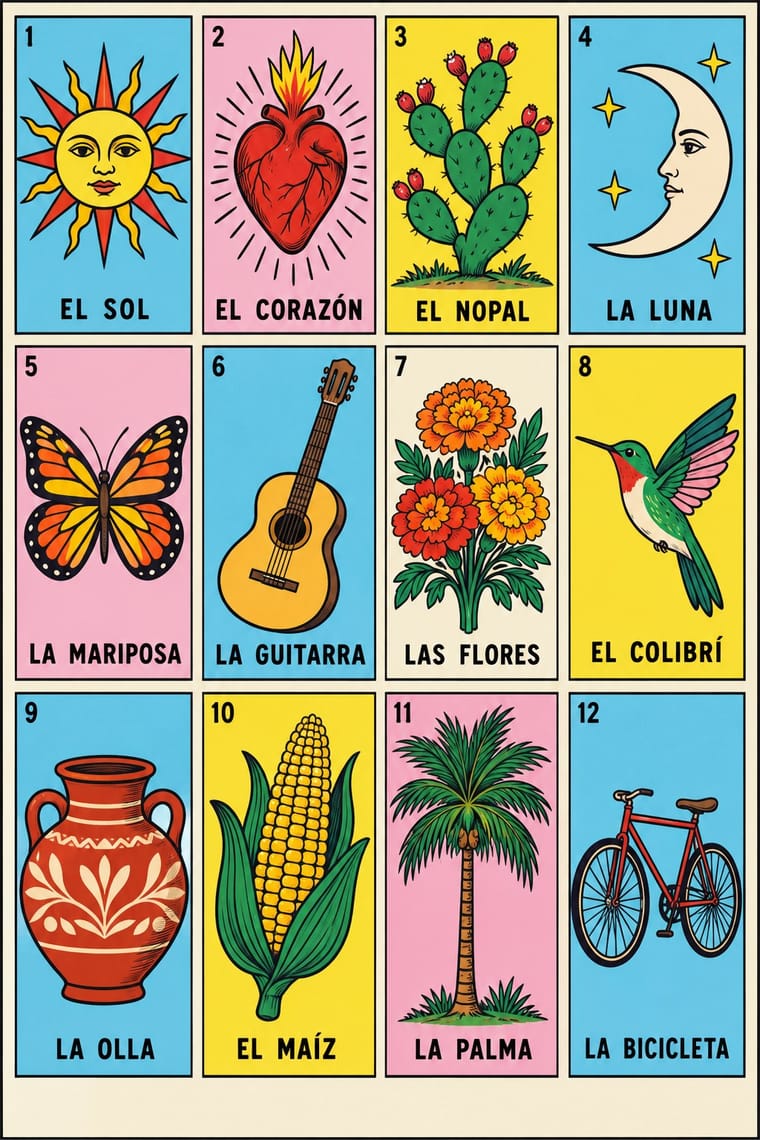
Lotería Card Imagery (Mexican Lotería)
Lotería Card Imagery is one of dawn-amphora’s nearest styles by choices; no real work of either fits the other better.
Choices that tell Dawn Amphora and Lotería Card Imagery apart Choice Dawn Amphora Lotería Card Imagery Sequential narrative occasional avoids Full polychrome — defining Complementary clash characteristic — Framed panels — defining Limited spot colours characteristic — No shared descent in the atlas: they reached these choices separately.
-
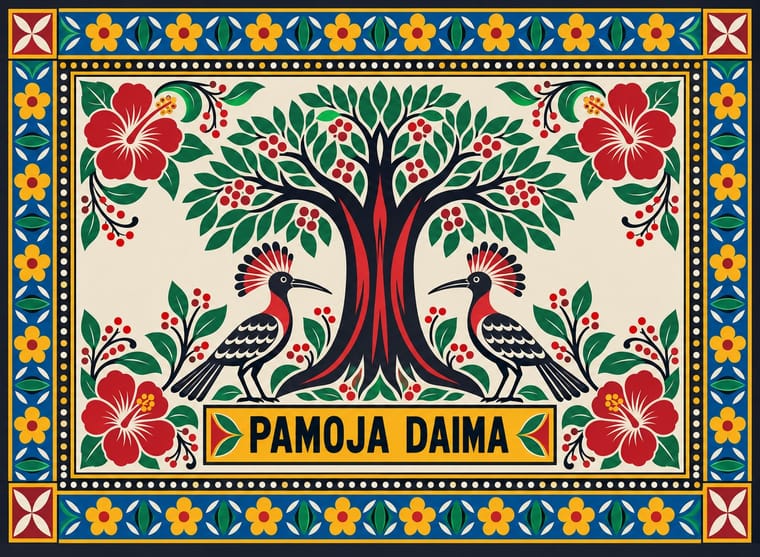
Kanga (Swahili Message Cloth)
Kanga is one of dawn-amphora’s nearest styles by choices; no real work of either fits the other better.
Choices that tell Dawn Amphora and Kanga apart Choice Dawn Amphora Kanga Full bleed occasional avoids Framed panels — defining Complementary clash characteristic — Central symmetry occasional defining Fluorescent & neon characteristic — No shared descent in the atlas: they reached these choices separately.
— means the choice isn’t among the style’s recorded choices. Critics recorded each work’s choices with the styles’ descriptions in view, so this shows whether the descriptions hold together, not proof that they are right.