One of our own styles · made in 2026
Corner Shop Mosaic
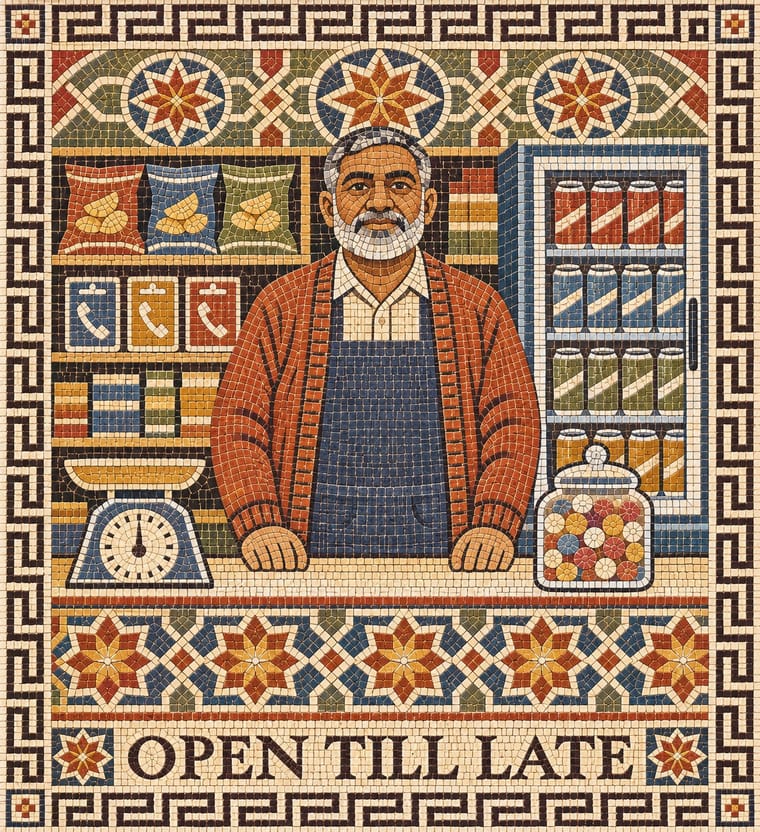
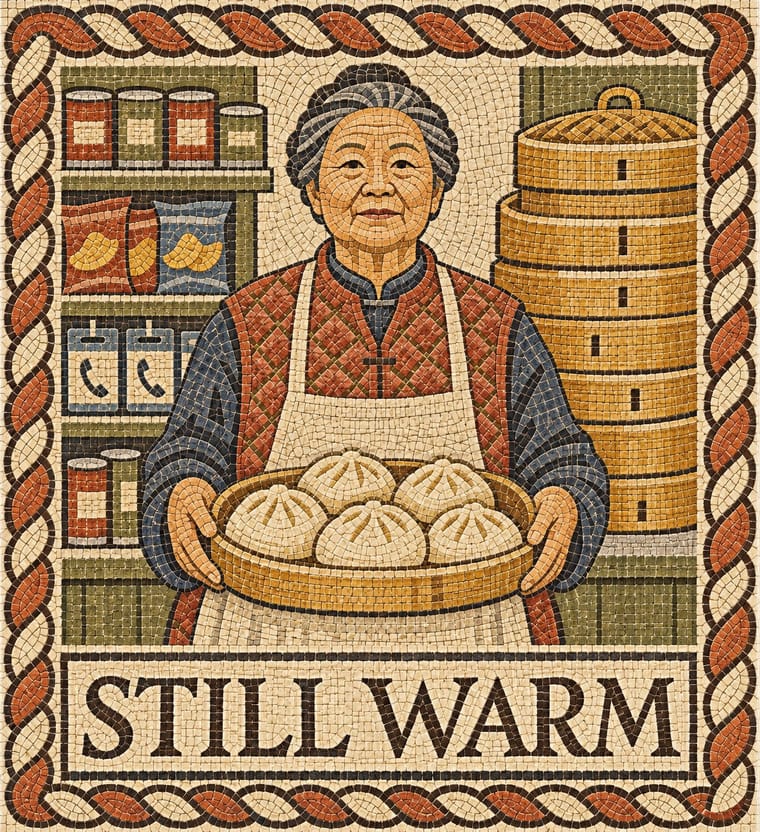
The people behind the counter, laid as a Roman floor mosaic. Small square stone tiles in limestone white, terracotta, ochre, olive and black build the shopkeeper, the fridge of cans, the kebab spit and the crates of oranges, inside a border of meander or twisted rope, with one short line of capitals in a panel below. The floor is seen flat from above and runs to the edge of the sheet. Each figure faces us with the gravity a Roman floor gave a charioteer.
Make something in this style Get advice in this style Mix it with another style
Use it with care
Copy no surviving Roman floor: invent every border and figure. Its sitters are working people of every background, shown with respect, never as a type or a joke about where they come from, and never a real person or a real shop's name. Its pictures are made by an image model: label them as generated and never pass one off as an ancient or a hand-laid mosaic.
01
More pictures in this style
8 pictures, AI-generated from its design choices: none is a real or historical work.
1 of 7
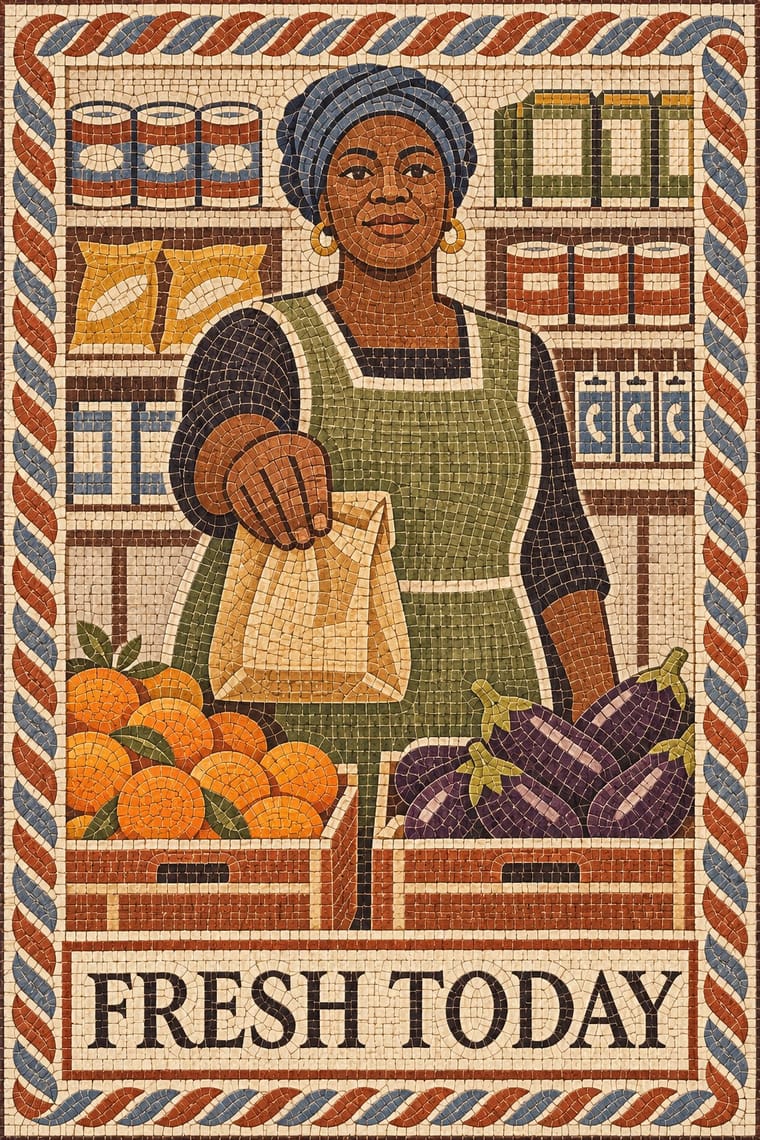
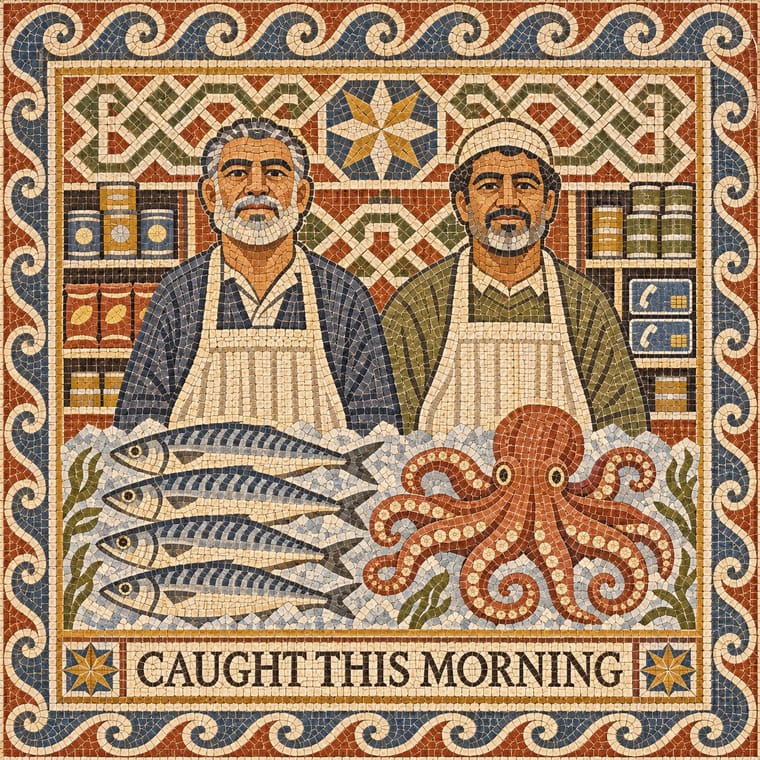
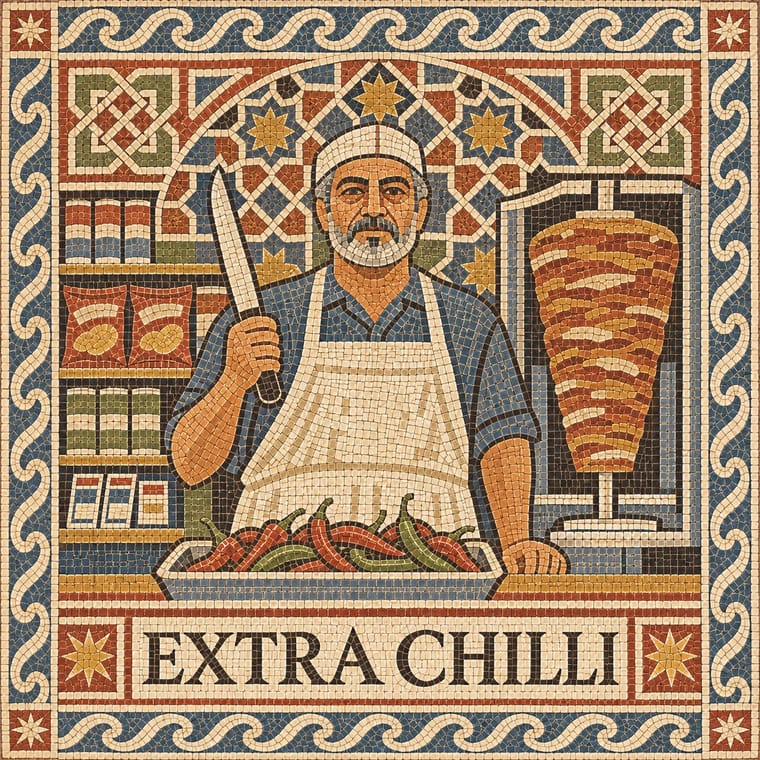
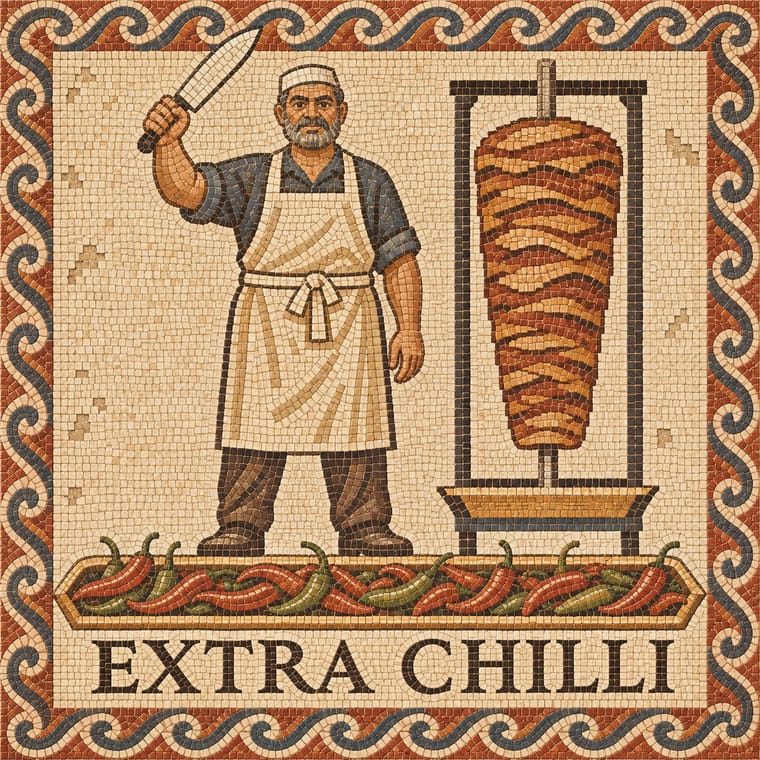
Try other colours
Change a colour and every picture on this page follows. It happens in your browser, from the same pictures: nothing new is made or saved.
Choose a colour to change it
-
#e9dfc8 -
#b5553a -
#2f2a26 -
#8a8f6a -
#c9a24a -
#6d8fa3
A faded colour isn’t in these pictures, so changing it changes nothing.
Light and dark stay where they are; greys hardly move.
More colours: any style’s, or your own
The pictures show the style’s own colours.
02
Make something in this style
Say what you need, and Stylogeny’s image studio draws it from Corner Shop Mosaic’s design choices and checks it against them. It takes about a minute, and you get a link to share.
03
How it works
Palette
-
#e9dfc8accent · 14% -
#b5553aaccent · 15% -
#2f2a26ink · 4% -
#8a8f6aaccent · 6% -
#c9a24aground · 18% -
#6d8fa3not in its pictures
Shares measured from its 14 pictures. The ground is what the pictures sit on (of the colours covering most, the most neutral), the ink stands out from it most, the rest are accents.
Typefaces
-
Cinzel
-
Roman inscription capitals laid in dark tiles, one short line in a panel under the figure
Who is in it. The people behind the counter: corner-shop keepers, market traders, kebab cooks, bakers, fishmongers and launderette attendants, of every background, forty and older, in aprons, cardigans and tabards. Each faces us, still and unsmiling or half-smiling, holding or standing beside what they sell, with the dignity a Roman floor gave a charioteer. A different person every time, never a caricature.
Direction
- What it says
- The people who keep a street fed and washed are given the floor Rome gave its champions.
- Performance
- Each keeper stands still and faces us, weight on both feet, holding the tool or the goods of the trade as an emblem. Half a smile at most; nobody serves, bows or jokes.
- Set
- The trade reduced to the few emblems the scene names, laid on one flat ground of pale stone with no room and no depth.
- Light
- None is laid: no cast shadow and no shine. Shading is two or three tones of the same stone in stepped bands along one side of a form.
- Camera
- The floor is seen flat from straight above and fills the sheet. Within it the keeper stands frontal, full, three-quarter or half length, as on a Roman panel.
- Frame
- One border, then the keeper in the middle with the scene's goods ranged at both sides like attributes, and the panel of capitals under the feet.
- Moment
- A pose held for two thousand years: whatever the keeper is doing is done for good.
- Finish
- Small square stone tiles with pale grout, rows that follow every outline, stepped edges, a few worn or missing tiles, in limestone, terracotta, ochre, olive, slate blue and black.
- A set of pictures
- A set has three keepers full length, two at half length close enough to read the face, one pair, and one panel with nobody in it.
- Never
- No star, rosette or interlace, no bright or shiny colour, no room in perspective, no caricature, no joke at a keeper's cost, no real shop name.
- Lay the whole picture in small square stone tiles with pale grout between them, as a Roman floor mosaic: the tiles follow the outlines of figures and things in curving rows and fill the ground in straight rows or fans, and every edge is stepped, never smooth.
- Keep to stone colours: limestone white, terracotta, ochre, olive, slate blue and black, with a few tones of each for shading, and no bright or shiny colour. Cans, crisps and phone cards are made of the same stone.
- Frame the scene with one border of Roman meander, wave or twisted rope, and use no other ornament: no stars, rosettes, interlace or patterned panels. Set one short line of Roman capitals in dark tiles in a panel under the scene. The floor runs to the edge of the sheet, seen flat from straight above, with no room, wall or cast shadow.
- Give today's trade a Roman floor's gravity: the fridge, the scales, the kebab spit and the lottery stand are laid as carefully as a charioteer's horses, and nothing is a joke at the keeper's cost.
- Vary the trade and the border: a corner shop, a market stall, a kebab counter, a bakery, a launderette, a fishmonger; one keeper, two together, or only the shop cat.
- Leave a few tiles missing, or mended in another stone, as an old floor would be.
A studio style: made by Stylogeny, not a documented movement.
With an idea put on it
-
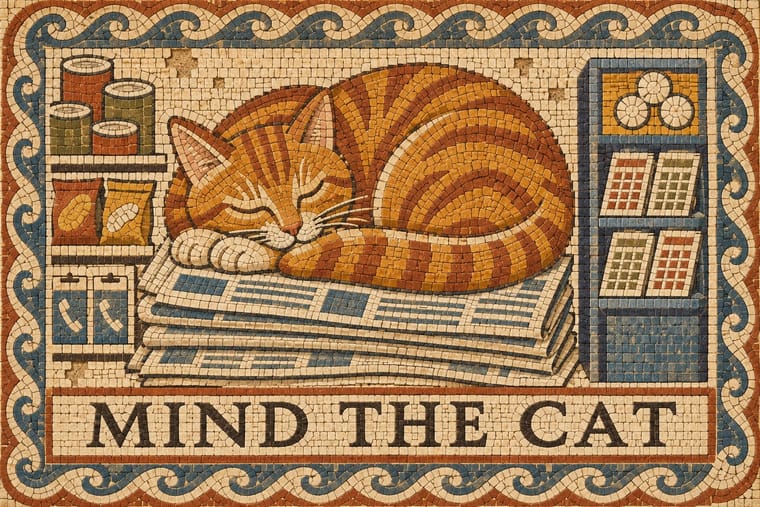
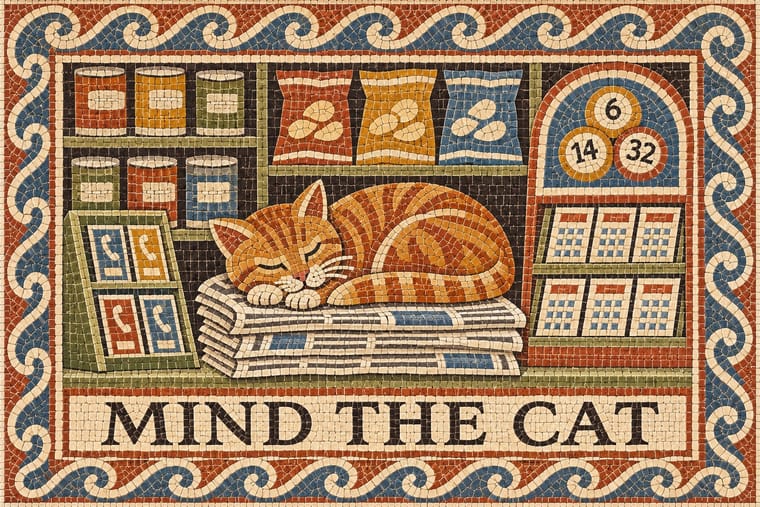
Replacement Where every other floor has its keeper this one has the cat, asleep in the keeper's place. -
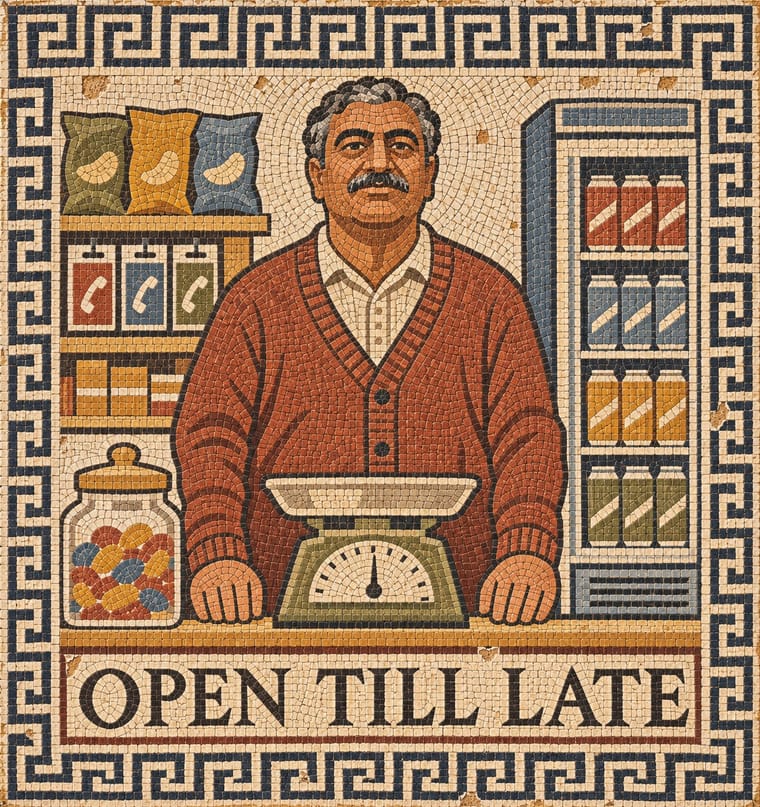
Size by rank He is laid larger than his fridge and his counter, as a Roman floor made its champion larger than his horses. -
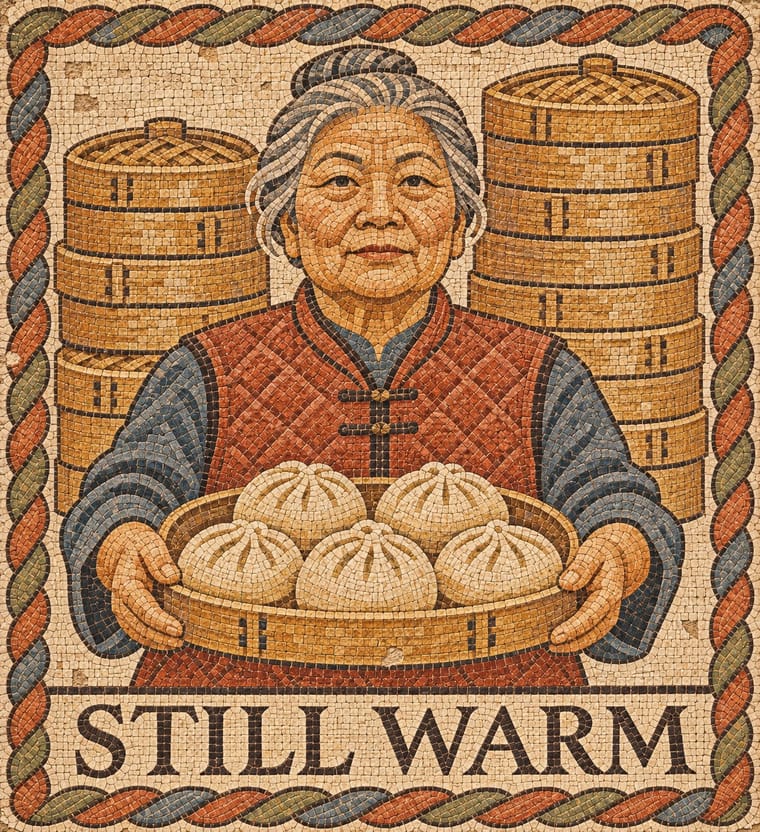
Eye contact She looks straight up out of the floor at whoever walks over it, and offers a bun. -
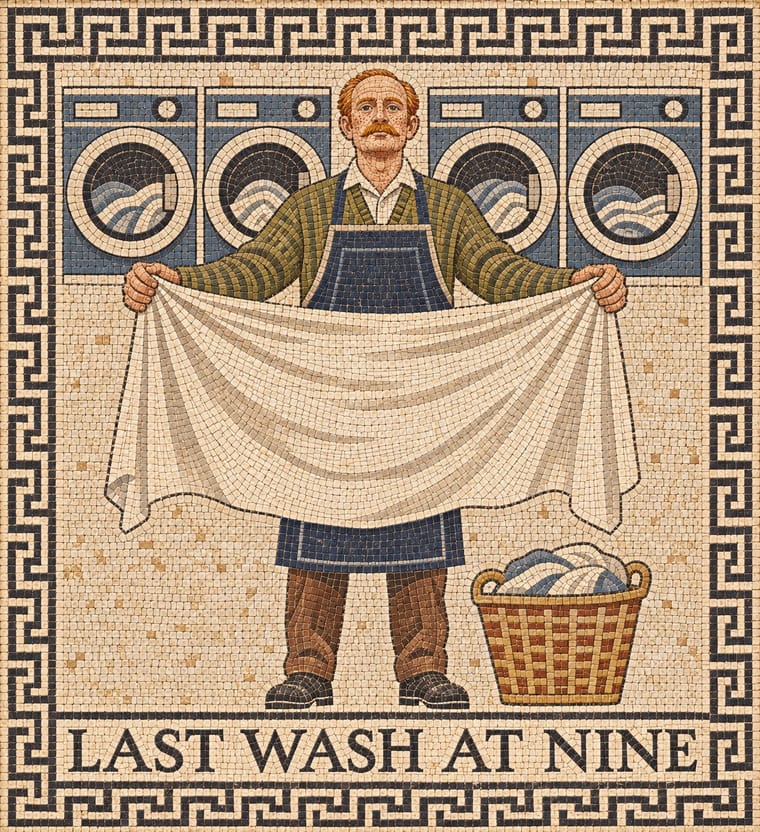
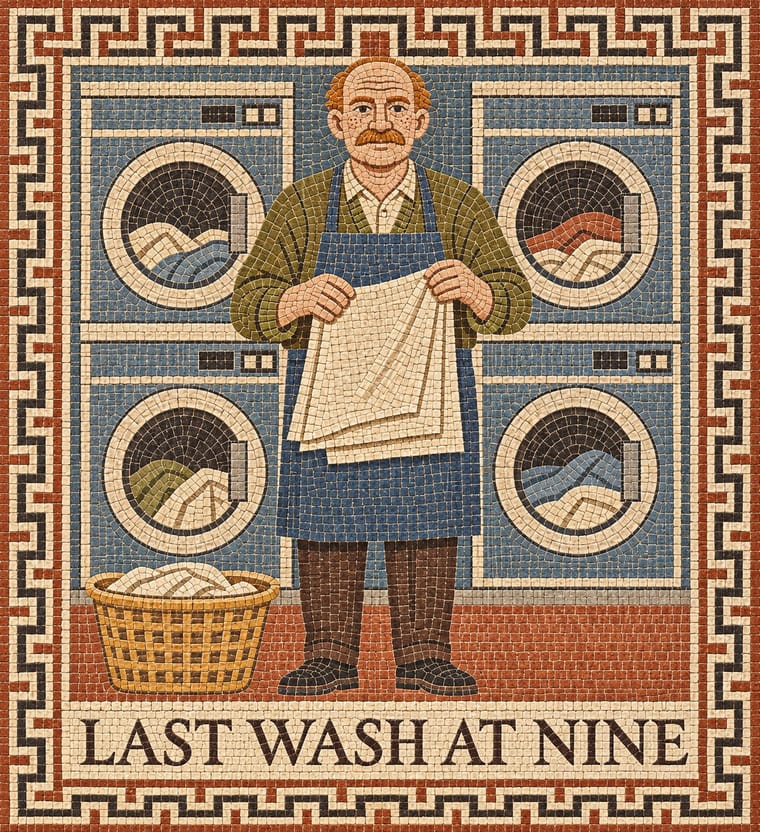
Visual rhyme Four round machine doors hang behind him like the shields on a Roman frieze. -
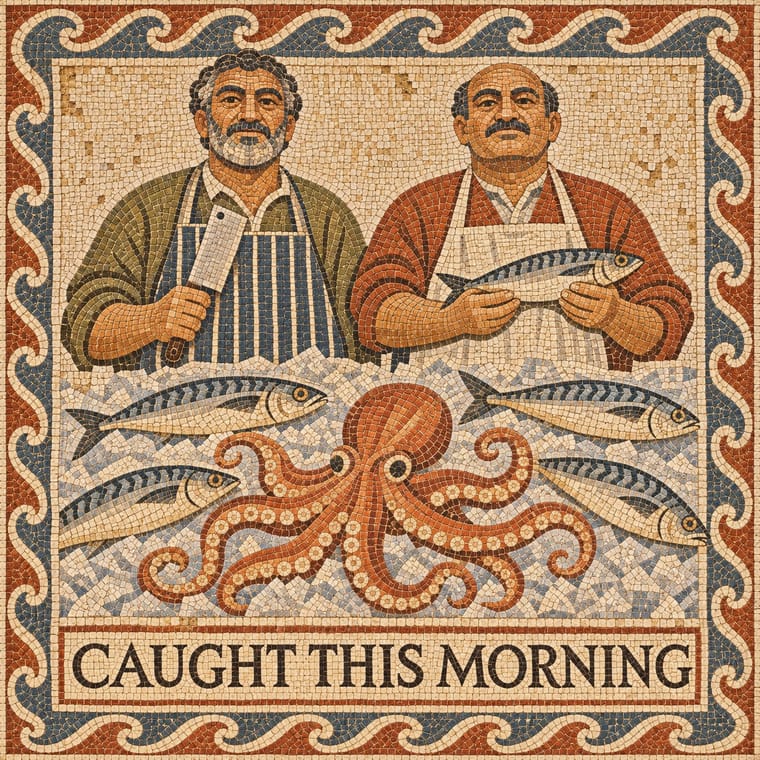
Quoting a famous image The fish on the ice are laid as Rome laid a sea floor, so the oldest subject in mosaic is this morning's catch. -
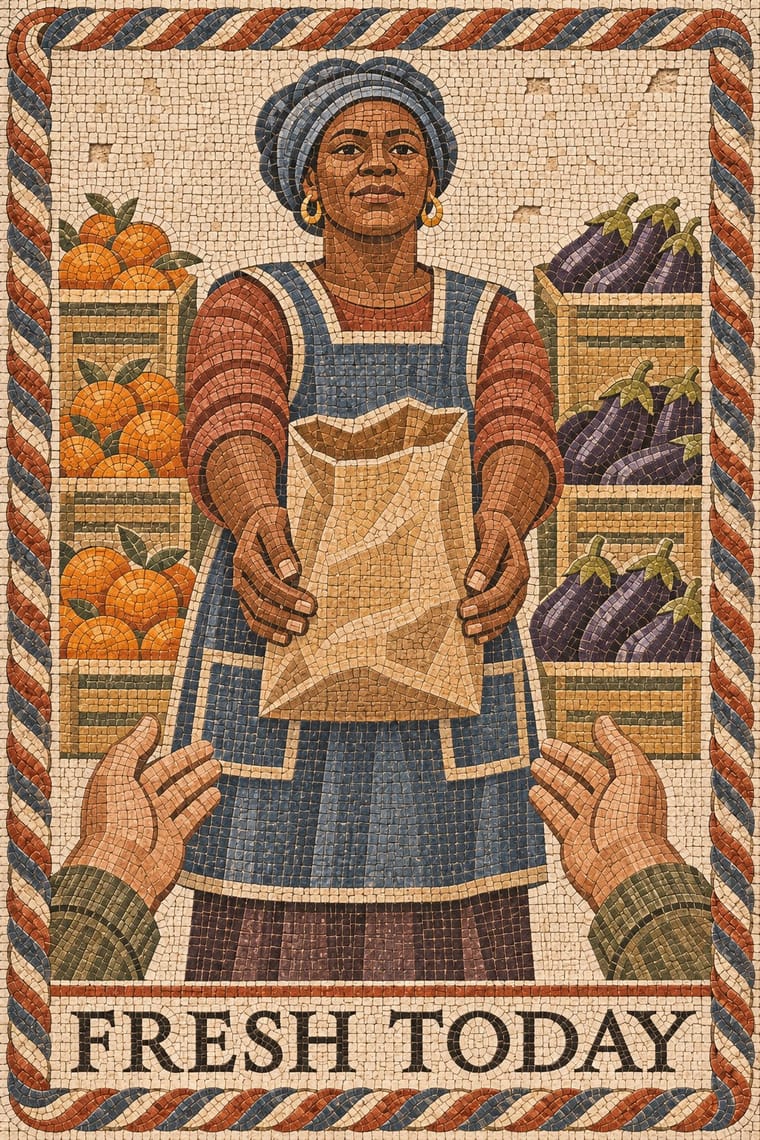
Point of view The bag is held out of the floor toward us, so whoever stands on it is the customer.
AI-generated: Corner Shop Mosaic with an idea put on it. Not a real or historical work.
Change it with an idea. Any of the 73 moves that make a design say something can go on this style.
04
Its design choices
From Stylogeny’s vocabulary of design choices: defining choices make the style, characteristic ones are usual, occasional ones turn up now and then.
- Layout & composition
- Space & hierarchy
- Typography
- Form & shape
- Surface & texture
- Medium & production
- Tone & intent
- Avoids
- Fluorescent & neon, Gradients, Gloss & highlights, Chrome & 3D render, Straight photography, Ornament-free
How its pictures are made Drawn & painted, light, viewpoint, pose, made with, figures
Kind of picture: Drawn & painted How they are made, from the questions Stylogeny asks of that kind:
- Light
-
- Flat form defining
- Shadowless defining
- Viewpoint
-
- Flattened planes defining
- Eye level characteristic
- Middle distance characteristic
- Pose
-
- Shoulders square to the camera defining
- Standing straight characteristic
- Eyes to the lens characteristic
- Stiff & held still characteristic
- Neutral face occasional
- Made with
-
- Mosaic, tile & inlay defining
- Figures
-
- Flat, frontal & hieratic defining
- Stock type & fixed likeness occasional
What new pictures of it show
Subjects Stylogeny draws it with, each taken from a kind of real work the style was made for.
- poster A corner-shop keeper in a cardigan behind his counter, a fridge of cans at his side, scales and a jar of sweets in front, inside a meander border
- record sleeve A kebab cook in an apron beside the turning spit, knife raised, a tray of chillies below, inside a wave border
- book cover A tall Black woman of fifty in a tabard among crates of oranges and aubergines, holding out a paper bag, inside a twisted-rope border
- magazine cover A pale, freckled man of sixty with a ginger moustache folding a sheet before four washing machines, a basket at his feet, inside a meander border
- postcard A ginger shop cat asleep on a stack of newspapers beside a lottery stand, with no person anywhere in the panel, inside a wave border
- poster A small Chinese grandmother in a quilted waistcoat holding a tray of steamed buns before a stack of bamboo steamers, inside a twisted-rope border
- album cover Two brothers behind a fishmonger's slab of ice, mackerel and an octopus laid out like a Roman sea floor, inside a wave border
05
What it’s close to
One of our own styles: Stylogeny made it from its own design choices, so no earlier style is claimed.
Corner Shop Mosaic Made 2026
No later style in the atlas grew out of it yet.
Alike in its design choices

06
Often taken for
corner-shop-mosaic has no real works recorded yet, so these are its nearest styles by its choices alone, with the choices that tell them apart.
-
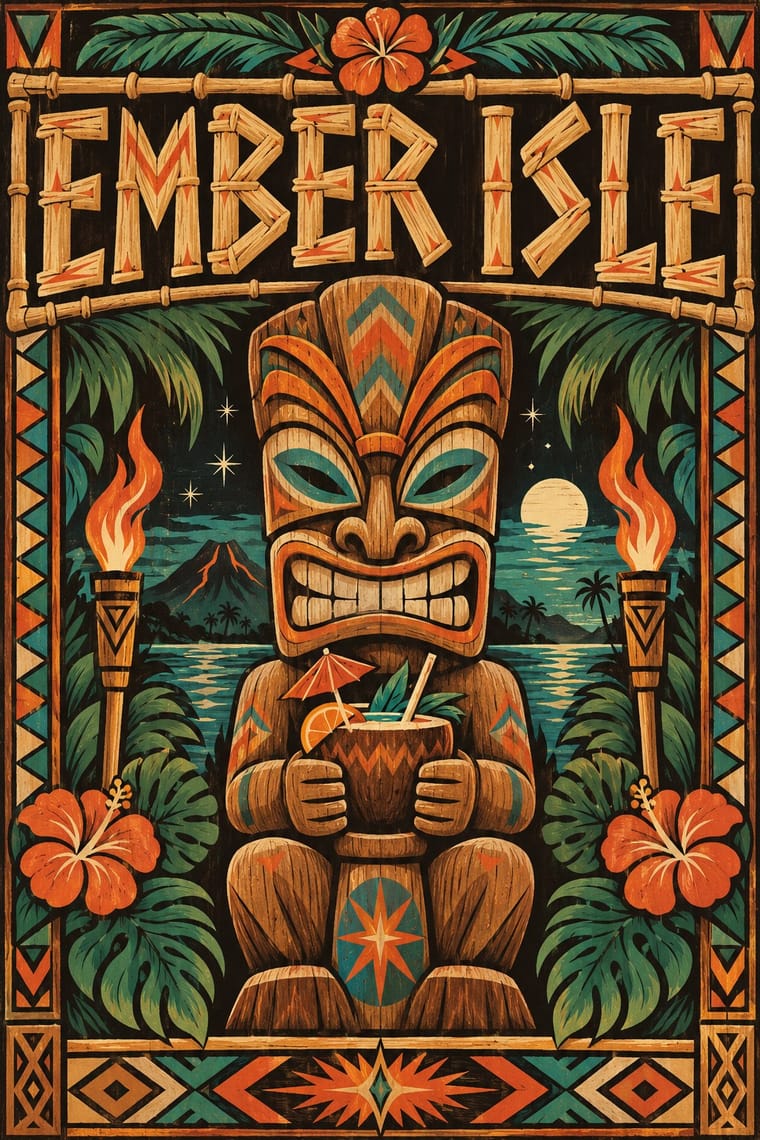
Tiki Pop (Polynesian Pop)
Tiki Pop is one of corner-shop-mosaic’s nearest styles by choices; no real work of either fits the other better.
Choices that tell Corner Shop Mosaic and Tiki Pop apart Choice Corner Shop Mosaic Tiki Pop Rectilinear characteristic — Folk & sacred symbols — defining Flat vector illustration characteristic — Ornamented display — defining Measured density characteristic — No shared descent in the atlas: they reached these choices separately.
-
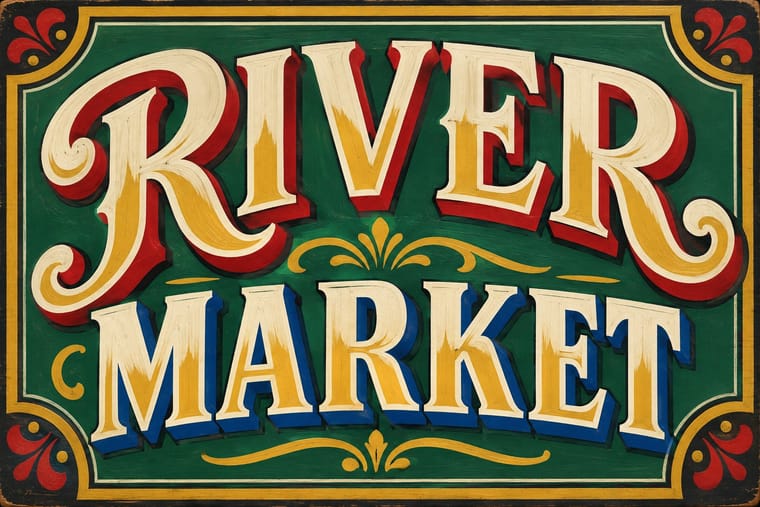
Hand-Painted Signage & Vernacular Lettering
Hand-Painted Signage & Vernacular Lettering is one of corner-shop-mosaic’s nearest styles by choices; no real work of either fits the other better.
Choices that tell Corner Shop Mosaic and Hand-Painted Signage apart Choice Corner Shop Mosaic Hand-Painted Signage Earth & mineral defining — Hard offset shadow — defining Stylised figuration defining occasional Hand-lettering — defining Light ground characteristic — No shared descent in the atlas: they reached these choices separately.
-
WPA Silkscreen Posters
WPA Silkscreen Posters is one of corner-shop-mosaic’s nearest styles by choices; no real work of either fits the other better.
Choices that tell Corner Shop Mosaic and WPA Silkscreen Posters apart Choice Corner Shop Mosaic WPA Silkscreen Posters Borders & frames defining — Flat fields — defining Rectilinear characteristic — Isolated object — characteristic Full bleed characteristic — No shared descent in the atlas: they reached these choices separately.
-
Colonial Maghreb Tourism Poster
Colonial Maghreb Tourism Poster is one of corner-shop-mosaic’s nearest styles by choices; no real work of either fits the other better.
Choices that tell Corner Shop Mosaic and Colonial Maghreb Tourism Poster apart Choice Corner Shop Mosaic Colonial Maghreb Tourism Poster Borders & frames defining occasional Flat fields — defining Light ground characteristic — Flat — defining Skeuomorphic material characteristic — No shared descent in the atlas: they reached these choices separately.
— means the choice isn’t among the style’s recorded choices. Critics recorded each work’s choices with the styles’ descriptions in view, so this shows whether the descriptions hold together, not proof that they are right.