Traditions & vernacular · 1887–present · Latin America & Caribbean, North America
Lotería Card Imagery (Mexican Lotería)
Also known as Lotería mexicana, Don Clemente lotería, Lotería cards and tablas
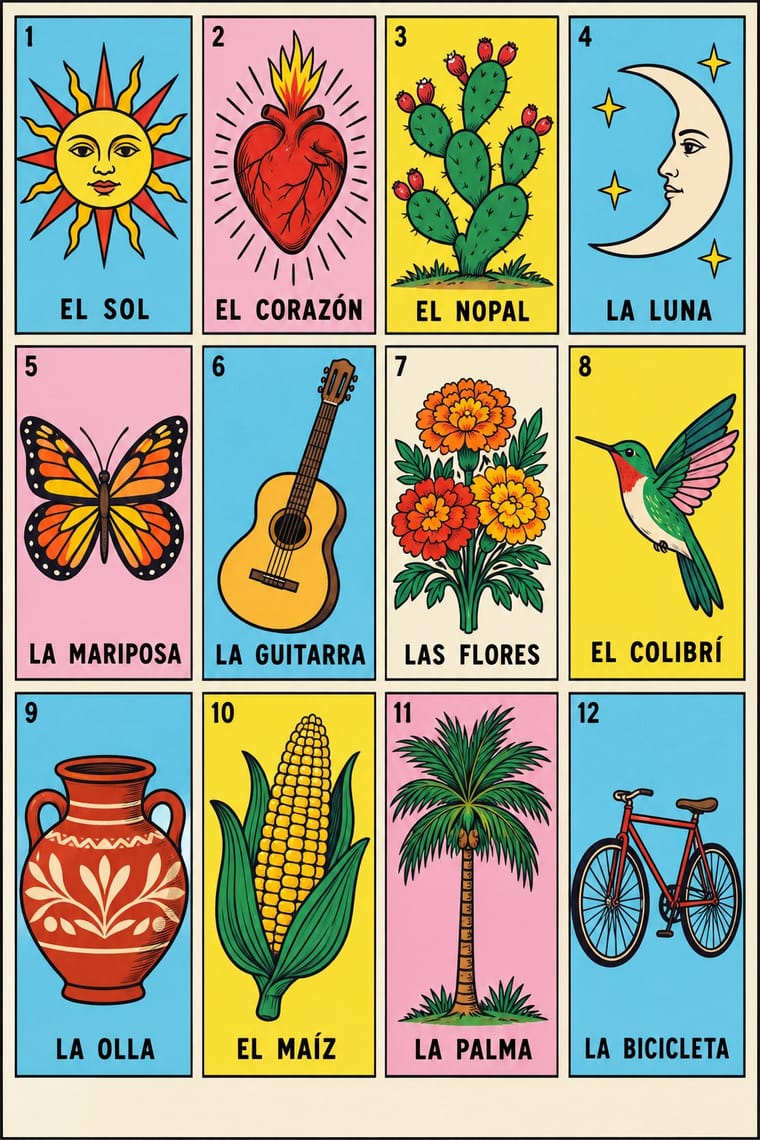
The picture deck of Mexico's lotería, a bingo-like game of chance. Clemente Jacques's 54-card deck, published from 1887 and known in today's version since the early 1920s, set the canon: one figure or object per card (El Gallo, La Sirena, La Muerte), usually on a pale tinted ground in a ruled frame, a small number at the top and its name in capitals at the foot. A standard tabla sets 16 of them in a 4 × 4 grid, marked with beans as the caller draws cards and sings verses. Chicano artists, designers and parody decks keep redrawing the set.
Make something in this styleGet advice in this styleMix it with another style
Use it with care
Lotería is a living family game, played across Mexico and much of the United States and in parts of Central America, and a marker of Mexican and Mexican-American identity, so do not use it as generic 'Mexican' party decoration for products with no tie to those communities, and commission and credit Mexican, Central American and Chicanx artists when you redraw it. The standard deck's nine human figures are all stereotypes of Indigenous people, upper-class white people and Afro-Latinos (TIME, citing Gloria Arjona), most plainly El Negrito (No. 26) and El Apache (No. 38), stock figures of a Black man and a Native American, and other decks carry the same kind of figure (the feathered Indio with bow and arrow on Lomas Garza's 1972 tablas): do not reproduce them as period charm; replace them, as new decks freely do. The owners of Don Clemente Gallo (Pasatiempos Gallo) hold the registered trademark of the original images, so draw new emblems rather than tracing them, and write card names in correct Spanish instead of mock-Spanish.
01
How it works
- Give each card one emblem: a single figure, animal, plant or object, shown whole in its most recognisable view (people frontal, animals mostly in profile or from above), on a flat tinted ground inside a ruled frame, with at most a strip of setting (a tiled floor, a doorway, reeds in water; La Chalupa's canal fills its whole card) and never a story around it.
- Number the card in small figures at the top left and name it at the foot, in the Don Clemente standard in plain, letterspaced capitals with its article (EL GALLO, LA SIRENA, LA MUERTE), so that picture, word and the caller's verse all point to one thing.
- Design the set as a closed system of emblems (54 in the standard deck) that mixes people, animals, plants, tools, instruments and heavenly bodies, all drawn in one hand and each scaled to fill its card whatever its real size (a shrimp or a scorpion as large as a soldier), so that any card can sit beside any other.
- Lay out the tabla as a grid of equal cells with no cell given precedence: 4 × 4 in the Don Clemente standard, 5 × 5 with bingo-style column numbering on the 75-card set Carmen Lomas Garza etched in 1972. Give each card its own fixed pale ground tint (sky blue, lemon, pink, cream), so that each board, a chance selection of cards, reads as a patchwork of colour.
- Draw with a firm dark outline and fine hatched modelling under clean, saturated colour, closer to commercial print illustration than to a flat cartoon, so each emblem reads at arm's length across a table and still rewards a close look.
- To make a new deck, keep the frame, number, name and grid and replace the emblems, as artists' and parody decks do (La Selfie, El Emoji), rather than tracing the Don Clemente drawings.
Mexico: a picture game of Italian origin, brought to New Spain in 1769, whose standard 54-card deck the French-born businessman Clemente Jacques began publishing in 1887 (the version known today traces to the early 1920s, according to the researcher Gloria Arjona); also played in parts of Central America, carried north with Mexican-American communities and redrawn by Chicano artists and designers in the United States
02
Its design choices
From Stylogeny’s vocabulary of design choices: defining choices make the style, characteristic ones are usual, occasional ones turn up now and then.
- Layout & composition
- Space & hierarchy
- Typography
- Colour
- Surface & texture
- Ornament
- Imagery
- Medium & production
- Tone & intent
- Avoids
- Horror vacui, Sequential narrative, Collage & layering, Dynamic asymmetry, Diagonal axis, Lowercase only, Experimental & distorted, Straight photography, Non-representational, Abundant decoration
Palette
#f4efe2#86c8e6#f4dd3c#f2bfd3#c62f2a#1d1d1b
Typefaces
Plain, letterspaced sans-serif capitals with the article for the card names at the foot of each Don Clemente card
EL CAMARON, LA ROSA; the classic printing drops the accents
Small numerals at the top left of each card
No. 1 to No. 54
Display capitals reading 'LOTERIA' and 'TABLA' with the board number and the maker's imprint in the header of each Pasatiempos Gallo tabla
Mixed-case lettered names without articles (Sol, Luna, Víbora, Rosita) on other decks, such as the one Carmen Lomas Garza etched in 1972
Hand-drawn capitals on homemade tablas and artists' redrawn decks
Known for
The Don Clemente deck of 54 cards
published by Clemente Jacques from 1887 and said to have been handed out to Mexican soldiers with their rations; its 'Don Clemente Gallo' edition was copyrighted in Mexico in 1913, and the version known today traces to the early 1920s according to Gloria Arjona (Wikipedia; Google Doodles; TIME)
Cards No. 1 El Gallo, No. 6 La Sirena, No. 14 La Muerte, No. 23 La Luna and No. 46 El Sol from the standard deck
Wikipedia
Pasatiempos Gallo tablas
4 × 4 grids of numbered, named cards on sky-blue, lemon, pink and cream grounds under a 'LOTERIA … TABLA 3' header with the Gallo logo and the imprint 'Hecho en México por Pasatiempos Gallo, S.A. de C.V.', set out with maize kernels in the toy room of the Museo de Culturas Populares, Centro Cultural Mexiquense, Toluca (Wikimedia Commons, 'ToyRoomToluca10.JPG'); and Don Clemente cards on home-made 4 × 4 boards (Wikimedia Commons, 'Loteria boards.jpg')
José Guadalupe Posada, Juego de lotería, printed in Mexico City between 1901 and 1920
Library of Congress, Prints and Photographs Division
Carmen Lomas Garza, Lotería–Primera Tabla, Segunda Tabla and Tercera Tabla, 1972, colour etchings
(Smithsonian American Art Museum 1995.25.1–3): three 5 × 5 tablas that together set out a 75-card deck numbered in bingo-style columns (1–5, 16–20 … 61–65 on the first), sharing many figures with the Don Clemente deck (Sol, Luna, Gallo, Corazón, Muerte) and lettered in mixed case without articles (Navío, Trompa, Víbora, Rosita) on soft violet, mint, yellow, grey, pink and orange grounds
Artemio Rodríguez, La Lotería, twelve black-and-white linocuts, 1995–1998, laying out cards in a grid like a tabla and mixing traditional figures with new ones such as La Migra and El Zapatista (Library of Congress; Katherine Blood, LOC blog, 2016)
Teresa Villegas, Nuevo Lotería, a deck of her paintings published by Don Clemente Gallo alongside the traditional set in 2001 and produced until 2008 (artist's account)
Mike Alfaro, Millennial Lotería, begun as an Instagram account in 2017, with new cards such as La Hashtag, La Feminist and La Selfie
Wikipedia; TIME
03
Make something in this style
Say what you need, and Stylogeny’s image studio draws it from Lotería Card Imagery (Mexican Lotería)’s design choices and checks it against them. It takes about a minute, and you get a link to share.
04
Where it comes from, and what it’s close to
Before it
The style it grew out of, and the styles it borrowed from.
Nothing earlier is recorded: in the atlas it is a starting point.

After it
The styles that grew out of it.
No later style in the atlas grew out of it yet.
Alike in its design choices
Styles that make many of the same choices, related or not, besides those above.


05
Sources
- Wikipedia: Lotería (a game of Italian origin brought to New Spain in 1769; Don Clemente Jacques began publishing the game in 1887, distributed to soldiers with their rations; each card has an image, its name and a number; tabla of a 4 × 4 grid; 54 cards; cantor; list of the 54 cards including No. 26 El negrito and No. 38 El Apache; a Catholic deck of the 1930s; Mike Alfaro's Millennial Lotería, 2017; Google Doodle of 9 December 2019 adding El buscador, El ajolote and El emoji): https://en.wikipedia.org/wiki/Loter%C3%ADa
- Google Doodles, 'Celebrating Lotería', 9 December 2019 (origin in 15th-century Italy, to Spain, reaching Mexico in 1769; 'One of the best known versions was created in Mexico by Frenchman Clemente Jacques in 1887'; the 'Don Clemente Gallo' edition copyrighted in Mexico in 1913; guest artists Chabaski, Cecilia Ruiz, Luis Pinto, Loris Lora and Vals): https://doodles.google/doodle/celebrating-loteria/
- Jasmine Aguilera, "'It Needed to Be Modernized.' The Artists Recreating Lotería, the Iconic Mexican Game of Bingo", TIME, 24 December 2020 (Clemente's images appear 'throughout Mexico, Central America and many parts of the U.S.'; Mike Alfaro, from Guatemala, recalls playing it with his family; Gloria Arjona, Caltech lecturer: 'The version that we know today can be traced back to the early 1920s'; the Clemente deck 'features nine people, all stereotypical depictions of indigenous people, upper class white people and Afro Latinos'; Mike Alfaro, originally from Guatemala, began Millennial Lotería as an Instagram account in 2017; Lotería Salvadoreña among newer decks): https://time.com/5923780/artists-redesign-loteria-mexican-bingo/
- Naomi Coquillon with Dani Thurber, 'Juego de Lotería', Minerva's Kaleidoscope, Library of Congress blog, 30 September 2021 (the gritón calls the cards; boards of 16 images; Don Clemente Jacques's boards; José Guadalupe Posada's Juego de lotería, printed in Mexico City between 1901 and 1920, loc.gov/item/99615953; Artemio Rodríguez's lotería board, 1997–1998, loc.gov/item/2016650189): https://blogs.loc.gov/families/2021/09/juego-de-loteria/
- Katherine Blood, 'Ingenuity and Homage: Poetic Lotería by Artemio Rodríguez', Library of Congress Catbird blog, 12 December 2016 (La Lotería, a series of twelve black-and-white linocuts made between 1995 and 1998, cards arranged in a grid like the board game, traditional figures mixed with new ones such as La Migra and El Zapatista; influences from early European woodcuts and Posada): https://blogs.loc.gov/catbird/2016/12/ingenuity-and-homage-poetic-lotera-by-artemio-rodrguez/
- Smithsonian American Art Museum, Carmen Lomas Garza, Lotería–Primera Tabla, Segunda Tabla and Tercera Tabla, 1972, colour etchings, 1995.25.1–3 (images inspected: three 5 × 5 tablas, numbered 1–5, 16–20, 31–35, 46–50, 61–65 on the first, 6–10 … 66–70 on the second and 11–15 … 71–75 on the third, names lettered in mixed case without articles on tinted grounds): https://americanart.si.edu/artwork/loteria-primera-tabla-34530 ; https://americanart.si.edu/node/41496 ; https://americanart.si.edu/node/42817
- Wikipedia: Carmen Lomas Garza (born 1948, Chicana artist and illustrator): https://en.wikipedia.org/wiki/Carmen_Lomas_Garza
- Teresa Villegas, 'History of La Lotería' (cards show the name at the bottom and a number at the top; the Don Clemente Gallo rendition introduced in 1887 by Clemente Jacques; the current owners of Don Clemente Gallo Pasatiempos own the registered trademark of the original images; her Nuevo Lotería published by Don Clemente Gallo in 2001, production ending in 2008): https://teresavillegas.com/history-of-la-loteria/
- Wikimedia Commons, 'ToyRoomToluca10.JPG' (Thelmadatter, 13 October 2012, CC BY-SA 3.0), lotería set up in the toy room of the Museo de Culturas Populares, Centro Cultural Mexiquense, Toluca: 4 × 4 tablas headed 'LOTERIA … TABLA 3' with the imprint 'Hecho en México por Pasatiempos Gallo, S.A. de C.V.', small numbers at top left, unaccented sans capitals at the foot, sky-blue, lemon, pink and cream grounds, maize kernels as markers: https://commons.wikimedia.org/wiki/File:ToyRoomToluca10.JPG ; and 'Loteria boards.jpg' (Alex Covarrubias, uploaded 2007, released into the public domain by its author, described as home-made boards), Don Clemente cards on 4 × 4 boards, one under a 'GRAN FABRICA DE NA[IPES]' strip: https://commons.wikimedia.org/wiki/File:Loteria_boards.jpg


How Stylogeny researches and checks a style: where the facts come from.